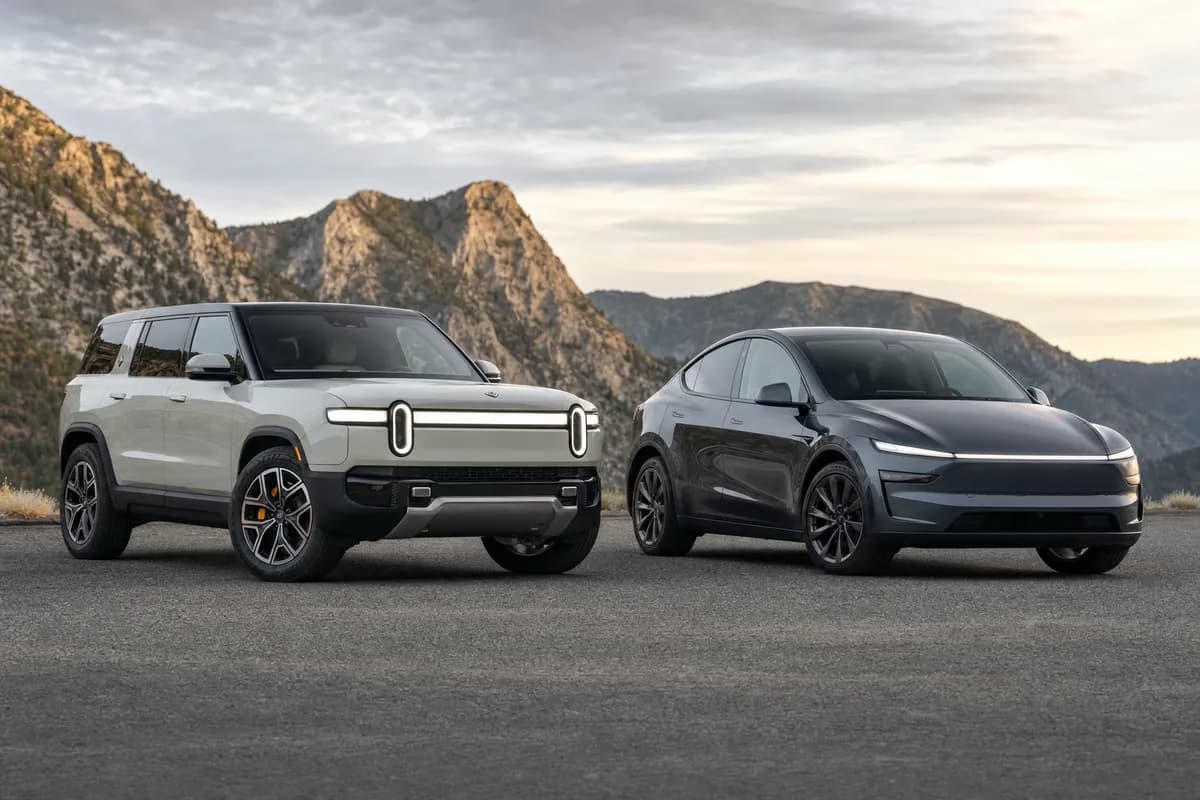
The 2027 Rivian R2 brings a fresh take on the electric SUV formula. Here’s how it stacks up against the Tesla Model Y for real buyers.
The 2027 Rivian R2 arrives with the awkward job of making electric SUVs interesting again. Tesla’s Model Y remains the default answer, but Rivian’s smaller, cheaper adventure machine may be the one buyers actually want to own.
Rivian has announced a starting price of $45,000 for the R2, putting it directly in Tesla Model Y territory. That is not an accident. The R2 is the vehicle Rivian needs to sell in serious numbers, so it cannot be a boutique toy with a boutique payment.
The current U.S. Tesla Model Y lineup starts around the mid-$40,000 mark for a Long Range Rear-Wheel Drive model, while Long Range All-Wheel Drive versions typically sit near $50,000 before options. Tesla changes pricing with the emotional stability of a raccoon near a trash can, so check the configurator before treating any number as gospel.
| Model |
Starting Price |
Drive Layout |
Claimed Range |
0-60 mph |
| 2027 Rivian R2 Single Motor |
$45,000 announced |
Rear-wheel drive |
300+ miles targeted |
Not yet confirmed |
| 2027 Rivian R2 Dual Motor |
Not yet announced |
All-wheel drive |
300+ miles targeted |
Under 3.5 seconds claimed |
| 2027 Rivian R2 Tri Motor |
Not yet announced |
All-wheel drive |
Not yet confirmed |
Over 3.0 seconds claimed |
| Tesla Model Y Long Range RWD |
About $45,000 |
Rear-wheel drive |
Up to 357 miles EPA |
About 5.4 seconds |
| Tesla Model Y Long Range AWD |
About $50,000 |
All-wheel drive |
Up to 327 miles EPA |
About 4.6 seconds |
Those R2 figures are manufacturer targets, not final EPA ratings. Rivian has confirmed single-, dual-, and tri-motor versions, with the fastest three-motor version expected to crack 60 mph in more than three seconds. That is properly rapid for a compact SUV, and significantly more entertaining than the average school-run appliance has any right to be.
The Model Y still holds the range advantage until Rivian posts certified numbers. Tesla’s most efficient Model Y Long Range RWD can manage up to 357 EPA-rated miles, while the AWD version trades some distance for traction and pace. Expect real-world highway range in either vehicle to drop meaningfully in cold weather, at 75 mph, or with a roof box turning the vehicle into a very expensive brick.
For this Rivian R2 vs Model Y matchup, the key point is simple: Tesla wins the proven range round today. Rivian may match the useful 300-mile class, but it has not yet earned the right to print a victory lap.
Charging: Tesla’s Network Is Still the Benchmark
The Model Y has one overwhelming ownership advantage: Tesla Supercharger access is native, seamless, and backed by the biggest dependable fast-charging network in North America. Plug in, let the vehicle handle payment, and get on with your life. It remains the least annoying public-charging experience in the business, which is praise that sounds faint until you have tried a broken station in freezing rain.
The R2 will use Tesla’s North American Charging Standard, commonly called NACS, and Rivian has committed to Supercharger access. That means R2 owners should be able to use compatible Tesla stations without carrying a prehistoric bag of adapters and hope. Rivian also plans DC fast-charging capability above 200 kW.
Rivian has not published final R2 charging-curve data, battery capacities, or an official 10-to-80-percent charging time. Tesla quotes a best-case 15-minute Supercharger stop adding up to roughly 169 miles on certain Model Y configurations. The Model Y’s 250-kW peak is useful, but its real advantage is consistency: there are simply more stalls in more places.
- Choose the Model Y if you make frequent interstate trips and want the simplest charging routine.
- Choose the R2 if you want Supercharger compatibility but prefer Rivian’s more conventional cabin and outdoorsy hardware.
- Wait for final R2 charging tests if you regularly tow, drive in winter, or cover 400-mile days.
Rivian’s own Adventure Network is smaller than Tesla’s Supercharger system but generally well placed near outdoor destinations. That suits the brand perfectly. The trouble is that a handful of scenic chargers does not beat thousands of convenient ones.
Practicality and Interior: The R2 Understands Human Hands
The 2027 Rivian R2 is about 185.6 inches long, making it roughly 4 inches shorter than the Model Y. It should be easier to park than the Tesla while still offering a roomy second row and a large rear cargo area. Rivian also gives the R2 a front trunk, split-opening rear glass, and a rear window that drops fully into the tailgate.
That rear glass is not a gimmick. It is exactly the sort of useful detail that makes loading skis, lumber, dogs, wet gear, or the questionable results of a weekend hardware-store spree easier. Rivian designs vehicles for people who use them, rather than people who enjoy explaining software updates at dinner parties.
The Model Y counters with exceptional cargo efficiency. Its low floor, deep underfloor storage, front trunk, and wide hatch make it one of the most practical vehicles in its class. Tesla has also improved the refreshed Model Y with better rear-seat comfort, a quieter cabin, and more premium-looking materials than the old model’s rental-car minimalism.
Still, the Tesla cabin remains almost entirely screen-operated. Climate settings, glovebox access, mirror adjustments, and countless routine controls live in the center display. Rivian uses a large screen too, but the R2 promises more physical controls where they matter, including steering-wheel buttons and practical stalk-based operation.
For families, both vehicles should work well. The Model Y is likely to retain the cargo-volume edge, while the R2 looks like the better companion for dirty boots, camping gear, bicycles, and anyone who believes an SUV should occasionally leave pavement without needing a lifestyle photoshoot.
Ownership Value, Software, and the Real Cost of Living With One
Tesla has the stronger record for efficiency, resale awareness, and over-the-air software development. The Model Y is everywhere, which hurts its exclusivity but helps parts availability, service knowledge, aftermarket support, and buyer confidence. It is the Toyota RAV4 of EVs, except faster and with more arguments attached.
Rivian has built a fiercely loyal following, and its software is among the best outside Tesla. Its navigation, route planning, camera system, phone integration, and drive-mode interface feel polished rather than beta-tested by unwilling customers. Rivian also offers a compelling hands-free driver-assistance system, though Tesla’s Autopilot and Full Self-Driving branding remain more familiar than reliably more useful.
The concern is service reach. Rivian’s service footprint has expanded, but it remains much smaller than Tesla’s and dramatically smaller than a legacy automaker’s dealer network. If you live near a Rivian service center, that is manageable. If your nearest location is several hours away, the R2’s charm could fade at the first warranty appointment.
Buyers should also avoid assuming either SUV will qualify for a federal EV tax credit. U.S. incentive rules, vehicle eligibility, battery sourcing requirements, and income limits change frequently. Treat any tax incentive as a bonus only after confirming the rules applicable at the time of delivery.
Verdict: The Better Buy Depends on How You Actually Drive
The Tesla Model Y remains the sensible winner for the buyer who wants maximum proven range, excellent efficiency, easy long-distance charging, and an established ownership ecosystem. It is fast, spacious, and brutally competent. If your electric SUV buying guide starts and ends with “make road trips painless,” buy the Tesla.
But the 2027 Rivian R2 is the more appealing vehicle. It has better proportions, smarter utility features, a more characterful design, genuine all-terrain credibility, and an interior that appears designed by people who remember that cars have knobs, cargo, mud, and passengers.
Alex Torque’s call: Buy the Model Y if you need an EV now and drive long distances often. Wait for the R2 if you want the most promising all-round contender for the best electric SUV 2026 conversation—and you can tolerate first-year uncertainty.
The R2 needs final EPA range numbers, pricing for its dual- and tri-motor models, and real charging tests before it can take the crown outright. Yet if Rivian delivers its $45,000 promise without turning the base model into a stripped-out penalty box, Tesla should be worried. The Model Y is the default choice; the R2 may be the choice with a pulse.
Frequently Asked Questions
Is the 2027 Rivian R2 cheaper than the Tesla Model Y?
The Rivian R2 is expected to start at $45,000, which puts it very close to the entry-level Tesla Model Y Long Range. Tesla adjusts prices often, so the cheaper option could vary by trim, incentives, and timing. Rivian has not yet announced pricing for the R2 dual-motor or tri-motor versions.
Will the Rivian R2 be able to use Tesla Superchargers?
Yes. The R2 uses the NACS charging port and is expected to access compatible Tesla Supercharger stations in North America. Availability can vary by Supercharger generation and site access rules, but Rivian owners should have far more fast-charging options than CCS-only EV buyers.
Which has more range: Rivian R2 or Tesla Model Y?
The Tesla Model Y has the advantage for now because its EPA figures are published and its Long Range RWD model is rated for up to 357 miles. Rivian is targeting more than 300 miles for the R2, but final EPA range has not been announced. The Tesla is the safer bet for buyers who prioritize verified highway distance.
Should I wait for the Rivian R2 or buy a Tesla Model Y now?
Buy a Model Y now if you need an electric SUV immediately, take frequent road trips, or live far from Rivian service. Wait for the R2 if you value rugged utility, more distinctive design, and a less screen-dependent interior. Just do not place blind faith in pre-production promises; wait for independent range, charging, and reliability results before signing the big check.
Get the latest car reviews in your inbox
Join thousands of car enthusiasts. No spam, unsubscribe any time.



Comments
Leave a comment