TPMS helps, but it’s not perfect. Learn why a tire pressure gauge matters, understand warning thresholds, and how often to check pressure.
In this article
Your TPMS light is a safety net, not a maintenance schedule. By the time it comes on, your tires may already be wearing harder, rolling less efficiently, and giving up some of their best handling.
TPMS Is Useful, but It Is Not a Precision Pressure Check
The tire pressure monitoring system in a modern vehicle is designed to warn you about a meaningful loss of pressure, not to keep every tire dialed into its ideal cold setting. That distinction matters more than most drivers realize. A tire can be noticeably low long before the dashboard asks for your attention.
For most passenger vehicles sold in the U.S., federal TPMS rules require the system to warn when one or more tires are roughly 25 percent below the vehicle placard pressure, or at 20 psi, whichever threshold is higher. The exact strategy varies by manufacturer, and some systems respond sooner, but that 25-percent figure explains why a TPMS warning is often late from an enthusiast’s maintenance perspective.
Take a truck, crossover, or sedan with a 36-psi recommended cold pressure. A 25-percent loss puts that tire at about 27 psi. That is a nine-psi drop—enough to change steering response, shoulder wear, braking feel, and fuel consumption even if the tire does not look obviously flat.
The pressure molded into the tire sidewall is the tire’s maximum rated pressure, not the pressure your vehicle should run. Use the cold-pressure figure on the driver’s-door placard unless the manufacturer provides a different load or towing specification.
Direct TPMS versus indirect TPMS
Most newer vehicles use direct TPMS, with a pressure sensor inside each wheel. These systems can display individual tire pressures on many 2026 models, but their displayed number can lag after driving and should not replace a cold gauge check.
Some vehicles use indirect TPMS, which compares wheel-speed data through the ABS system. A soft tire rotates at a slightly different speed, so the system can flag a pressure loss—but it cannot tell you the actual psi. It also needs to be reset after you adjust pressures or rotate tires.
TPMS is good for: Alerting you to a puncture, a major leak, or a tire that has become dangerously low.
A hand gauge is good for: Setting all four tires accurately when they are cold.
A portable inflator is good for: Correcting a low reading immediately, instead of promising yourself you will stop at a gas station later.
Tire Pressure Gauge vs TPMS Accuracy: What the Numbers Really Mean
When comparing tire pressure gauge vs TPMS accuracy, the gauge usually wins for routine maintenance—provided it is a decent gauge and you use it correctly. A direct TPMS sensor is a rugged, battery-powered device living inside a hot wheel. It is built to identify a substantial pressure loss over time, not serve as a laboratory instrument.
A quality digital gauge with 0.1-psi resolution can make repeatable readings easy, but resolution is not the same as accuracy. Look for a reputable gauge rated around ±1 psi in the range your vehicle uses, then verify it occasionally against a known-good gauge or a trusted tire shop’s calibrated equipment.
Tool type
Typical useful precision
Best use
Watch-out
Direct TPMS display
Good for trend monitoring
Detecting pressure loss while driving
May update slowly and usually warns late
Digital hand gauge
Often reads in 0.1-psi increments
Setting cold pressure at home
Cheap units can be inconsistent
Dial gauge
Easy to read in 1-psi increments
Garage use and repeatable checks
Can be damaged by drops or rough storage
Pencil gauge
Basic whole-psi reading
Glovebox backup
Harder to read precisely and easy to lose
Advertisement
For most DIY drivers, the best digital tire pressure gauge is one with a solid brass or steel chuck, a backlit display, an auto-off function, and a pressure range that suits the vehicle. A compact 0–60 psi gauge is ideal for many cars and crossovers. Owners of heavy-duty pickups, trailers, or 80-psi-rated LT tires should buy a gauge with a higher range.
Model choices change, but proven enthusiast-friendly options include the JACO ElitePro Digital Tire Pressure Gauge, the AstroAI Digital Tire Pressure Gauge, and the Rhino USA Heavy Duty Digital Tire Pressure Gauge. The JACO is the more garage-oriented choice, while AstroAI and Rhino USA units are common affordable options for a vehicle kit. Buy from a legitimate retailer; counterfeit gauges and weak batteries cause plenty of bad readings.
How to Check Tire Pressure the Right Way
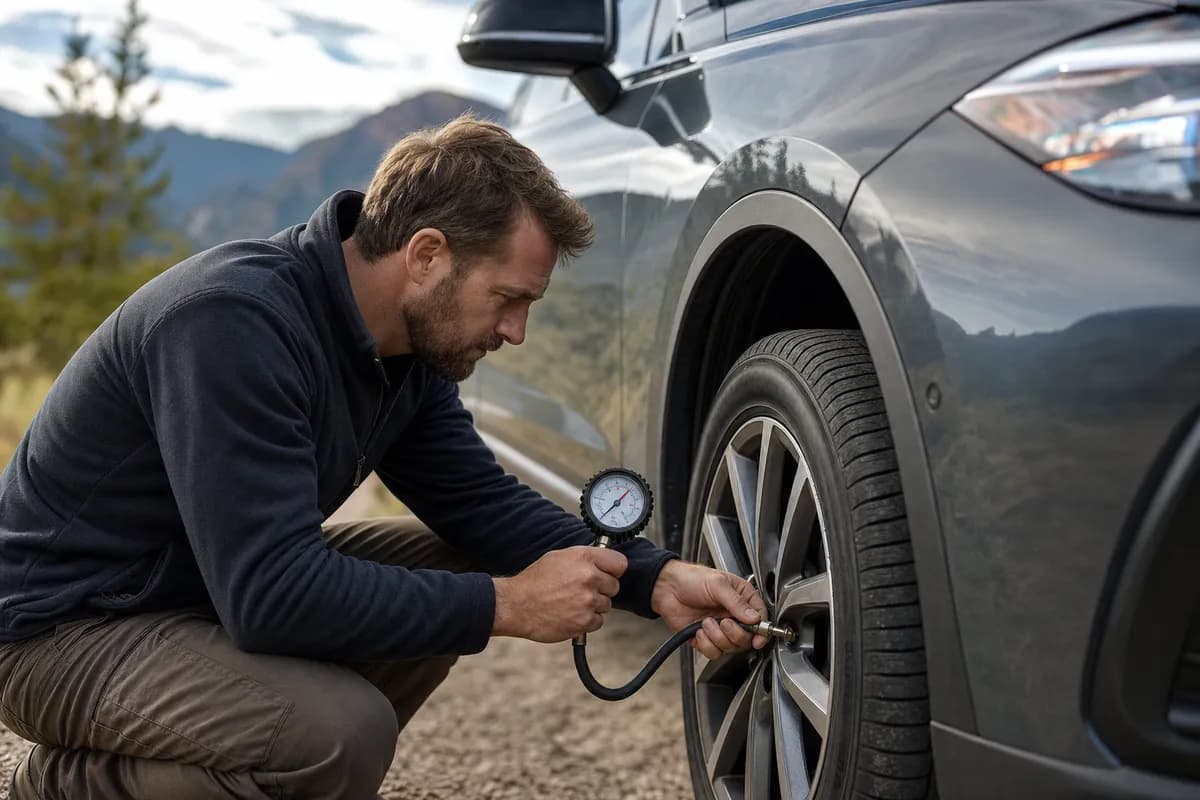
Check pressure when the tires are cold: ideally before the vehicle has been driven, or after it has been parked for at least three hours. Driving flexes the tire casing and heats the air inside, increasing the reading. A hot tire is not “overinflated” just because it reads several psi above the door-sticker number.
Ambient temperature also changes pressure. A useful rule is roughly 1 psi for every 10 degrees Fahrenheit of temperature change. That is why the first real cold snap can trigger a TPMS light on a vehicle that seemed fine in late summer.
Find the recommended cold pressure on the driver’s-door placard.
Remove the valve cap and press the gauge firmly and straight onto the valve stem.
Take a second reading if the first seems odd, especially if you heard air escaping around the chuck.
Set each tire to the placard pressure, then reinstall the valve caps.
Check the spare too if your vehicle has a full-size spare or a compact spare that requires inflation.
How often to check tire pressure depends on use, but once a month is the smart baseline. Check before a road trip, before towing, after a major temperature swing, and anytime the vehicle pulls, rides strangely, or shows uneven tire wear. Track-day cars, off-road rigs, and work trucks deserve checks before every outing.
Do not chase identical TPMS display numbers
A one-psi difference between tires, gauges, and the dashboard display is rarely a crisis. What matters is setting the tires consistently with one known-good gauge and watching for a tire that begins losing pressure faster than the others.
If one corner needs air every week, do not blame the seasons forever. Inspect for a nail, valve-core leak, cracked valve stem, corroded wheel bead, or a damaged tire. A tire shop can dunk-test the assembly or use leak-detection solution to find a slow leak quickly.
Choosing a Portable Tire Inflator That Will Actually Get Used
A portable tire inflator turns a pressure gauge from a diagnostic tool into a complete roadside solution. The right unit depends on whether you are topping off a commuter car, airing up a half-ton pickup, or maintaining multiple vehicles and trailers.
Inflator
Power source
Best fit
Practical note
Milwaukee M18 Inflator
M18 battery
Garage, truck, and frequent use
Fast, convenient, and pricey if you do not own M18 batteries
DeWalt DCC020IB
20V battery, 12V, or AC
Mixed home and roadside use
Versatile power options; battery and charger may be separate
VIAIR 88P
12V battery clamps
Truck, SUV, and larger tire duty
Strong choice for repeated fills; requires access to the battery
For daily-driver duty, prioritize an inflator with an automatic shutoff target, a readable display, a flexible hose, and a screw-on or locking chuck. Set the target one psi below your desired pressure, let the unit stop, then confirm with your separate gauge. Built-in inflator gauges are convenient, but they are not always the most accurate part of the tool.
Small USB-rechargeable inflators are handy for a bicycle, motorcycle, or emergency top-off. They can be painfully slow on a 35-inch truck tire or a low trailer tire, though. If you own a truck, SUV, camper, or off-road vehicle, a 12-volt compressor or cordless shop-brand inflator is usually the better long-term purchase.
Verdict: Treat TPMS as Your Backup, Not Your Baseline
TPMS has saved plenty of tires—and likely prevented plenty of roadside disasters—but the TPMS warning threshold is not where careful owners should begin paying attention. A tire that is 4 or 5 psi low may still be far from triggering the light, while already costing you tread life and crisp vehicle behavior.
Keep a quality gauge in every vehicle, check pressures monthly when cold, and carry a portable tire inflator you trust. That simple three-part routine—placard pressure, accurate gauge, immediate air source—does more for tire life than waiting for a yellow dashboard symbol.
Frequently Asked Questions
Is my TPMS more accurate than a tire pressure gauge?
For setting cold tire pressure, a quality hand gauge is generally the better tool. Direct TPMS is accurate enough to monitor trends and detect meaningful pressure loss, but the display may lag and the warning system is not designed for fine adjustments.
At what pressure does the TPMS warning light come on?
Many systems are designed to warn at roughly 25 percent below the vehicle’s recommended cold pressure. On a vehicle specified at 36 psi, that can be around 27 psi, though the exact warning point varies by manufacturer and system design.
How often should I check my tire pressure if I have TPMS?
Check it with a gauge at least once a month and before long trips, towing, or major temperature changes. TPMS is a backup alert, not a substitute for scheduled pressure checks.
What is the best portable tire inflator for a car?
A compact cordless inflator is excellent for normal passenger-car top-offs, especially if you already own the matching battery platform. For larger SUV, truck, trailer, or off-road tires, choose a stronger 12-volt compressor such as the VIAIR 88P or a robust cordless unit such as the Milwaukee M18 Inflator.
Affiliate disclosure: some links on this page earn us a commission at no extra cost to you.
Mike Wrenchworth is the guy you call when something breaks, rattles, or makes a noise it shouldn’t. With 20 years as an ASE-certified master technician and a decade running his own independent shop in Austin, Texas, Mike has seen every automotive disaster imaginable—and fixed most of them. Now he shares his hard-won wisdom with RevvedUpCars readers, covering everything from basic maintenance to weekend restoration projects. Mike believes in doing it right the first time, buying quality tools, and never skipping the torque wrench. His garage currently houses a work-in-progress 1969 Camaro, a bulletproof Toyota Land Cruiser, and whatever his wife is driving this week. Mike’s philosophy: every car can be a great car with proper maintenance and a little mechanical sympathy.
Get the latest car reviews in your inbox
Join thousands of car enthusiasts. No spam, unsubscribe any time.



Comments
Leave a comment