Hard freezes reveal weak batteries fast. Run 2026 DIY checks for cold cranking amps and capacity loss, plus smart maintainer picks to prevent no-starts.
The first hard freeze has a way of exposing a battery that was merely “getting by” in October. Your starter needs more power just as the battery becomes less willing to give it.
Why Car Batteries Fail in Cold Weather
Cold does not usually kill a healthy battery overnight. It reveals existing weakness: sulfation, low state of charge, internal wear, loose terminals, or a charging system that has not been keeping up.
A conventional 12-volt lead-acid battery produces electricity through a chemical reaction. As temperature drops, that reaction slows down. At the same time, cold engine oil thickens and the starter motor needs more current to turn the crankshaft.
- At 32 degrees F, a lead-acid battery may deliver roughly 65 percent of its rated capacity.
- At 0 degrees F, available capacity can fall to about 40 percent.
- A cold engine can require roughly twice the cranking power it needs on a warm day.
- A partially discharged battery can freeze around 20 degrees F, while a fully charged battery resists freezing to roughly minus 75 degrees F.
That combination explains why car batteries fail in cold weather. The battery is weaker, the engine is harder to turn, and a marginal connection or tired starter can consume the small remaining margin.
Cold cranking amps explained
Cold cranking amps, or CCA, is the number printed prominently on most replacement batteries. It is a standardized measure of how much current a fully charged 12-volt battery can provide for 30 seconds at 0 degrees F while maintaining at least 7.2 volts.
Higher CCA is useful in a cold climate, especially with a large-displacement engine, diesel, turbocharged application, or lots of winter electrical demand. But buying the highest number on the shelf is not automatically the right move. Use the battery group size, terminal layout, and minimum CCA specified for your vehicle first.
CCA measures starting power, not total reserve capacity. A battery can crank strongly once and still be a poor choice for a vehicle that sits for weeks or runs accessories with the engine off.
How to Test a Car Battery Before Winter
The best time to find a weak battery is in your driveway, not in a grocery-store parking lot after sunset. Start with a fully charged battery, because voltage readings from a partially charged battery can make a good battery look bad.
1. Check age, case condition, and connections
Find the date code or installation sticker. Many batteries last three to five years in normal use, but Texas-style heat can shorten that life dramatically before the battery ever sees its first serious winter.
- Replace a battery with a swollen case, leaking electrolyte, cracked housing, or loose posts.
- Clean corrosion from terminals and cable ends with a battery-terminal brush.
- Confirm the hold-down is tight. A battery that moves around can suffer internal plate damage.
- Inspect the ground cable where it attaches to the body or engine block.
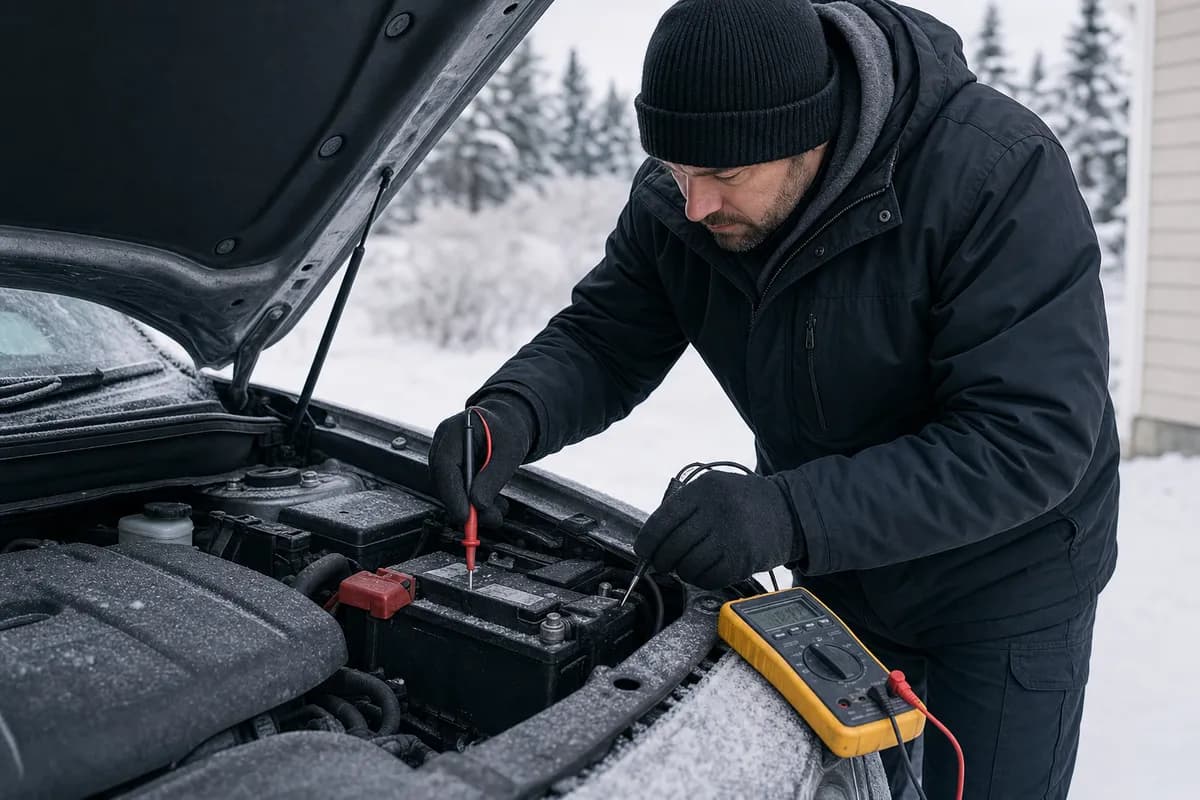
With the engine off for several hours, measure voltage directly at the battery posts with a digital multimeter. Do not measure on the cable clamps if corrosion is present; you want the battery’s actual voltage.
| Resting voltage at about 70 degrees F |
Approximate state of charge |
What it suggests |
| 12.6 to 12.8 volts |
100 percent |
Fully charged; continue with load or conductance testing if the battery is old. |
| 12.4 volts |
About 75 percent |
Charge it before judging battery health. |
| 12.2 volts |
About 50 percent |
Low enough to cause winter starting trouble; charge and retest. |
| 12.0 volts or less |
About 25 percent or less |
Deeply discharged, failing, or affected by a parasitic draw. |
Voltage alone does not reveal true battery health. A sulfated battery can show 12.6 volts after charging, then collapse as soon as the starter asks for current.
3. Use a conductance tester or load test
For a practical DIY check, use an electronic battery conductance tester. Enter the battery’s rated CCA and test at the posts; the tool estimates available CCA, internal resistance, and state of health.
As a rule of thumb, a battery that tests below roughly 70 percent of its rated CCA deserves attention before winter. A result below 60 percent, a “replace battery” verdict, or a battery that repeatedly needs charging means it is time to stop gambling.
A traditional carbon-pile load tester is more direct, but it must be used correctly. The classic benchmark is holding a load equal to half the rated CCA for 15 seconds; voltage should generally stay above 9.6 volts at 70 degrees F, with temperature correction required in colder conditions.
4. Rule out the charging system
With the engine running, most modern vehicles should show roughly 13.5 to 14.8 volts at the battery, although smart alternators can vary output based on temperature and operating conditions. Check your service information before condemning an alternator on voltage alone.
If the battery is new but keeps going flat, investigate parasitic draw, short-trip use, a failing alternator, or an accessory that stays awake after shutdown. Replacing batteries without finding the cause is how people end up buying two batteries in one winter.
Best Car Battery for Cold Weather 2026: Sensible AGM Choices
Absorbent glass mat, or AGM, batteries are a strong upgrade for many modern vehicles. They generally tolerate cycling better than conventional flooded batteries, recharge efficiently, resist vibration, and provide strong starting output in cold weather.
Do not install an AGM battery in place of a flooded battery if your vehicle’s battery-management system requires registration, coding, or adaptation without completing that procedure. Many late-model European vehicles and some domestic models monitor battery type and age closely.
| Product line |
Battery type |
Best fit |
Cold-weather strengths |
Watch-outs |
| Interstate MTX AGM |
AGM |
Daily drivers, SUVs, trucks, and start-stop-equipped applications |
Broad availability, solid vibration resistance, application-specific CCA options |
Verify group size and CCA because specifications vary widely by fitment. |
| DieHard Platinum AGM |
AGM |
Owners wanting a widely available premium replacement |
Strong reserve capacity options and good fitment coverage for modern vehicles |
Compare warranty terms and actual CCA by group size, not just the product name. |
| Odyssey Extreme AGM |
AGM |
Performance cars, off-road rigs, winch-equipped vehicles, and high-vibration use |
High cranking output, robust construction, strong deep-cycle capability |
Usually costs more and may be unnecessary for a lightly used commuter. |
Interstate, DieHard, and Odyssey all make credible AGM options, but the “best car battery for cold weather 2026” is the one that matches your vehicle’s specified group size and electrical needs. Compare actual CCA, reserve capacity, warranty coverage, terminal orientation, and manufacturing date at the point of purchase.
For a stock commuter, an Interstate MTX AGM or DieHard Platinum AGM in the correct fitment is a sensible answer. For a modified vehicle with a winch, audio system, frequent accessory use, or serious vibration exposure, the Odyssey Extreme line can justify its higher price.
Can a Battery Tender Plus Maintainer Prevent a No-Start?
Yes, if the real problem is inactivity and normal self-discharge rather than a failing battery. The Battery Tender Plus maintainer is a 12-volt, 1.25-amp smart charger designed to charge and then maintain a lead-acid battery without the constant overcharging risk of an old-school trickle charger.
It is especially useful for weekend cars, classics, motorcycles, seasonal vehicles, and trucks that sit through cold spells. A maintainer keeps the battery closer to full charge, which improves available cranking power and reduces the risk of electrolyte freezing.
- Use the included ring-terminal lead for vehicles stored regularly; install it with the ignition off and route it away from moving or hot parts.
- Connect to a sound battery in a dry, ventilated area and follow the maintainer manufacturer’s instructions.
- Do not use a maintainer as a cure for a battery that fails a load test or has a swollen case.
- Check electrolyte level only on serviceable flooded batteries; sealed AGM batteries should not be opened.
A Battery Tender Plus maintainer is cheap insurance for a healthy battery that sits. It cannot restore lost plate material, reverse severe sulfation, or compensate for a dead cell.
Verdict: Test Early, Buy for the Vehicle, Maintain What Sits
Winter no-starts are rarely mysterious. Most come from an aging battery that was already undercharged, underperforming, or poorly connected before temperatures dropped.
Test your battery before the first real cold snap, not after it leaves you stranded. If it is more than three or four years old, tests poorly against its rated CCA, or needs repeated charging, replace it with the correct-fit AGM option rather than hoping it survives one more season.
For vehicles that sit, a Battery Tender Plus maintainer can make the difference between a quick Saturday morning start and a dead, frozen battery. Keep the terminals clean, keep the battery charged, and give cold-cranking amps the respect they deserve.
Frequently Asked Questions
Why does my car battery die when it gets cold?
Cold temperatures slow the battery’s chemical reaction, reducing available power. The engine also needs more cranking torque because oil thickens in low temperatures, so a weak battery can suddenly fall short.
What voltage should a car battery be before winter?
A fully charged, rested 12-volt lead-acid battery should generally read about 12.6 to 12.8 volts at moderate temperatures. A reading around 12.2 volts means it is only about half charged and should be charged, then tested for actual health.
How do I know if my battery has enough cold cranking amps?
Use a conductance tester and enter the CCA printed on the battery label. If available CCA is below about 70 percent of the rating, or the tester recommends replacement, do not trust it through a hard winter.
Is a Battery Tender Plus the same as a trickle charger?
No. The Battery Tender Plus is a smart maintainer that changes charging behavior as the battery reaches full charge. A basic trickle charger may continue feeding current and can overcharge a battery if left connected too long.
Get the latest car reviews in your inbox
Join thousands of car enthusiasts. No spam, unsubscribe any time.





Comments
Leave a comment