The 2027 BYD Seal 6 Touring brings EV-style range and rich tech to the hybrid sedan class, but the trade-offs could surprise you.
BYD has brought a plug-in estate car to a hybrid-sedan fight, which is either brilliantly pragmatic or gloriously cheeky. The Seal 6 Touring has the battery range and equipment to worry Toyota and Hyundai, but it also arrives with a few inconvenient caveats.
The BYD Seal 6 Touring changes the family-car equation
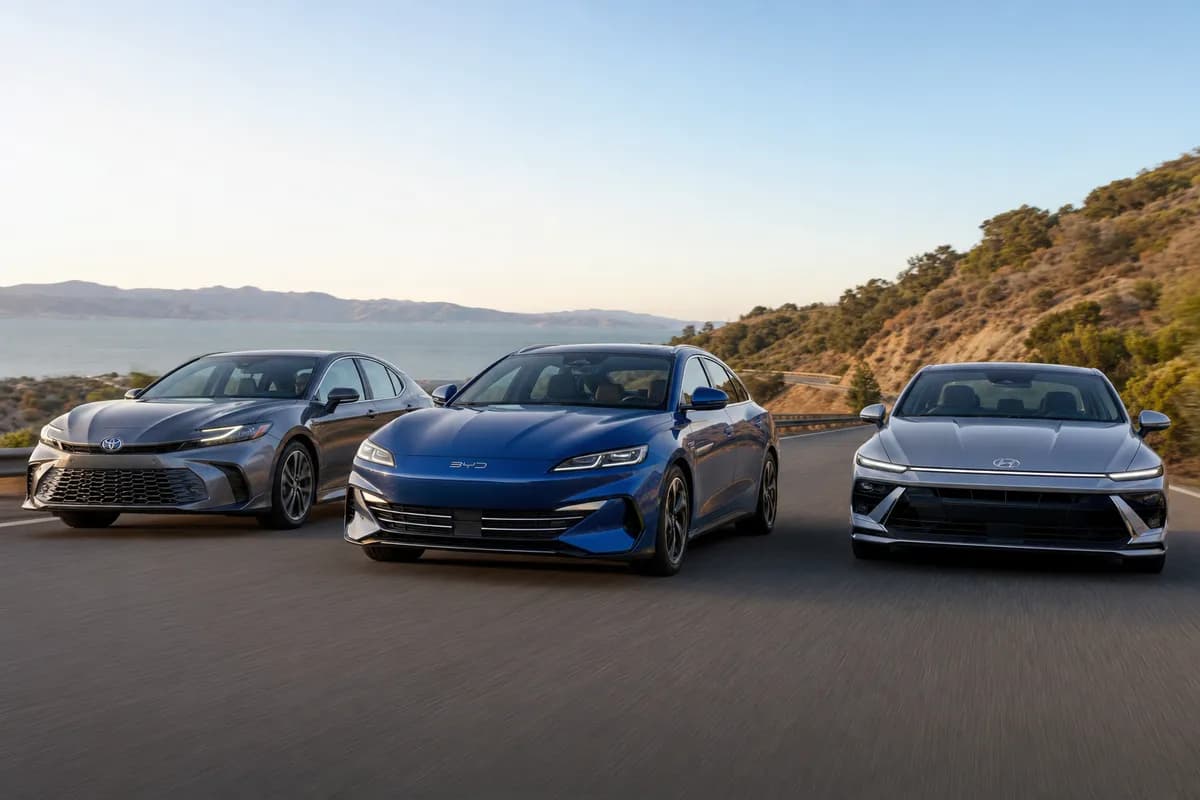
The 2027 BYD Seal 6 Touring review starts with a small naming problem: it is not really a direct Camry rival in body style. The BYD is a five-door Touring estate with a plug-in hybrid powertrain, while the Toyota Camry Hybrid and Hyundai Sonata Hybrid are conventional hybrid saloons. But buyers shopping for an efficient, roomy, technology-heavy family car will absolutely cross-shop them.
BYD’s formula is familiar from its DM-i plug-in hybrid models. A 1.5-litre petrol engine works with an electric motor and Blade Battery, prioritising electric running before calling on petrol power for longer trips. In higher-spec Comfort form, the Seal 6 Touring uses a 19.0kWh battery, produces 212PS, and claims up to 64 miles of electric-only range under WLTP testing.
That number matters. Neither the Camry nor the Sonata can drive 64 miles without burning fuel; their batteries are tiny by comparison and exist mainly to assist their petrol engines. If you can charge at home or at work, the BYD can realistically complete most weekday commutes as an EV, then still cover a holiday run without hunting for rapid chargers.
| Model |
Powertrain |
Power |
Claimed electric range |
0-62mph / 0-60mph |
Combined efficiency |
| BYD Seal 6 Touring DM-i Comfort |
1.5-litre PHEV, 19.0kWh battery |
212PS |
Up to 64 miles WLTP |
8.5 sec 0-62mph |
Official PHEV figure depends heavily on charging use |
| Toyota Camry Hybrid FWD |
2.5-litre full hybrid |
225hp |
None |
About 7.5 sec 0-60mph |
Up to 51mpg EPA combined |
| Hyundai Sonata Hybrid |
2.0-litre full hybrid |
192hp |
None |
About 8.0 sec 0-60mph |
Up to 47mpg EPA combined |
There is a catch before anyone declares BYD the best 2027 hybrid midsize sedan. Seal 6 Touring range and price figures currently relate to its available market specification, while Camry and Sonata figures vary by country, trim, test cycle and drivetrain. More importantly, the BYD’s headline consumption number only looks heroic when its battery is regularly charged.
Run the BYD flat every day and never plug it in, and you are hauling a large battery around with you. The Toyota’s full-hybrid system is less exciting but more foolproof: fill it with petrol, drive it, and it will return excellent economy regardless of your charging habits.
The Seal 6 Touring’s 64-mile WLTP electric range is its killer stat. Real-world range will fall in cold weather, at motorway speeds and with a boot full of family paraphernalia, but even a conservative 45 to 55 miles of usable electric running is meaningful. For a commuter with a driveway socket, it can slash petrol consumption in a way the Camry and Sonata simply cannot match.
BYD also quotes an exceptionally long total driving range when the battery and fuel tank are full. Treat that claim with the healthy suspicion normally reserved for a salesman promising “one careful owner.” The car can clearly travel a very long way, but the meaningful metric is how often you charge, not how impressive the combined-range brochure figure looks.
The Camry is the sharper performer. Its 225hp hybrid system gives it a useful edge over the 212PS BYD and a clear advantage over the 192hp Sonata. It is not a sports saloon, obviously, but the Toyota responds cleanly when overtaking and feels less breathless than the Hyundai at motorway speeds.
The Sonata Hybrid is the relaxed one. Its powertrain is smooth and its six-speed automatic gives it a more natural stepping-stone feel than the droning e-CVT character some drivers dislike in Toyota hybrids. Still, it cannot match the Camry’s pace or the BYD’s ability to leave the petrol engine asleep for an entire school run.
- Best for electric commuting: BYD Seal 6 Touring.
- Best for effortless fuel economy without charging: Toyota Camry Hybrid.
- Best for drivers who prefer a conventional automatic feel: Hyundai Sonata Hybrid.
Space, cabin tech and daily usability
The Touring body gives the BYD a substantial practical advantage. BYD quotes up to 1,535 litres of cargo space with the rear seats folded, which makes the Seal 6 a better fit for prams, dogs, flat-pack furniture and the usual family-car indignities. The Camry and Sonata have respectable saloon boots, but their conventional trunks are fundamentally less useful.
| Model |
Body style |
Key practicality advantage |
Infotainment approach |
Notable ownership strength |
| BYD Seal 6 Touring |
Estate / wagon |
Large hatch opening and up to 1,535 litres with seats folded |
Large rotating central touchscreen, digital instruments |
Electric-only commuting potential |
| Toyota Camry Hybrid |
Four-door saloon |
Roomy rear seat and mature ergonomic layout |
Available 12.3-inch touchscreen and digital cluster |
Hybrid reliability record and strong resale confidence |
| Hyundai Sonata Hybrid |
Four-door saloon |
Generous passenger room and wide-opening doors |
Dual 12.3-inch display layout on upper trims |
Strong warranty coverage in supported markets |
BYD wins the showroom wow factor. Its rotating touchscreen is clever, the cabin presentation is generally plush for the money, and standard equipment levels tend to embarrass mainstream rivals. The brand’s habit of fitting features rather than making buyers negotiate with an options list is refreshing.
Yet the Toyota is easier to live with at 7:15 on a wet Tuesday morning. Its controls are more conventional, its software feels less like a consumer-electronics experiment, and the driving position is less theatrical. The Camry does not try to impress you with party tricks; it simply gets on with being a very competent car.
The Sonata splits the difference. Its twin-screen dashboard looks modern, the cabin is airy, and Hyundai has become very good at making everyday controls make sense. It is the best-looking saloon here by some distance, although that dramatic fastback profile does nibble away at rearward visibility.
BYD Seal 6 price range specs: value is the weapon, confidence is the question
BYD’s Seal 6 Touring pricing has been positioned aggressively in markets where it is sold, with UK-spec cars introduced from roughly £33,990 for the lower-range Boost model and about £36,990 for the longer-range Comfort. The Boost uses a smaller 10.08kWh battery, 181PS and a quoted 0-62mph time of 8.9 seconds. The Comfort is the one to buy because the bigger battery is the whole point of this car.
For that money, the BYD can undercut or match well-equipped hybrid saloons while offering more equipment and genuine plug-in capability. That is not a subtle value proposition. It is BYD walking into the established-brand showroom, dropping a loaded estate car on the desk and asking why the competition costs more.
But value is not merely the purchase price. Toyota’s dealer network, proven hybrid durability and formidable resale reputation remain powerful advantages. A Camry owner can reasonably expect the car to be understood by almost any workshop; a BYD buyer must check local dealer coverage, parts availability, charging access and residual-value forecasts before signing.
Buy the BYD for the charging ability and the wagon body, not because its official economy figure looks magical. Without regular charging, the Camry Hybrid is the smarter financial decision.
Verdict: which electrified family car should you buy?
The BYD Seal 6 Touring is the most interesting car here and, for the right household, the best one. If you have reliable home charging, need estate-car practicality and want a lavish equipment list without premium-brand pricing, it makes the Camry and Sonata look conservative. Its 64-mile electric range turns the daily slog into a mostly petrol-free operation.
For everyone else, the Toyota Camry Hybrid remains the safest overall recommendation. It is quicker than the Hyundai, dramatically more established than the BYD, and capable of outstanding economy without asking you to alter your routine. It is not thrilling, but neither is paying more for fuel because you forgot to plug in.
The Hyundai Sonata Hybrid is the stylish alternative, especially for buyers who value its cabin design and conventional automatic transmission. But in a straight BYD Seal 6 Touring vs Toyota Camry Hybrid vs Hyundai Sonata Hybrid contest, it finishes third. The BYD delivers the cleverest package; the Camry delivers the least complicated ownership experience.
Frequently Asked Questions
Is the BYD Seal 6 Touring a full EV or a hybrid?
The BYD Seal 6 Touring is a plug-in hybrid, not a full battery-electric vehicle. It has a petrol engine, electric motor and rechargeable battery, allowing it to cover up to 64 miles on electricity in higher-spec WLTP-tested form.
Is the BYD Seal 6 Touring better than the Toyota Camry Hybrid?
It is better for drivers who can charge regularly and need a large estate-car load area. The Camry Hybrid is better for buyers who want dependable fuel economy with no charging routine, a proven dealer network and stronger long-term resale confidence.
Which has the best fuel economy: BYD Seal 6 Touring, Camry Hybrid or Sonata Hybrid?
The BYD can be cheapest to run if it is frequently charged and most journeys fit within its electric range. If you cannot charge, the Camry Hybrid’s EPA rating of up to 51mpg combined makes it the more dependable efficiency champion, ahead of the Sonata Hybrid’s up-to-47mpg rating.
What is the expected BYD Seal 6 Touring price and range?
Available-market specifications have placed the Seal 6 Touring from about £33,990, with the longer-range Comfort model around £36,990. The Comfort version uses a 19.0kWh battery and claims up to 64 miles of WLTP electric range, though final 2027 pricing and specifications may vary by market.
Get the latest car reviews in your inbox
Join thousands of car enthusiasts. No spam, unsubscribe any time.



Comments
Leave a comment