Braked later, turned in sharper, and stayed cooler: alignment basics, brake pads, cooling checks, and reversible mods for DIY track day fun.
There is a particular satisfaction in passing a much faster car because you braked later, carried more speed, and put your little coupe exactly where it needed to be. The new slow-car-fast crowd is not waiting for 600 horsepower. They are checking tire pressures in the paddock, swapping pads in the driveway, and learning why an extra degree of negative camber matters.
Why Lightweight Cars Are Winning Back Track-Day Drivers
High-output EVs and modern super-sedans are astonishingly quick, but speed comes with mass, heat, expensive consumables, and a shorter margin for error. A lightweight rear-drive sports car lets drivers work on technique without turning every track day into a tire-and-brake budget crisis.
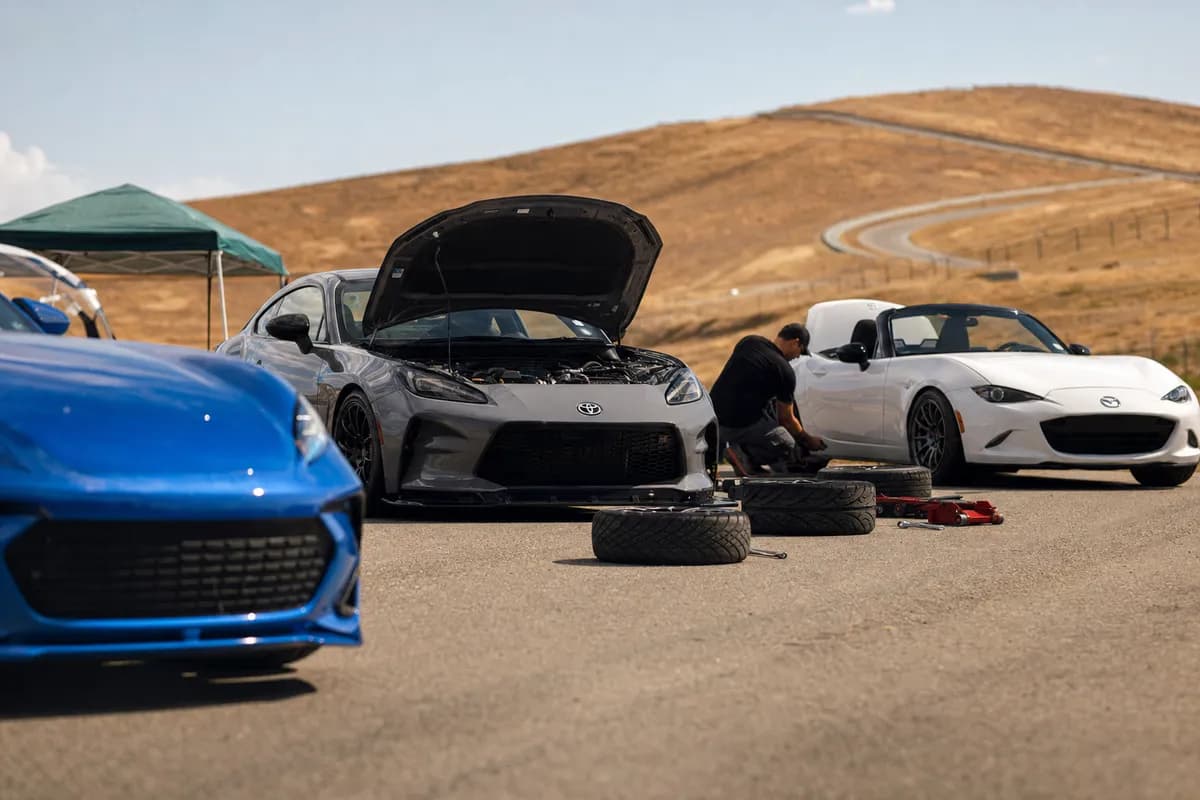
The Mazda MX-5 Miata, Subaru BRZ, and Toyota GR86 remain the accessible end of the enthusiast spectrum. They have modest power, manual-transmission availability, responsive chassis tuning, and huge aftermarket support. More importantly, they reward momentum, smooth hands, and proper setup.
| Model |
Approx. Curb Weight |
Factory Power |
Drivetrain |
Track-Day Strength |
| 2026 Mazda MX-5 Miata |
About 2,340-2,450 lb, depending on trim and roof |
181 hp |
Rear-wheel drive |
Light weight, excellent feedback, low consumable cost |
| 2027 Subaru BRZ |
About 2,800-2,850 lb in current-generation form |
228 hp |
Rear-wheel drive |
Balanced chassis, usable cabin, strong aftermarket |
| Toyota GR86 |
About 2,810-2,850 lb in current-generation form |
228 hp |
Rear-wheel drive |
Sharp turn-in, playful balance, shared BRZ parts support |
Exact 2026 Miata and 2027 BRZ equipment can vary by market and final manufacturer specifications, so verify your specific trim before ordering parts. Still, the basic formula has not changed: low mass and modest output make these cars approachable, communicative, and genuinely entertaining below triple-digit speeds.
A well-driven 180-hp roadster teaches more about braking, vision, and corner exit than a powerful car that masks every mistake with acceleration.
Start With Alignment, Tires, and Driver Feedback
The best lightweight sports car alignment is not a random collection of aggressive numbers copied from a forum signature. It depends on tire type, ride height, track surface, how much street driving the car sees, and whether the driver can feel the difference between understeer and an overloaded front tire.
Factory alignment settings prioritize tire life, stability, and broad consumer use. Track work asks more from the outside front tire, especially on a strut-front BRZ or GR86. The Miata’s double-wishbone-style front geometry responds very well to added negative camber, too.
| Setting |
Street-Friendly Track Starting Point |
What It Changes |
Watch For |
| Front camber |
-2.0 to -2.8 degrees |
Helps the outside front tire stay flatter in corners |
Inner-edge wear if toe is excessive |
| Rear camber |
-1.5 to -2.2 degrees |
Maintains rear grip and stability under load |
Too much can reduce traction on corner exit |
| Front toe |
Zero to slight toe-out |
Improves initial turn-in response |
Toe-out can make highway behavior nervous |
| Rear toe |
Slight toe-in |
Adds stability under braking and acceleration |
Excess toe creates drag and tire wear |
For a 2026 Mazda MX-5 Miata track day build, a sensible baseline is roughly -2.0 to -2.5 degrees of front camber, moderate rear camber, and near-zero front toe. A BRZ or GR86 often needs camber bolts, camber plates, or lower-control-arm adjustment to reach useful front numbers without compromising the rest of the setup.
Do not overlook tire pressures. Record cold pressures before the first session, then check them immediately after coming off track. Most 200-treadwear performance tires work best within a specific hot-pressure range, but that range varies by tire model; use the tire manufacturer’s guidance and adjust in small steps.
- Mark tire shoulders with a paint pen to see whether the tire is rolling onto the sidewall.
- Use a quality pressure gauge, not the coin-operated air pump gauge.
- Inspect tread for feathering, graining, or melted-looking outer shoulders.
- Get an alignment printout and keep it in the car’s track-day notebook.
Brake Pads and Fluid: The First Real Track-Day Upgrade
For most new drivers, brakes are the first system that needs attention. Factory pads can be fine for short, novice-level sessions, but repeated heavy stops generate heat that overwhelms street compounds. The pedal gets long, the pad begins to smear, and the driver starts braking earlier for the wrong reason.
Toyota GR86 track day brake pads should be chosen around temperature range and driving style, not internet hype. The same applies to the BRZ and Miata. A pad that survives a 20-minute session but squeals terribly on the street may be perfect for a dedicated wheel-and-tire track setup, but annoying on a daily driver.
| Brake Item |
Street Use |
Novice/Intermediate Track Use |
Dedicated Track Use |
| Pad compound |
Low dust, quiet, low-temperature bite |
Dual-duty performance compound |
High-temperature track compound |
| Brake fluid |
Fresh DOT 4 |
High dry-boiling-point DOT 4 |
Motorsport-grade fluid changed frequently |
| Rotor strategy |
Inspect at service intervals |
Measure and inspect before every event |
Track mileage log and replace preventively |
Fresh fluid is non-negotiable. A proper flush with a reputable high-temperature DOT 4 fluid is cheap insurance, and it gives you a chance to inspect hoses, caliper boots, pad thickness, and rotor condition. If the pedal goes soft on track, do not assume it is “just brake fade”; stop and diagnose the car.
- Bring a spare set of pads if the current set is below half thickness.
- Check rotor thickness against the minimum specification cast or stamped on the rotor.
- Torque wheel nuts with a torque wrench, then recheck after the first heat cycle.
- Allow a cooldown lap and avoid setting the parking brake immediately after a hard session.
Cooling Checks and DIY Maintenance Before Power Mods
Reliability is the real performance modification. A car that finishes every session is faster over a season than one that makes another 15 horsepower but spends weekends on jack stands waiting for parts.
For 2027 Subaru BRZ DIY maintenance, begin with the boring jobs. Check engine oil at the same level ground and temperature every time, inspect for seepage around the timing cover and oil pan, and look underneath for damaged splash shields or loose exhaust hardware. The FA24-powered BRZ and GR86 deserve careful oil-level monitoring during sustained high-g driving.
The Miata’s lighter mass is easier on consumables, but it still needs attention. Inspect coolant level, radiator condition, fan operation, belt condition, and every hose clamp you can reach. A small coolant leak that is harmless in traffic can become a session-ending problem when ambient temperatures climb and the engine stays loaded.
- Change engine oil and filter before an event if service is due soon.
- Inspect brake fluid level, pad thickness, rotor surfaces, and wheel-bearing play.
- Check coolant level only when the engine is cold.
- Torque wheel nuts to the manufacturer specification.
- Inspect suspension bushings, ball joints, tie-rod ends, and shock bodies for leaks.
- Empty loose items from the cabin, trunk, and glovebox before tech inspection.
Track use also exposes small problems in driveline fluids. If a manual transmission or differential has unknown service history, refresh it with the manufacturer-specified fluid before asking it to handle repeated hot laps. Do not automatically choose the thickest fluid on the shelf; synchronizers, limited-slip differentials, and cold operation all have requirements.
Reversible Mods That Keep the Car Fun on Monday
The best reversible track day modifications improve safety, consistency, or driver confidence without turning a pleasant road car into a punishing project. Wheels, pads, fluid, alignment hardware, seat-time tools, and a second set of tires generally offer more value than intake noise or a questionable tune.
A dedicated track wheel set is one of the smartest purchases for all three cars. It lets you preserve street tires, run a more track-focused compound, and make tire rotation easier. Stay conservative with fitment: rubbing tires and over-aggressive offsets create problems that no amount of social-media approval can fix.
- Track pads and fresh fluid: Easy to reverse and immediately useful.
- Camber bolts or adjustable arms: Adds alignment range without permanent body changes.
- High-quality brake ducting: Useful where available, especially for repeated summer sessions.
- Removable track-day number panels: Adds paddock personality without permanent graphics.
- A data timer or phone mount: Helps drivers compare laps and review consistency.
- Performance seat time: An instructor session remains the highest-return “mod.”
Be cautious with springs, coilovers, and big sway bars. These can improve a car when selected as part of a complete plan, but they can also reduce compliance and upset balance on rough circuits. Install one major change at a time, record the results, and resist the urge to tune around a problem created by the last modification.
The Verdict: Build the Driver, Then Build the Car
The Miata, BRZ, and GR86 are reviving grassroots track culture because they make the fundamentals matter again. They are affordable enough to service at home, capable enough to reward careful setup, and forgiving enough for drivers who are still learning where the limit lives.
Start with maintenance, brake fluid, suitable pads, tire pressures, and an alignment that supports your tire choice. Then spend money on track time and instruction. The fast lap in a lightweight sports car rarely comes from a flashy part; it comes from a dependable car and a driver willing to learn.
Frequently Asked Questions
What are the best 2026 Mazda MX-5 Miata track day mods for beginners?
Start with fresh high-temperature DOT 4 brake fluid, track-capable pads, a careful alignment, and good tires. A second wheel set is also useful, but driver coaching and more seat time will improve lap times more than power parts.
What alignment should I use for a Subaru BRZ or Toyota GR86 track day?
A reasonable street-and-track starting point is roughly -2.0 to -2.8 degrees of front camber, modest rear negative camber, near-zero front toe, and slight rear toe-in. Exact settings depend on tire model, ride height, and driving style, so inspect tire wear and adjust from there.
Do I need track brake pads for a Toyota GR86?
If you are attending a full lapping day with repeated 20-minute sessions, dedicated dual-duty or track-capable pads are a wise investment. Fresh high-boiling-point brake fluid matters just as much, since boiling fluid can create a soft pedal even when the pads are still usable.
Are reversible track day modifications worth it?
Yes, because they improve reliability and performance without permanently changing the car’s character or resale appeal. Pads, fluid, wheels, alignment components, removable numbers, and a data logger can all make a track day better while keeping the car comfortable enough for normal road use.
Get the latest car reviews in your inbox
Join thousands of car enthusiasts. No spam, unsubscribe any time.





Comments
Leave a comment