In 2026, your Level 2 charger price is only part of the bill. See what you’ll really pay for electrician work, wiring, and panel upgrades.
The sticker price on a Level 2 charger is rarely the number that surprises new EV owners. The expensive part is usually the path between your electrical panel and the parking spot.
What a Level 2 Home EV Charger Costs in 2026
For most U.S. homeowners, a straightforward 2026 home EV charger installation lands between $900 and $2,500, including the charger, labor, permit, and basic materials. That assumes an available panel slot, a reasonably short wire run, and no major electrical repairs hiding behind the drywall.
The broad national range is much wider: roughly $500 to $6,000-plus. A garage wall ten feet from a modern 200-amp panel can be a quick morning job. A detached garage, full 100-amp panel, old service equipment, or a 100-foot underground trench can turn the same project into a serious electrical upgrade.
| Installation scenario |
Typical all-in cost |
What drives the price |
| Simple garage installation |
$900-$1,500 |
Short run, open panel capacity, 32-40 amp charger |
| Typical installed Level 2 charger |
$1,500-$2,500 |
40-60 amp circuit, 25-75 feet of wiring, permit |
| Long run or detached garage |
$2,500-$4,500 |
Trenching, conduit, difficult routing, subpanel work |
| Service or panel upgrade required |
$4,000-$10,000+ |
New panel, meter work, utility coordination, service conductors |
Those figures are planning numbers, not a substitute for a local quote. Labor rates in Austin, Los Angeles, Boston, and Seattle can be dramatically different from rates in smaller markets, and permit requirements vary by city and county.
Also separate the car’s charging capability from the charger’s output. A Ford Mustang Mach-E, Hyundai Ioniq 5, Tesla Model Y, Rivian R1S, and Chevrolet Equinox EV can all use Level 2 charging, but their onboard AC charging limits differ. Buying an 80-amp unit makes little sense if the vehicle accepts only 32 or 40 amps on AC power.
Charger Price vs. Level 2 Charger Electrician Cost
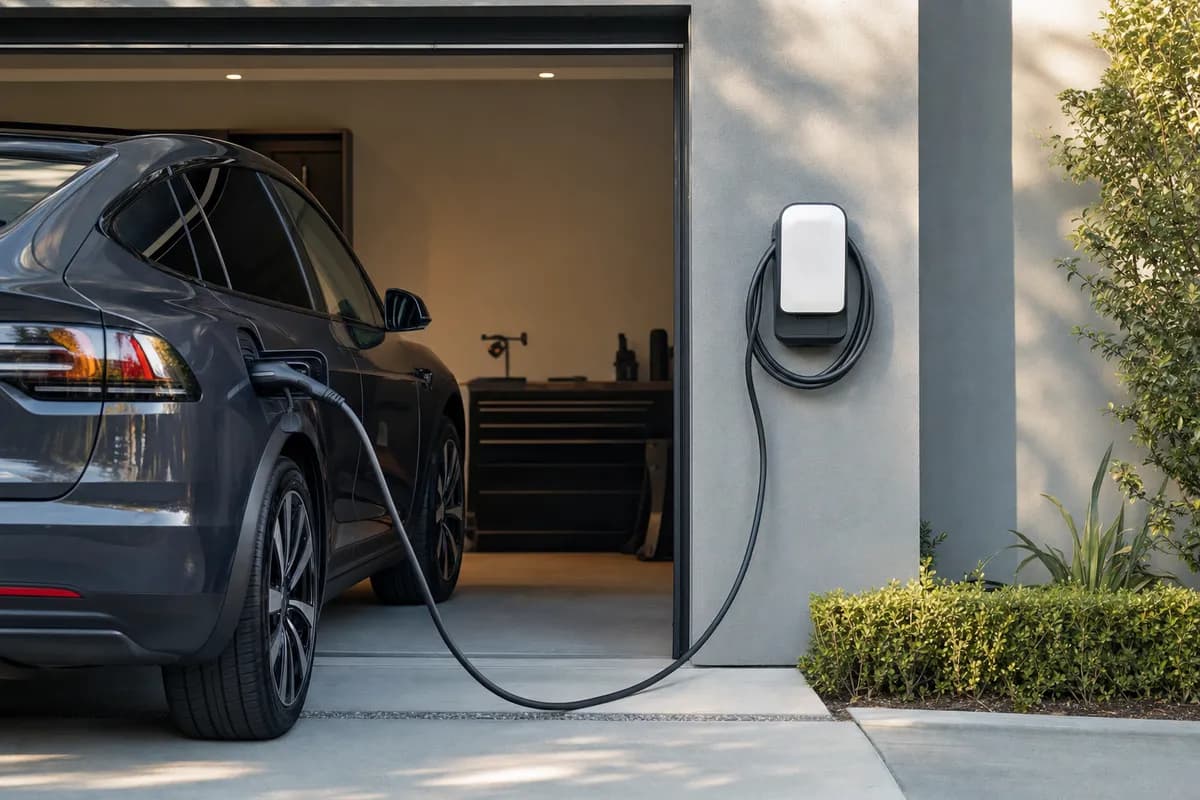
The wall-mounted EVSE—commonly called the charger, though the actual charger is onboard the vehicle—is only one line item. Good mainstream units generally cost $350 to $800, while high-output, load-managed, or premium-connected units can reach $1,000 or more.
Popular 2026 choices include the Tesla Universal Wall Connector, ChargePoint Home Flex, Emporia Level 2 EV Charger, Autel MaxiCharger AC, Wallbox Pulsar Plus, and Grizzl-E Classic. Most are capable units when properly installed; the right pick depends more on circuit size, connector needs, smart features, and local utility programs than on a logo.
| Cost item |
Typical 2026 price |
What changes it |
| Level 2 EVSE hardware |
$350-$1,000+ |
Amperage, Wi-Fi features, cable length, load management |
| Electrician labor |
$500-$1,800 |
Regional rates, access, circuit complexity, time on site |
| Wire, breaker, conduit, fittings |
$200-$1,200+ |
Wire gauge, copper cost, circuit length, indoor/outdoor routing |
| Permit and inspection |
$75-$500+ |
Local jurisdiction and project scope |
| Panel or service upgrade |
$2,000-$8,000+ |
Panel condition, amperage, utility work, meter equipment |
A typical Level 2 charger electrician cost for a simple job is often $500 to $1,200 before the charger itself. That usually covers mounting the unit, installing a dedicated two-pole breaker, running cable through an accessible garage or basement, testing the circuit, and handling standard paperwork.
Long cable runs are the quiet budget killer. EV charging circuits use heavy copper conductors, especially for 48-amp and 80-amp charging, and wire prices add up quickly. Routing through finished walls, crawlspaces, attics in hot climates, masonry, or a detached structure adds labor just as fast.
A Level 2 EV circuit is a continuous load. That means electricians generally size the circuit at 125 percent of the charger’s continuous output: a 40-amp charger typically needs a 50-amp circuit, while a 48-amp charger needs a 60-amp circuit.
Hardwired vs. Plug-In EV Charger: Which Installation Makes Sense?
The hardwired vs plug-in EV charger decision affects both cost and capability. A plug-in unit uses a 240-volt receptacle, usually a NEMA 14-50, while a hardwired unit connects directly to the branch circuit through a disconnecting means or breaker.
A 14-50 installation can be a sensible choice for a 32-amp or 40-amp charger, especially if you may move soon and want to take the EVSE with you. Expect the receptacle, cover, box, and required GFCI protection to add material cost. Use an industrial-grade receptacle, not the cheapest hardware-store outlet, because EV charging loads run for hours and expose weak connections.
Hardwiring is usually the cleaner long-term answer. It eliminates one heat-producing connection, supports many 48-amp chargers, looks tidier, and can avoid some outlet-related nuisance trips. It also lets the electrician configure the charger and circuit as a matched system rather than leaving a high-current receptacle as another potential failure point.
| Setup |
Best for |
Typical charging output |
Trade-off |
| Plug-in NEMA 14-50 |
Flexibility and 32-40 amp charging |
Up to 40 amps continuous |
Requires quality receptacle and adds a connection point |
| Hardwired 48-amp EVSE |
Most daily-driving households |
48 amps continuous on 60-amp circuit |
Less convenient to remove or relocate |
| Hardwired 80-amp EVSE |
High-demand households and compatible vehicles |
Up to 80 amps continuous |
Requires large circuit, suitable panel, and higher cost |
For perspective, a 48-amp Level 2 charger typically adds around 35 to 45 miles of range per hour, depending on the vehicle and conditions. A 32-amp setup often adds roughly 25 to 30 miles per hour. Either one easily refills the average commuter’s daily use overnight.
Panel Capacity and the Real EV Panel Upgrade Cost
A full breaker panel is not automatically an undersized panel. Electricians perform a load calculation that considers the home’s service size, electric range, dryer, HVAC equipment, water heater, existing loads, and the proposed EV circuit. Two empty breaker spaces do not guarantee that adding a 60-amp circuit is safe.
An EV panel upgrade cost commonly falls between $2,000 and $5,000 for a panel replacement or larger load center when the existing service conductors and meter arrangement can remain. If the home needs a 100-amp-to-200-amp service upgrade, utility coordination, a new meter base, or new service conductors, the bill can climb to $6,000 to $10,000 or beyond.
Before authorizing a service upgrade, ask about load management. Systems from manufacturers such as Wallbox, Emporia, and Tesla can monitor household demand and temporarily reduce EV charging when the home approaches its service limit. In the right house, that can preserve safe operation without paying for a larger utility service immediately.
- Available breaker spaces: A tandem breaker or subpanel may solve a space problem, but not a load-capacity problem.
- Panel age and condition: Corrosion, overheating, obsolete equipment, and known-problem panels deserve attention before adding a major continuous load.
- Distance to parking: A panel on the opposite side of the house can cost more than a better charger.
- Future electrical plans: Heat pumps, induction cooking, electric water heaters, and a second EV all increase demand.
- Utility incentives: Some utilities offer rebates for approved smart chargers or off-peak managed charging enrollment.
Do not skip permits to save a few dollars. A permitted installation provides an inspection, helps document the work for insurance and resale, and gives the electrician a clear code-compliance target. More than one shop has been called to repair a “cheap” unpermitted EV outlet with melted insulation behind it.
How to Get an Accurate Installation Quote
Get at least two or three quotes from licensed electrical contractors who routinely install EV circuits. The lowest quote is not automatically the bargain if it omits permit fees, GFCI protection, conduit, panel work, or the actual cost of a proper receptacle.
- Photograph the electrical panel with its door open and labels visible.
- Measure the approximate route from panel to charger location, including walls, attic, crawlspace, or trenching.
- Provide the exact EVSE model and desired output, such as a 40-amp plug-in unit or 48-amp hardwired unit.
- Ask whether the quote includes permit, inspection, breaker, wire, conduit, patching, and charger commissioning.
- Ask for a load calculation if panel capacity is questionable, rather than accepting a guess based on empty spaces.
For most owners, the sweet spot is a quality 40- or 48-amp EVSE on a properly installed dedicated circuit. It delivers far more overnight range than most households need without forcing the expense of an 80-amp circuit or an unnecessary service upgrade.
Verdict: Budget $1,500 to $2,500 for a normal professionally installed Level 2 setup, then keep a contingency fund for panel and routing surprises. Spend money first on safe electrical work, adequate wire sizing, and a reputable installer; the difference between a $450 charger and a $700 charger matters far less than the quality of the circuit feeding it.
Frequently Asked Questions
How much does it cost to install a Level 2 EV charger at home in 2026?
Most straightforward installations cost about $900 to $2,500 all-in, including the charger, labor, materials, and permit. Homes needing a long wire run, trenching, panel work, or a service upgrade can cost substantially more.
Do I need a 200-amp panel for a Level 2 EV charger?
No. Many homes with 100-amp, 125-amp, or 150-amp service can safely support EV charging after a proper load calculation. If capacity is tight, a smart load-management charger may avoid an immediate service upgrade.
Is a hardwired EV charger better than a plug-in charger?
For many permanent installations, yes. Hardwired chargers support higher output, remove a high-current receptacle connection, and generally provide a cleaner installation, while plug-in units offer easier removal and portability.
Can I install a Level 2 EV charger myself?
Some experienced homeowners can legally perform electrical work in certain jurisdictions, but rules vary and permits may still be required. Because this is a high-current continuous load, a licensed electrician is the safer choice for most owners and may be required for rebates or warranty coverage.
Get the latest car reviews in your inbox
Join thousands of car enthusiasts. No spam, unsubscribe any time.



Comments
Leave a comment