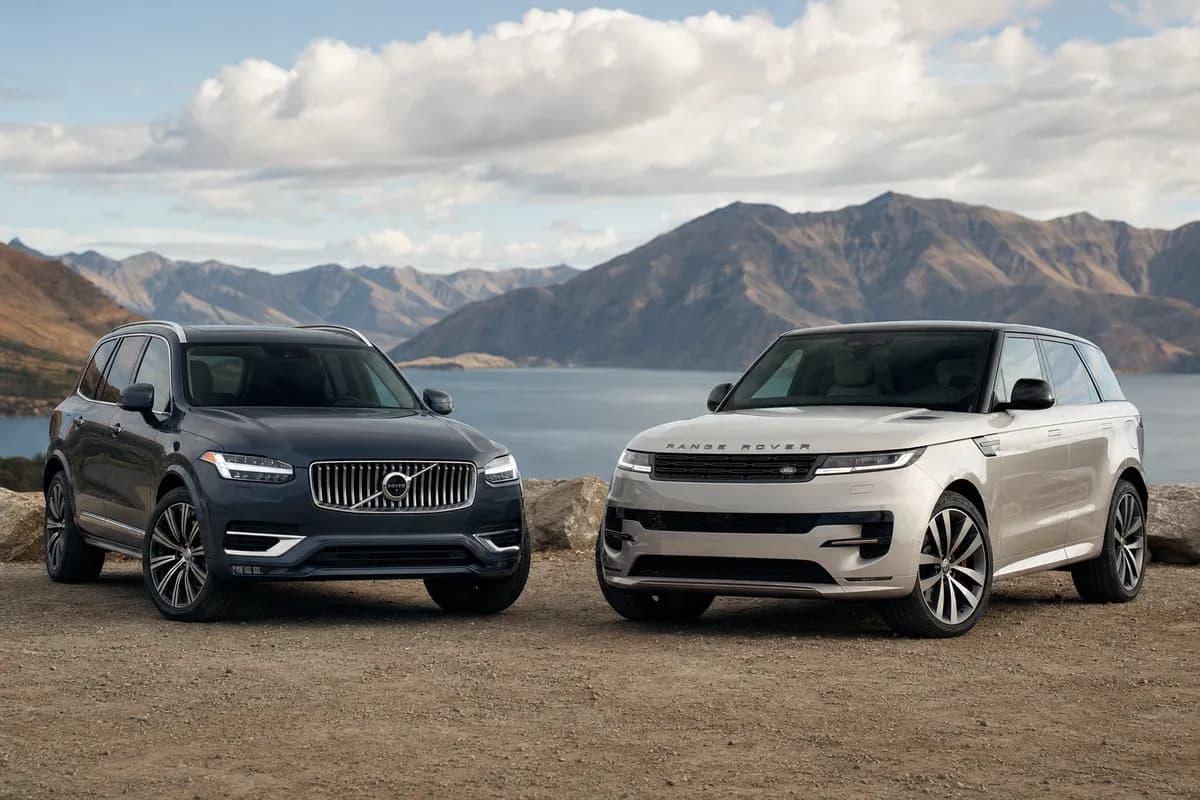
The 2025 Volvo XC90 and Range Rover Sport both wear premium SUV badges, both promise all-weather confidence, and both can be had with plug-in hybrid muscle. That is roughly where the similarities stop.
The 2025 Volvo XC90 and Range Rover Sport both wear premium SUV badges, both promise all-weather confidence, and both can be had with plug-in hybrid muscle. That is roughly where the similarities stop. The Volvo is the tailored Scandinavian family tool: calm, clever, safety-obsessed, and priced like someone in the finance department still has a pulse. The Range Rover Sport is the aristocrat in trail shoes: richer, faster, more capable off-road, and expensive enough to make your accountant stare silently out a window. This is not just a luxury SUV comparison. This is a personality test with leather seats.
Positioning and Price: Sensible Swede Meets British Swagger
The 2025 Volvo XC90 starts around $58,695 including destination in B5 AWD Core form in the U.S., while the 2025 Range Rover Sport P360 SE starts around $85,325 including destination. That is not a gap. That is an entire Honda Civic Si parked between them.
Move up the ladder and the story gets even spicier. A Volvo XC90 T8 plug-in hybrid in higher trims can push into the low-$80,000 range, while a Range Rover Sport P550e Autobiography plug-in hybrid sits deep into six-figure territory. The outrageous Range Rover Sport SV, with its 626-hp twin-turbo V8, plays in the $180,000 neighborhood. At that point, you are no longer cross-shopping a Volvo. You are cross-shopping a lake house with worse depreciation.
The XC90 offers seating for six or seven, depending on configuration. The Range Rover Sport is a two-row, five-seat SUV. That matters. If you have three kids, grandparents, carpool duty, or a golden retriever with delusions of royalty, the Volvo’s third row gives it an immediate practical advantage. The Range Rover Sport counters with a larger, more indulgent second row and more presence than a Scandinavian design studio would ever allow itself to admit is desirable.
- Volvo XC90 base price: about $58,695 including destination
- Range Rover Sport base price: about $85,325 including destination
- XC90 seating: six or seven passengers
- Range Rover Sport seating: five passengers
- XC90 maximum towing: up to 5,000 pounds
- Range Rover Sport maximum towing: up to 7,716 pounds when properly equipped
So before anyone gets misty-eyed about “premium SUV lifestyles,” be honest about your life. If you need three rows, the Range Rover Sport has already lost. If you need to look like you own the mountain rather than merely drive to it, the Volvo starts to feel a little like a very nice faculty parking permit.
Performance: Polished Efficiency vs Big-Chested Authority
The XC90 powertrain lineup is wonderfully modern, if not especially theatrical. The B5 AWD uses a turbocharged 2.0-liter mild-hybrid four-cylinder producing 247 hp and 258 lb-ft. It is adequate, in the same way oatmeal is adequate. The B6 AWD raises output to 295 hp and 310 lb-ft, giving the XC90 the shove it deserves. But the one to buy is the T8 plug-in hybrid, which combines a turbocharged 2.0-liter engine with electric drive for 455 hp and 523 lb-ft. Volvo claims 0-60 mph in about 5.0 seconds, and it feels every bit that quick once the electric motor wakes up and punts the rear axle into the conversation.
The T8 also offers about 32 miles of EPA-rated electric range, enough to make school runs, commutes, and smug coffee shop arrivals without burning fuel. It is the best XC90 because it makes the old platform feel young again. Quiet, punchy, and smooth, it gives the Volvo actual luxury-car pace without destroying the whole sensible-family-SUV mission.
The Range Rover Sport begins where the Volvo B6 wishes it lived. The P360 uses a 3.0-liter turbocharged inline-six mild hybrid with 355 hp and 369 lb-ft, good for 0-60 mph in around 5.7 seconds. The P400 version bumps that to 395 hp and 406 lb-ft, dropping the run to about 5.4 seconds. Then there is the P550e plug-in hybrid, which delivers 542 hp and 590 lb-ft and can hit 60 mph in roughly 4.7 seconds. It also offers more than 50 miles of electric-only range in EPA testing, depending on configuration, which is a genuine everyday advantage.
And yes, the Range Rover Sport SV exists, with a 626-hp twin-turbo V8 and a claimed 0-60 mph time of about 3.6 seconds. It is hilariously unnecessary, which is another way of saying excellent. But it is also so far beyond the XC90’s orbit that comparing them feels like asking a Labrador to fight a helicopter.
On the road, the difference is not just speed. The Volvo is composed, quiet, and mature. It rides well, steers accurately, and generally behaves like a car designed by people who believe drama is something to be discussed in therapy. The Range Rover Sport is heavier, but it disguises mass brilliantly. Available air suspension, adaptive dynamics, and rear-wheel steering make it feel expensive from the first roundabout. It has that rare luxury-SUV trick: the body control of something athletic and the isolation of something that hates potholes on moral grounds.
The Volvo XC90 T8 is quick enough to surprise you. The Range Rover Sport is quick enough to make you start justifying bad decisions with phrases like “residual value” and “client entertainment.”
Cabin, Comfort and Practicality: IKEA Calm vs Private Club Excess
The XC90’s interior remains one of the great minimalist cabins, even though the basic architecture dates back to 2015. That is ancient in car years, but Volvo got the bones right. The dashboard is clean, the seats are superb, and the optional wool-blend upholstery is more interesting than yet another slab of black leather pretending to be luxury. The driving position is commanding without being truckish, outward visibility is strong, and the cabin has a serene, low-stress quality that still feels special.
The front seats are classic Volvo: supportive, long-distance brilliant, and designed by people who apparently understand spines. Second-row space is generous, and the available captain’s chairs make family loading easier. The third row is best for children or flexible adults with a forgiving chiropractor, but its existence is the point. Cargo space is about 12.6 cubic feet behind the third row, around 35.6 cubic feet behind the second row, and roughly 65.5 cubic feet with the rear seats folded.
The Range Rover Sport, meanwhile, feels a class richer because it is priced a class richer. The materials are gorgeous, the seating position is magnificent, and the cabin has that unmistakable Range Rover trick of making the outside world feel slightly less relevant. The Sport does not have the cathedral-like vastness of the full-size Range Rover, but it delivers real luxury theatre: broad surfaces, elegant trim, excellent sound insulation, and a rear seat that treats passengers as people rather than cargo with opinions.
Cargo volume in the Range Rover Sport is strong for a two-row SUV, with about 31.9 cubic feet behind the second row and roughly 53 cubic feet with the rear seats folded. The Volvo wins maximum flexibility because of its third row. The Range Rover wins outright indulgence. Sit in both and the Volvo feels tasteful. The Range Rover feels expensive. There is a difference, and your wallet will notice before your backside does.
Family duty
The XC90 is the better family SUV. Full stop. Easier price, more seats, better packaging, lower running anxiety, and a cabin that does not make you flinch every time a child enters holding a yogurt tube. It is premium without becoming precious.
Luxury duty
The Range Rover Sport is the more luxurious object. It has better cabin theatre, more road presence, stronger isolation, and a richer sense of occasion. It is the one you want for a long weekend at a five-star resort. The Volvo is the one you want when that weekend also involves three booster seats and a Costco run.
Tech, Safety and Capability: Volvo Brains, Range Rover Boots
Volvo built its reputation on safety, and the XC90 still leans hard into that identity. Standard equipment typically includes automatic emergency braking, blind-spot monitoring, lane-keeping assistance, rear cross-traffic alert, adaptive cruise control availability, and Volvo’s Pilot Assist semi-automated driving support. The XC90 has also historically performed well in crash testing, including strong results from major safety agencies. Volvo does not make safety feel like an optional subscription to common sense, and that deserves applause.
The infotainment system is based around a 9-inch portrait touchscreen with Google built-in, including Google Maps, Google Assistant, and access to apps through Google Play. It works well when you use voice control, but Volvo’s obsession with touchscreen minimalism means too many functions are buried in menus. Adjusting basic settings while driving can feel like operating a microwave during turbulence. The available Bowers and Wilkins audio system, however, is magnificent.
The Range Rover Sport uses JLR’s Pivi Pro infotainment system with a large 13.1-inch curved touchscreen and a digital driver display. It looks fantastic and generally works far better than old Land Rover systems, which is admittedly a low bar historically located underground. Wireless Apple CarPlay and Android Auto are available, the graphics are crisp, and the system gives the cabin a more cutting-edge feel than the Volvo.
Where the Range Rover Sport demolishes the XC90 is capability. The Volvo has all-wheel drive, hill-descent control, and enough ground clearance for snow, gravel roads, and bad weather. It is absolutely competent for the way most luxury SUV owners actually live. The Range Rover Sport, though, is a proper off-road weapon in a dinner jacket. With its available air suspension, Terrain Response systems, locking differentials depending on trim, serious approach and departure capability, and up to roughly 35.4 inches of wading depth, it can do things the Volvo would prefer to watch from a tasteful distance.
Towing also favors the Brit. The XC90’s 5,000-pound rating is useful for small trailers, boats, and toys. The Range Rover Sport’s maximum 7,716-pound rating puts it in a different league. If you regularly tow a horse trailer, a larger boat, or something expensive enough to have its own insurance agent, the Range Rover makes the stronger case.
The catch, because of course there is one, is ownership confidence. Volvo is not perfect, especially with complex plug-in hybrid hardware, but Land Rover’s long-term reliability reputation remains the ghost at the banquet. Newer Range Rovers are better than the horror stories suggest, but if your idea of luxury includes never learning the service advisor’s birthday, the XC90 is the safer bet.
Verdict: The XC90 Is the Smarter Buy, the Range Rover Sport Is the Better Indulgence
If this were a beauty contest judged outside a boutique hotel, the Range Rover Sport would win before the Volvo found parking. It looks richer, drives with more authority, tows more, goes farther off-road, and has an interior that makes the XC90 feel restrained to the point of self-denial. The P550e plug-in hybrid is especially compelling: fast, refined, and capable of meaningful electric driving. If money is not the deciding factor, and you want the SUV that feels truly special every time you walk up to it, buy the Range Rover Sport.
But most people do not buy cars in a vacuum lined with cashmere. They buy them with budgets, kids, commutes, insurance quotes, depreciation curves, and the haunting knowledge that tires are not free. In the real world, the 2025 Volvo XC90 T8 is the sharper choice for most premium SUV buyers. It is quick, efficient, handsome, comfortable, safer-feeling, easier to justify, and far more practical thanks to its available third row. It may not have the Range Rover’s swagger, but it also does not ask you to pay nearly thirty grand more just to get through the front door.
The best XC90 is the T8 plug-in hybrid in Plus or Ultra trim. Skip the base B5 unless your driving life is deeply unhurried. The T8 gives the Volvo the performance its chassis deserves and the electric range that makes daily driving cheaper and quieter.
The best Range Rover Sport is the P400 Dynamic SE if you want the sweet spot, or the P550e Autobiography if you want the full modern Range Rover experience without climbing into SV lunacy. The base P360 is fine, but “fine” feels undercooked at this price.
Final call: choose the Volvo XC90 if you are buying with your head and still want your heart mildly entertained. Choose the Range Rover Sport if you are buying with your heart and have instructed your head to stop asking tedious questions.
In the battle of the premium SUVs, the Range Rover Sport is the more desirable machine. The Volvo XC90 is the better recommendation. And that, annoyingly for the romantics among us, is exactly why the Volvo wins for most buyers.
Affiliate disclosure: This article contains affiliate links. RevvedUpCars may earn a small commission on qualifying purchases at no extra cost to you.