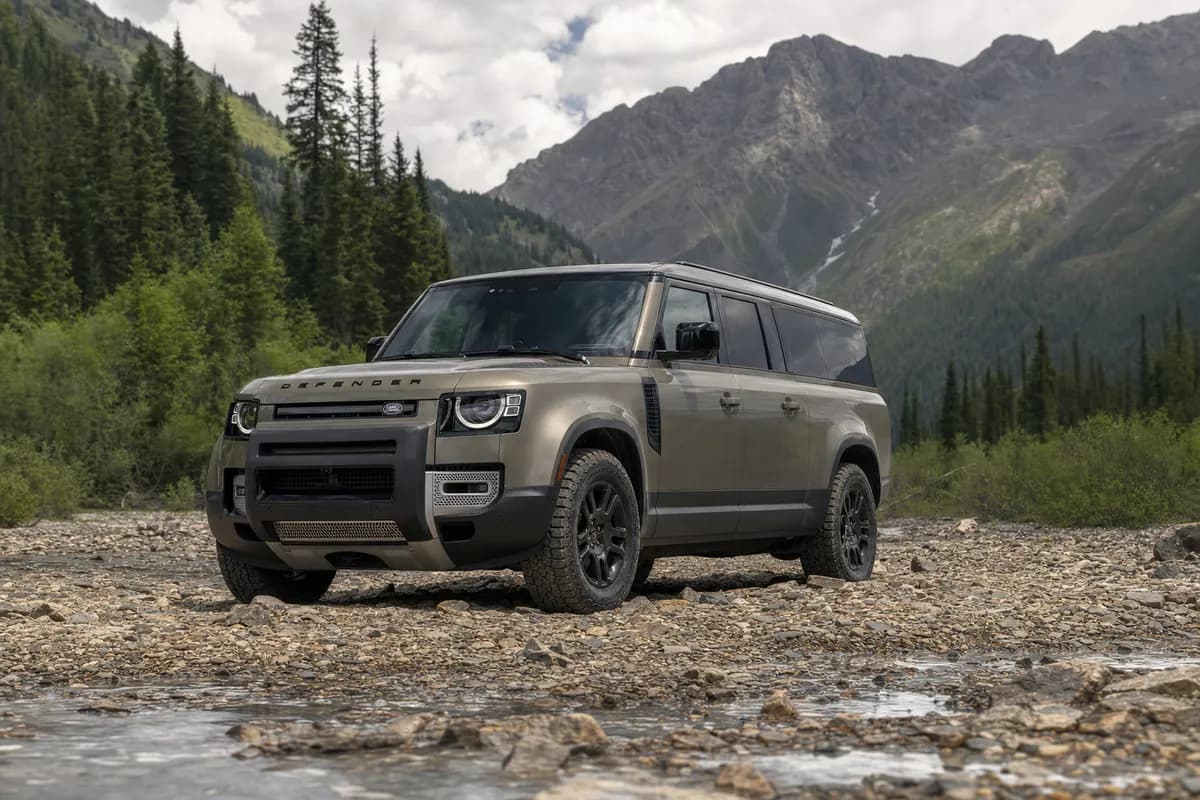
The 2025 Land Rover Defender 130 is the Defender that looked at a 110, decided subtlety was for people who alphabetize spice racks, and bolted on enough rear overhang to seat the whole expedition party plus their regrettable luggage choices.
The 2025 Land Rover Defender 130 is the Defender that looked at a 110, decided subtlety was for people who alphabetize spice racks, and bolted on enough rear overhang to seat the whole expedition party plus their regrettable luggage choices. It is huge, heavy, expensive, and shaped like a luxury refrigerator with a snorkel fantasy. It is also, annoyingly for skeptics, one of the most capable three-row off-road SUVs you can buy. After extended time living with the big 130 on highways, muddy tracks, rutted climbs, loose gravel, and the everyday brutality of school runs and parking garages, the verdict is clear: this is not the purest Defender, but it may be the most useful one.
The Big Defender Problem: Size, Weight, and Physics
The Defender 130 stretches to roughly 211 inches long with the rear-mounted spare tire, which makes it longer than a Cadillac Escalade. Let that sink in. This is a vehicle wearing expedition cosplay while occupying the footprint of an airport shuttle. The key detail, though, is that the 130 uses the same 119-inch wheelbase as the Defender 110. Land Rover added the extra length behind the rear axle, not between the axles.
That decision is both clever and occasionally hilarious. On the road, the 130 feels stable and planted. Off-road, it preserves the same basic breakover advantage as the 110, but the rear overhang is the bill collector. Approach angle is still excellent at up to 37.5 degrees with air suspension raised, and breakover is around 27.8 degrees. Departure angle, however, drops to about 28.5 degrees. That is still respectable, but in technical terrain you become very aware of the long backside trailing behind you like a guilty conscience.
Ground clearance is the Defender’s party trick. With the electronic air suspension in off-road height, the 130 offers up to 11.5 inches of clearance and a claimed 35.4 inches of wading depth. Those are not brochure numbers to casually ignore. They matter when the trail turns into a waterlogged trench or when rocky ruts try to rearrange the underbody. The Defender’s short front overhang and squared-off visibility help, and the available 3D surround camera system is genuinely useful rather than a tech gimmick designed to impress people in golf-club parking lots.
But physics still exists. Depending on trim and engine, the Defender 130 weighs well over 5,500 pounds. Add passengers, roof gear, recovery kit, and camping equipment, and you are piloting a rolling country estate through soft ground. In mud and sand, tire choice matters more than Land Rover’s marketing department would like to admit. The standard all-season tires are fine for wet roads and mild trails, but if you actually plan to use the 130 as intended, all-terrain rubber is not optional. It is the difference between “heroic expedition vehicle” and “very expensive lawn ornament.”
Powertrains: P400 Is the Sweet Spot, V8 Is the Theater
The 2025 Defender 130 lineup centers around the familiar mild-hybrid inline-six P400 and the supercharged V8 in upper trims. The P400 uses a 3.0-liter turbocharged and electrically supercharged inline-six making 395 horsepower and 406 lb-ft of torque. It is paired with an eight-speed automatic transmission and standard four-wheel drive with a two-speed transfer case. Land Rover quotes 0-60 mph in the low six-second range, which is entirely adequate for something this large and blunt.
The P400 is the engine I would buy. It has torque where you need it, it is smoother than the old-school grumble-and-thump crowd wants to admit, and the mild-hybrid system helps fill in low-rpm response. On trails, throttle modulation is controlled and predictable, especially in the dedicated off-road drive modes. On the highway, it has enough muscle to pass decisively without sounding like it is trying to escape the hood.
Then there is the V8. The Defender 130 V8 uses Land Rover’s 5.0-liter supercharged engine, producing 493 horsepower and 450 lb-ft of torque. It turns the 130 from capable overland bus into something more absurd and more entertaining. The noise is rich, the acceleration is indecent, and the whole experience feels like wearing hiking boots with a tuxedo. Is it necessary? Absolutely not. Is it wonderful? Also yes.
But the V8 makes less sense in the 130 than it does in the Defender 90 or 110. The big 130 is about range, people, equipment, and control. The V8 adds drama, cost, thirst, and weight. EPA fuel economy varies by configuration, but nobody buys a Defender 130 because they enjoy passing gas stations with smug restraint. Still, the P400 is already no economy hero, typically landing in the mid-to-high teens in mixed real-world use. Load it up, add roof accessories, or drive into a headwind, and the fuel gauge starts descending like a bad stock pick.
Towing capacity is a strong point. Properly equipped, the Defender 130 is rated to tow up to 8,201 pounds. That beats many lifestyle SUVs and puts it in the same conversation as serious body-on-frame machines. The air suspension helps level loads, and the powertrain has the torque to manage a trailer without drama. But again, length matters: with a trailer attached, this thing becomes less “nimble adventure rig” and more “private rail service.”
Off-Road: Electronics That Actually Earn Their Keep
The modern Defender has been accused of being too digital, too plush, too far removed from the ladder-frame agricultural hero of old. Some of that criticism is nostalgia wearing mud boots. The old Defender was charming, yes, but it was also noisy, cramped, slow, leaky, and ergonomically designed by someone who apparently hated knees. The new one is better at almost everything, and the Defender 130 proves it repeatedly once the pavement ends.
Land Rover’s Terrain Response 2 system is the core of the experience. It adjusts throttle mapping, transmission behavior, traction control, differential settings, ride height, and stability control for surfaces like mud, ruts, sand, rock crawl, and grass/gravel/snow. In the best Land Rover tradition, it makes difficult terrain feel less dramatic than it should. That can be slightly unnerving if you enjoy mechanical clanks, axle articulation theater, and visible suffering. The Defender simply calculates, grips, and goes.
With the available active rear locking differential and center differential, the 130 finds traction with impressive calm. Independent suspension skeptics love to point at solid-axle rivals like the Jeep Wrangler Rubicon and snort. Fair enough: a Wrangler Rubicon with 33-inch tires, disconnecting sway bar, front and rear lockers, and a shorter body is still the sharper tool for hard-core rock crawling. A Ford Bronco Badlands with the Sasquatch package is also easier to place on narrow technical trails, and its trail hardware feels more enthusiast-focused.
But the Defender 130 is not trying to be a Wrangler. It is trying to take six or seven people and their gear across ugly country without making them question their life choices. In that mission, it is superb. The suspension breathes over corrugations. The body structure feels tight. The steering is accurate enough to place the nose between rocks, and the low-range gearing gives the vehicle a sense of patience on steep descents. Hill Descent Control remains one of the best in the business, allowing controlled progress without the clumsy brake-pedal panic common in lesser SUVs.
The 130’s real weakness is tight terrain. Switchbacks, dense forest trails, and sharp ledges expose the length. You must think further ahead than in a Defender 90, Wrangler, Bronco, or even a Toyota Land Cruiser. The rear swing can surprise you, and departure angle demands respect. If your idea of off-roading involves technical rock gardens every weekend, buy the shorter Defender 110 or a Rubicon and stop pretending the third row matters.
Compared with the new Lexus GX 550 Overtrail, the Defender feels more sophisticated and more configurable off-road, though the Lexus counters with Toyota-family durability confidence and a twin-turbo V6 making 349 horsepower and 479 lb-ft. Compared with the 2024 Toyota Land Cruiser hybrid, rated at 326 horsepower and 465 lb-ft, the Defender is roomier, more premium, and more powerful, but also costlier and more complex. Compared with a Mercedes-Benz G-Class, the Defender 130 is far more practical and less ridiculous, though the G remains the aristocratic brick for buyers who consider subtlety a personal attack.
Living With It: Eight Seats, Real Cargo, and Luxury With Mud on Its Shoes
The Defender 130’s strongest argument is not its wading depth or its air suspension. It is the cabin. Unlike many three-row SUVs that treat the third row as punishment seating for children and compact enemies, the 130 offers genuinely usable rear accommodation. Depending on configuration, it seats up to eight passengers, and the third row is more adult-friendly than what you get in a Defender 110. That is the whole point of the extended body.
Cargo space is also far better than in the 110 when all rows are in use. The Defender 130 offers about 13.7 cubic feet behind the third row, around 43.5 cubic feet behind the second row, and up to roughly 88.9 cubic feet with the rear seats folded. Those numbers matter because adventure vehicles often collapse into comedy once every seat is occupied. The 130 can carry people and stuff at the same time. Revolutionary, apparently.
The driving position is excellent: upright, commanding, and surrounded by the kind of squared-off reference points that make a large SUV easier to place. The dashboard has exposed structural-style elements, chunky controls, and enough rugged theater to remind you that you did not buy a Range Rover. The Pivi Pro infotainment system is much better than old Land Rover interfaces, with a large central touchscreen, logical menus, and quick responses most of the time. Wireless Apple CarPlay and Android Auto are expected at this price and work as they should.
Material quality depends heavily on trim, but the overall vibe is premium utility rather than fragile luxury. That is a good thing. The best Defender cabins feel durable enough to accept muddy boots but expensive enough to justify the payment. The available Meridian sound systems are excellent. The climate system is strong. The seating comfort over long distances is first-rate. This is where the Defender 130 humiliates a Wrangler. After five hours on the highway, the Land Rover feels like a luxury SUV. The Jeep feels like a tent that learned to file taxes.
Road manners are impressively composed. The 130 is not sporty, no matter how many horses you stuff under the hood. It leans when pushed, and the mass never disappears. But it tracks well, rides beautifully on air suspension, and filters broken pavement with the calm of a much more conventional luxury SUV. Wind noise is present because the body is shaped like a filing cabinet, but it is not obnoxious. Tire noise depends on rubber choice; aggressive all-terrains add the expected hum.
Reliability remains the elephant wearing a Land Rover badge. The Defender has improved the brand’s reputation in some ways, but Land Rover ownership still demands realistic expectations. Complex air suspension, advanced electronics, mild-hybrid systems, and off-road hardware mean there is more to maintain and more to potentially annoy you. If you are cross-shopping a Toyota Land Cruiser purely because you want to own one vehicle for 250,000 miles with minimal drama, the Defender may not be your emotional support appliance. Budget for maintenance, choose your dealer carefully, and do not skip software updates.
Verdict: The Best Defender for Big Families, Not the Best Defender for Purists
The 2025 Land Rover Defender 130 is a fascinating contradiction. It is too long for the tightest trails, too heavy to feel nimble, too expensive to be casual, and too complex to satisfy the “I only trust things fixed with a hammer” crowd. And yet, judged by what it is actually built to do, it is outstanding.
This is the Defender for people who want real off-road ability without giving up third-row practicality, highway comfort, towing strength, and premium appointments. The P400 version is the smart buy: strong, smooth, and capable without tipping fully into V8 excess. The V8 is magnificent nonsense, but the kind of nonsense that makes tunnels better and accountants sad.
If you want maximum trail toughness, buy a Jeep Wrangler Rubicon or Ford Bronco Badlands. If you want the safest long-term reliability bet, the Toyota Land Cruiser and Lexus GX 550 deserve a hard look. If you want a luxury image weapon, the Mercedes-Benz G-Class still rules the valet lane. But if you want one SUV that can haul a family, cross a flooded trail, tow a serious trailer, cruise in comfort, and still make you turn around in the driveway for one more look, the Defender 130 has a rare breadth of talent.
RevvedUpCars verdict: The 2025 Land Rover Defender 130 is not the sharpest off-road tool, but it is the most convincing big-family adventure SUV in the class. Buy the P400, fit proper all-terrain tires, learn its rear overhang, and go get it dirty. Just do not pretend it is small, cheap, or simple. It is none of those things — and it is better for it.
Affiliate disclosure: This article contains affiliate links. RevvedUpCars may earn a small commission on qualifying purchases at no extra cost to you.