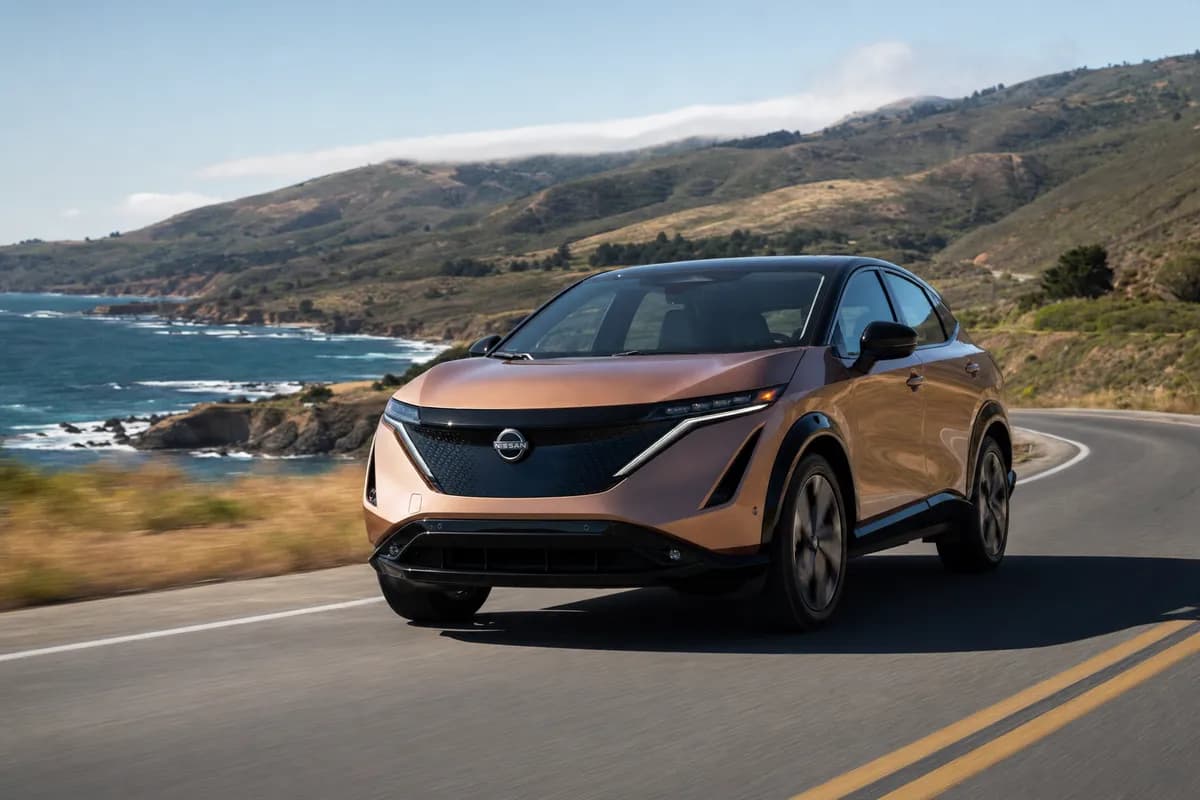
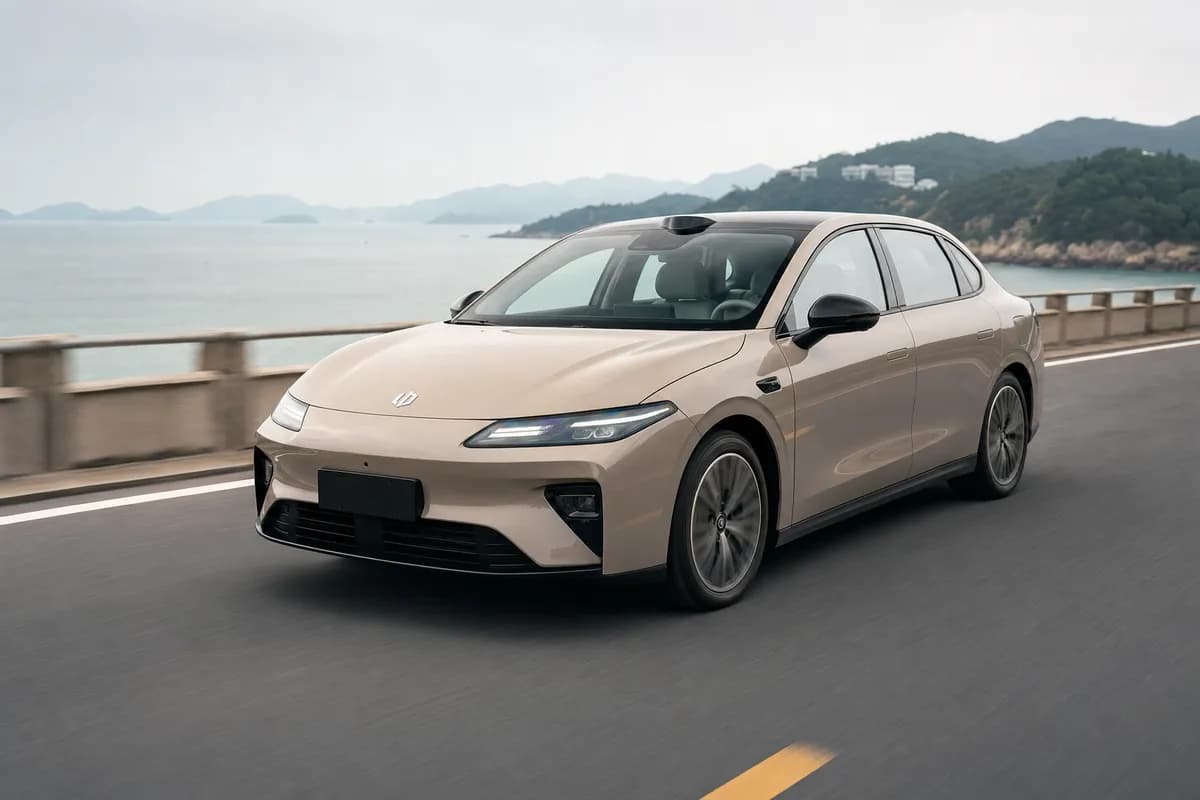
The 2024 Nissan Ariya is what happens when Nissan finally remembers it invented the mainstream EV hatchback, then decides to build one for adults with knees, luggage, and a mild hatred of brittle suspension tuning.
For context, the Ariya lineup starts with the smaller-battery Engage at roughly $39,590 before destination, while the longest-range Venture+ front-wheel-drive model is rated at 304 miles. The plush Platinum+ e-4ORCE sits around the mid-$50,000s before options and incentives. Our preferred sweet spot is the Evolve+ or Empower+ zone: big battery, useful equipment, and not quite enough financial pain to make you wonder why you didn’t buy a Lexus RZ on a lease deal.
Dimensionally, the Ariya is right in the thick of the electric crossover scrum. It measures 182.9 inches long, rides on a 109.3-inch wheelbase, and offers 22.8 cubic feet of cargo space behind the rear seats, expanding to about 59.7 cubic feet with the seats folded. That is useful, but not class-leading. A Tesla Model Y gives you more cargo volume, a front trunk, and a more useful underfloor setup. The Volkswagen ID.4 also beats it for box-swallowing ability with around 30.3 cubic feet behind the second row. The Hyundai Ioniq 5 offers more rear-seat sprawl and far quicker charging.
So no, the Ariya does not win the spec-sheet practicality war by brute force. Nissan’s EV plays a subtler game: comfort, layout, calmness, and daily usability.
On the Road: Smooth, Quick, and Blessedly Not Trying to Be a Sports Car
Many electric crossovers suffer from what I call “instant torque delusion.” They launch hard once, then spend the rest of the drive pretending that a heavy family appliance is a Nürburgring weapon. The Ariya is smarter than that. It is quick, but it does not wear a backwards baseball cap.
With the dual-motor e-4ORCE setup, the Ariya moves with real authority. Expect 0-60 mph in roughly 5.0 seconds, depending on conditions, which is plenty for an EV crossover designed to transport humans rather than intimidate them. The shove is clean and progressive, not neck-snapping for the sake of a YouTube thumbnail. From 30-70 mph, where daily driving actually happens, it feels muscular and relaxed.
The e-4ORCE system is the real star. Nissan uses front and rear motor control, plus brake-based yaw management, to keep the body flatter and the torque distribution tidier than you expect from something this comfort-biased. Punch out of a wet roundabout and the Ariya does not flail, push wide, or do the front-drive EV scrabble. It simply grips and goes. There is a pleasingly mature confidence to it.
Ride quality is one of the Ariya’s best traits. On broken urban pavement, expansion joints, and those nasty mid-corner scars that make some EVs thump like overloaded filing cabinets, the Nissan stays composed. The suspension is soft enough to feel expensive, but not so floaty that passengers start reaching for ginger chews. The steering is light and accurate, though not especially communicative. That is fine. Nobody buying this instead of a Kia EV6 GT is asking for fingertip chatter from the front tires.
Noise suppression is excellent. Wind noise is low, tire roar is well contained, and the whole car has the hushed, padded feel that makes long commutes less hateful. In that sense, the Ariya feels more premium than its badge suggests. It is more serene than a Model Y, less busy than a Mustang Mach-E, and less plasticky in its movements than a Toyota bZ4X.
The brakes are smooth, too, which should not be remarkable in 2024 but somehow still is. Regenerative braking can be adjusted, and Nissan’s e-Step system provides strong deceleration, though it will not bring the car to a complete stop in all situations like a true one-pedal setup. That is mildly annoying if you are coming from a Tesla or Chevrolet Bolt, but the blending between regen and friction braking is polished.
The Ariya is not exciting in the tail-out, grin-like-an-idiot sense. It is exciting in the “this heavy EV finally behaves like a properly engineered car” sense. That matters more.
Interior and Practicality: The Ariya’s Best Argument
Open the door and the Ariya immediately makes several rivals look like they were designed during a lunch break. The cabin is airy, modern, and genuinely pleasant. There is a flat floor, a broad dashboard, slim climate vents, and a lounge-like layout that stops short of looking like a concept car someone forgot to make usable.
The front seats are excellent: wide, supportive, and comfortable for long drives. Rear-seat room is generous, helped by the flat EV floor and long wheelbase. Adults fit comfortably in the back, and the cabin width means three across is possible, though not exactly a spa day. The Ariya is especially good for families who need rear-facing child seats; the door openings are wide, and there is enough legroom up front that parents do not have to drive with their knees under their chin.
Nissan also deserves credit for the sliding center console. It can move electrically fore and aft, opening up space between the front seats or bringing the controls closer. Is it necessary? Not really. Is it cool in a very Japanese executive-lounge way? Absolutely. There is also a clever under-dash tray and useful storage throughout the cabin.
But then we get to the Ariya’s strangest party trick: haptic buttons embedded in wood-look trim. They look fantastic. They also require more attention than proper physical switches. Nissan has at least kept a dedicated volume knob, which in 2024 qualifies as an act of humanitarian service, but the climate controls are more style than substance. They work, but they are not as satisfying as real buttons in a car meant to reduce daily friction.
The dual 12.3-inch displays are crisp and logically arranged. Wireless Apple CarPlay is included, Android Auto is available, and the interface is far less maddening than the Volkswagen ID.4’s earlier software. Nissan’s menus are not flashy, but they are understandable, which is what you want when you are trying to change a setting without becoming part of the scenery.
Cargo space is where the “most practical” claim starts to wobble. The Ariya’s 22.8 cubic feet behind the rear seats is perfectly usable for groceries, strollers, luggage, and everyday family clutter. Fold the seats and you get nearly 60 cubic feet, which is good. But there is no front trunk, and rivals simply offer more space. A Tesla Model Y is the cargo king here, with a deep rear hold, underfloor storage, and a frunk. The VW ID.4 is boxier and easier to load. The Ford Mustang Mach-E also gives you a front trunk, which is handy for charge cables or muddy gear.
So the Ariya is practical, but not maximum-practical. Think beautifully furnished apartment, not warehouse.
Range and Charging: Good Range, Average Speed
The 2024 Ariya’s range numbers are competitive, especially if you choose the right version. The front-drive Venture+ is the range hero at 304 miles EPA. The front-drive Evolve+ and Empower+ sit around 289 miles. The dual-motor e-4ORCE models trade some range for traction and power, with our Evolve+ e-4ORCE rated at 272 miles. The Platinum+ e-4ORCE is rated slightly lower at about 267 miles.
In mixed real-world driving, the Ariya feels honest. Driven normally in moderate weather, expect efficiency in the high-2 to low-3 miles-per-kWh range depending on speed, tires, temperature, and how often you enjoy the dual-motor punch. On the highway, like most EVs, it burns through range faster than the brochure suggests. At 70 mph, plan conservatively if you are road-tripping.
Charging is the bigger issue. The Ariya peaks at about 130 kW on a DC fast charger. Nissan says a larger-battery Ariya can charge from 10-80 percent in roughly 35 to 40 minutes under ideal conditions. That is acceptable, but it is not impressive anymore. A Hyundai Ioniq 5 or Kia EV6 on a proper 350-kW charger can do the same job in about 18 minutes. Even the Tesla Model Y benefits from a superb charging network and strong route-planning integration.
At home, the Ariya’s 7.2-kW onboard AC charger is also merely adequate. Many rivals offer 10.9-kW or 11-kW onboard charging, meaning they can refill faster overnight on a capable Level 2 setup. For most owners, plugging in at home every few nights will be fine. But if your driving pattern involves frequent deep discharges and quick turnarounds, the Ariya is not the sharpest tool in the charging shed.
Then there is the connector question. The 2024 Ariya uses CCS, while the industry is marching toward Tesla’s NACS port. Nissan has announced its move to NACS for future EVs, but buyers of this Ariya should understand that adapter access and network compatibility matter. The Ariya is not stranded, but it is not as plug-and-play convenient as a Tesla on a long trip.
That is the central contradiction: the Ariya is deeply practical around town and only average when the journey stretches past its battery comfort zone.
Against the Rivals: Where the Ariya Wins and Loses
Against the Tesla Model Y, the Ariya is quieter, more comfortable, and has a warmer, better-finished cabin. The Model Y counters with better cargo capacity, a frunk, quicker charging access, stronger software, and better efficiency. If you road-trip often or treat cargo space like a competitive sport, buy the Tesla. If you want refinement and do not want your dashboard to resemble a dentist’s waiting room with an iPad glued to it, the Ariya has charm.
Against the Hyundai Ioniq 5, the Nissan feels more settled and traditionally luxurious. The Hyundai has a roomier rear seat, faster 800-volt charging, and a more futuristic personality. The Ioniq 5 is the better road-trip machine. The Ariya is the better quiet commuter.
Against the Kia EV6, the Ariya is calmer and easier to live with, while the Kia is sharper, lower, sportier, and more fun. The EV6 has quicker charging and a more driver-focused feel. The Ariya has a more relaxing cabin and a friendlier ride.
Against the Volkswagen ID.4, the Ariya feels more premium and more polished dynamically. The VW offers more cargo space and often strong lease deals, but its control interface can be an ergonomic prank. I would take the Ariya’s cabin and powertrain tuning over the ID.4’s, even if the VW wins on raw storage.
Against the Ford Mustang Mach-E, the Nissan is less dramatic but more serene. The Mach-E has better branding, a frunk, and livelier handling. The Ariya has a smoother ride and a more elegant interior. Choose based on whether you want energy or ease.
Verdict: Not the Most Practical, But One of the Easiest to Live With
Is the 2024 Nissan Ariya the most practical electric crossover? No. Not if we are being ruthless, and we should be. The Tesla Model Y carries more, charges more conveniently, and makes road trips easier. The Hyundai Ioniq 5 and Kia EV6 charge much faster. The Volkswagen ID.4 offers more cargo space for less drama at the dealership. The Ariya’s lack of a frunk, modest cargo hold, 130-kW DC charging peak, and 7.2-kW AC charger keep it from taking the practicality crown.
But that does not make it a weak choice. Quite the opposite. The Ariya is one of the most pleasant electric crossovers to drive every day. It rides beautifully, feels genuinely premium inside, has adult-friendly passenger space, delivers honest range, and offers a calmness many rivals sacrifice in pursuit of gimmicks or acceleration bragging rights.
The best version is a large-battery front-drive model if range and value matter most, or an Evolve+ e-4ORCE if you want all-weather confidence and a serious performance bump without going full luxury-price silly. Skip the smallest battery unless your use case is strictly urban and your charging routine is predictable.
The Ariya is not the EV crossover for spreadsheet warriors. It is the one for people who actually have to sit in traffic, haul kids, drive through rain, park at the supermarket, and arrive somewhere without feeling like they have been lightly beaten by sport suspension and touchscreen nonsense.
Final call: The 2024 Nissan Ariya is not the most practical electric crossover by the numbers, but it may be the most practical one for buyers who value comfort, refinement, and day-to-day ease over cargo bragging rights. It is not the king of the class. It is the grown-up in the room — and frankly, this room needed one.
Affiliate disclosure: This article contains affiliate links. RevvedUpCars may earn a small commission on qualifying purchases at no extra cost to you.