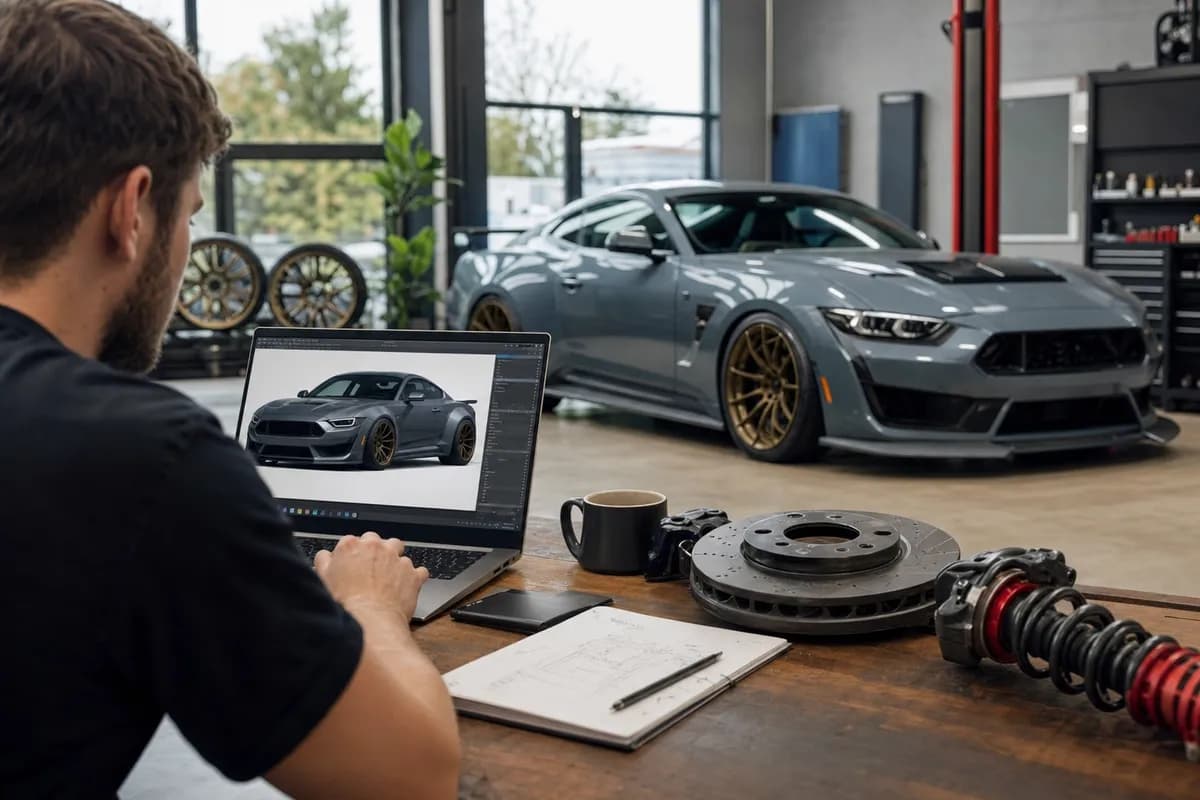
The smartest tool in a 2025 garage might not be a 10mm socket, a torque wrench, or a lift. It might be the AI chat window open on a laptop next to a half-disassembled Civic, Miata, Mustang, WRX, or GR86.
That is a big deal because most modification mistakes are not caused by lack of passion. They are caused by missing one small detail. Wrong offset. Incorrect hub bore. Spring rate mismatch. Downpipe that needs a tune. Brake kit that does not clear the wheels. Coilovers that lower the car too much for the tires you already bought. Ask me how many cars I have seen roll into the shop on rubbing tires and fresh regret.
AI is especially useful because it can connect related systems. A human might shop wheels in one browser tab, suspension in another, and tires in a third. A good AI prompt can force the whole plan into one conversation: “I have a 2022 Subaru WRX, want 18x9.5 wheels, mild daily-driver drop, no fender rolling, 300 wheel horsepower goal, and a $4,000 budget. What are the conflicts?”
That kind of question is where AI shines. It might point out that your wheel choice, tire width, ride height, alignment, and brake clearance are not separate decisions. They are one package.
Shop rule: AI is not the mechanic, fabricator, tuner, or alignment tech. It is the planning assistant that helps you ask better questions before the expensive part starts.
Fitment Checks: Where AI Helps, and Where It Still Gets Dangerous
If there is one area where enthusiasts are leaning hard into AI car modification, it is fitment. Wheel and tire choices are visual, expensive, and easy to get slightly wrong. A proper wheel fitment guide needs more than diameter and bolt pattern. You need width, offset, center bore, brake clearance, tire section width, overall tire diameter, suspension type, fender clearance, ride height, alignment specs, and sometimes even the exact tire model.
That last part matters. A 255/35R18 Michelin Pilot Sport 4S and a 255/35R18 Falken Azenis RT660 can have different real-world shoulder shapes and section widths. Same printed size, different behavior under the fender. AI can remind you to check those specs, but it may not know the exact casing shape unless you feed it reliable data.
Example: 2022 Toyota GR86 / Subaru BRZ
The second-generation GR86 and BRZ are popular budget car build platforms because they are light, simple, and responsive. A common enthusiast goal is an 18x9.5 wheel with a 255 tire. AI can quickly compare common fitments like 17x9 +45 with 245/40R17 versus 18x9.5 +40 with 255/35R18.
That is useful, but the answer needs context. On a GR86, an 18x9.5 +40 with a 255/35R18 may require camber, careful ride height, and possibly fender attention depending on tire model and suspension setup. A milder 17x9 +45 with 245/40R17 is often easier for dual-duty street and autocross use. AI can map the pros and cons: lighter tire cost, gearing effect, sidewall compliance, and rubbing risk.
Where AI can get you in trouble is by giving a confident “yes, it fits” without specifying conditions. Fits at stock height? Fits lowered one inch? Fits with -2.5 degrees of front camber? Fits without rubbing under compression? Those are different answers.
Example: NC Miata vs. ND Miata
Another common trap is generation confusion. Ask an AI tool about “Miata wheel fitment,” and it may blend NA, NB, NC, and ND data if you are not specific. An NC Miata has very different factory wheel sizing and fender room than an NA or NB. An ND Miata has its own popular 16- and 17-inch setups. If you ask vague questions, you get vague answers dressed up in confident language.
A better prompt is specific: “For a 2019 Mazda MX-5 ND2 Club with factory Brembo brakes, compare 17x8 +45 and 17x9 +45 wheels for 225/45R17 and 245/40R17 tires. I want no fender rolling and street alignment.” Now the AI has enough constraints to produce something closer to useful.
What to Verify Before Buying Wheels
- Bolt pattern: Do not trust memory. Verify the exact chassis and year.
- Center bore: Know whether you need hub-centric rings.
- Offset and width together: A +35 offset means different things on a 7.5-inch wheel and a 9.5-inch wheel.
- Brake clearance: Diameter alone does not guarantee caliper clearance. Spoke shape matters.
- Tire diameter: Big changes can affect speedometer readings, gearing, ABS behavior, and fender clearance.
- Alignment assumptions: Aggressive fitment often depends on added negative camber.
- Suspension type: Coilovers may create more inner clearance than stock struts on some cars, but not always.
Use AI to build the checklist. Use manufacturer specs, fitment galleries, real build threads, and a tape measure to confirm it. If the fitment is tight, call the wheel company or a specialist vendor before ordering.
Budget Builds: AI Is Great at Finding the Parts You Forgot
The biggest advantage of AI in car mod planning is not finding the flashiest part. It is finding the boring parts that wreck a budget. Every experienced builder knows the part price is only the beginning. A $950 set of coilovers may also require adjustable end links, camber bolts, alignment, replacement top hats, anti-seize, and maybe fresh sway bar bushings if the originals are cooked. Suddenly that $950 suspension upgrade is a $1,400 weekend.
AI can build a more honest budget car build plan if you ask it to include supporting items, tools, labor, consumables, and tuning. That turns it from a shopping assistant into a reality check.
Example: $5,000 Street/Track Civic Si Plan
Let’s say you own a 2017 Honda Civic Si and want a reliable street/track setup for about $5,000. A typical AI-assisted plan might break the budget into stages:
- Maintenance baseline: Fluids, brake inspection, plugs, filters, serpentine belt inspection, and any worn mounts or suspension bushings.
- Brakes: High-temperature fluid such as Motul RBF 600 or Castrol SRF, quality pads like Hawk DTC, G-Loc, or Ferodo depending on use, and fresh rotors if needed.
- Tires: A 200-treadwear tire such as Falken RT660, Yokohama A052, Bridgestone RE-71RS, or Kumho V730 depending on event type and budget.
- Suspension: Conservative coilovers or quality dampers and springs, plus alignment parts if camber is needed.
- Power: Intake and exhaust only if they fit the goal, with tuning costs included when required.
The AI’s job is to rank upgrades by impact. On most dual-duty cars, tires, brakes, fluids, and alignment deliver more lap-time confidence than an intake or blow-off valve. That may not be as exciting as a big shiny part, but it is how experienced builders avoid wasting money.
Ask the AI to format your plan as “must-have,” “nice-to-have,” and “later.” For a track-curious daily driver, the must-have list is usually maintenance, brakes, tires, and driver education. The nice-to-have list might include dampers, seats, and data logging. The later list is often power.
Example: Mustang GT Power Budget
For a 2018-2023 Mustang GT, AI can compare a naturally aspirated bolt-on path against forced induction. It might show that a cold air intake, long-tube headers, exhaust, and E85 tune can be a strong package, but it should also flag emissions legality, tuning requirements, fuel system limitations, noise, and installation labor. A supercharger kit may advertise a dramatic horsepower number, but the real budget can include colder plugs, injectors, fuel pump upgrades, clutch or 10R80 transmission considerations, half-shafts, tires, and tuning.
That is the difference between “Can I afford the kit?” and “Can I afford the build?” AI is useful because it pushes the second question if prompted correctly.
Prompt Like a Builder, Not Like a Shopper
The quality of AI car modification advice depends heavily on the prompt. “What mods should I do to my BMW?” is almost useless. “I have a 2016 BMW 340i xDrive with the B58, 82,000 miles, stock turbo, ZF8 automatic, daily driven in Texas, and I want a reliable 400 wheel horsepower on 93 octane with a $3,500 parts budget” is much better.
A good AI prompt should include the exact vehicle, current condition, intended use, budget, tools available, emissions requirements, and tolerance for noise, harshness, downtime, and risk. If you daily drive the car, say so. If you have no lift, say so. If you cannot pass inspection with a catless downpipe, definitely say so.
Here is a practical prompt template enthusiasts can use:
“Act as a conservative performance shop advisor. I own a [year/make/model/trim/engine/transmission] with [mileage] and current mods of [list]. My goal is [daily/track/autocross/show/off-road/drag] with a budget of [amount]. I want to keep [comfort/reliability/emissions/warranty] as priorities. Create a staged mod plan, list supporting parts, tools, labor difficulty, tuning needs, common failure points, and what I should verify before buying.”
Then follow up with harder questions:
- What parts in this plan can conflict with each other?
- What should I replace while I am already in there?
- What are the hidden costs?
- What would you skip if reliability matters more than peak power?
- What specs should I verify from the manufacturer?
- What are common forum complaints about this exact part?
That last question is important. AI tools can summarize patterns from community discussions when browsing or search features are available, but you still want to read the original threads. Forums like NASIOC, Miata.net, CivicX, Bimmerpost, Mustang6G, GR86.org, and Grassroots Motorsports remain gold mines because they contain real owner experiences, not just marketing copy.
Where AI Still Fails: Confidence, Context, and Safety
AI can be impressive, but it has bad shop habits if left unsupervised. The biggest one is confidence. It may invent torque specs, blend model years, recommend incompatible parts, or overlook emissions and safety rules. I have seen human parts counters make those mistakes too, but AI can make them faster and with nicer formatting.
Be especially careful with torque specs, wiring, brake work, airbag systems, fuel systems, high-voltage hybrids and EVs, and tuning. If an AI tool gives you a torque value for rod bolts, brake caliper brackets, flywheel bolts, or suspension arms, verify it against the factory service manual or a trusted service database. Do not let a chatbot be the final authority on anything that can cause a wheel to leave the car.
AI also struggles when a car has mid-year changes. A 2005 Subaru Legacy GT, a 2006 BMW 330i, or a 2015 Mustang can have details that depend on production date, trim, package, market, or previous owner modifications. The older the car, the more important inspection becomes. Rust, worn bushings, seized bolts, cracked vacuum lines, tired mounts, and hacked wiring do not show up in a prompt unless you tell the AI they exist.
For tuning, treat AI as an educational tool, not a calibrator. It can explain what air-fuel ratio, ignition timing, boost control, knock correction, and fuel trims mean. It should not be writing your final map. Use reputable tuners, proven off-the-shelf maps when appropriate, and proper datalog review. A bad tune can kill an engine faster than a bad wheel offset can chew a tire.
The Smart Verification Loop
The best builders in 2025 are not blindly trusting AI. They are using a verification loop:
- Ask AI for the plan: Get stages, part categories, fitment concerns, and budget estimates.
- Cross-check with primary sources: Manufacturer specs, factory service manuals, and vendor documentation.
- Search real owner results: Forums, build threads, fitment galleries, dyno charts, and event paddocks.
- Measure your own car: Especially for wheels, brakes, ride height, exhaust routing, and rusted hardware.
- Revise the plan: Update the budget and sequence before ordering parts.
That loop is how AI becomes useful instead of risky. It turns a scattered pile of opinions into an organized build plan with known assumptions.
Verdict: AI Won’t Build Your Car, But It Can Save Your Build
AI car modification is not a gimmick anymore. For enthusiasts planning DIY car mods in 2025, it is becoming as normal as checking a forum or watching an install video. The real value is not that AI knows everything. It does not. The value is that it helps you slow down before you spend money, compare options clearly, and catch the supporting details that separate a clean build from a parts-bin headache.
For wheel fitment, AI can explain offset, tire sizing, camber, and clearance tradeoffs, but you still need a proper wheel fitment guide, real-world examples, and measurements. For a budget car build, AI can expose hidden costs and help stage upgrades around maintenance, reliability, and actual driving goals. For power mods, it can identify tuning needs and supporting systems before the engine is on borrowed time.
My advice from two decades of fixing both cars and owner decisions: use AI like a sharp apprentice. Give it specific information, make it show its assumptions, and check its work. Let it organize the plan, build the budget, and point you toward questions you may not have known to ask. But before you torque the bolt, flash the ECU, or click “buy now” on wheels that barely clear in someone else’s photo, verify with real specs and real experience.
The best builds have always come from patience, research, and honest goals. AI just gives today’s enthusiasts a faster way to get there without learning every lesson the expensive way.
Affiliate disclosure: This article contains affiliate links. RevvedUpCars may earn a small commission on qualifying purchases at no extra cost to you.