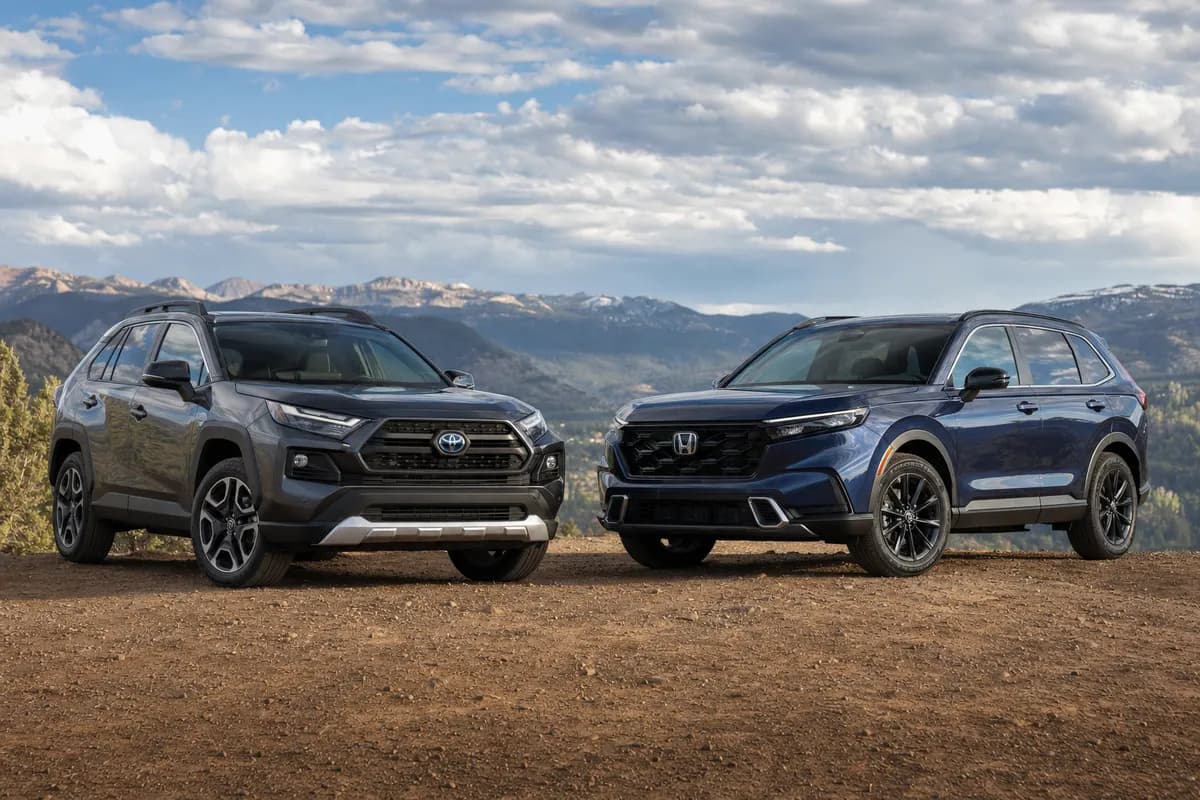
The 2025 Toyota RAV4 Hybrid and 2025 Honda CR-V Hybrid are the two sensible shoes of the compact SUV world — except one of them has better grip, better fuel economy, and a bit more punch when the light turns green.
The 2025 Honda CR-V Hybrid uses a 2.0-liter four-cylinder engine with Honda’s two-motor hybrid system. Output is 204 horsepower, with Honda emphasizing smooth electric-motor drive feel rather than punchy acceleration. Front-wheel drive is available on Sport and Sport-L trims, while the Sport Touring Hybrid comes standard with all-wheel drive.
On paper, the RAV4 Hybrid has the edge. In practice, it feels quicker too. Independent testing has typically put the RAV4 Hybrid in the low-to-mid 7-second range from 0-60 mph, while the CR-V Hybrid tends to land closer to the 8-second mark. Neither is going to trouble a Porsche Macan, but the Toyota feels more eager when merging onto a fast highway or darting into a gap in traffic.
That said, Honda’s system is smoother and quieter in the way it blends gas and electric power. The CR-V Hybrid often feels like an EV at neighborhood speeds, and when the engine does fire, it’s generally less buzzy than the Toyota’s 2.5-liter under hard acceleration. The RAV4 Hybrid can drone when you pin it, because the eCVT lets the engine hang at higher revs. It’s not unbearable. It’s just not elegant.
Performance verdict: The Toyota RAV4 Hybrid is quicker and more confident when you ask for speed. The Honda CR-V Hybrid is smoother, calmer, and more refined. If your right foot has opinions, buy the Toyota. If your passengers have opinions, buy the Honda.
Fuel Economy and Real-World Efficiency: RAV4 Lands the Bigger Blow
This is where Toyota walks into the room, cracks its knuckles, and reminds everyone it has been building hybrid SUVs since before half the market knew what regenerative braking was.
The 2025 Toyota RAV4 Hybrid is EPA-rated at 41 mpg city, 38 mpg highway, and 39 mpg combined. Crucially, that comes with standard all-wheel drive across the hybrid lineup. You don’t have to pay extra or accept a fuel-economy penalty to get four driven wheels.
The 2025 Honda CR-V Hybrid is rated at 43 mpg city, 36 mpg highway, and 40 mpg combined in front-wheel-drive Sport and Sport-L trims. Add all-wheel drive and the rating drops to 40 mpg city, 34 mpg highway, and 37 mpg combined. The AWD-only Sport Touring Hybrid also carries that 40/34/37 mpg rating.
So here’s the real-world wrinkle: if you’re comparing a front-drive CR-V Hybrid to the RAV4 Hybrid AWD, Honda technically wins the combined EPA number by 1 mpg. But most compact SUV buyers want all-wheel drive, especially in snowy states, wet climates, or places where “gravel driveway” is a personality trait. Once AWD enters the chat, Toyota wins: 39 mpg combined versus Honda’s 37 mpg combined.
Over 12,000 miles per year, that difference isn’t life-changing, but it’s not imaginary either. At $3.50 per gallon, the RAV4 Hybrid AWD uses roughly 308 gallons annually at 39 mpg. The CR-V Hybrid AWD uses about 324 gallons at 37 mpg. That’s around $56 per year in Toyota’s favor. Not enough to fund retirement, but enough for a nice dinner where you can smugly mention your fuel economy and ruin the mood.
The bigger point is consistency. The RAV4 Hybrid tends to deliver excellent numbers without much driver effort. Toyota’s hybrid system is superb in stop-and-go traffic, cold starts, short trips, and ugly suburban crawling. The Honda is very efficient too, but its highway rating suffers more, and AWD trims simply can’t match the Toyota’s official combined figure.
Efficiency verdict: Front-drive Honda CR-V Hybrid models are brilliant around town, but the Toyota RAV4 Hybrid is the better AWD efficiency play. In the real world, that matters.
Interior, Space, and Comfort: Honda Makes Toyota Look Old
Now we arrive at the part where the RAV4 Hybrid starts looking like the veteran athlete still winning games but clearly icing both knees afterward. The current RAV4 generation dates back to 2019, and while Toyota has updated the tech, the cabin architecture feels older than the CR-V’s.
The Honda CR-V Hybrid has the better interior. Full stop. The dashboard is cleaner, the controls feel more modern, and the honeycomb vent design still looks sharp rather than gimmicky. The driving position is excellent, outward visibility is strong, and the front seats are more supportive over long distances. Honda does “normal car ergonomics” better than almost anyone, and the CR-V is proof.
The Toyota RAV4 Hybrid counters with tough-looking design, chunky knobs, and a cabin that feels ready for abuse. It’s more rugged in vibe, less polished in execution. The switchgear is durable, the layout is easy to understand, and the available 10.5-inch touchscreen is a welcome upgrade over older Toyota systems. But compared with the CR-V, the RAV4 feels narrower, busier, and less premium.
Space is a clear Honda advantage. The CR-V offers 39.3 cubic feet of cargo space behind the rear seats and up to 76.5 cubic feet with them folded. The RAV4 Hybrid offers 37.5 cubic feet behind the rear seats and 69.8 cubic feet maximum. That’s not a rounding error; that’s the difference between “yes, it fits” and “take the front wheel off the bike and stop complaining.”
Rear-seat comfort also favors the CR-V. Honda gives you a more spacious second row, generous legroom, and doors that open wide enough to make child-seat installation less of a yoga-based punishment. The Toyota’s rear bench is perfectly usable, but the CR-V feels more relaxed and adult-friendly.
Noise isolation is another Honda win. The CR-V Hybrid is calmer at speed, with less road roar and a more settled highway demeanor. The RAV4 Hybrid is not crude, but tire noise and engine sound are more noticeable, especially on coarse pavement. If your daily drive includes a lot of highway miles, the Honda will feel like the more expensive machine.
Cabin verdict: Honda wins this round decisively. The CR-V Hybrid is roomier, quieter, more comfortable, and more modern inside. The RAV4 Hybrid is practical, but it no longer feels fresh.
Driving, Handling, and Bad-Weather Confidence: Toyota Has the Grit, Honda Has the Grace
The Toyota RAV4 Hybrid drives with a kind of sturdy bluntness. Steering is predictable, body control is tidy enough, and the standard AWD system gives it useful traction when the weather turns unpleasant. It’s not playful, but it is confident. The RAV4 Hybrid feels like it was engineered by people who understand that most roads are broken, most drivers are late, and most weather forecasts are lies.
The Honda CR-V Hybrid is the more polished driver’s car in the traditional sense. The steering is more natural, the chassis feels better tied down, and the ride has a more sophisticated edge. It flows down a road better than the RAV4. It doesn’t feel sporty exactly, but it feels cohesive, which is a very Honda thing. The suspension absorbs impacts without feeling floaty, and the brake pedal feel is impressively natural for a hybrid.
But Toyota claws back points with standard AWD. On the Honda, you must choose AWD or pay for the top Sport Touring trim to get it standard. That matters because buyers in this segment often cross-shop based on monthly payment, not philosophical drivetrain purity. With the RAV4 Hybrid, every trim gets AWD baked in.
Ground clearance is close: most RAV4 Hybrid trims sit around 8.1 inches, while the CR-V Hybrid AWD is around 8.0 inches. Neither is an off-roader, despite what roof baskets and Instagram filters might imply. The RAV4 Woodland Edition adds a slightly more outdoorsy flavor with all-terrain-oriented equipment and a raised adventure vibe, but let’s not pretend it’s a 4Runner. It’s a trailhead commuter with better shoes.
Towing is also a small Toyota win. The RAV4 Hybrid is rated to tow up to 1,750 pounds, while the CR-V Hybrid is rated at 1,000 pounds. If you’re pulling a small utility trailer, a pair of dirt bikes, or a lightweight teardrop camper, the Toyota gives you more breathing room. If you’re towing anything genuinely heavy, buy something bigger and stop bullying compact crossovers.
Driving verdict: Honda is smoother and nicer to drive. Toyota is quicker, more traction-focused, and more useful if you tow light loads or face regular bad weather.
Pricing, Trims, and Ownership: Toyota Plays the Long Game
The 2025 Toyota RAV4 Hybrid lineup starts with the LE Hybrid and runs through trims such as XLE Hybrid, SE Hybrid, Woodland Edition, XLE Premium Hybrid, XSE Hybrid, and Limited Hybrid. Base pricing starts around the low $30,000s before destination, with loaded trims climbing into the low $40,000s. The spread is broad, which is good news: Toyota lets you buy a fairly affordable hybrid AWD SUV without forcing you into luxury cosplay.
The 2025 Honda CR-V Hybrid lineup is simpler: Sport Hybrid, Sport-L Hybrid, and Sport Touring Hybrid. Pricing generally starts in the mid $30,000s before destination, with the Sport Touring Hybrid landing above $40,000. The Sport and Sport-L can be had with front-wheel drive or all-wheel drive, while the Sport Touring is AWD-only.
Honda gives you a richer-feeling vehicle, but Toyota gives you more ways to configure one. Want the cheapest AWD hybrid between these two? That’s the RAV4 Hybrid. Want the nicest interior without going full luxury badge? That’s the CR-V Hybrid Sport-L or Sport Touring.
Both brands have excellent reputations for reliability and resale value, though Toyota still owns the hybrid trust crown. Its hybrid systems have been battle-tested in taxis, rideshare fleets, commuter pods, and Priuses with odometers that look like national debt figures. Honda’s hybrid system is also strong, but Toyota’s track record is the industry benchmark.
Technology is more of a draw. Toyota’s current infotainment system is much better than its old one, with wireless Apple CarPlay and Android Auto widely available, plus available larger screens. Honda’s interface is simpler and cleaner, though some trims use a smaller touchscreen than you might expect at this price. Both offer strong driver-assistance suites: Toyota Safety Sense and Honda Sensing include expected features like adaptive cruise control, lane-keeping assistance, forward collision warning, and automatic emergency braking.
One annoyance: neither vehicle is exactly cheap anymore. These are compact family SUVs flirting with $40,000 when nicely equipped. That is the market now, apparently — a place where “sensible” comes with a payment that makes you stare silently into the middle distance.
Value verdict: Toyota offers better entry-level hybrid AWD value and stronger hybrid credibility. Honda feels more premium but makes you pay for the nicer experience.
Verdict: The CR-V Hybrid Wins the Daily Grind, But the RAV4 Hybrid Wins the Spreadsheet
If I’m recommending one to a family that values comfort, space, quietness, and a cabin that doesn’t feel one generation behind, I’m pointing them toward the 2025 Honda CR-V Hybrid. It is the better everyday vehicle to sit in, load up, and live with. The rear seat is better, the cargo hold is bigger, the ride is calmer, and the interior feels like Honda actually remembered humans have elbows, ears, and lower backs.
But if the question is which hybrid system makes more sense in the real world — especially for buyers who want all-wheel drive — the 2025 Toyota RAV4 Hybrid is brutally compelling. It’s quicker, more efficient than the AWD CR-V Hybrid, cheaper to access with AWD, rated to tow more, and backed by Toyota’s unmatched hybrid résumé. It may not charm you, but it will serve you with the grim competence of a very efficient appliance that occasionally does a decent impression of a hot hatch at a green light.
So here’s the final call:
Buy the 2025 Honda CR-V Hybrid if you want the better family SUV: more space, better comfort, cleaner interior design, and a smoother driving experience.
Buy the 2025 Toyota RAV4 Hybrid if you want the better hybrid SUV: standard AWD, stronger fuel economy in AWD form, quicker acceleration, better towing, and proven long-term durability.
My winner? The 2025 Honda CR-V Hybrid — by a nose. It’s the vehicle I’d rather drive every day, especially with passengers and cargo aboard. But this is not a knockout. The RAV4 Hybrid is still the smarter pick for snow-belt commuters, efficiency hawks, and buyers who treat resale value like a competitive sport.
The CR-V wins because the real world is not just mpg math. It’s school runs, road trips, bad pavement, back-seat complaints, and the quiet joy of a cabin that doesn’t drone when you ask for power. Toyota built the better hybrid. Honda built the better SUV. In 2025, that gives the CR-V Hybrid the crown — just don’t expect the RAV4 Hybrid to stop selling like free coffee at a tire shop.
Affiliate disclosure: This article contains affiliate links. RevvedUpCars may earn a small commission on qualifying purchases at no extra cost to you.