Toyota and Lexus are making a meaningful change to the day-to-day EV ownership experience for 2026, and it goes well beyond a routine spec update.
Toyota and Lexus are making a meaningful change to the day-to-day EV ownership experience for 2026, and it goes well beyond a routine spec update. The headline is simple: faster DC charging on key models, broader public fast-charging access through native North American Charging Standard integration, and a clearer path toward the brands’ next wave of battery-electric vehicles. For buyers considering a Toyota bZ or Lexus RZ, the latest upgrades address two of the biggest pain points in the current market: where you can charge, and how long you will spend plugged in when you get there. Just as important, they offer an early look at the 2027 Toyota EV roadmap and how the company plans to make its future electric lineup more usable in the real world.
Toyota and Lexus are fixing the practical weak spots of their EVs
For Toyota, this matters because the company has entered the modern EV race more cautiously than many rivals. The Toyota bZ4X launched into a market already defined by improving range, expanding charging networks, and rising buyer expectations around road-trip convenience. Lexus, meanwhile, positioned the RZ as a premium electric crossover, but premium buyers are especially sensitive to fast-charging performance and network reliability. In both cases, charging has been one of the main areas where the vehicles needed to catch up.
The latest Toyota EV charging 2026 changes are designed to close that gap. Toyota says 2026 model-year battery-electric vehicles, including the updated Toyota bZ and Lexus RZ, will gain access to faster Level 3 DC charging speeds and a simpler route to major fast-charging infrastructure. The key hardware change is the move to the NACS Toyota Lexus charging port on 2026 battery-electric models, opening access to Tesla Superchargers across North America without requiring buyers to rely solely on CCS-based stations.
That is not a small development. In the U.S. charging market, vehicle hardware and public-network compatibility have become nearly as important as battery size or EPA range. Tesla’s Supercharger network remains the benchmark for reliability, ease of use, and geographic coverage, especially on long-distance routes. By adopting NACS, Toyota and Lexus are aligning themselves with the charging standard that is quickly becoming the default across the industry.
For buyers, that means a 2026 Toyota or Lexus EV should be easier to live with away from home, particularly in regions where non-Tesla public charging can still be inconsistent. For the brands, it is an overdue but necessary move that makes their EVs more competitive without requiring a ground-up vehicle redesign.
What changes for the 2026 Toyota bZ and Lexus RZ
The most immediate product news centers on the refreshed Toyota bZ and Lexus RZ for the 2026 model year. These vehicles are expected to benefit from both charging-hardware changes and charging-speed improvements intended to reduce downtime during travel.
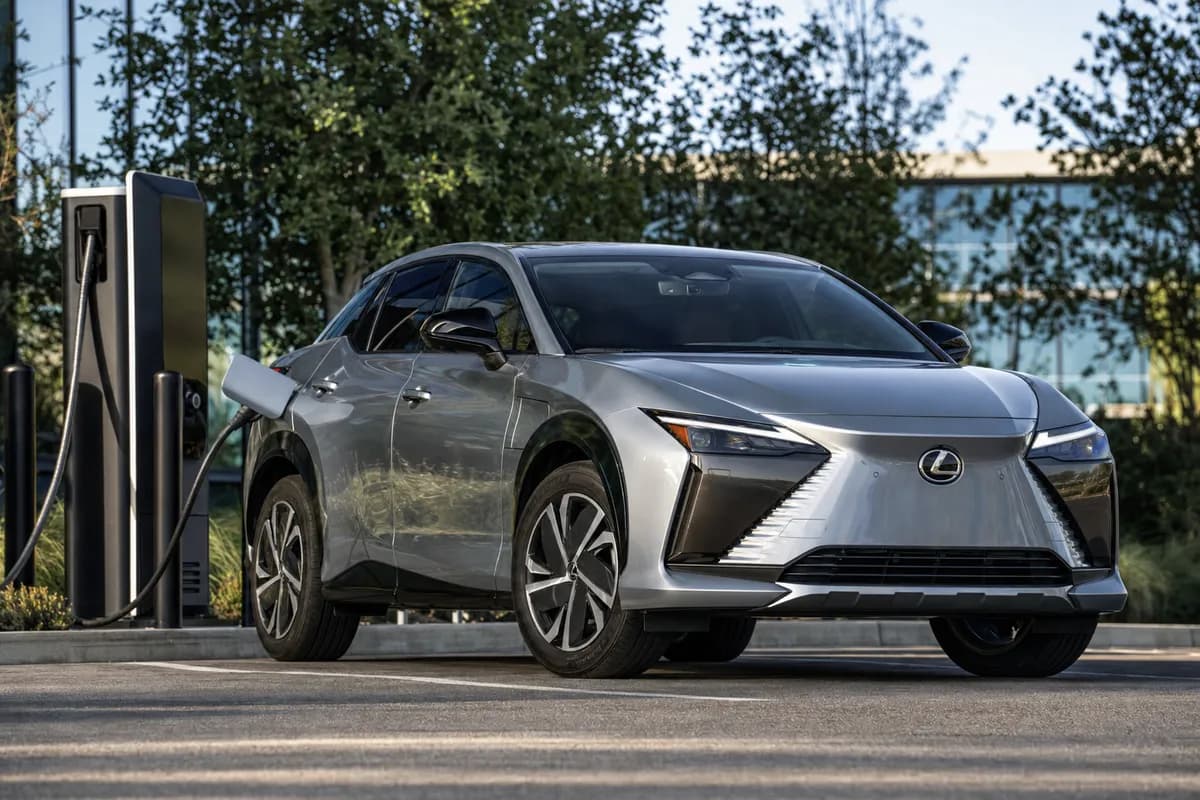
On the Toyota side, the Toyota bZ charging update includes adoption of a NACS charge port and improved DC fast-charging capability. Toyota has said the 2026 bZ will support DC fast-charging speeds up to 150 kW. That figure does not vault the vehicle to the front of the segment on paper, but it is an important step because real usability depends on more than just a peak number. Charger availability, battery preconditioning, charging-curve stability, and network compatibility all matter. Access to a broader and generally more dependable charging network can often make a 150-kW EV easier to road-trip than a theoretically faster vehicle with limited charger options.
Lexus is making a similar move with the RZ. The updated crossover gains NACS compatibility and improved charging performance, with faster DC charging and route-planning features meant to better support longer trips. For a luxury EV, that is especially important. Buyers in this class are less interested in charging workarounds and more interested in a seamless ownership experience.
The latest Lexus RZ fast charging improvements should therefore be read as a competitiveness upgrade, not just a technical tweak. Premium EV rivals from Tesla, BMW, Mercedes-Benz, Audi, and Genesis all increasingly treat charging convenience as part of the product itself. Lexus needed to respond.
Here is what these 2026 changes mean in practical terms:
- Wider charging access: NACS hardware gives drivers access to Tesla Superchargers in addition to existing charging options, depending on network and vehicle integration.
- Less trip planning friction: More high-quality fast-charging locations reduce the need to route around unreliable stations.
- Better resale and future-proofing: A native NACS port makes 2026 models more aligned with the direction of the North American market.
- Improved usability for apartment dwellers and road-trippers: Buyers who cannot rely mainly on home charging stand to benefit the most.
It is also worth noting what this announcement does not do. A 150-kW charge rate is solid, but it is still below the peak figures claimed by some Hyundai, Kia, Porsche, and GM Ultium-based EVs. Toyota and Lexus are not rewriting the DC fast-charging leaderboard here. Instead, they are fixing one of the more visible weaknesses in their EV ownership proposition: dependable access.
Why NACS matters more than another spec-sheet number
The move to NACS Toyota Lexus hardware is arguably the most important part of this story because it changes the charging equation in a way buyers can feel immediately. Over the past two years, NACS has gone from Tesla-exclusive connector to the de facto charging standard for much of the North American auto industry. Ford, GM, Rivian, Volvo, Polestar, Mercedes-Benz, Nissan, Honda, and others have either committed to adoption or already started integrating access. Toyota and Lexus joining that shift was expected. Now it is becoming product reality.
For consumers, the significance is straightforward. Charging anxiety is no longer just about range anxiety. Many EVs can now travel 250 to 350 miles on a full charge. The more persistent concern is whether the next charger will be open, functioning, and easy to activate. Tesla’s network still has the strongest reputation on those points.
That means the Toyota and Lexus switch to NACS should have a bigger real-world effect than a modest battery-capacity bump or an extra 10 miles of rated range. A buyer comparing a Toyota bZ against similarly sized electric crossovers may care less about a narrow difference in EPA range and more about whether weekend trips, holiday travel, and intercity drives feel manageable.
There is also a strategic angle. Adopting NACS lets Toyota and Lexus reduce one of the barriers that may have kept mainstream buyers from considering their EVs. Toyota remains one of the most powerful brands in the industry, with enormous customer loyalty and strong dealer reach. If its electric products become easier to charge publicly, they become easier to recommend to the large group of buyers who are EV-curious but still skeptical of infrastructure.
In 2026, charging compatibility may matter more to many buyers than raw charging speed. A slightly slower EV with broad, reliable fast-charger access is often the more useful vehicle.
That is the context in which these updates should be judged. Toyota and Lexus are not simply following a connector trend. They are adapting to the reality that charging standards now shape EV competitiveness in the same way fuel economy and serviceability once shaped the internal-combustion market.
How the 2026 charging upgrades set up Toyota’s 2027 EV roadmap
The bigger significance of these 2026 changes is that they appear to be groundwork for the company’s next generation of electric vehicles. The 2027 Toyota EV roadmap is expected to bring a broader lineup, more advanced battery strategies, and a more mature software-and-charging ecosystem. If Toyota wants those future models to land successfully, the charging experience has to be sorted out now.
Toyota has already signaled a more expansive long-term battery-electric plan, including next-generation EV architectures and a wider spread of models across Toyota and Lexus. While the company has continued investing heavily in hybrids and plug-in hybrids, it has also acknowledged the need for a stronger pure-EV offering in major global markets. That means future electric vehicles cannot arrive with charging compromises that feel dated at launch.
Seen in that light, the 2026 bZ and RZ updates serve several purposes:
- They normalize NACS within Toyota and Lexus EV ownership. By 2027, buyers should expect native compatibility, not adapter-based workarounds.
- They help dealers and customers transition to a simpler public-charging message. Charging confusion remains a sales obstacle, and standardization helps.
- They create a baseline for future EV launches. Any new Toyota or Lexus EV arriving in 2027 will be judged partly by how well it charges and where it can charge.
- They position Toyota to scale EV volume more credibly. Broader charging access supports higher sales ambitions.
This is particularly important because Toyota’s future EV strategy will likely be evaluated differently than that of a startup or niche luxury brand. Consumers expect Toyota products to be rational, dependable, and easy to own. If the company wants to bring that reputation into the EV era, infrastructure compatibility has to be part of the promise.
There is another reason the 2027 timeline matters. The EV market is moving into a more demanding phase. Early adopters were often willing to tolerate charging quirks, app fragmentation, or inconsistent routes. Mainstream buyers are less forgiving. By 2027, the competitive set will be even stronger, and buyers will expect not just acceptable charging, but confidence-inspiring charging. Toyota’s 2026 updates look like a bridge to that expectation.
What real buyers should take away before choosing a bZ or RZ
For shoppers, the practical takeaway is clear: if charging convenience is high on your priority list, the 2026 Toyota bZ and Lexus RZ should be more compelling than the versions that came before them. That does not automatically make them class leaders, but it does make them easier to consider seriously.
Buyers should think about these upgrades through their own use case:
- If you charge mostly at home: The NACS shift may matter less on a daily basis, but it improves flexibility for occasional road trips and future network compatibility.
- If you live in an apartment or rely on public charging: This update is much more significant. Expanded fast-charger access can directly affect convenience and ownership stress.
- If you road-trip frequently: Native access to Tesla’s network could be one of the most important reasons to choose a 2026 model over an earlier one.
- If you are cross-shopping luxury EVs: The Lexus RZ becomes more viable, though buyers should still compare charging speeds, route-planning software, range, and pricing against rivals.
Timing also matters. Buyers considering a current model may want to weigh the benefits of waiting for the 2026 updates, particularly if they expect to use DC fast chargers regularly. The charging hardware change is not a minor trim difference; it affects how and where the vehicle fits into the broader North American charging landscape.
At the same time, shoppers should stay realistic. A NACS port and improved charging speeds do not erase every competitive disadvantage overnight. Toyota and Lexus still need strong route planning, robust battery thermal management, clear charging-state communication, and compelling overall value. Charging access is foundational, but it is not the entire product.
Verdict: a necessary upgrade that makes Toyota and Lexus EVs easier to recommend
The 2026 charging upgrades for Toyota and Lexus are best understood as a practical correction rather than a flashy breakthrough. The refreshed Toyota bZ and Lexus RZ do not suddenly redefine EV performance or charging speed, but they address a core weakness that mattered to buyers. Better DC fast charging and native NACS Toyota Lexus compatibility should make these vehicles more usable, more future-proof, and more competitive where it counts: on actual roads, using actual charging networks.
That is why this news matters. The Toyota EV charging 2026 improvements are not just about specs; they are about reducing friction for owners. The Toyota bZ charging update makes the model a more credible choice for mainstream EV shoppers. The improved Lexus RZ fast charging story brings the luxury crossover closer to what premium buyers now expect. And taken together, these moves suggest Toyota is finally putting the ownership fundamentals in place for its next generation of battery-electric products.
If the company follows through, the 2027 Toyota EV roadmap could arrive with fewer compromises and a much stronger case to real-world buyers. In the EV market, that may matter more than any headline-grabbing promise.
Affiliate disclosure: This article contains affiliate links. RevvedUpCars may earn a small commission on qualifying purchases at no extra cost to you.