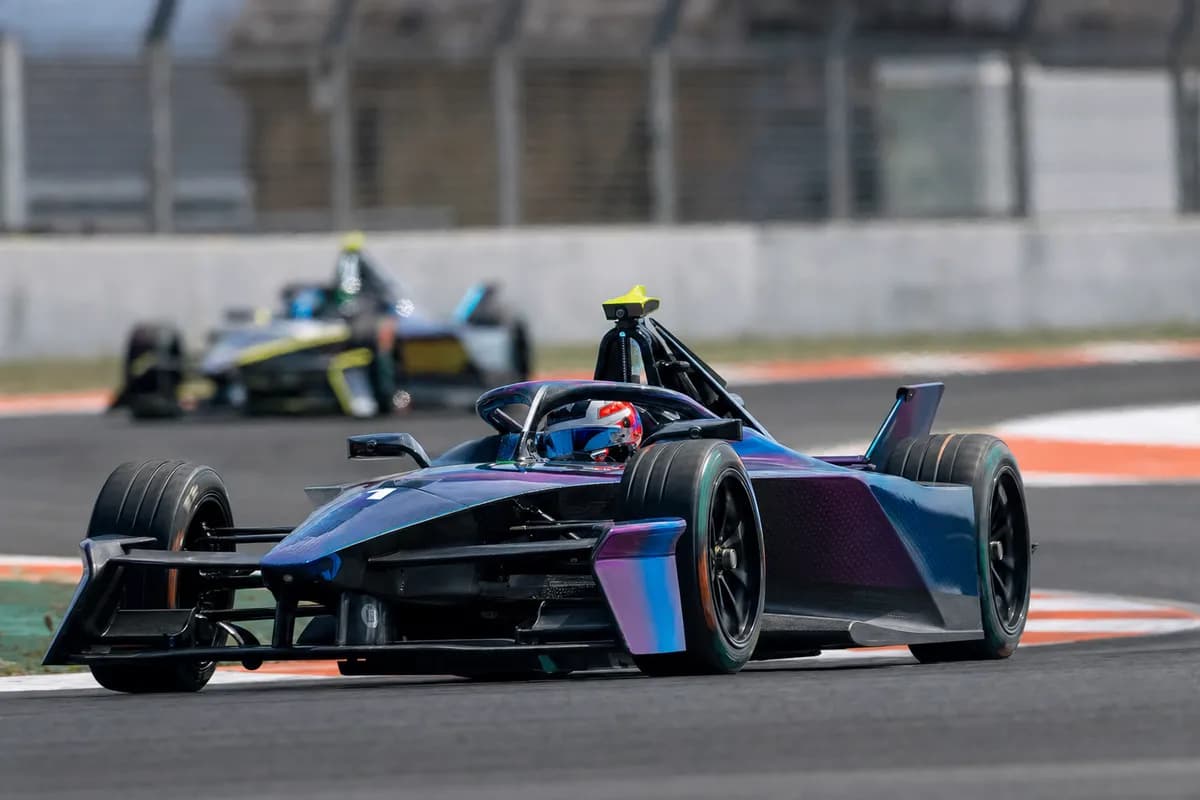
Formula E’s 2024 season is less about a clean-sheet reset and more about a sharper second year for the Gen3 rules. The cars are still the fastest, lightest and most energy-sensitive machines the championship has used, but the competitive picture has shifted: Jaguar has stacked…
ERT’s 2024 driver pairing of Dan Ticktum and Sergio Sette Camara gives the team continuity, which matters in a series where race execution and energy strategy can be as important as outright pace. The challenge is clear: the ERT X24 package has to find efficiency and reliability against better-funded rivals with stronger simulation tools and established customer-team data loops.
ABT CUPRA continues into 2024 with Mahindra powertrains after a difficult return season in 2023. Lucas di Grassi remains the team’s anchor, joined by Nico Müller. ABT’s issue is not race craft; it is extracting enough performance from the Mahindra M9Electro package to compete consistently beyond the midfield. For CUPRA, the programme also remains a useful electric-performance marketing link as the road-car brand expands its EV range in Europe.
Maserati MSG Racing is another team worth watching, not because it is new to the grid, but because 2024 is the second season of Maserati’s Formula E identity and the first with rookie Jehan Daruvala alongside Maximilian Günther. The Maserati Tipo Folgore is based on DS/Stellantis technology, and Günther proved in 2023 that the package can win on the right weekend. The question is whether MSG can deliver that pace more regularly.
The sharpest competitive move is at Jaguar TCS Racing. The factory team pairs Mitch Evans with Nick Cassidy, who moved across from Envision after finishing second in the 2023 drivers’ standings. That gives Jaguar arguably the strongest line-up on the grid. It also increases the pressure: Jaguar had the pace to win the 2023 teams’ title through customer outfit Envision Racing, but the factory squad now needs to convert its I-TYPE 6 performance into both championships.
Teams to Watch: Jaguar, Porsche, Nissan and the Independents
The 2024 title fight is expected to revolve around the most efficient Gen3 powertrains and the teams best able to manage race energy. Formula E is not a flat-out sprint. Drivers are constantly trading track position, lift-and-coasting, managing battery temperature and using attack mode at precisely timed moments. The strongest cars are not simply the fastest over one lap; they are the most efficient over a full race distance.
Jaguar TCS Racing and Envision Racing
Jaguar enters 2024 with two routes to victory: its factory team and customer outfit Envision Racing. Envision won the 2023 teams’ championship using Jaguar hardware, while Cassidy and Evans were both race winners. For 2024, Envision fields Sébastien Buemi and Robin Frijns, a highly experienced pairing that should keep the team competitive even after Cassidy’s departure.
The Jaguar I-TYPE 6 has been one of the most efficient Gen3 cars, particularly in races where energy saving creates peloton-style running. That style has sometimes frustrated fans because drivers avoid leading too early, but it rewards teams with accurate models and disciplined drivers. Jaguar’s task is to keep its efficiency edge while improving qualifying consistency.
TAG Heuer Porsche and Andretti
TAG Heuer Porsche remains a benchmark. The Porsche 99X Electric Gen3 delivered the 2023 drivers’ title with Jake Dennis, who races for customer team Andretti, while the factory squad fields Pascal Wehrlein and António Félix da Costa. Porsche’s strength has been traction, race efficiency and strong energy deployment out of slower corners, which is particularly valuable on Formula E’s stop-start street circuits.
Andretti’s role is important. With Dennis, the team showed that a customer outfit can beat factory programmes if it executes cleanly. That is part of Formula E’s appeal: while manufacturers supply the core hardware, software understanding and strategy can still swing a race. In 2024, Dennis carries the target of being reigning champion, and Porsche’s rivals have had a full off-season to analyse where the 99X package was strongest.
Nissan and NEOM McLaren
Nissan Formula E Team enters 2024 with Sacha Fenestraz and returning race winner Oliver Rowland. Its customer team, NEOM McLaren, fields Jake Hughes and Sam Bird. Nissan’s Gen3 car showed flashes of strong one-lap pace in 2023, and Hughes in particular demonstrated that McLaren could be a qualifying threat. The next step is converting grid position into race results.
That is harder than it sounds. Formula E’s current race pattern often punishes early leaders, because running in clean air can use more energy than sitting in the pack. Nissan’s 2024 priority is therefore race efficiency and energy prediction. If it has improved there, both the factory team and McLaren should be more regular podium contenders.
Mahindra, ABT CUPRA and ERT
Mahindra Racing starts 2024 with a refreshed driver line-up: Nyck de Vries, the Season 7 Formula E champion, and Edoardo Mortara, one of the series’ most effective street-circuit racers. That is a serious reset after a difficult 2023. Mahindra also supplies ABT CUPRA, so any step forward in the M9Electro powertrain would benefit two teams.
ERT is the outlier. Its budget and technical base are smaller, but Formula E’s cost cap and spec chassis mean the gap is not as wide as in many top-level series. A realistic 2024 target for ERT is regular points rather than wins. Even so, its presence matters: Formula E needs independent technical stories as the grid becomes more consolidated around major automotive groups.
The Gen3 Car: What Makes 2024 Different
The 2024 season is the second full year of Formula E’s Gen3 platform, introduced for Season 9. The car is built around a common Spark Racing Technology chassis, a battery supplied by Williams Advanced Engineering, Hankook all-weather tyres and team-developed rear powertrains. The numbers remain significant.
- Maximum power: 350 kW, equal to about 469 hp, in qualifying and attack mode conditions.
- Race power: typically 300 kW, or about 402 hp, depending on format and event rules.
- Top speed: around 200 mph, or 322 km/h, making Gen3 the fastest Formula E car to date.
- Regeneration capacity: up to 600 kW, split between a 250 kW front motor-generator unit and a 350 kW rear unit.
- Energy recovery: roughly 40 percent of the energy used in a race can come from regenerative braking.
- Weight: around 840 kg including the driver, lighter than the previous Gen2 car.
The most important engineering feature is the front motor-generator unit. It is not used to drive the front wheels in the current Gen3 race configuration, but it can recover energy under braking. Combined with the rear unit, the car can regenerate far more aggressively than previous Formula E machines. This is why the Gen3 car does not use conventional rear hydraulic brakes in normal configuration.
That braking system changes how drivers race. Regeneration is not just a way to save energy; it is a stability and balance tool. Teams have to calibrate braking maps, rear motor response and front regeneration carefully so the driver can attack without locking or overheating the system. On bumpy street circuits, that is a major challenge.
The Hankook iON race tyre is another defining feature. Formula E uses a grooved, all-weather tyre rather than separate slicks and wets. That reduces freight, tyre usage and waste, but it also creates a narrower performance window than a conventional slick. Grip management is crucial, particularly at tracks with low surface evolution or cooler temperatures.
Compared with Formula 1, Formula E is slower in absolute lap time because the cars have less downforce, narrower tyres and far less total energy available. But the comparison misses the point. Formula E’s technical contest is about efficiency under constraint: how much lap time a team can extract while using the least energy, recovering the most under braking and keeping the battery within its temperature limits.
Tech Innovations to Watch in 2024
Formula E’s biggest technology changes in 2024 are not all visible from the grandstand. Some are software-led, some relate to race format, and some are already aimed at the next step of the Gen3 cycle.
Smarter Energy Management
The most important development area is energy management software. Formula E teams build detailed models that predict energy use based on pace, traffic, temperature, safety cars and attack mode timing. During a race, engineers constantly update those models while drivers manage lift points and regeneration targets.
This is where the championship has direct relevance to road EVs. A Formula E car is not a showroom EV, but the principles are familiar: efficient inverters, battery temperature control, regenerative braking calibration and predictive energy use. The best teams are those that can make the car fast without wasting energy. That is exactly the problem automakers face when trying to increase real-world EV range without simply adding battery mass.
Attack Mode and the Search for Better Racing
Attack mode remains Formula E’s main sporting tool. Drivers must leave the racing line to activate a temporary power boost, creating a strategic trade-off between track position and extra output. In theory, it adds overtaking. In practice, its impact varies by circuit. On some layouts it works well; on others, the energy-saving pack dynamic dominates.
The long-awaited fast-charging race feature, originally discussed as “Attack Charge,” has not become a regular part of the 2024 race format. The concept is simple: a mandatory high-power pit stop would add energy during the race and unlock a more powerful attack mode phase. The technical ambition is substantial, with charging power discussed at levels far beyond today’s typical public DC fast chargers. The challenge is reliability, safety and sporting clarity. Formula E cannot afford a feature that creates confusion or decides races through hardware variance.
Gen3 Evo on the Horizon
The next major step is Gen3 Evo, revealed in 2024 for the following phase of competition. It is not a completely new car, but it is a meaningful upgrade. The headline feature is temporary all-wheel drive, using the front motor for propulsion in defined situations such as race starts, qualifying duels and attack mode. Formula E says the Gen3 Evo can accelerate from 0-60 mph in about 1.82 seconds, an eye-catching figure even if it applies only under specific conditions.
More important than the headline acceleration claim is what all-wheel-drive deployment means for control software. Teams will have to manage torque distribution, grip, energy use and tyre temperature more precisely. For manufacturers, that work aligns closely with high-performance electric road cars, where dual- and tri-motor layouts are increasingly common.
The Gen3 Evo package also brings revised bodywork and updated Hankook tyres, with Formula E targeting a noticeable increase in grip. That matters because the current Gen3 car can look nervous on low-grip street surfaces. More mechanical grip should help drivers race harder and reduce the sliding that can make energy management even more delicate.
Sustainability Under Scrutiny
Formula E continues to market itself around sustainability, but the more important question is whether it can keep reducing the footprint of a global championship. The series uses a single all-weather tyre to cut tyre volumes, limits freight where possible and runs shorter event formats than many international racing series. The Gen3 battery is designed around both performance and end-of-life management, while the Hankook tyre includes bio-based and recycled materials.
That does not make international motorsport carbon-free. Flying teams, cars and equipment around the world still has an environmental cost. The credible argument for Formula E is not that racing is impact-free; it is that the championship provides a competitive laboratory for EV efficiency while putting electric mobility in front of urban audiences. In 2024, that argument needs to be made with data, not slogans.
Calendar Changes Add New Variables
The 2024 calendar gives teams a mix of familiar street circuits and important new tests. The season opened in Mexico City, one of Formula E’s best venues because the Autódromo Hermanos Rodríguez layout offers a more conventional racing surface and a stadium atmosphere. Diriyah, São Paulo, Monaco, Berlin, Portland and London remain key fixtures.
The major addition is Tokyo, Formula E’s first race in Japan. That is strategically important. Japan is home to Nissan, one of the championship’s central manufacturers, and remains a major global car market with a complicated EV transition. A strong Tokyo event gives Formula E a foothold in a country where hybrids have historically dominated the electrification conversation.
Shanghai also returns China to the Formula E calendar, using the Shanghai International Circuit venue rather than a tight downtown course. That matters commercially because China is the world’s largest EV market and the most aggressive battleground for battery-electric technology. For a championship built around electric mobility, visibility in China is essential.
Misano replaces Rome after concerns about the suitability of the Rome street circuit for the faster Gen3 cars. That change reflects a broader issue: Formula E’s cars are now quick enough that not every tight street layout works. The championship has to balance its urban-racing identity with circuits that allow safe, credible racing for a 350 kW electric car.
Verdict: 2024 Is a Proving Year for Formula E
Formula E 2024 is not defined by a wave of new entrants. It is defined by consolidation. The Gen3 car is entering its mature phase, the strongest manufacturers are better understood, and the competitive margins are tightening. Jaguar and Porsche look like the reference points, Nissan has the ingredients to move forward, Mahindra needs its reset to work, and ERT gives the grid an independent technical storyline worth following.
The technology picture is similarly evolutionary. The current Gen3 car already delivers the series’ core message: high power, aggressive regeneration and intense energy management in a compact race format. The next step, Gen3 Evo, should make the cars quicker and more relevant to the multi-motor EVs now reaching the road.
The risk for Formula E is that efficiency-led racing can become too tactical, with drivers reluctant to lead and fans left waiting for the race to ignite. The opportunity is that no other major championship is built so directly around the engineering problems that define modern electric cars: range, regeneration, software, charging and thermal management.
For 2024, the teams to watch are Jaguar, Porsche, Nissan and the rebranded ERT operation. The technologies to watch are energy software, braking regeneration, race-format charging and the transition to Gen3 Evo. If Formula E can turn those ingredients into clearer, harder racing, Season 10 will be more than a bridge year. It will be the season that proves the Gen3 era has substance beyond its headline numbers.
Affiliate disclosure: This article contains affiliate links. RevvedUpCars may earn a small commission on qualifying purchases at no extra cost to you.