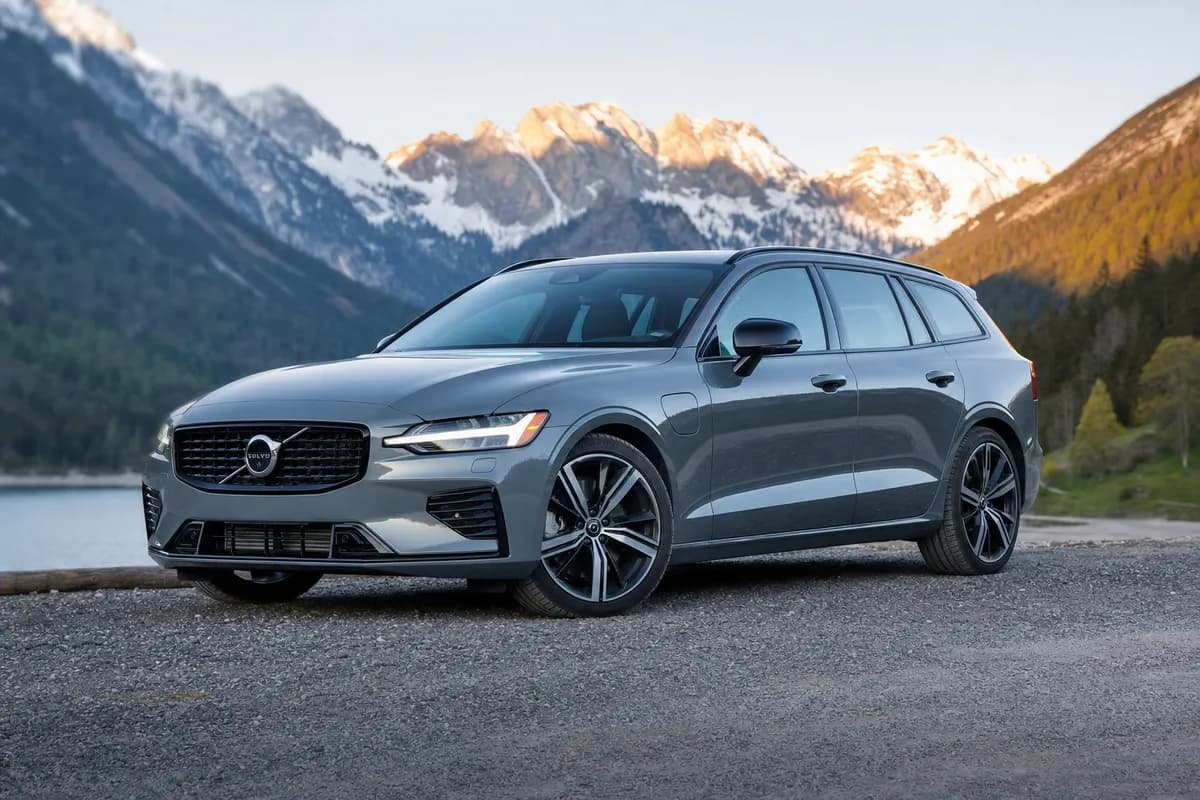
The 2024 Volvo V60 Recharge is what happens when sensible shoes discover anabolic steroids. It’s a plug-in hybrid wagon with 41 miles of EPA electric range, 455 horsepower, all-wheel drive, Brembo brakes, Öhlins dampers, and enough cargo space to shame most “lifestyle”…
The 2024 Volvo V60 Recharge is what happens when sensible shoes discover anabolic steroids. It’s a plug-in hybrid wagon with 41 miles of EPA electric range, 455 horsepower, all-wheel drive, Brembo brakes, Öhlins dampers, and enough cargo space to shame most “lifestyle” crossovers. After living with it as a real car rather than worshipping it as an endangered species, the truth is clear: this is one of the best enthusiast family cars on sale, but it asks you to tolerate some very Swedish stubbornness along the way.
The Setup: A Wagon With a Very Big Hammer
The 2024 Volvo V60 Recharge comes to the U.S. in one gloriously unambiguous form: T8 eAWD Polestar Engineered. That means a turbocharged 2.0-liter four-cylinder driving the front wheels, an electric motor driving the rear axle, and a lithium-ion battery large enough to make the car genuinely useful as an EV for daily driving. Total output is 455 horsepower and 523 lb-ft of torque. In a Volvo wagon. Yes, your neighborhood HOA may need a moment.
Volvo claims a 0-60 mph time of about 4.3 seconds, and independent testing has put it in that same neighborhood, with some runs dipping closer to 4.1 seconds. That makes it quicker than an Audi A4 allroad by a geological era, quicker than many sport sedans, and not wildly far off the pace of heavier performance SUVs wearing much sillier badges. It is also rated at 41 miles of electric range and 74 MPGe by the EPA, with gas-only economy around 31 mpg combined.
The as-tested financial reality is less cuddly. The V60 Recharge Polestar Engineered starts around the low-$70,000 range before options and fees. That is serious money for a compact-ish wagon, especially when the regular V60 Cross Country B5 starts roughly $20,000 lower. But the Cross Country has 247 horsepower, no plug, and the dynamic personality of a warm cup of chamomile. The Recharge is the one you buy because you still believe cars should make errands feel like a getaway drive.
- Powertrain: 2.0-liter turbo four-cylinder plus rear electric motor
- Total output: 455 hp and 523 lb-ft
- Drivetrain: Electric all-wheel drive
- EPA electric range: 41 miles
- EPA gas economy: 31 mpg combined
- Cargo space: 22.9 cu ft behind rear seats, 60.5 cu ft with seats folded
- Charging: Level 2 charging in about five hours; no DC fast charging
Living Electric: The Plug-In Bit Actually Works
Many plug-in hybrids are compliance cars with a charging port glued on like a guilty afterthought. The V60 Recharge is not one of them. The battery is big enough that the car can cover a normal commute, school run, grocery loop, and gym detour without waking the engine. If you have home charging, this Volvo can behave like an EV during the week and a fast gasoline wagon on the weekend. That is the whole point of a plug-in hybrid, and it’s astonishing how many brands still manage to miss it.
In urban and suburban use, the electric motor is smooth, quiet, and strong enough to keep up with traffic without demanding internal-combustion backup. The car defaults to Hybrid mode and does a decent job deciding when to use electrons and when to burn fuel. Select Pure mode, and it leans heavily into EV operation. Push too hard, or ask for serious acceleration, and the gas engine joins in. Unlike earlier Volvo T8 setups, this latest-generation system feels less like two drivetrains negotiating a custody agreement and more like one properly integrated unit.
There are limitations. The onboard charger is not quick by modern EV standards. On a 240-volt Level 2 charger, expect a full refill in roughly five hours. On a household outlet, prepare to measure time with a sundial. There is also no DC fast-charging capability, but that is normal for a plug-in hybrid and not a meaningful problem unless you enjoy making poor planning choices in public.
The bigger issue is that Volvo’s interface can make simple energy management feel more fussy than it should. The Google-based infotainment system is clean and generally smart, but key hybrid functions are buried deeper than ideal, and Volvo’s touchscreen-heavy approach still asks you to poke glass for tasks that should be handled by proper physical controls. The Swedes have mastered ergonomic seats, safety structures, and tasteful wood trim, then apparently decided climate shortcuts were a moral weakness.
Still, the payoff is superb. Used properly, the V60 Recharge can return absurd real-world efficiency for something this quick. Short trips are nearly silent and fuel-free. Long trips deliver conventional hybrid economy once the battery is depleted. And unlike a full EV, you can drive 500 miles in a day without planning your life around chargers behind discount furniture stores.
Performance: Fast, Heavy, and Better Than It Has Any Right to Be
Press the accelerator hard and the V60 Recharge stops being a wellness product. The combined shove from the electric motor and turbo four is immediate, thick, and faintly ridiculous. The rear motor fills in torque instantly, the gas engine piles on power, and the eight-speed automatic mostly keeps its composure. This is not a high-revving sports car powertrain; it is a torque trebuchet. It launches the wagon forward with the kind of calm violence that makes passengers stop mid-sentence.
The Polestar Engineered hardware matters. You get Öhlins dual-flow-valve dampers, a front strut brace, gold-painted Brembo brakes, and performance-oriented tuning that gives the V60 a sharper edge than the standard Volvo catalog would suggest. The steering is accurate rather than chatty, and the car resists roll well for something that weighs around two and a quarter tons depending on configuration. The battery and hybrid equipment add mass, and you feel it under hard braking and quick direction changes, but the chassis is impressively disciplined.
The V60 Recharge is not an M3 Touring substitute. First, because BMW refuses to sell the M3 Touring in the U.S., presumably to protect Americans from joy. Second, because the Volvo’s mission is different. It is fast, sure-footed, and surprisingly composed, but it does not beg to be driven by the scruff of the neck. The brake pedal can feel slightly inconsistent as it blends regenerative and friction braking, and the all-wheel-drive system prioritizes clean traction over lurid theatrics.
Compared with an Audi A4 allroad, the Volvo is in another performance class entirely. The Audi’s 261-hp turbo four is polished, but it feels underarmed next to the V60’s 455-hp hybrid wallop. The Mercedes-Benz E 450 All-Terrain is larger, smoother, and more luxurious, with a silky inline-six making 375 hp, but it costs similar money once equipped and lacks the Volvo’s plug-in electric usefulness. The Subaru Outback Touring XT is vastly cheaper and genuinely practical, but comparing its 260-hp turbo flat-four to the V60 Recharge is like comparing trail mix to espresso.
The Volvo’s adjustable Öhlins dampers are both a blessing and a mild prank. They are mechanically adjustable, which is wonderful if you enjoy crawling around the car like a race engineer and less wonderful if you expected adaptive dampers to be, you know, adaptive. Set correctly, the ride-and-handling balance is excellent: firm, tied down, controlled, and never sloppy. Set too stiffly, the V60 can get busy over broken pavement, especially on its low-profile performance tires. This is the cost of putting gold brake calipers on your Scandinavian school-run machine.
Cabin, Practicality, and the Anti-SUV Argument
The cabin is classic modern Volvo: minimalist, calm, beautifully assembled, and allergic to vulgarity. The seats are outstanding, especially over long distances. Volvo has been making some of the best chairs in the business for decades, and the V60 continues that tradition. The driving position is low and natural, visibility is strong, and the wagon body gives you the practical benefits of a crossover without the handling penalties of sitting on a bar stool.
Cargo space measures 22.9 cubic feet behind the rear seats and 60.5 cubic feet with them folded. That is not three-row SUV territory, obviously, but it is plenty for dogs, strollers, skis, camera gear, flat-pack furniture, and the accumulated nonsense of family life. The load floor is low, the opening is usefully shaped, and the roofline is long enough to make the space genuinely usable rather than merely impressive in a brochure.
This is where the V60 makes crossovers look faintly silly. A Volvo XC60 Recharge gives you a higher seating position and a bit more cargo flexibility, but it cannot match the V60’s low-slung poise. The wagon is easier to load, nicer to drive quickly, and more elegant in a way that SUVs rarely manage. If you need maximum rear-seat height or regularly haul bulky cargo, fine, buy the crossover. If you want a car that works for family life without surrendering to crossover beige-ification, the V60 is the sharper choice.
The infotainment system is a mixed bag. Google Maps integration is excellent, voice commands are generally useful, and the digital instrument display is crisp. But Volvo’s insistence on routing too many basic functions through the central screen remains irritating. The lack of traditional buttons for common climate and drive-mode adjustments feels less like Scandinavian simplicity and more like cost-cutting wearing a turtleneck.
Build quality, however, is strong. The materials feel expensive without shouting. The cabin stays quiet in EV mode and remains refined when the gas engine fires. At highway speeds, wind and tire noise are well controlled, although the performance rubber can add some texture on coarse pavement. Long-distance comfort is a major strength, and the V60’s relaxed cruising demeanor makes its explosive passing power even more satisfying. It’s a velvet glove with a taser hidden in the palm.
Long-Term Gripes: Brilliant, But Not Effortless
A few thousand miles with a car always reveal the difference between charm and annoyance. The V60 Recharge has both.
The good stuff stays good. The seats remain magnificent. The EV range continues to be useful. The acceleration never gets old. The wagon body proves its worth every time you slide in luggage without lifting it to chest height. The understated design ages beautifully, too. In a parking lot full of angry-mouth SUVs, the V60 looks like it has a library card and a black belt.
But the frustrations persist. The brake feel can still be odd at low speeds. The touchscreen dependence still annoys. The gas engine, while powerful, does not sound especially inspiring when worked hard. It’s effective rather than emotional, a high-output appliance doing its job with Scandinavian punctuality. The car’s weight is also impossible to ignore when the road gets tight and lumpy. Physics may be boring, but it is undefeated.
There is also the matter of price and complexity. Plug-in hybrids are mechanically complicated machines: combustion engine, turbocharging, battery pack, electric rear drive unit, power electronics, regenerative braking, and all the software required to make the symphony play in tune. Volvo’s warranty coverage and dealer network help, but buyers planning to own one far beyond the warranty should go in with eyes open. This is not a 1990s brick wagon you fix with a socket set and stern language.
Maintenance costs will also likely exceed those of a conventional family wagon, partly because this is a premium performance model wearing specialized components. Tires will not be cheap. Brake hardware is serious. The Öhlins dampers are excellent but not budget-bin parts. If your idea of ownership bliss is minimal cost per mile, a hybrid Toyota Camry will look at the V60 Recharge and quietly call it dramatic.
But that misses the point. The V60 Recharge is not trying to be the cheapest way to move a family. It is trying to be one car that can commute electrically, road-trip easily, haul real stuff, embarrass sport sedans, and avoid the SUV herd. On that brief, it lands a clean hit.
Verdict: The Thinking Driver’s Family Weapon
The 2024 Volvo V60 Recharge is expensive, slightly overcomplicated, and occasionally too clever for its own good. It is also fast, efficient, beautiful, practical, and more interesting than nearly every luxury crossover at the same price. If you can charge at home and you still care how a car drives, this is the plug-in hybrid wagon to buy.
The V60 Recharge is not perfect. The brake blending needs polish, the infotainment needs more hard controls, and the manually adjustable dampers feel a bit precious in a daily driver. But none of those flaws erase the central achievement: Volvo has built a 455-hp plug-in hybrid wagon that can run errands without using gas, sprint like a junior super-wagon, and carry a family without making its owner dead behind the eyes.
Against the Audi A4 allroad, the Volvo is vastly quicker and far more electrified. Against the Mercedes E 450 All-Terrain, it is smaller and less plush but more efficient and more mischievous. Against an XC60 Recharge, it is the connoisseur’s pick: lower, sleeker, better to drive, and less resigned to the crossover monoculture.
Would I buy one? If I had home charging, a family to move, and a pulse, absolutely. The V60 Recharge is a rare car that makes sense on a spreadsheet and still makes you take the long way home. In 2024, that combination is almost suspicious. Volvo should be applauded for building it, and mildly scolded for not making more wagons like it.
Affiliate disclosure: This article contains affiliate links. RevvedUpCars may earn a small commission on qualifying purchases at no extra cost to you.