The mid-size truck class used to be a quiet corner of the showroom where sensible people bought sensible pickups and everyone else bought an F-150. Not anymore.
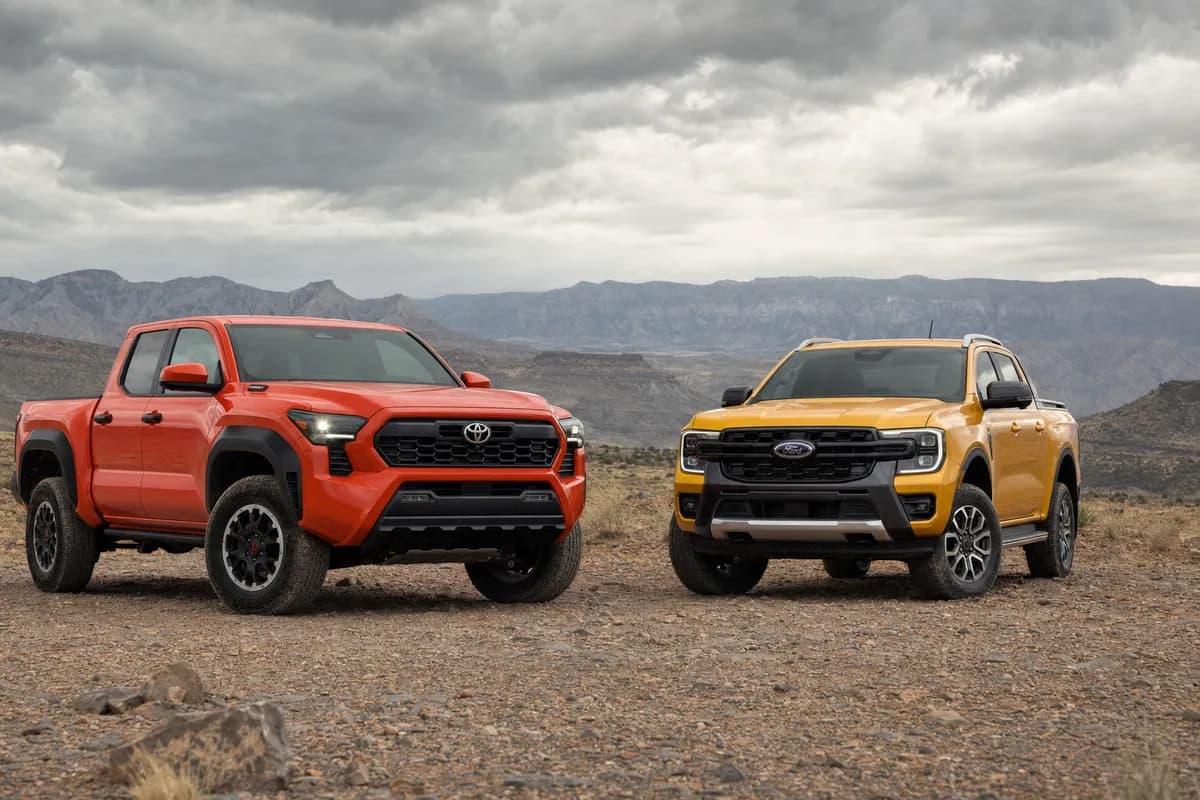
The star Toyota powertrain is the i-FORCE MAX hybrid, pairing the 2.4-liter turbo with an electric motor for 326 hp and a huge 465 lb-ft of torque. That torque number is the headline. It is more than the Ford Ranger Raptor’s 430 lb-ft and makes the Tacoma feel muscular at low speed, especially when climbing, towing, or crawling over ugly terrain. The hybrid is not a Prius-with-a-bed economy special. It is a torque amplifier.
Ford’s base Ranger uses a 2.3-liter EcoBoost turbo-four producing 270 hp and 310 lb-ft, paired with a 10-speed automatic. That engine is already strong enough for most buyers and feels less strained than the numbers suggest. But Ford’s killer move is the optional 2.7-liter EcoBoost V6, rated at 315 hp and 400 lb-ft. It gives the Ranger the kind of smooth, broad shove that Toyota’s non-hybrid Tacoma simply cannot match.
Then there is the Ranger Raptor, which uses a 3.0-liter twin-turbo EcoBoost V6 making 405 hp and 430 lb-ft. Published instrumented testing has put the Ranger Raptor around 5.3 seconds to 60 mph, which is absurd for a mid-size pickup with knobby tires and the aerodynamic profile of a garden shed. The Tacoma hybrid is torquey and satisfying, but the Raptor is the only one here that feels genuinely quick in a way that makes passengers stop mid-sentence.
Verdict on engines: Tacoma wins for hybrid torque and manual-transmission character. Ranger wins for everyday refinement, V6 smoothness, and outright performance. If you want the best single engine in the normal range, take Ford’s 2.7-liter V6. If you want the most interesting powertrain, take Toyota’s hybrid. If you want to embarrass hot hatches between trailheads, Ranger Raptor. Obviously.
Capability: Ford Works Harder, Toyota Gives You More Ways to Play
Truck capability is where marketing departments earn their caffeine. Every brochure shows dirt, dogs, kayaks, and one suspiciously clean mountain bike. The numbers, however, are less sentimental.
The 2025 Ford Ranger can tow up to 7,500 pounds when properly equipped. That is a meaningful advantage over the Tacoma, which tops out around 6,500 pounds in its best towing configuration, with hybrid models generally rated lower depending on trim. Payload also favors the Ranger in many configurations, with maximum payload figures around 1,800 pounds, while the Tacoma peaks around 1,700 pounds. These are not night-and-day differences, but if you tow regularly, the Ford’s advantage matters.
The Ranger also benefits from simpler lineup logic. In the U.S., it is sold as a crew cab with a five-foot bed. That may sound limiting, but it makes shopping easier. You choose XL, XLT, Lariat, or Raptor, then add packages. Done. Ford has clearly decided that most mid-size truck buyers want four doors and a short bed, and frankly, Ford is right.
Toyota gives you more configurations. The Tacoma is available as an XtraCab with a six-foot bed, or as a Double Cab with five- or six-foot bed options depending on trim. That makes it more flexible if you need bed length without jumping into a full-size truck. Toyota also offers more personality through trims: SR, SR5, TRD PreRunner, TRD Sport, TRD Off-Road, Limited, Trailhunter, and TRD Pro. It is less a lineup and more a small civilization.
The Tacoma’s composite bed is a nice touch, resisting dents and corrosion without needing a spray-in liner. Ford’s bed is conventional but well shaped and easy to use. Both offer useful power outlets, tie-downs, bed lighting, and accessory systems. Toyota leans harder into overlanding accessories; Ford leans harder into getting the job done without needing a lifestyle mood board.
- Maximum towing: Ford Ranger up to 7,500 lb; Toyota Tacoma up to about 6,500 lb.
- Maximum payload: Ranger around 1,800 lb; Tacoma around 1,700 lb depending on configuration.
- Cab and bed choice: Tacoma offers more variety; Ranger keeps it simple with crew cab/five-foot bed packaging.
- Transmission choice: Tacoma offers a six-speed manual on select trims; Ranger is automatic-only.
Verdict on utility: Ranger is the better tow-and-haul tool. Tacoma is the more configurable truck. If you are pulling a camper often, buy the Ford. If you want a truck tailored to your exact flavor of weekend nonsense, Toyota has the deeper closet.
Interior and Tech: Ranger Feels Simpler, Tacoma Feels More Modern
The previous-generation Tacoma interior was beloved by people who also enjoy sitting on park benches. The 2025 Tacoma is a massive improvement. The driving position is better, the materials are more convincing, and the cabin finally feels designed for adults rather than action figures. Higher trims get a big 14-inch touchscreen, a 12.3-inch digital gauge cluster, wireless Apple CarPlay and Android Auto, and enough chunky switchgear to make you feel like you are operating equipment rather than selecting a podcast.
Ford’s Ranger interior is cleaner and more straightforward. Standard models use a vertically oriented 10.1-inch touchscreen, while upper trims get a 12-inch display. The interface is quick enough, the cabin storage is smart, and the general layout feels more conventional than the Tacoma’s bolder, more industrial dashboard. That is not an insult. In daily use, boringly logical beats “adventurous” if adventurous means stabbing through menus to find basic settings.
The Tacoma has the stronger visual identity. A TRD Off-Road or Trailhunter cabin feels rugged without becoming cartoonish. The Ranger XLT and Lariat feel more restrained, almost crossover-like, which some buyers will prefer. Ford’s seats are comfortable, but Toyota’s latest Tacoma seats are a big step up, especially in trims with the IsoDynamic Performance Seat setup in the TRD Pro. That system uses shock absorbers built into the seat frame to reduce head toss off-road. It sounds like a gimmick until you hit a rough trail at speed and realize your spine is not filing a formal complaint.
Rear-seat space is acceptable in both, but neither truck will make a Honda Ridgeline nervous for family comfort. The Ranger’s crew cab packaging is straightforward and practical. The Tacoma Double Cab is usable, but the seating position can still feel a little knees-up for taller adults. If your “crew” includes full-size humans on a regular basis, test the back seat before signing anything. Your friends may forgive you. Your children, eventually.
Safety tech is strong across both lineups. Toyota includes Toyota Safety Sense 3.0 with features such as adaptive cruise control, lane departure alert, pre-collision braking, and road sign assist. Ford offers its Co-Pilot360 suite, with availability depending on trim and package. Toyota deserves credit for broad standardization, while Ford’s system is polished and easy to live with.
Verdict on cabins: Tacoma has the more distinctive and adventurous interior. Ranger has the simpler, calmer one. I prefer the Tacoma’s personality, but the Ranger’s ergonomics are harder to fault.
Off-Road Hardware: Tacoma Has the Menu, Ranger Raptor Has the Hammer
This is the spicy bit. Toyota has spent decades making the Tacoma the default answer for people who say “trail-rated” without irony. Ford, meanwhile, looked at the Tacoma’s loyalists and launched the Ranger Raptor like a brick through a dealership window.
The Tacoma lineup offers several genuine off-road trims. The TRD Off-Road is the sensible sweet spot, with an electronically locking rear differential, Bilstein dampers, available front stabilizer-bar disconnect, all-terrain tires, crawl control, and multi-terrain select. It is the one most buyers should get if they actually plan to leave pavement.
The Trailhunter is Toyota’s overlanding special, developed with ARB and fitted with Old Man Emu suspension components, underbody protection, a high-clearance rear bumper, rock rails, and off-road accessories from the factory. It is aimed at buyers who want to bolt on a rooftop tent and call it a personality. Jokes aside, it is impressively complete.
The TRD Pro is the desert-running halo trim, using Fox internal-bypass shocks, 33-inch all-terrain tires, extra armor, and the hybrid powertrain. It has real hardware and real attitude, but it also has a real problem: price. Loaded Tacoma TRD Pro and Trailhunter models can push into the mid-$60,000 range. That is full-size truck money, luxury SUV money, and “maybe I should rethink my hobbies” money.
Ford’s standard Ranger can be equipped with the FX4 Off-Road Package, which adds off-road-tuned shocks, skid plates, an electronic locking rear differential, terrain modes, and trail control. It is solid, but it is not as specialized as Toyota’s TRD Off-Road ecosystem. Ford’s normal Ranger is a capable truck that can go off-road. The Tacoma feels like it was born there and learned taxes later.
Then comes the Ranger Raptor. It gets a widened track, reinforced frame components, 33-inch BFGoodrich all-terrain tires, Fox Live Valve shocks, locking front and rear differentials, serious underbody protection, and that 405-hp twin-turbo V6. This is not just an appearance package with angry decals. It is a factory-built hooligan. On fast dirt, the Ranger Raptor is in another league. It has the power, suspension travel, cooling, and chassis composure to do things a Tacoma TRD Pro can do only while breathing harder and charging more.
But the Raptor also has tradeoffs. Its towing rating drops to around 5,510 pounds, and payload is lower than regular Ranger models. It is wide, thirsty, and not cheap. Still, as an off-road performance truck, it makes the Tacoma TRD Pro look expensive rather than dominant.
Hard truth: The Tacoma TRD Off-Road is the smarter trail truck for most people. The Ranger Raptor is the better high-speed off-road weapon. The Tacoma TRD Pro is cool, but Ford has made it very hard to justify at similar money.
Pricing and Ownership: Toyota Resale vs Ford Value
Pricing moves around with destination charges and packages, but the broad picture is clear. The 2025 Toyota Tacoma starts in the low-$30,000 range for basic SR models and climbs quickly. Mid-level TRD Sport and TRD Off-Road trims land in the 40s when equipped the way most buyers want. Hybrid trims and luxury/off-road halo models can push into the 50s and 60s.
The 2025 Ford Ranger also starts in the low-to-mid $30,000 range, with XLT and Lariat models filling the heart of the market. Add the 2.7-liter V6 and four-wheel drive, and you are comfortably into the 40s. The Ranger Raptor starts in the mid-$50,000 range, which is not pocket change, but next to a loaded Tacoma TRD Pro or Trailhunter, it starts looking like a performance bargain. That sentence would have sounded insane ten years ago, yet here we are.
Toyota’s ace card is resale value. Tacomas historically hold value like gold bars with cupholders, and there is little reason to think the latest generation will collapse on the used market. The brand’s reliability reputation remains a huge emotional and financial advantage, even as the new turbo and hybrid systems are more complex than the old V6.
Ford’s Ranger is likely to depreciate more, but that can cut both ways. If you buy new and keep it briefly, Toyota is safer. If you shop used after a couple of years, the Ranger may be the smarter deal. Ford also deserves credit for offering the 2.7-liter V6, because it gives buyers a strong middle option without forcing them into the Raptor.
Verdict: Ranger Wins the Head, Tacoma Still Grabs the Heart
The 2025 Toyota Tacoma and 2025 Ford Ranger are both vastly better than the trucks they replaced, but they are not trying to win the same way.
The Toyota Tacoma is the enthusiast’s Swiss Army knife. It has more trims, more configurations, a manual transmission, a brilliant torque-rich hybrid, and deeper off-road credibility in the mainstream trims. The TRD Off-Road is the Tacoma to buy: capable, tough-looking, and not yet fully intoxicated by halo-truck pricing. The Trailhunter is excellent if you genuinely overland. The TRD Pro is desirable, but at its price, desire starts arguing with common sense.
The Ford Ranger is the more disciplined truck. It tows more, its available 2.7-liter V6 is excellent, its cabin is easy to use, and its lineup is refreshingly simple. For buyers who want one mid-size pickup to commute, tow, haul, and occasionally hit a trail, the Ranger XLT or Lariat with the 2.7-liter EcoBoost is the best all-around choice here. It is not as romantic as the Tacoma, but neither is a good socket wrench, and you still reach for it first.
And then there is the Ranger Raptor, which is the class troublemaker. If your budget reaches the mid-$50,000 range and you want the most capable high-speed off-road truck in this comparison, the Raptor wins. It is faster, rowdier, and more special than the Tacoma TRD Pro, while often costing less than Toyota’s top trims. That is not a small victory. That is Ford walking into Toyota’s dojo wearing muddy boots.
Final call: Buy the Tacoma TRD Off-Road if you want the best blend of trail ability, resale strength, and Toyota character. Buy the Ranger with the 2.7-liter V6 if you want the better everyday truck. Buy the Ranger Raptor if you want the one that makes you laugh out loud. The mid-size truck battle has intensified, yes. But for the first time in a long time, Toyota is not the automatic answer. Ford has brought a very sharp knife to this fight, and the Tacoma finally has scars to prove it.
Affiliate disclosure: This article contains affiliate links. RevvedUpCars may earn a small commission on qualifying purchases at no extra cost to you.