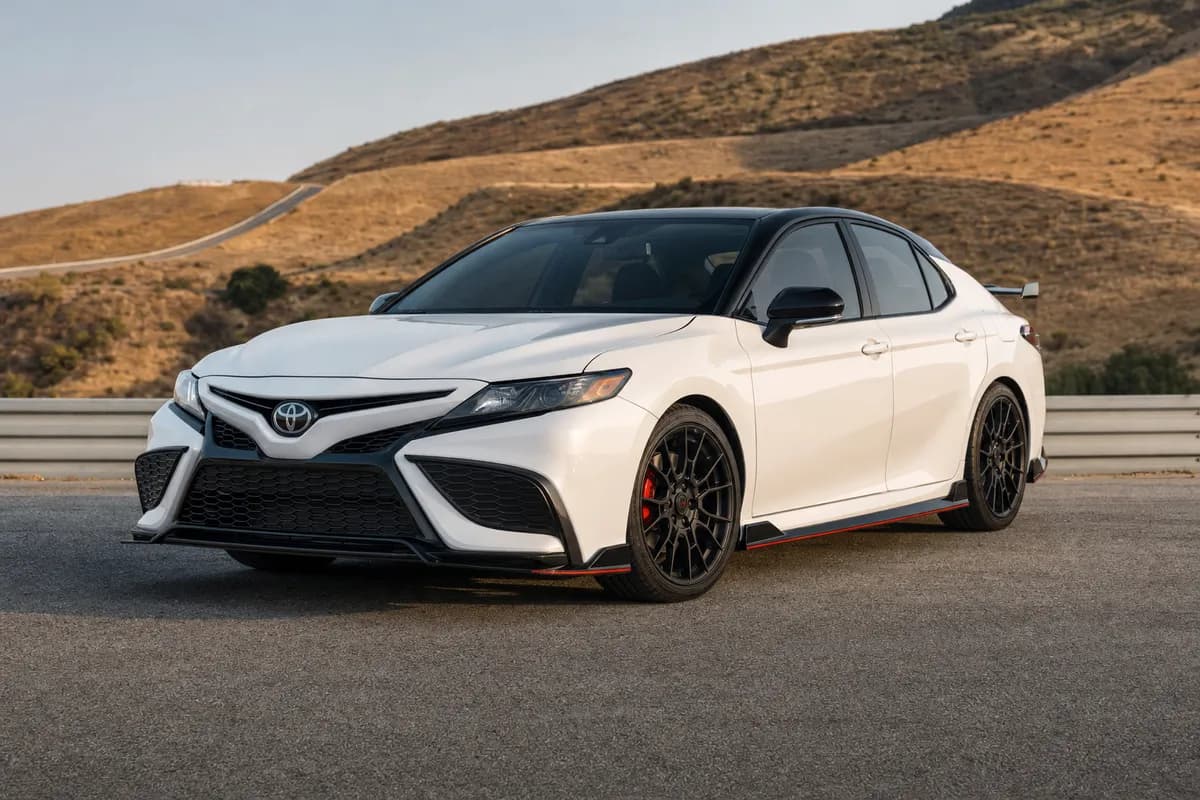
The 2024 Toyota Camry TRD is the family sedan that shows up to school pickup wearing a splitter, a wing, matte-black wheels, and the expression of someone who definitely knows where the good back road is.
The 2024 Toyota Camry TRD is the family sedan that shows up to school pickup wearing a splitter, a wing, matte-black wheels, and the expression of someone who definitely knows where the good back road is. It is not subtle, not especially luxurious, and not pretending to be a rear-drive sports sedan. Good. Subtlety is overrated. What Toyota has built here is a practical, reliable, naturally aspirated V6 sedan with enough chassis tuning to make the Camry badge feel a little less like a spreadsheet and a little more like a dare.
What Makes the 2024 Camry TRD Different?
The Camry TRD sits in a strange and rather brilliant corner of Toyota’s lineup. It is not the most expensive Camry, nor the plushest, nor the most efficient. It is the one tuned by Toyota Racing Development, which means the accountants were forced to leave the room just long enough for someone to bolt on proper hardware.
Under the hood is Toyota’s 3.5-liter naturally aspirated V6, producing 301 horsepower and 267 lb-ft of torque. That power goes to the front wheels through an eight-speed automatic transmission. No turbochargers, no hybrid system, no fake drama. Just a big, smooth V6 doing big, smooth V6 things.
The TRD package is not just a body kit and red seatbelts, although yes, there are red seatbelts, and yes, they are trying very hard. Toyota fits the Camry TRD with unique shocks, stiffer springs, thicker underbody bracing, larger front brakes, a lower ride height, a TRD cat-back exhaust, and 19-inch matte-black wheels. The suspension sits about 0.6 inch lower than a standard Camry, and the body gets a front splitter, side skirts, rear diffuser, and fixed rear wing.
Does the wing provide meaningful downforce on your commute to Costco? Probably not unless your Costco is at the end of the Mulsanne Straight. But it gives the TRD presence, and in a world full of anonymous gray crossovers, presence counts.
- Engine: 3.5-liter naturally aspirated V6
- Output: 301 hp and 267 lb-ft
- Transmission: 8-speed automatic
- Drivetrain: Front-wheel drive
- Fuel economy: 22 mpg city, 31 mpg highway, 25 mpg combined
- Cargo volume: 15.1 cubic feet
- Starting price: roughly $33,000 before options and fees
That price is key. The Camry TRD undercuts many sport sedans while offering real horsepower, Toyota reliability, and enough daily usability to make your responsible side stop hyperventilating.
Performance: Old-School V6 Charm in a Turbocharged World
The V6 is the star here, and it deserves applause. In 2024, naturally aspirated six-cylinder engines in affordable sedans are becoming museum pieces. The Honda Accord has gone hybrid-only for its high-output role. The Mazda6 is gone. Nissan’s Altima is more interested in rental counters than apexes. Meanwhile, the Camry TRD is still out here with six cylinders, a proper intake growl, and a TRD exhaust that gives it a deeper voice without turning every cold start into neighborhood diplomacy.
Acceleration is strong. Independent testing has placed the Camry TRD’s 0-60 mph time around 5.6 seconds, with the quarter-mile in the low-14-second range. That is quick enough to embarrass a lot of supposedly sportier machinery, and it feels especially satisfying because the engine builds power cleanly all the way up the rev range. No lag, no weird torque fill, no waiting for a turbo to find its shoes.
The eight-speed automatic is not a dual-clutch scalpel, but it is competent. In normal driving, it shifts smoothly and keeps the V6 relaxed. Push harder, and it can occasionally hesitate before delivering the right gear, which is where the Hyundai Sonata N Line and Kia K5 GT feel a touch more aggressive. Still, Toyota’s transmission programming is predictable, and predictability matters when you are asking a front-drive sedan to handle 301 horsepower without turning into a smoke machine.
And yes, this is still front-wheel drive. If you launch it like a teenager leaving a Cars & Coffee meet, the Camry TRD will tug at the wheel and remind you that physics has not been canceled. But once moving, traction is decent, and the V6 gives the car a lovely surge of power from midrange to redline.
The TRD chassis upgrades make a bigger difference than skeptics might expect. The steering is not talkative in the way an old BMW 3 Series was talkative, but it is accurate and nicely weighted. Body roll is controlled, the front end bites cleanly, and the car feels flatter and more disciplined than a standard Camry SE or XSE. The added bracing gives the body a tighter feel, especially during quick transitions.
Braking is also upgraded, with larger front rotors and dual-piston calipers. Pedal feel is firm enough, stopping power is confidence-inspiring, and the hardware is better suited to enthusiastic driving than what you get in the ordinary Camry trims. This is not a track-day special, though. Push it hard for repeated hot laps and you will find the limits of front-drive balance, tire heat, and an automatic transmission that would rather not be bullied all afternoon.
The Camry TRD is not a sports car. It is a very fast, very competent family sedan wearing boxing gloves. And that is far more useful.
Ride, Interior, and Everyday Practicality
Here is where the “Performance Meets Practicality” bit actually matters. Plenty of sporty sedans are fun for 20 minutes and annoying for the next three years. The Camry TRD avoids that trap, mostly.
The ride is firmer than a regular Camry, and anyone expecting Lexus softness has wandered into the wrong aisle. The TRD suspension has less patience for broken pavement, sharp expansion joints, and potholes that look like they were installed by a municipal hate group. But it is not punishing. The structure feels solid, the damping is controlled, and the car settles quickly after impacts rather than bouncing around like an over-caffeinated compact.
Inside, the TRD gets sport seats with red accents, red stitching, TRD floor mats, aluminum pedals, and enough red trim to remind you that this is the spicy Camry. The seating position is good, the front seats are supportive, and outward visibility is better than you get in many modern sedans with chopped rooflines and bunker-slit rear glass.
The cabin materials are fine rather than fancy. This is where the TRD’s value play becomes obvious. Toyota spent money on the engine, chassis, brakes, and styling, not on turning the dashboard into a leather-wrapped lounge. If you want more luxury, the Camry XLE V6 or XSE V6 will serve you better. If you want the sharper-driving one, stay with the TRD.
Tech is similarly functional. Depending on configuration, the Camry offers Toyota’s touchscreen infotainment system with Apple CarPlay and Android Auto, along with available JBL audio. The interface is not dazzling, but it is easy to use, which is more than I can say for some systems that require three submenus and a spiritual guide just to adjust fan speed.
The back seat is roomy enough for adults, and the trunk offers 15.1 cubic feet of cargo space. That is proper sedan practicality. There is one important caveat: because of the TRD’s structural bracing, the rear seatback does not fold down like it does in other Camry trims. If you regularly haul skis, flat-pack furniture, or suspiciously long objects from home improvement stores, this matters. For most buyers, the trunk will be enough. For some, it will be the deal-breaker.
Fuel economy is acceptable rather than impressive. The EPA rates the V6 TRD at 22 mpg city, 31 mpg highway, and 25 mpg combined. A Camry Hybrid will demolish that figure, returning more than 50 mpg in some trims. But a Camry Hybrid also does not sound like this, pull like this, or make you invent excuses to take the long way home.
How It Compares: Sonata N Line, Kia K5 GT, Accord, and Camry XSE
The Camry TRD’s most obvious rivals are the Hyundai Sonata N Line and Kia K5 GT. Both use a 2.5-liter turbocharged four-cylinder making 290 horsepower and 311 lb-ft of torque. Both are quick, with 0-60 mph times around the low-five-second range in ideal conditions. Both also offer more low-end torque than the Camry TRD.
But here is the catch: the Hyundai and Kia can struggle to put that torque down cleanly through the front wheels. They are hilarious, punchy, and occasionally a bit unruly. The Camry TRD feels more linear and mature. The Toyota’s V6 does not hit as hard at low rpm, but it revs more naturally and sounds better doing it. The Korean twins are turbocharged energy drinks; the Camry TRD is a well-aged steak with a side of mischief.
The 2024 Honda Accord is the grown-up in the room, and probably the better choice if efficiency, interior polish, and everyday refinement matter most. The Accord Hybrid makes 204 horsepower and returns excellent fuel economy, but it does not match the Camry TRD’s acceleration or attitude. Since Honda dropped the old 2.0-liter turbo Accord, Toyota has had the affordable V6 sedan niche practically to itself.
Then there is the internal fight: Camry TRD versus Camry XSE V6. The XSE V6 has the same 301-hp engine but a more premium interior, available creature comforts, and a less shouty personality. It is the better car for someone who wants speed without the wing. The TRD is the better car for someone who values handling hardware, sharper styling, and a lower price over luxury trimmings.
I would also mention the Volkswagen Jetta GLI, but it plays in a smaller class with less power, even if its handling balance and manual transmission availability give it enthusiast credibility. The Acura Integra A-Spec is more premium and more nimble, especially with the manual, but it is nowhere near as muscular unless you step up to the much pricier Type S.
In short, the Camry TRD is not trying to be a German sport sedan. It is trying to be the most entertaining version of a durable, spacious, mainstream Toyota sedan. That sounds modest until you realize how few cars now bother to do that at all.
Verdict: The Last Great Affordable V6 Sedan Rebel
The 2024 Toyota Camry TRD is not perfect. The ride is firm, the interior is more “sporty rental upgrade” than premium performance lounge, and the fixed rear seat limits cargo flexibility. The automatic transmission is good, not great. The rear wing will not be to every taste, especially if your idea of automotive style begins and ends with “resale beige.”
But the good stuff is very good. The V6 is strong, smooth, and increasingly rare. The chassis upgrades are meaningful. The brakes are better than standard. The styling has actual personality. The price is reasonable. And beneath all the red stitching and aerodynamic theater, it is still a Camry, which means it should start every morning, tolerate abuse, and avoid the mechanical melodrama that makes some sport sedans feel exciting for all the wrong reasons.
This is also a car with timing on its side. With the next-generation Camry moving heavily into hybrid territory, the 2024 Camry TRD feels like the end of a particular era: affordable midsize sedan, naturally aspirated V6, front-drive practicality, factory-backed attitude. It is the sort of car people ignore when new and then get nostalgic about ten years later when everything else is a boosted four-cylinder crossover with a fake exhaust note piped through 14 speakers.
Buy the Camry TRD if you want a reliable daily driver with real horsepower, useful space, and just enough edge to make Monday morning less miserable. Skip it if you want luxury, maximum fuel economy, all-wheel drive, or a truly track-ready machine. For that, look elsewhere and bring more money.
My verdict? The 2024 Toyota Camry TRD is the best kind of oddball: practical enough to justify, quick enough to enjoy, and loud enough visually to annoy people who think cars should be appliances. It is not the most refined Camry, but it is absolutely the one I would take home.
Affiliate disclosure: This article contains affiliate links. RevvedUpCars may earn a small commission on qualifying purchases at no extra cost to you.