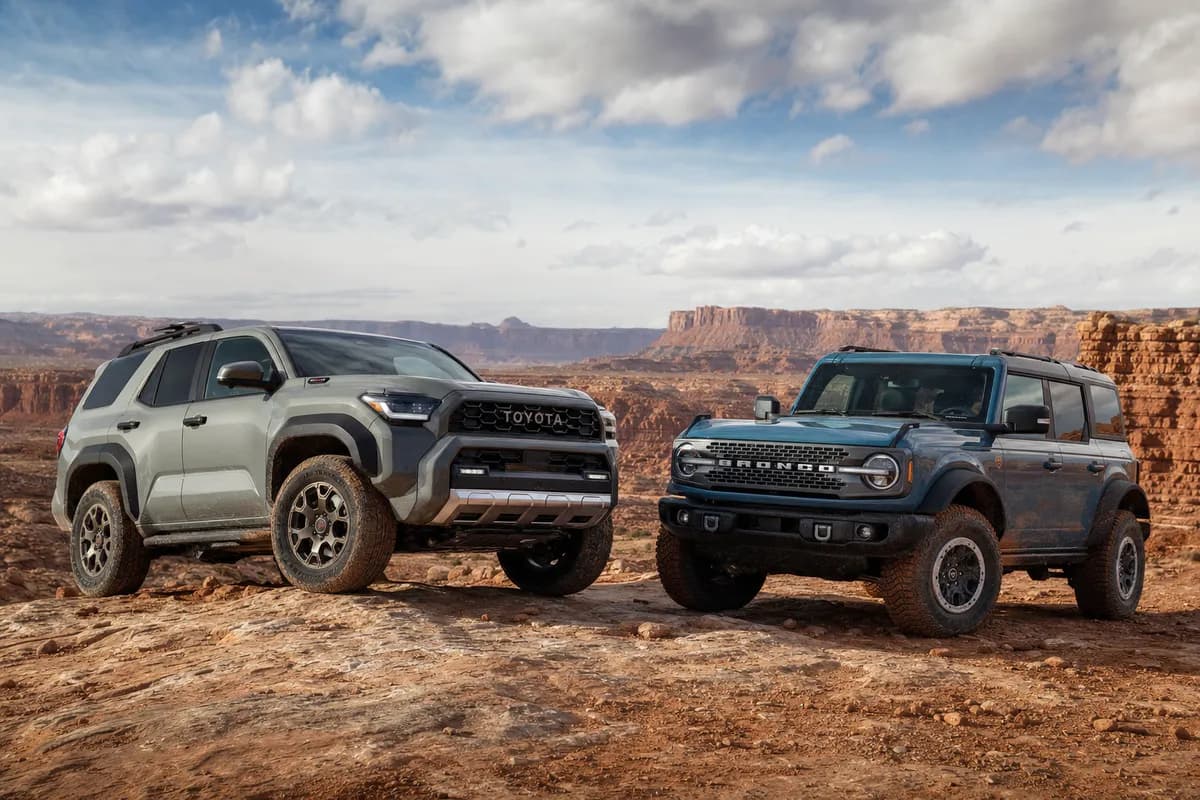
The 2025 Toyota 4Runner and Ford Bronco are not just SUVs; they are two different answers to the same muddy question: do you want to conquer the trail with Toyota’s granite-jawed dependability or Ford’s doors-off, chest-out swagger?
The 2025 Toyota 4Runner and Ford Bronco are not just SUVs; they are two different answers to the same muddy question: do you want to conquer the trail with Toyota’s granite-jawed dependability or Ford’s doors-off, chest-out swagger? The new sixth-generation 4Runner finally drags Toyota’s beloved off-roader into the modern era with turbo power, hybrid torque, and a serious Trailhunter trim. The Bronco, meanwhile, remains the extrovert of the segment: removable roof, optional manual gearbox, Sasquatch tires, locking diffs, and enough trail attitude to make a Wrangler nervous. Both are legends. One is the smarter long-term adventure tool. The other is the better toy. Let’s get dirty.
The 2025 Toyota 4Runner Is Finally New — And It Needed To Be
For years, the old Toyota 4Runner got away with murder. It had a five-speed automatic when the rest of the industry had moved on, a thirsty 4.0-liter V6 that made 270 hp and 278 lb-ft, and road manners best described as “farm equipment with Bluetooth.” People still bought it because it was tough, honest, and about as fragile as a cinder block.
The 2025 Toyota 4Runner changes the script. It rides on Toyota’s TNGA-F body-on-frame platform, the same architecture family used by the Tacoma, Land Cruiser, Tundra, and Sequoia. That matters because Toyota has finally given the 4Runner the bones, powertrains, and technology to fight modern rivals rather than just outlive them.
The standard engine is a 2.4-liter turbocharged four-cylinder called i-FORCE, producing 278 hp and 317 lb-ft of torque. That is already a meaningful torque jump over the old V6. The headline act, however, is the i-FORCE MAX hybrid, which pairs that turbo four with an electric motor for 326 hp and 465 lb-ft of torque. That is not just more torque than the Bronco’s 2.7-liter V6; it is more torque than some old-school V8 trucks.
Every 2025 4Runner uses an eight-speed automatic transmission. Rear-wheel drive is available on lower trims, with part-time or full-time four-wheel drive depending on model. Toyota also finally gives shoppers a proper spread of personalities: SR5, TRD Sport, TRD Off-Road, Limited, Platinum, TRD Pro, and the new Trailhunter.
The Trailhunter is the one aimed directly at people who use words like “overlanding” without irony. It gets Old Man Emu dampers, 33-inch Toyo Open Country all-terrain tires, a high-mount air intake, underbody protection, rock rails, a roof rack, and bronze exterior accents. The TRD Pro goes more desert-brawler, with Fox QS3 adjustable shocks, aggressive tires, a heritage grille, and Toyota’s usual helping of look-at-me skid-plate theater.
On paper, the 4Runner also becomes more useful. Toyota quotes a 6,000-pound towing capacity, which beats the standard Bronco’s 3,500-pound rating and even tops the Bronco Raptor’s 4,500-pound figure. If you tow a small camper, dirt bikes, or a utility trailer, that is not trivia — that is the difference between choosing the Toyota and leaving the Ford at home.
The Ford Bronco Still Owns The Drama
The Ford Bronco does not try to be sensible first. It tries to make you grin first. That is why it has removable doors, removable roof panels, a short-wheelbase two-door body style, an available seven-speed manual transmission, and styling that looks like it was sketched on a cooler at a desert campsite.
For 2025, the Bronco lineup remains one of the broadest in the off-road SUV world. The engine range starts with Ford’s 2.3-liter EcoBoost four-cylinder, rated at up to 300 hp and 325 lb-ft of torque on premium fuel. The optional 2.7-liter twin-turbo V6 produces 330 hp and 415 lb-ft. Then there is the unhinged Bronco Raptor, which uses a 3.0-liter twin-turbo V6 making 418 hp and 440 lb-ft.
Transmission choice is a major Bronco advantage. The 2.3-liter engine can be paired with a seven-speed manual, which includes a crawler gear for slow-speed trail work. Most Broncos use a 10-speed automatic. Toyota, by contrast, gives the 4Runner only an automatic. That will not bother most buyers, but for purists, the Bronco lands a clean jab.
Then there is the Sasquatch Package, Ford’s brilliantly named bundle of off-road hardware. It brings 35-inch tires, front and rear locking differentials, Bilstein position-sensitive dampers, a high-clearance suspension, and wider fender flares. A Bronco Badlands Sasquatch is the sort of machine that makes rocky climbs look like poorly maintained driveways.
The numbers back up the attitude. Depending on configuration, the Bronco can deliver up to 11.6 inches of ground clearance, an approach angle of up to 43.2 degrees, a departure angle of up to 37.2 degrees, and a breakover angle of up to 29 degrees. Water-fording capability reaches 33.5 inches with the right setup. Those are serious figures, and they beat the 4Runner in pure clearance and geometry.
Ford also offers the Bronco in two-door and four-door forms. Toyota only sells the 2025 4Runner as a four-door SUV. If you want a short, nimble, old-school trail rig with a removable roof and a manual gearbox, the 4Runner simply has no answer. Toyota is selling an adventure SUV. Ford is selling a lifestyle event with beadlock-capable wheels.
Off-Road: Bronco Climbs Harder, 4Runner Travels Smarter
Here is the blunt truth: if your idea of off-roading involves technical rock crawling, deep ruts, tight wooded trails, and taking the hard line because your ego made the booking, the Ford Bronco is the sharper tool.
The Bronco’s available 35-inch tires, superior approach and departure angles, disconnecting front stabilizer bar on Badlands models, and front-and-rear locking differentials give it a mechanical edge. It feels built for punishment in a theatrical way. You point it at a ledge, hear the tires slap, feel the suspension work, and the thing just claws upward while looking absurdly pleased with itself.
The 4Runner is different. Toyota’s off-road systems are less flamboyant but deeply effective. TRD Off-Road, TRD Pro, and Trailhunter trims offer hardware such as an electronically controlled locking rear differential, Multi-Terrain Select, Crawl Control, and a stabilizer-bar disconnect system on select models. The hybrid’s 465 lb-ft of torque should be especially valuable off-road, because low-speed torque is what saves you from needing momentum — and momentum is how bumpers become trail souvenirs.
The 4Runner Trailhunter may not match a Bronco Sasquatch on raw geometry, but it comes across as the better expedition rig. It has the towing capacity, the cargo-friendly fixed-roof body, Toyota’s reputation for durability, and factory overlanding gear that looks less like cosplay and more like it might survive a week in Utah without a support truck.
Think of it this way: the Bronco is better at the obstacle. The 4Runner is better at the journey.
If you are building an Instagram-famous rock crawler, buy the Bronco. If you are driving 700 miles to a trailhead, camping for three days, and driving home with all your fluids still inside the vehicle, the 4Runner starts to look awfully persuasive.
On-Road Manners, Interior Tech, And Daily Life
This is where the Toyota claws back ground. The previous 4Runner drove like nostalgia with a steering wheel. The 2025 model is far more modern, with better structural rigidity, a stronger powertrain lineup, improved cabin technology, and a more composed ride. It still uses a body-on-frame platform, so do not expect Lexus RX isolation, but the new 4Runner should finally feel like a current vehicle rather than a charmingly stubborn relic.
Inside, Toyota offers an available 14-inch touchscreen, a 12.3-inch digital gauge cluster, wireless Apple CarPlay and Android Auto, multiple USB-C ports, and the latest Toyota Safety Sense driver-assistance suite. Higher trims add nicer materials, heated and ventilated seats, a head-up display, and premium audio. The cabin design is chunky without being cartoonish, which is exactly right for a 4Runner.
The Bronco interior is more playful but less refined. It has rubberized controls, grab handles, available marine-grade vinyl seats, washable flooring, and dashboard materials clearly chosen with mud in mind rather than fingertips. That is appropriate. It is also noisy. Remove the roof panels and the Bronco is magnificent. Put them back on and drive at highway speed, and the wind noise reminds you that removable roofs are a compromise, not a miracle.
Ford’s infotainment system is strong, with a large touchscreen, SYNC software, over-the-air update capability, trail camera views, and useful off-road displays. The Bronco also has excellent visibility, especially compared with many modern SUVs that seem designed by people who believe windows are a structural weakness.
But for daily driving, the 4Runner is likely the easier companion. Its fixed roof should make it quieter. Its cargo area is more conventional. Its hybrid torque gives it effortless low-speed shove. Its 6,000-pound tow rating adds real utility. And while neither SUV will sip fuel like a Prius, the Toyota hybrid should have a meaningful efficiency advantage over the thirstier Bronco V6 and Bronco Raptor models.
Pricing also matters. The 2025 Toyota 4Runner starts at about $42,000 including destination for the SR5, with off-road and luxury trims climbing through the $50,000s and flagship TRD Pro and Trailhunter models pushing into the high-$60,000 range. The 2025 Ford Bronco starts around the high-$30,000 to low-$40,000 range depending on trim and destination charges, but a well-equipped Badlands Sasquatch can rapidly charge past $55,000. The Bronco Raptor lives in another tax bracket altogether, with pricing around the $90,000 mark.
In other words, both can get expensive very quickly. The difference is that Toyota’s pricey trims feel like long-term tools, while Ford’s expensive trims feel like adventure toys with monthly payments.
Verdict: Buy The 4Runner For The Long Haul, The Bronco For The Wild Weekend
The 2025 Toyota 4Runner and Ford Bronco are both legitimate off-road SUVs, but they are not interchangeable. Anyone telling you “just pick the one you like” is dodging the point. They serve different masters.
The Ford Bronco is the one I would take to an off-road park. It has better trail geometry, available 35-inch tires, a manual transmission, removable body panels, more personality, and the kind of mechanical swagger that makes every muddy track feel like an event. A Bronco Badlands Sasquatch is a factory-built troublemaker, and the Bronco Raptor is gloriously excessive if your budget and tire fund are both irresponsible enough.
The Toyota 4Runner is the one I would buy with my own money if I planned to keep it for 10 years. The new turbo and hybrid powertrains finally give it the muscle it needed, the 6,000-pound tow rating is genuinely useful, and the Trailhunter trim gives overlanders a serious factory option. It will not deliver the Bronco’s roof-off theater, but it counters with Toyota durability, better road-trip logic, and a sense that it was engineered to be used hard long after the novelty wears off.
So here is the verdict: the Ford Bronco is the better off-road toy; the 2025 Toyota 4Runner is the better off-road SUV.
If you want maximum drama, open-air freedom, and the most capable technical trail machine straight from the showroom, buy the Bronco. If you want a tougher, more practical, more tow-friendly adventure rig that feels built for years of abuse rather than weekends of applause, buy the 4Runner. The Bronco wins the party. The 4Runner wins the decade.
Affiliate disclosure: This article contains affiliate links. RevvedUpCars may earn a small commission on qualifying purchases at no extra cost to you.