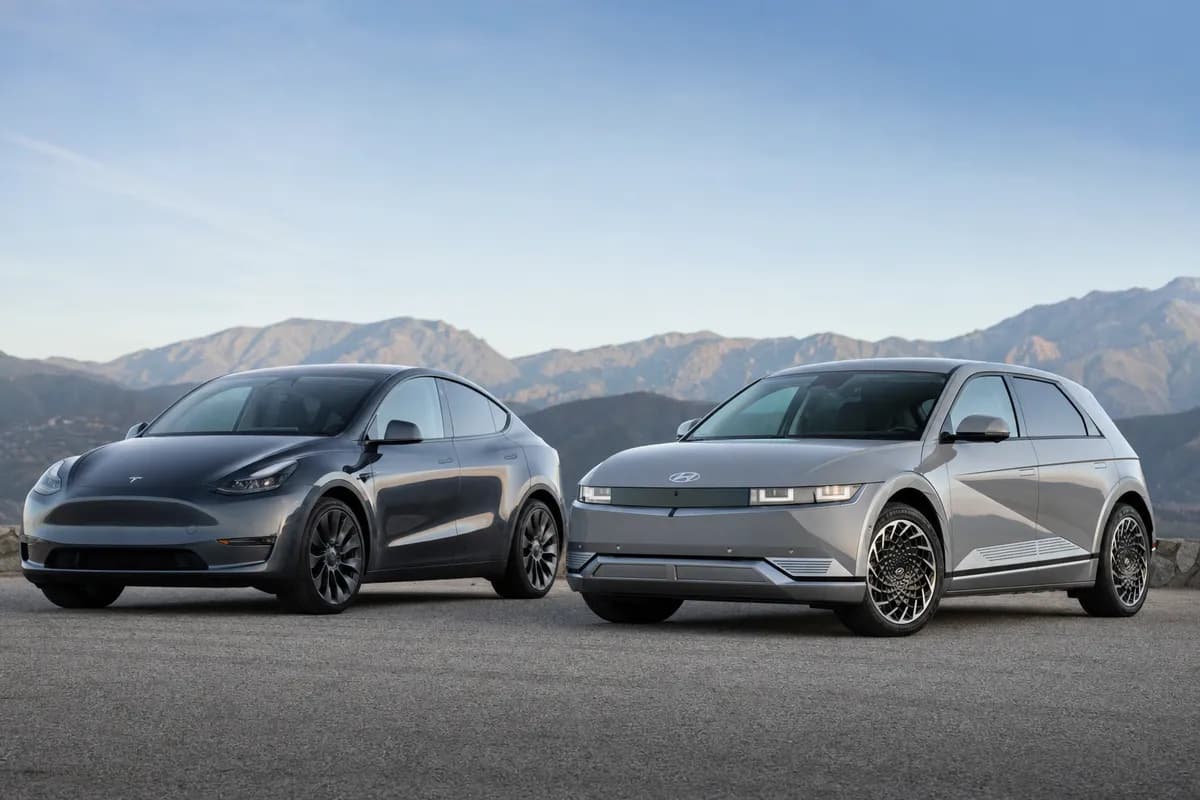
The Tesla Model Y has been the electric SUV default setting for years: quick, efficient, relentlessly connected, and about as common in suburban driveways as a Golden Retriever.
The Tesla Model Y has been the electric SUV default setting for years: quick, efficient, relentlessly connected, and about as common in suburban driveways as a Golden Retriever. The Hyundai Ioniq 5, meanwhile, is the cooler kid with pixel lights, lounge-chair vibes, and charging hardware that makes most EVs look like they’re sipping electrons through a cocktail straw. In 2025, this fight is no longer Silicon Valley disruptor versus legacy automaker experiment. It’s two fully mature electric crossovers punching for the same family garage. So which one actually deserves your money?
The Hard Numbers: Range, Power, Space, and Price
Let’s start where every EV argument eventually ends up: range, charging, and how much cash leaves your account. The 2025 Tesla Model Y remains one of the most efficient electric SUVs you can buy. Depending on configuration, expect EPA-estimated range in the neighborhood of roughly 277 to 337 miles on earlier 2025 trims, with updated Long Range versions pushing higher in some configurations. The key trims remain familiar: Model Y Long Range RWD, Model Y Long Range AWD, and Model Y Performance.
The 2025 Hyundai Ioniq 5 has had a meaningful update, too. Battery capacity rises, and the lineup includes SE Standard Range, SE, SEL, Limited, the tougher-looking XRT, and the completely unhinged Ioniq 5 N. The updated Ioniq 5 offers up to 318 miles of EPA-estimated range in rear-drive long-range form, while AWD versions typically land closer to the high-200-mile zone. The bonkers Ioniq 5 N is rated around 221 miles, because physics charges interest.
- 2025 Tesla Model Y Long Range AWD: typically around 300-plus miles of EPA range, 0-60 mph in the mid-4-second range.
- 2025 Tesla Model Y Performance: around 0-60 mph in about 3.5 seconds, with less range and a much firmer attitude.
- 2025 Hyundai Ioniq 5 Long Range RWD: up to 318 miles EPA-estimated, smoother and more relaxed than savage.
- 2025 Hyundai Ioniq 5 AWD: roughly 300-plus horsepower depending on trim, 0-60 mph in about 5 seconds.
- 2025 Hyundai Ioniq 5 N: 641 hp with N Grin Boost, 0-60 mph in roughly 3.0 seconds, and the personality of a caffeinated rally car.
Pricing changes constantly because Tesla treats MSRPs like a day trader treats crypto, but the Model Y generally starts in the mid-$40,000 range before incentives and climbs into the low-to-mid $50,000s for Performance or heavily optioned versions. The Hyundai Ioniq 5 broadly plays in the same sandbox, starting around the low-$40,000s and stretching into the mid-$50,000s for Limited AWD models. The Ioniq 5 N is a different animal entirely, landing above $65,000.
On paper, the Tesla has the edge in maximum range and cargo practicality. The Hyundai counters with better charging hardware, more design swagger, and a cabin that feels less like a minimalist tech office and more like somewhere actual humans might want to sit.
Driving: Tesla Is Sharper, Hyundai Is Kinder
The Model Y drives like a Tesla, which is both praise and warning. The steering is quick, the throttle response is immediate, and even the non-Performance versions have enough punch to embarrass gas SUVs that still think turbo lag is a character trait. A Long Range AWD Model Y feels genuinely fast in daily driving. The Performance version is properly rapid, though it also rides with the subtlety of a shopping cart over cobblestones when the pavement gets ugly.
Tesla’s chassis tuning is purposeful but not plush. It corners flat, changes direction eagerly, and gives the driver confidence. But it can also feel brittle over broken roads, especially on bigger wheels. The Model Y wants you to drive briskly. It is not especially interested in coddling your spine while doing it.
The Ioniq 5 is more mature in the traditional automotive sense. It rides better. It is quieter. It has that long-wheelbase glide that makes it feel almost luxury-car calm at highway speeds. The standard AWD version is quick enough for any sane family, but it doesn’t jab you in the ribs the way the Tesla does. Instead, it delivers power with creamy smoothness and less drama.
Then there’s the Ioniq 5 N, which deserves its own paragraph and possibly its own therapist. Hyundai’s N division took a sensible EV crossover and gave it fake gearshifts, simulated engine noise, track cooling, drift modes, and up to 641 hp with boost engaged. It sounds ridiculous because it is. It is also one of the most entertaining electric performance cars on sale, full stop. It makes the Model Y Performance feel clinically quick but emotionally undercooked.
If you want the quickest, cleanest, most efficient everyday EV SUV, the Model Y still has the moves. If you want comfort, character, and a ride that doesn’t punish you for living somewhere with winter, the Ioniq 5 is the better road car.
Charging and Range: Hyundai Has the Hardware, Tesla Has the Empire
This is where things get deliciously complicated. For years, Tesla’s Supercharger network was the trump card. It was simple, reliable, widespread, and idiot-proof. Pull up, plug in, walk away. No app roulette. No broken stalls. No “charger unavailable” nonsense while your kids ask why dinner is now happening at a gas station Subway.
The 2025 Hyundai Ioniq 5 narrows that advantage in a big way because it adopts the NACS charging port for North America, meaning access to Tesla’s Supercharger network is part of the picture. That is a huge shift. The Ioniq 5 also retains one of the best charging architectures in the business: an 800-volt electrical system capable of very rapid DC fast charging when connected to a powerful enough charger.
On a 350-kW DC fast charger, the Ioniq 5 can charge from 10 to 80 percent in about 18 minutes under ideal conditions. That is superb. It is faster than the Model Y, which typically needs closer to the high-20-minute range for a comparable 10-to-80 percent session on a V3 Supercharger. Tesla peaks at up to 250 kW, while the Hyundai can peak around the 230-plus kW range, but the Hyundai’s advantage is how well it holds a strong charging curve on compatible hardware.
But here’s the catch, because there’s always a catch. The Ioniq 5’s 800-volt system is brilliant on the right charger, but not every Tesla Supercharger delivers peak performance for 800-volt cars. On some Superchargers, the Hyundai may charge slower than it does on a top-tier CCS 350-kW unit. Tesla’s network is still the easier road-trip experience, even as the connector advantage fades.
- Best charging speed: Hyundai Ioniq 5 on a proper 350-kW DC fast charger.
- Best charging simplicity: Tesla Model Y on the Supercharger network.
- Best road-trip confidence: Tesla, still, though the gap is shrinking fast.
- Best home-charging experience: basically a tie, assuming you install a Level 2 charger.
The Ioniq 5 also has a neat trick Tesla still refuses to offer: Vehicle-to-Load capability. Hyundai’s V2L system can power laptops, small appliances, camping gear, or emergency equipment. It turns the car into a giant battery bank. Tesla owners get fart sounds and streaming apps. Fun, yes. Useful during a blackout? Not so much.
Interior, Tech, and Practicality: Minimalism Meets Actual Buttons
The Model Y cabin is brutally simple. There is a steering wheel, seats, a panoramic glass roof, and one central touchscreen that controls almost everything. It looks clean. It also means adjusting basic functions often involves poking through menus like you’re configuring a router. Tesla’s infotainment system is fast, crisp, and loaded with features, but the lack of Apple CarPlay and Android Auto remains stubbornly annoying. Tesla thinks its software is better. Often it is. But customers should still have the choice.
Hyundai gives you a more conventional setup, and that is not an insult. The Ioniq 5 has dual 12.3-inch displays, physical controls for key functions, available head-up display, and a cabin layout that feels airy and thoughtful. The flat floor and sliding center console make it feel more like a lounge than a crossover. Materials are generally pleasant, and the design has aged beautifully because it never tried to look like every other SUV in the mall parking lot.
Space is a fascinating split. The Ioniq 5 has a massive 118.1-inch wheelbase, longer than many midsize SUVs, and rear-seat legroom is excellent. Adults fit comfortably in the back, and the rear seat slides and reclines. It is a better passenger vehicle than the Model Y.
The Tesla, however, fights back hard with cargo capacity. The Model Y offers roughly 30 cubic feet behind the rear seats and more than 70 cubic feet with the seats folded, depending on measurement method and configuration. The Hyundai Ioniq 5 offers about 27 cubic feet behind the second row and around 59 cubic feet maximum. The Tesla also has a more useful front trunk. Hyundai’s frunk is tiny in comparison, especially on AWD models.
Software is Tesla’s home turf. Over-the-air updates are frequent and meaningful. The app is excellent. Route planning with Superchargers is seamless. Dog Mode, Sentry Mode, integrated dashcam recording, and native entertainment features remain best-in-class. Hyundai’s infotainment is easier to use in some ways and now much improved, but it does not feel as deeply integrated as Tesla’s ecosystem.
Driver assistance is another spicy one. Tesla’s standard Autopilot remains strong for lane-centering and adaptive cruise control, but the company’s marketing around Full Self-Driving has long been more confident than the system deserves. It is impressive, but it is not a chauffeur. Hyundai’s Highway Driving Assist is less flashy but generally predictable, especially on mapped highways. I’d rather have predictable than theatrical when a two-ton EV is doing 70 mph.
Ownership Costs, Reliability, and Daily Life
The Model Y’s biggest ownership advantage is efficiency. Tesla has spent years squeezing miles from every kilowatt-hour, and it shows. A Model Y Long Range is one of the most energy-efficient electric SUVs in the class. Over 15,000 miles per year, that can mean lower electricity costs compared with thirstier EVs like the Ford Mustang Mach-E GT or Volkswagen ID.4 AWD.
Hyundai’s efficiency is good, particularly in rear-drive form, but AWD models on larger wheels can burn through electrons faster. The Ioniq 5’s boxier shape and larger frontal personality do not cheat the air quite as ruthlessly as the Tesla. Style has a drag coefficient, darling.
Warranty coverage favors Hyundai. The Ioniq 5 comes with Hyundai’s excellent 5-year/60,000-mile basic warranty, 10-year/100,000-mile powertrain warranty, and 10-year/100,000-mile battery warranty. Tesla typically offers a 4-year/50,000-mile basic warranty and an 8-year battery and drive unit warranty, with mileage depending on trim. Tesla’s warranty is fine. Hyundai’s is better.
Build quality is where Hyundai lands a clean punch. Ioniq 5 panel gaps, trim fit, and cabin assembly generally feel more consistent. Tesla has improved, but it still carries a reputation for occasional delivery-day weirdness: misaligned panels, rattles, paint defects, or interior squeaks. Not every Model Y has issues, but enough have that buyers should inspect before accepting delivery. Yes, you should have to inspect a new car. No, that should not be normal.
Tax credits and incentives matter, too. In 2025, eligibility can depend on final assembly, battery sourcing, trim, MSRP, and your income. Tesla’s Model Y has often been one of the safer bets for federal EV tax credit eligibility in the U.S., while the 2025 Ioniq 5’s move to North American production improves its position substantially. Still, verify by VIN and purchase date before signing. The federal rulebook reads like it was assembled by raccoons with spreadsheets.
Verdict: The Winner Depends on Whether You Value Brains or Soul
So, which electric SUV reigns supreme in 2025? If I’m scoring this like a cold-blooded spreadsheet, the Tesla Model Y still wins. It has better overall efficiency, more cargo space, slicker software, stronger route planning, and the easiest charging experience in the real world. It is the EV SUV benchmark because it nails the boring stuff with ruthless competence. The Model Y is not charming, but it is devastatingly effective.
But if I’m recommending the EV I’d rather live with every day, the answer gets more interesting. The Hyundai Ioniq 5 rides better, looks better, feels more special, charges faster on the right hardware, and has a cabin designed by people who apparently remember that buttons are not a crime. It is the more comfortable family car and the more distinctive object. It also carries a better warranty and a calmer personality.
The Model Y is the better tool. The Ioniq 5 is the better car.
If you road-trip constantly, rely on public charging, need maximum cargo room, and want the cleanest EV ownership experience, buy the Tesla Model Y Long Range. It remains the rational champion, and rational champions win a lot of comparison tests for a reason.
If you care about ride comfort, design, rear-seat space, charging speed, and not driving the same EV as three people on your street, buy the Hyundai Ioniq 5 Limited RWD or AWD. It is the one with personality, and in 2025 it no longer has to apologize for its charging access.
And if you’re cross-shopping the Model Y Performance against the Ioniq 5 N, stop pretending this is about family practicality. The Tesla is quicker and cleaner in the traditional EV sense. The Hyundai is louder, sillier, more adjustable, and vastly more entertaining. I’d take the Ioniq 5 N every time, then explain the tire bill later.
Final call: The 2025 Tesla Model Y remains the overall winner for most buyers because it is more efficient, more practical, and easier to charge. But the Hyundai Ioniq 5 is the one I’d recommend to anyone who wants an EV SUV with comfort, character, and a pulse. Supreme? Tesla by points. Favorite? Hyundai by heart.
Affiliate disclosure: This article contains affiliate links. RevvedUpCars may earn a small commission on qualifying purchases at no extra cost to you.