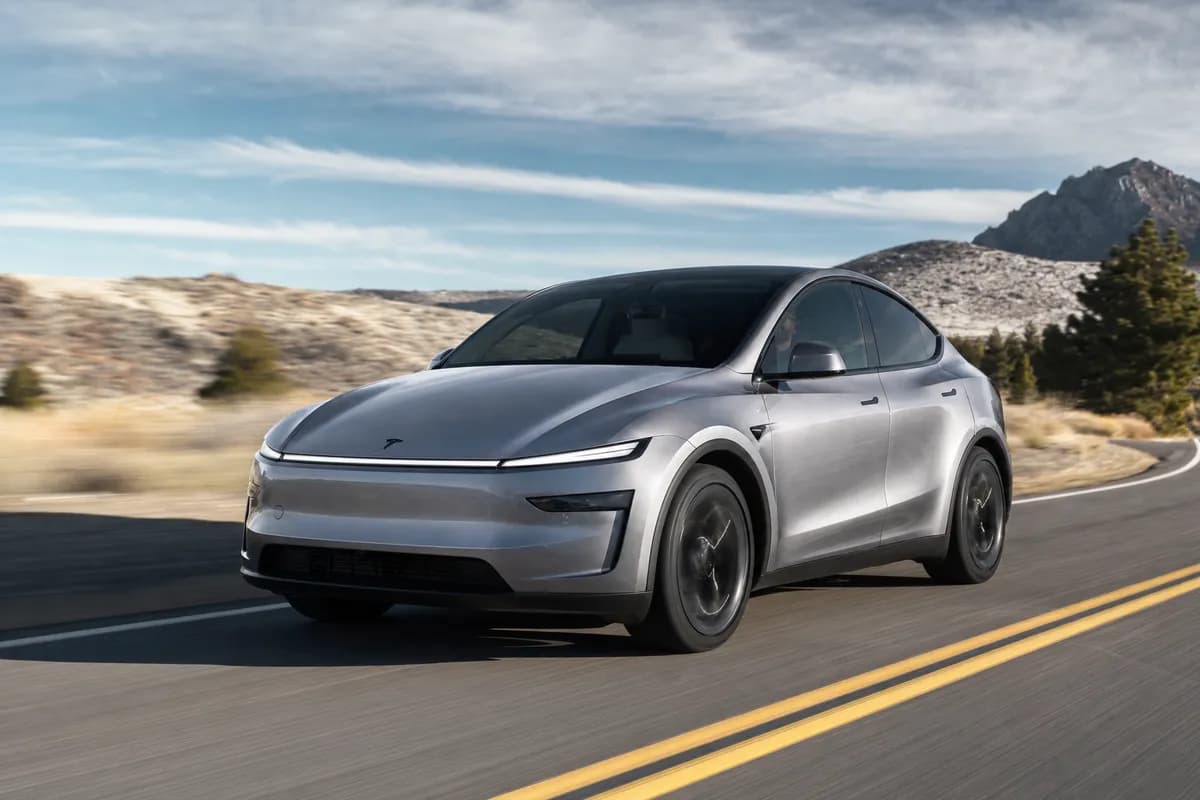
The 2024 Tesla Model Y does not arrive with champagne, laser lights, or a dramatic new face. It arrives like a firmware update with wheels: familiar, smugly efficient, and still annoyingly hard to beat.
The 2024 Tesla Model Y does not arrive with champagne, laser lights, or a dramatic new face. It arrives like a firmware update with wheels: familiar, smugly efficient, and still annoyingly hard to beat. This is the electric crossover everyone either recommends or resents, and after a first drive in the updated-for-2024 lineup, the verdict is not complicated. The Model Y still lives up to the hype — but the hype now comes with asterisks, because Hyundai, Kia, Ford, and even Chevrolet have stopped politely watching Tesla run laps around them.
Let’s clear the fog first. The 2024 Model Y is not the heavily revised “Juniper” update people keep whispering about. This is still the current-generation Model Y: minimalist cabin, giant central screen, no Apple CarPlay, no Android Auto, rapid acceleration, brilliant charging access, and build quality that has improved but still occasionally feels like it was signed off by a committee composed of software engineers and raccoons. Yet as a real-world EV — not a show-stand bauble, not a spec-sheet fantasy — it remains one of the most complete family cars on sale.
What You Get: Familiar Shape, Ruthless Packaging
The 2024 Tesla Model Y lineup in the U.S. is centered around three core versions: Rear-Wheel Drive, Long Range AWD, and Performance. Depending on configuration and market timing, EPA-rated range lands around 260 miles for the entry Rear-Wheel Drive model, up to 330 miles for the Long Range AWD, and roughly 303 miles for the Performance. Tesla being Tesla, prices shift more often than a teenager’s music taste, but the Model Y continues to qualify for federal EV incentives in many configurations, which is a major reason it keeps mugging the competition in sales charts.
Dimensionally, it is still a compact-to-midsize crossover tweener: about 187 inches long, with a 113.8-inch wheelbase, five seats as standard, and an optional third row that should be considered emergency seating for children, very forgiving adults, or enemies. Cargo space is excellent: Tesla quotes up to 76 cubic feet with the rear seats folded, and there is a useful front trunk as well. The underfloor rear storage bin is genuinely handy, not a marketing gimmick.
The packaging is where the Model Y starts punching rivals in the throat. A Hyundai Ioniq 5 is cooler to look at and comfier over bad roads. A Kia EV6 is sharper from the driver’s seat. A Ford Mustang Mach-E feels more traditionally car-like inside. But the Model Y combines range, cargo space, charging access, efficiency, and software into one cohesive tool. It is less “lifestyle object” and more “domestic appliance that can do 0-60 mph faster than a BMW M340i if you pick the Performance.”
- 2024 Tesla Model Y Long Range AWD: around 330 miles EPA range, 0-60 mph in 4.8 seconds, dual-motor all-wheel drive.
- 2024 Tesla Model Y Performance: around 303 miles EPA range, 0-60 mph in 3.5 seconds, larger wheels, lowered suspension, performance brakes.
- Maximum cargo space: up to 76 cubic feet with rear seats folded.
- Peak DC fast charging: up to 250 kW on compatible Tesla Superchargers.
- Towing capacity: up to 3,500 pounds when properly equipped.
The cabin is still Tesla’s greatest party trick and greatest self-own. There are almost no physical controls. The 15-inch center touchscreen handles nearly everything: speed, climate, navigation, media, mirrors, wipers, glovebox, and settings. It is quick, crisp, and still one of the best infotainment systems in the business. It is also mildly ridiculous that adjusting the airflow direction requires screen poking when a 1998 Corolla solved this problem with plastic vents and human dignity.
There is no instrument cluster. No head-up display. No Apple CarPlay. No Android Auto. Tesla’s native software is good enough that many buyers will not care, but the omission still feels arrogant. If Hyundai can give you CarPlay in an Ioniq 5 and still manage a slick EV interface, Tesla can too. It simply chooses not to.
On the Road: Fast, Quiet, Efficient — But Not Plush
My first drive in the 2024 Model Y Long Range AWD confirmed what the spec sheet suggests: this thing is quick in the way modern EVs are quick, meaning it makes internal-combustion powertrains feel like they are taking a meeting before deciding whether to accelerate. Tesla claims 0-60 mph in 4.8 seconds for the Long Range, and it feels every bit that urgent. The Performance version’s claimed 3.5-second sprint is genuinely savage for a family crossover, though it comes with compromises we will get to shortly.
The Long Range AWD is the sweet spot. The throttle response is immediate but easy to meter. There is no fake drama, no pretend gearshifts, no theatrical nonsense. You squeeze the pedal and the Model Y simply leaves. Merging onto a highway is effortless. Passing on a two-lane road requires a thought, not a plan. It is the kind of car that quietly ruins slower vehicles for you.
Steering is quick and accurate, with selectable weight, though not much real feel. The Model Y changes direction cleanly and carries its battery weight low, so body roll is controlled. It is not a sports SUV, regardless of what the Performance badge implies, but it is more agile than a Volkswagen ID.4 and less floaty than a Nissan Ariya. Against a Kia EV6, though, the Tesla feels less playful. The Kia has more steering texture and a better sense of chassis polish. The Tesla counters by being simpler, faster, and more efficient.
Ride quality is where the Model Y still catches a jab to the ribs. Tesla has improved suspension tuning over the years, and the 2024 car is less brittle than earlier examples, but it is still not plush. On smooth roads, it feels taut and controlled. On broken pavement, expansion joints, and pockmarked city streets, the Model Y can thump and fidget. The Long Range on smaller wheels is the one to buy if comfort matters. The Performance, with its larger wheels and firmer setup, looks meaner and launches harder, but it also reminds you that style and sidewall are mortal enemies.
Noise suppression is good, not class-leading. Wind noise is modest, tire noise depends heavily on wheel and tire choice, and the absence of engine vibration makes every suspension thud more noticeable. The Ioniq 5 and Ariya feel more lounge-like. The Model Y feels more like a very quiet machine built to get things done quickly.
The Model Y does not charm you with luxury. It wins by making other EVs feel like they are still finishing the paperwork.
Regenerative braking is strong and intuitive. Tesla’s one-pedal driving remains among the best calibrated in the industry. Around town, you can drive smoothly without touching the brake pedal most of the time. The brake pedal itself is fine when called upon, though not especially communicative. Again, very Tesla: effective, slightly sterile, and difficult to argue with.
Efficiency and Charging: This Is Still Tesla’s Hammer
Here is where the Model Y continues to make rival EVs sweat through their polo shirts. Tesla’s efficiency remains excellent. In mixed driving, a Long Range AWD Model Y can reasonably return around 3.5 to 4.0 miles per kWh depending on temperature, speed, elevation, and wheel choice. That matters more than peak horsepower in daily ownership. Efficiency means you need less battery to go farther, spend less time charging, and pay less per mile.
The Hyundai Ioniq 5 and Kia EV6 have a brilliant 800-volt architecture and can charge from 10 to 80 percent in about 18 minutes under ideal conditions. That is superb. But the Tesla advantage is not just charging speed; it is charging reliability and route integration. The Supercharger network remains the gold standard in North America. Plug in, charge, leave. No app archaeology. No broken stall roulette. No payment-screen hostage situation. Just electricity delivered with refreshing competence.
The 2024 Model Y can accept up to 250 kW at compatible Superchargers, though like every EV, that peak is not sustained through the whole session. Still, the navigation preconditions the battery automatically, estimates arrival state of charge accurately, and routes you through charging stops with a level of confidence many competitors still cannot match. Ford, GM, Rivian, Hyundai, Kia, and others are moving toward Tesla’s NACS charging standard, which says everything you need to know. The industry looked at Tesla’s homework and finally stopped pretending the dog ate theirs.
For home charging, the Model Y is easy to live with. A Level 2 home charger can replenish the battery overnight for typical commuting. With electricity costs far below gasoline in many regions, operating costs remain a major selling point. Tires, however, are the lurking tax. Heavy EVs with instant torque eat rubber if driven enthusiastically, and the Performance model is particularly fond of turning expensive tires into dust.
Real-world range will not always match the EPA number, especially at highway speeds in cold weather. Drive a Model Y Long Range at 75 mph in winter with the cabin warm and you will not see 330 miles. Nobody should be shocked by this; physics is undefeated. But the Model Y’s efficiency gives it more cushion than many rivals. A Mustang Mach-E Extended Range AWD is competitive on range, but the Tesla’s charging ecosystem and route planning remain easier. The Volkswagen ID.4 is comfortable and sensible, but it feels sleepier and less efficient. The Chevy Blazer EV looks sharp and finally gives GM a serious electric crossover, but its rollout has not exactly been a masterclass in software confidence.
Interior, Tech, and Daily Use: Brilliant, Annoying, Brilliant Again
The interior design is either calming or barren depending on your tolerance for minimalism. Materials are decent rather than premium. The vegan upholstery feels durable, the seats are supportive, and outward visibility is good forward and to the sides. Rear visibility is not great, though the camera system helps. The glass roof makes the cabin airy, and rear-seat space is generous for adults. This is a legitimately good family vehicle.
The center screen is the command center and, credit where due, it is superbly responsive. Google-based navigation, streaming apps, sentry mode, dog mode, camp mode, over-the-air updates, built-in dashcam capability — Tesla’s software features still feel ahead of most legacy automakers. The phone-as-key function works well, and the app is excellent. Preconditioning the cabin from your phone on a freezing morning is one of those EV luxuries that quickly becomes non-negotiable.
But Tesla’s obsession with screen-based controls remains maddening. Wiper controls through the touchscreen and steering wheel button logic are not as intuitive as a stalk. Mirror adjustment through menus is clever once and annoying forever. The lack of a driver display is also a needless omission. A small speed readout in front of the driver would not ruin the minimalist aesthetic. It would ruin one spreadsheet cell in Tesla’s cost model.
Driver assistance is another complicated Tesla topic. Basic Autopilot includes adaptive cruise control and lane centering, and on the highway it can be impressively smooth. Enhanced Autopilot and Full Self-Driving Capability cost extra, and despite the branding, the car is not autonomous. Supervised FSD has improved, and it can be fascinating, but it still requires attention and intervention. Anyone telling you it turns the Model Y into a robot chauffeur is either misinformed or trying to sell you something.
The lack of ultrasonic parking sensors in newer Teslas remains controversial. Tesla Vision has improved, but camera-based distance estimation is still not as consistently confidence-inspiring as old-fashioned sensors in tight parking situations. For a vehicle that is otherwise so computationally smug, occasionally being vague near a garage wall is not a great look.
Build quality? Better than the bad old days, but inspect before delivery. Panel gaps, paint quality, trim alignment, and interior rattles have improved overall, yet Tesla still does not have the bank-vault consistency of Toyota, Lexus, or even the better Korean EVs. If you are buying one, do not be shy during delivery. Check everything. This is not cynicism; it is self-defense.
Verdict: Yes, It Lives Up to the Hype — Just Don’t Buy the Wrong One
The 2024 Tesla Model Y lives up to the hype because it focuses on what EV buyers actually need: range, efficiency, charging access, cargo space, acceleration, and software that makes the car easier to live with over time. It is not the most beautiful electric crossover. It is not the most luxurious. It is not the best-riding. It is not even the most emotionally engaging. Yet as a complete ownership proposition, it remains brutally effective.
The Long Range AWD is the one to buy. It has the best blend of range, traction, speed, comfort, and resale confidence. The Rear-Wheel Drive model makes sense if price is the main concern and your climate is mild, though the shorter range narrows its appeal for road-trippers. The Performance is hilarious, but unless you regularly need to embarrass sports sedans between school runs, it is more flex than necessity. Fast, yes. Essential, no.
Against the Hyundai Ioniq 5, the Model Y is less comfortable but more efficient and easier to charge. Against the Kia EV6, it is less stylish and less engaging, but more practical. Against the Ford Mustang Mach-E, it feels cleaner and more software-native, though the Ford has a warmer cabin and better conventional controls. Against the Volkswagen ID.4, the Tesla is simply the sharper tool. The ID.4 is a nice EV; the Model Y is a better answer.
There are reasons not to buy one. If you demand Apple CarPlay, physical buttons, plush ride quality, or dealership hand-holding, the Model Y may irritate you. If you want impeccable assembly, inspect carefully. If you believe “Full Self-Driving” means full self-driving, please step away from the configurator and read the fine print.
But if you want an electric crossover that works brilliantly in the real world, the 2024 Tesla Model Y is still the benchmark. Not because it is perfect. It is not. It is the benchmark because it makes ownership easier than almost anything else in the class. The hype is loud, occasionally unbearable, and fueled by a fan base that can make a charging cable sound like a religious artifact. Annoying? Absolutely. Wrong? Not this time.
RevvedUpCars verdict: The 2024 Tesla Model Y remains the electric crossover to beat. Buy the Long Range AWD, skip the expensive self-driving promises unless you truly understand what you are getting, and choose the smaller wheels if your spine has voting rights.
Affiliate disclosure: This article contains affiliate links. RevvedUpCars may earn a small commission on qualifying purchases at no extra cost to you.