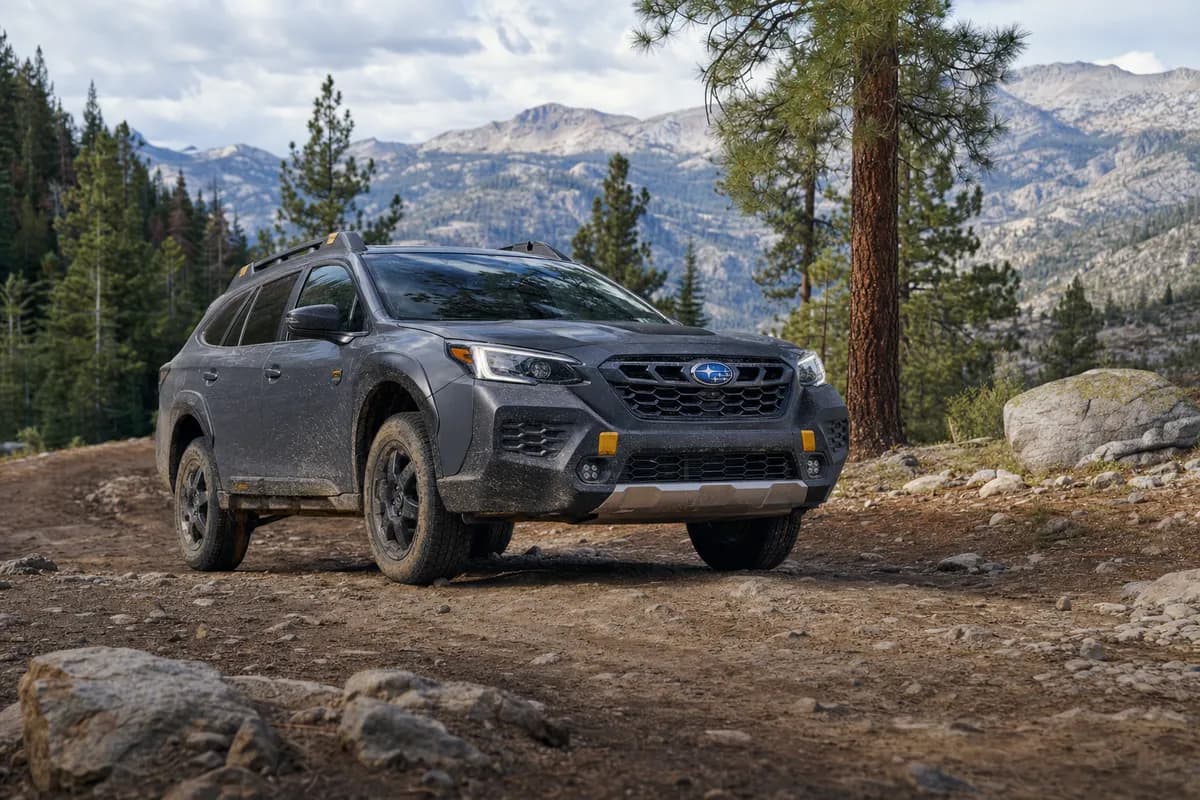
The 2024 Subaru Outback Wilderness is what happens when a sensible family wagon grows a beard, buys proper boots, and starts ignoring “Road Closed” signs. It is not a Jeep Wrangler. It is not pretending to be a Toyota 4Runner. Good. Those are blunt instruments.
The 2024 Subaru Outback Wilderness is what happens when a sensible family wagon grows a beard, buys proper boots, and starts ignoring “Road Closed” signs. It is not a Jeep Wrangler. It is not pretending to be a Toyota 4Runner. Good. Those are blunt instruments. The Outback Wilderness is a smarter, lower, longer, more comfortable answer for people who spend Monday on the interstate and Saturday crawling toward a trailhead, ski hut, fishing access road, or campsite that makes normal crossovers whimper into their stability-control systems.
After putting the 2024 Subaru Outback Wilderness through highway miles, rutted dirt, muddy climbs, loose gravel, washboard tracks, and off-camber forest-road nonsense, the verdict is simple: this is the best version of the Outback if you actually use your crossover outside suburbia. It has real off-road upgrades, a punchy turbocharged engine, legitimate all-weather traction, and enough everyday comfort that you won’t hate it on the commute. But it also has limits, and Subaru’s beloved CVT remains the mechanical equivalent of a very competent accountant wearing hiking boots.
What Makes the 2024 Outback Wilderness Different?
The Wilderness trim is not just an Outback with black plastic cladding and a few copper-colored decorations slapped on by a marketing intern. Subaru made meaningful changes, and that matters.
Under the hood is Subaru’s 2.4-liter turbocharged flat-four producing 260 horsepower and 277 lb-ft of torque. That is the engine you want. The standard 2.5-liter naturally aspirated boxer in lesser Outbacks makes 182 horsepower, which is fine if your idea of urgency is politely merging sometime before next Tuesday. The turbo gives the Wilderness proper shove, especially at altitude and when loaded with people, dogs, camping gear, and the emotional baggage of modern outdoor recreation.
The engine is paired with Subaru’s Lineartronic CVT and standard symmetrical all-wheel drive. Wilderness models get a revised final-drive ratio of 4.44:1, giving better low-speed response off-road and snappier acceleration around town. The system also includes dual-function X-MODE with Snow/Dirt and Deep Snow/Mud settings, plus hill-descent control.
The numbers are the headline:
- Ground clearance: 9.5 inches
- Approach angle: 20.0 degrees
- Breakover angle: 21.2 degrees
- Departure angle: 23.6 degrees
- Engine: 2.4-liter turbocharged boxer-four
- Output: 260 hp, 277 lb-ft
- Towing capacity: 3,500 pounds
- EPA fuel economy: 21 mpg city, 26 mpg highway, 23 mpg combined
- Tires: Yokohama Geolandar A/T all-terrains on 17-inch wheels
- Roof rail capacity: 220 pounds dynamic, 700 pounds static
That 9.5 inches of clearance is more than a Toyota RAV4 TRD Off-Road, Honda Passport TrailSport, Mazda CX-50 Meridian, and Ford Bronco Sport Badlands. It is also just a tenth shy of a Toyota 4Runner. Yes, the 4Runner has a proper transfer case and better articulation, but the Outback Wilderness has the ground clearance to back up its costume.
Subaru also fits a front skid plate, a full-size spare tire, water-resistant StarTex upholstery, washable cargo surfaces, unique bumpers, black 17-inch wheels, chunky all-terrain tires, and roof rails designed to support a rooftop tent when parked. In other words, this is not a mall-crawler trim. It is a “mud on the floor mats by Tuesday” trim.
Off-Road Test: Better Than a Crossover Has Any Right to Be
On dirt, the Outback Wilderness immediately feels more confident than the standard Outback. The extra ground clearance is the obvious win, but the tires are the real heroes. The Yokohama Geolandar A/T G015s are not hardcore mud-terrain rubber, but they bite into gravel, wet dirt, and loose climbs with far more authority than the low-rolling-resistance tires fitted to most crossovers. They also carry the three-peak mountain snowflake rating, which makes this Subaru a serious winter weapon before you even start talking about all-wheel drive.
On a rutted forest trail with standing water, embedded rocks, and slick clay sections, the Wilderness did what Subarus have done for decades: it found grip where other soft-roaders start spinning, flashing warning lights, and quietly reconsidering their life choices. Subaru’s all-wheel-drive system is still one of the best in this class because it feels proactive rather than reactive. You do not wait for the front tires to panic before the rear axle joins the conversation. The car just hooks up and goes.
In Deep Snow/Mud mode, X-MODE sharpens throttle mapping, adjusts the CVT behavior, and allows more wheelspin to keep momentum. That matters in sloppy terrain. Too many modern crossovers strangle themselves with overzealous traction control the moment a tire slips. The Outback Wilderness is smarter. It lets the tires churn, then brakes individual wheels to redirect torque where it is needed.
The revised gearing also pays off. Low-speed crawling is easier than in the regular Outback XT, and the throttle is less twitchy than you’d expect from a turbo engine. Hill-descent control works cleanly, though it is not as smooth as the best systems from Land Rover or Jeep. Still, on steep loose descents, it kept the Subaru composed without the driver having to ride the brake pedal like a nervous driving instructor.
But let’s not get silly. This is still a unibody wagon with a CVT, long overhangs, and no low-range transfer case. It will not follow a Wrangler Rubicon over boulders. It will not articulate like a 4Runner TRD Off-Road. It does not have locking differentials. If your weekend hobby involves choosing tire placement over dishwasher-sized rocks, buy something with skid plates you can hear from the next county.
The Outback Wilderness is not built for rock crawling. It is built to make bad roads, snowstorms, fire trails, muddy campsites, and neglected trailheads feel boringly manageable. That is far more useful to most buyers.
The suspension tuning is also well judged. It is soft enough to breathe over washboard roads without rattling your fillings loose, yet controlled enough that the body does not flop around like an old Land Cruiser on tired shocks. The long wheelbase helps stability on gravel, and the low roofline compared with boxier SUVs gives it a planted feel. You can hustle it down a dirt road with real confidence.
On-Road Manners: Turbo Punch, CVT Grumbles, Big Comfort
Back on pavement, the 2024 Outback Wilderness reminds you why this formula works. It drives like a wagon, not a truck. The seating position is elevated but not skyscraper-high. The body is long and stable. Visibility is excellent. The steering is light but accurate. It is the sort of vehicle you can drive six hours to the mountains without arriving shaped like a question mark.
The turbocharged 2.4-liter engine is the key difference between “acceptable” and “actually enjoyable.” Instrumented tests of turbo Outback models typically put 0-60 mph in the roughly 5.8- to 6.1-second range, and the Wilderness feels right in that neighborhood despite its all-terrain tires and taller stance. That makes it quicker than a Honda Passport TrailSport, quicker than a Toyota RAV4 TRD Off-Road, and dramatically quicker than any non-turbo Outback.
Midrange torque is strong. Passing on two-lane roads is easy. Climbing grades at highway speeds does not require a formal written request from the accelerator pedal. The engine has a slightly gruff boxer thrum under load, but it suits the Wilderness better than it does the luxury-leaning Touring XT.
Now, the CVT. Subaru’s Lineartronic transmission is efficient, durable enough in normal use, and better calibrated here than it used to be. It simulates stepped “gears” under hard acceleration and uses paddle shifters if you want to pretend you are in charge. But it still cannot fully hide the elastic, rubber-band sensation that CVTs often deliver. Mash the throttle, and the engine revs up while the vehicle catches up a beat later. It is not terrible. It is not a dealbreaker. But Mazda’s six-speed automatic in the CX-50 Turbo feels more natural, and Honda’s nine-speed in the Passport TrailSport is more conventional, even if not always smarter.
The Wilderness also pays a price for its off-road hardware. The all-terrain tires add some hum at highway speeds, though not enough to ruin the cabin. The lifted suspension creates more body roll than a regular Outback, and emergency braking distances are not sports-sedan short. Around corners, it grips respectably for what it is, but the message from the chassis is clear: enjoy the scenery, Colin McRae.
Fuel economy is another compromise. The EPA rates the Outback Wilderness at 21 mpg city, 26 mpg highway, and 23 mpg combined. In mixed real-world driving, expect low-to-mid 20s unless you drive like every gallon is personally sponsored by OPEC. A standard Outback 2.5i can do much better, but it also feels like it is powered by a leaf blower when loaded. Pick your sin.
Interior, Tech, and Daily Use: Rugged Without Being Punitive
Inside, the Outback Wilderness gets the balance right. It feels durable without looking like a rental-spec work van. The water-resistant StarTex seats are excellent for owners with dogs, kids, wet jackets, muddy boots, or hobbies that involve smelling faintly of campfire. They are easy to wipe down and grippy enough off-road. The copper stitching and Wilderness logos are a little theatrical, but at least Subaru committed to the bit.
Passenger space is generous. The Outback has always been one of the most usable not-quite-SUVs on the market, and the Wilderness keeps that strength. Rear-seat legroom is adult-friendly, the cargo opening is low and wide, and the cargo floor is long enough for real gear instead of one designer suitcase and a yoga mat.
Cargo volume measures 32.6 cubic feet behind the rear seats and 75.6 cubic feet with the rear seats folded. That is more useful than many compact SUVs and close enough to some midsizers that you start questioning why everyone insists on buying taller, thirstier boxes. The roof rails are also genuinely functional, with a 700-pound static load rating, making rooftop tent setups viable.
The centerpiece of the dashboard is Subaru’s vertically oriented 11.6-inch touchscreen. It handles navigation, audio, climate shortcuts, drive settings, Apple CarPlay, and Android Auto. The screen is better than early versions of this system, but it still is not my favorite. Too many basic functions live inside the display, and the interface can lag just enough to annoy you when you are wearing gloves or bouncing down a trail. Subaru gives you physical knobs for volume and tuning, thankfully, but more hard climate controls would be welcome. Buttons are not a moral failing, automakers.
Safety technology is strong. Subaru’s EyeSight driver-assist suite includes adaptive cruise control, lane-centering assistance, lane-departure warning, automatic emergency braking, and related active-safety features. Blind-spot monitoring and rear cross-traffic alert are also part of the package. The adaptive cruise system works smoothly on highways, though the lane-centering can be a little fussy on poorly marked roads.
Pricing is where the Wilderness starts to look very compelling. The 2024 Subaru Outback Wilderness starts around $39,960 before destination, or roughly $41,255 delivered depending on fees. Add options such as a moonroof, navigation, and upgraded audio, and you are still generally in the low-to-mid $40,000 range.
That puts it against some interesting rivals:
- Mazda CX-50 2.5 Turbo Meridian Edition: More stylish, sharper on-road, available with up to 256 hp and 320 lb-ft on premium fuel, but less ground clearance at 8.6 inches.
- Honda Passport TrailSport: Bigger, V6-powered, and rated to tow up to 5,000 pounds, but thirstier and more expensive.
- Ford Bronco Sport Badlands: More trail-focused in tight terrain, with clever 4x4 hardware, but smaller and less refined on long highway drives.
- Toyota RAV4 TRD Off-Road: Efficient and dependable, but down on power and not as convincing in rougher terrain.
- Toyota 4Runner TRD Off-Road: A real body-on-frame bruiser, but ancient, inefficient, and far less pleasant as a daily driver.
The Subaru does not beat all of them at everything. The Passport tows more. The Bronco Sport Badlands is better in tight, technical terrain. The 4Runner is tougher. The Mazda feels richer and drives with more polish. But as a total package for real people who need one vehicle to commute, travel, haul gear, handle winter, and explore beyond pavement, the Outback Wilderness lands a very clean punch.
Verdict: The Best Outback, and One of the Smartest Adventure Crossovers
The 2024 Subaru Outback Wilderness is not perfect, and that is partly why I like it. It has compromises you can actually understand. The fuel economy is merely okay because it has a turbo engine, real clearance, and all-terrain tires. The CVT is slightly joyless because Subaru prioritized traction, efficiency, and smoothness. The infotainment system is occasionally irritating because apparently every automaker must now put basic controls behind glass and call it progress.
But the core machine is excellent. The Wilderness is quicker than it looks, more capable than most crossovers, more comfortable than traditional off-road SUVs, and more practical than lifestyle toys like the Bronco Sport. It feels engineered for owners who actually go places, not just people who want their car to look good in a gravel driveway next to a $900 cooler.
If you are choosing between a regular Outback XT and the Wilderness, buy the Wilderness if you regularly deal with snow, mud, rough access roads, camping routes, or rutted rural tracks. The tires, clearance, gearing, and washable interior are worth it. If you never leave pavement, the Touring XT is quieter and more polished. If you want hardcore off-road capability, stop pretending and buy a Wrangler, Bronco, or 4Runner.
For everyone else, this is the sweet spot: a rugged wagon with legitimate off-road talent, everyday comfort, and enough turbocharged muscle to keep boredom out of the driver’s seat.
Final verdict: The 2024 Subaru Outback Wilderness is the most convincing adventure wagon on sale today. It is not a rock crawler, and it does not need to be. It is a brutally useful, genuinely capable, all-weather escape pod for people who want to go farther than the pavement without punishing themselves the other five days a week.
Affiliate disclosure: This article contains affiliate links. RevvedUpCars may earn a small commission on qualifying purchases at no extra cost to you.