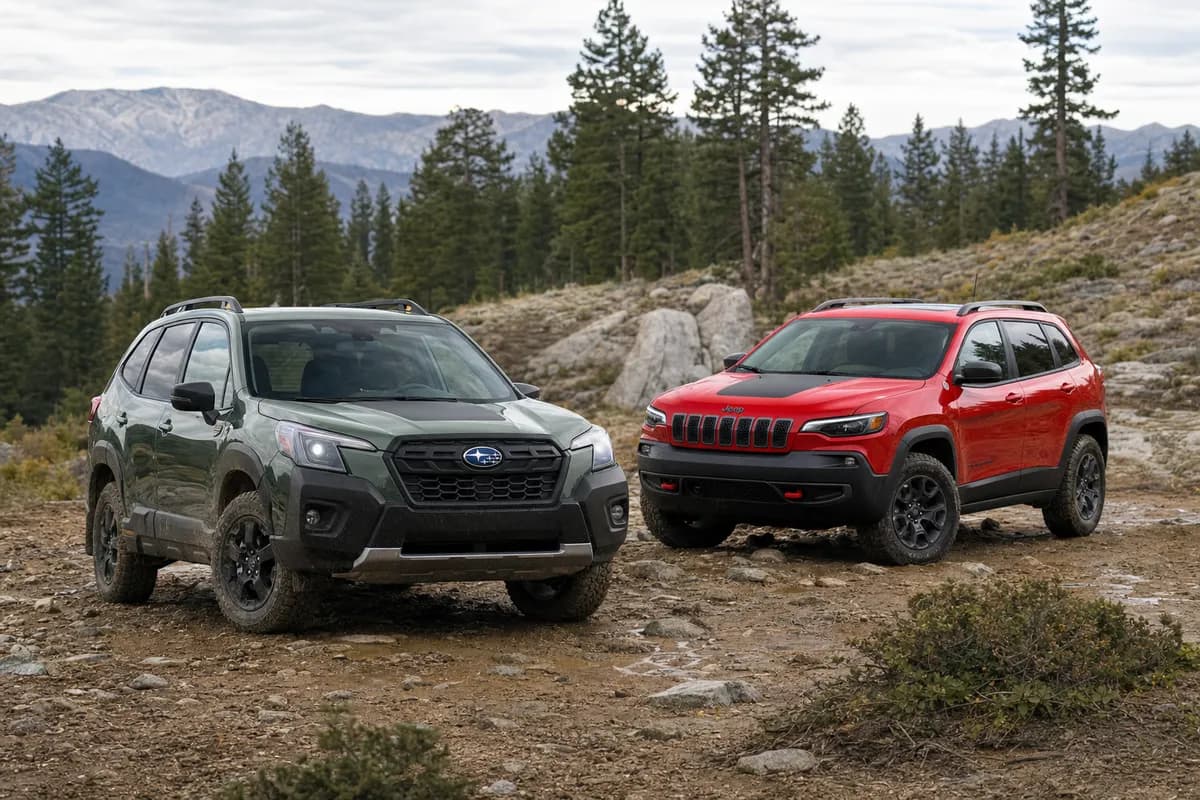
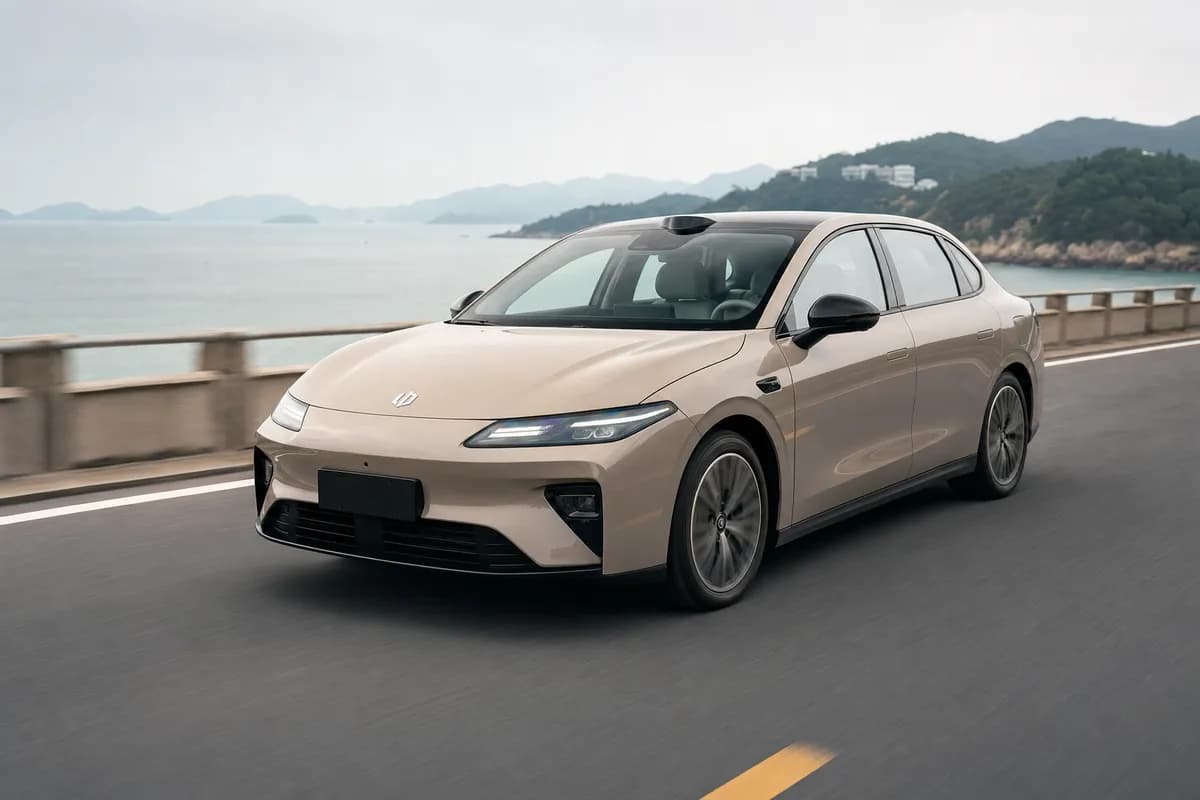
The 2025 Subaru Forester Wilderness turns up to the trailhead wearing sensible hiking boots, a water-resistant backpack, and the calm expression of someone who actually read the map.
The 2025 Subaru Forester Wilderness turns up to the trailhead wearing sensible hiking boots, a water-resistant backpack, and the calm expression of someone who actually read the map. The Jeep Cherokee Trailhawk arrives like it owns the place: red tow hooks, chunkier geometry, a proper low-range system, and the smug confidence of a brand that has been selling dirt as a lifestyle since before Subaru discovered cladding. But here’s the catch: Jeep no longer sells a new Cherokee Trailhawk in the U.S., while Subaru will happily put you in a new Forester Wilderness today. So this is more than a mud-slinging contest. It’s a question plenty of buyers are actually asking: buy the new Subaru, or hunt down a used Cherokee Trailhawk because Jeep still has the better off-road hardware?
We put them through the sort of terrain that separates brochure bravado from actual capability: rutted two-track, loose climbs, offset articulation holes, slick clay, rock shelves, and a water crossing deep enough to make a crossover owner suddenly remember their finance term. The result? One is more comfortable being abused. The other is more clever than it looks.
Hardware Check: Subaru Brings Clearance, Jeep Brings The Big Tools
Let’s start with the numbers, because tires and tow hooks sell dreams, but geometry pays the bills.
The 2025 Subaru Forester Wilderness uses Subaru’s familiar 2.5-liter flat-four making 182 horsepower and 176 lb-ft of torque, paired with a continuously variable transmission and standard symmetrical all-wheel drive. It rides on 17-inch wheels with Yokohama Geolandar all-terrain tires, has 9.2 inches of ground clearance, and gets a revised final-drive ratio versus the regular Forester for better low-speed response. Subaru also fits dual-function X-Mode, which includes Snow/Dirt and Deep Snow/Mud settings.
The Jeep Cherokee Trailhawk, last sold in the U.S. for 2023, is the more serious mechanical proposition. In its final form, it used a 2.0-liter turbocharged four-cylinder with 270 horsepower and 295 lb-ft of torque, a 9-speed automatic transmission, and Jeep Active Drive Lock. That system includes a proper low-range setting and a mechanical locking rear differential. Ground clearance is 8.7 inches, but the Trailhawk counters with better off-road angles: roughly 29.9 degrees approach, 22.9 degrees breakover, and 32.2 degrees departure. The Subaru Forester Wilderness sits at approximately 23.5 degrees approach, 21.0 degrees breakover, and 25.4 degrees departure.
Translation? The Subaru has more belly clearance. The Jeep has better nose and tail clearance, more torque, a low range, and a rear locker. That’s not a small advantage. That’s the off-road equivalent of showing up to a knife fight with a winch catalog.
- 2025 Subaru Forester Wilderness: 182 hp, 176 lb-ft, CVT, AWD, 9.2 inches ground clearance, dual-function X-Mode, all-terrain tires.
- Jeep Cherokee Trailhawk: 270 hp, 295 lb-ft, 9-speed automatic, low range, locking rear differential, 8.7 inches ground clearance, Trail Rated hardware.
- Key Subaru advantage: better ride comfort, more clearance, newer availability, excellent traction programming.
- Key Jeep advantage: torque, gearing, rear locker, approach and departure angles.
Trail Test: Ruts, Rocks, Climbs, And The Bit Where Crossovers Panic
Our test loop began gently enough: a washboard gravel section followed by a rutted forest trail with exposed roots and shallow water cuts. This is where the Forester Wilderness immediately made friends. The Subaru’s suspension tuning is outstanding for this class. It floats over chatter without feeling loose, and its steering stays light but accurate. You can place it cleanly between rocks, and the tall glasshouse gives it a major visibility advantage over the Jeep. If you are new to off-roading, the Subaru makes the trail feel less intimidating.
The Cherokee Trailhawk feels tougher but heavier. Its steering has more weight, its body motions are less airy, and its 9-speed automatic can occasionally feel like it’s deciding between gears with the urgency of a committee meeting. But when the trail steepens, the Jeep stops messing about. Engage low range, select Rock mode, lock the rear differential when needed, and it climbs with a mechanical certainty the Subaru cannot fully mimic.
On our loose 18-degree dirt climb, the Forester Wilderness made it up cleanly using X-Mode in Deep Snow/Mud. It allowed a little wheelspin, shuffled torque quickly, and maintained momentum. The CVT is better here than internet commenters who haven’t driven one will admit. It keeps the engine in its useful rev band, and the shorter Wilderness gearing helps. But it still requires commitment. Lift off at the wrong moment and the Subaru needs a second to gather itself.
The Cherokee Trailhawk simply dug in and walked up. The turbo engine’s 295 lb-ft arrives low enough to matter, and low range gives the driver more precise control. Where the Subaru asks for momentum, the Jeep uses gearing. That distinction matters when the trail gets slow, steep, and ugly.
Next came the articulation section: diagonal holes designed to lift one wheel and expose traction systems that look heroic only on showroom video loops. The Forester Wilderness did surprisingly well. Subaru’s brake-based traction control is quick, and X-Mode reduces throttle sensitivity enough to prevent ham-fisted inputs. But with one wheel light and the opposite rear unloaded, it needed a little throttle to persuade the system to brake the spinning wheel and send torque where useful.
The Jeep? Rear locker. End of paragraph? Almost. With the locker engaged, it crawled through with less drama and less throttle. The Cherokee’s body structure also felt stout, with fewer rattles and less flex noise than expected from a unibody crossover. It’s not a Wrangler, no matter what your uncle with seven ducks on his dashboard claims, but the Trailhawk is genuinely engineered for trail work.
The Subaru is clever. The Jeep is mechanical. On easy and moderate trails, clever is enough. On harder trails, mechanical wins.
Mud And Water: X-Mode Impresses, Trailhawk Still Has The Edge
Mud is where many soft-roaders go to die, usually after their drivers discover that “AWD” and “unstoppable” are not synonyms. Both of these vehicles wore all-terrain tires, and both entered the slick clay section with tire pressures dropped moderately for grip and comfort.
The Forester Wilderness was excellent in shallow mud. Subaru’s symmetrical all-wheel-drive system reacts predictably, and the vehicle’s relatively light footprint helps it skim across soft surfaces rather than bulldoze into them. The CVT also avoids abrupt shifts, which is useful when traction is inconsistent. In Deep Snow/Mud mode, the Forester allows more wheelspin than the standard setting, helping clear the tread blocks and maintain motion.
Where the Subaru struggled was in deeper, stickier ruts. Its ground clearance is good, but its front overhang and departure angle are less confidence-inspiring than the Jeep’s. The Forester’s lower front fascia touched more than once on sharper entries, and while nothing broke, hearing plastic kiss earth is never the soundtrack of dominance. It’s more the sound of your future parts invoice clearing its throat.
The Cherokee Trailhawk had the better mud behavior when things got nastier. The turbocharged torque helped keep the tires churning, and the low-range setting gave more throttle precision. Its front and rear tow hooks are also not decorative jewelry; they’re proper recovery points. Subaru gives the Wilderness useful underbody protection and ruggedized trim, but the Jeep feels more like it expects extraction to be part of the game.
In the water crossing, both vehicles handled themselves well within sensible limits. The Forester’s official ground clearance of 9.2 inches inspires confidence, but water fording is about more than clearance: intake location, electronics protection, bow wave control, and exit traction matter too. The Cherokee Trailhawk again felt more purpose-built, with better approach and departure angles helping it enter and exit without scraping. Neither is a submarine. If you want to cosplay as a Navy vessel, buy a snorkel-equipped 4Runner and a therapist.
Daily Driving Matters: The Subaru Wins Monday Through Friday
Here is where the Forester Wilderness starts clawing back ground. Because unless your commute includes a boulder field and a suspiciously deep creek, you still have to live with the thing.
On pavement, the Subaru is the easier, friendlier vehicle. Its ride is supple, outward visibility is superb, and the cabin layout is practical in that deeply Subaru way: fewer theatrics, more “yes, your dog fits.” The Forester Wilderness also returns better fuel economy than the Cherokee Trailhawk. EPA ratings for the Forester Wilderness are around 25 mpg city, 28 mpg highway, and 26 mpg combined. The turbo Cherokee Trailhawk sits closer to 20 mpg city, 26 mpg highway, and 22 mpg combined, depending on model year and configuration.
The Subaru also has a cargo and usability advantage for many buyers. Its boxy roofline makes loading camping gear easier, and the tall seating position and big windows reduce fatigue on long drives. Subaru’s EyeSight driver-assistance suite is standard, and while the Wilderness trim’s interior is not luxurious, it is durable, water-resistant, and clearly designed for people who own muddy boots rather than just Instagram filters.
The Jeep counters with stronger acceleration and a higher towing rating when properly equipped. The Cherokee Trailhawk can tow up to around 4,000 pounds in turbo form, while the Forester Wilderness is rated at 3,000 pounds. If your adventure kit includes a small camper, dirt bikes, or a utility trailer, the Jeep’s extra torque and towing headroom matter.
But the Cherokee is also the older vehicle. Its infotainment and cabin design were showing age by the time it left the market, and used examples vary wildly in condition. A Trailhawk that spent its life at Whole Foods is one thing. A Trailhawk that has been pinstriped by mesquite, overheated in sand, and power-washed into electrical resentment is another. Buying used off-road vehicles is like dating someone who says they “love spontaneity.” Could be fun. Could be expensive.
- Best daily driver: Subaru Forester Wilderness.
- Best towing choice: Jeep Cherokee Trailhawk.
- Best visibility and ease of use: Subaru Forester Wilderness.
- Best low-speed trail control: Jeep Cherokee Trailhawk.
- Best new-car ownership proposition: Subaru, because Jeep discontinued the Cherokee.
Capability Verdict: The Jeep Wins The Trail, The Subaru Wins The Ownership Argument
If this test were judged purely on off-road hardware and tough-terrain performance, the Jeep Cherokee Trailhawk wins. Not by a marketing inch. By a proper mechanical margin. Its low-range system, locking rear differential, stronger turbo engine, better approach and departure angles, and more confident recovery setup make it the more capable machine when the trail turns from scenic to spiteful.
The Trailhawk is the one I’d choose for repeated rocky climbs, deep ruts, and technical crawling where momentum is not your friend. It feels more comfortable being dragged through unpleasant terrain, and it gives the driver more tools to solve problems. The Subaru’s software is excellent, but software still has to fake what the Jeep can lock, gear down, and torque through.
But buyers do not live in spec sheets or articulation pits. They live with payments, warranties, fuel bills, commutes, dogs, kids, trailheads, and the occasional grim realization that “mild overlanding” mostly means hauling a cooler to a campsite with cell service. In that world, the 2025 Subaru Forester Wilderness is the smarter buy for most people. It is more efficient, easier to drive every day, available new, backed by a fresh warranty, and still legitimately capable on forest roads, snowed-in tracks, muddy campsites, and moderate trails.
It also has the Subaru magic trick: it makes ordinary drivers better off-road. The Forester Wilderness communicates clearly, finds traction quickly, and rarely feels like it’s one bad decision away from a recovery strap. It is not a rock crawler, and anyone who tells you otherwise probably thinks a roof basket adds horsepower. But it is one of the most capable compact crossovers you can buy new.
So here’s the clean verdict:
- Buy the Jeep Cherokee Trailhawk if you want the more serious off-road machine and are comfortable shopping used. It has the hardware, torque, and geometry to tackle harder trails with less drama.
- Buy the 2025 Subaru Forester Wilderness if you want a new, reliable, efficient, trail-capable crossover that shines in real-world adventure use and doesn’t punish you on the drive home.
The Jeep wins the obstacle course. The Subaru wins the life test. And for most buyers, that makes the Forester Wilderness the better answer, even if the Trailhawk is the one you’d rather have when the trail gets ugly and your passenger starts quietly Googling “nearest tow service.”
Final call: For maximum off-road capability, the Jeep Cherokee Trailhawk remains the tougher tool. For the best all-around adventure crossover in 2025, the Subaru Forester Wilderness is the one I’d park in my driveway.
Affiliate disclosure: This article contains affiliate links. RevvedUpCars may earn a small commission on qualifying purchases at no extra cost to you.