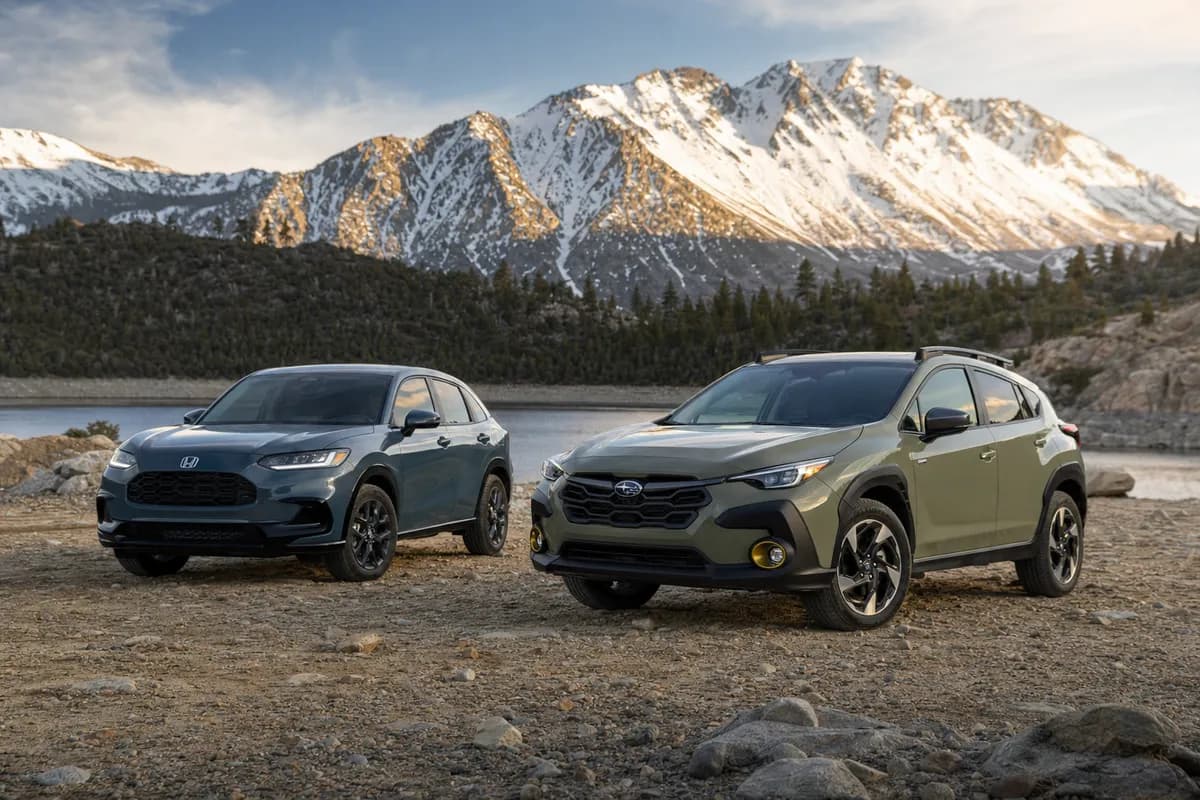
The 2024 Subaru Crosstrek and 2024 Honda HR-V are both compact crossovers in the same way hiking boots and clean white sneakers are both footwear.
The numbers back it up. The HR-V offers 24.4 cubic feet of cargo space behind the rear seats and 55.1 cubic feet with the rear seats folded. The Crosstrek gives you about 19.9 cubic feet behind the rear seats and roughly 54.7 cubic feet maximum. That means the Honda is notably better when the rear seats are up, which is how normal people use their cars most of the time. Grocery runs, airport bags, strollers, camera gear, and gym bags fit more easily in the HR-V.
Rear-seat passengers also fare slightly better in the Honda. HR-V rear legroom is about 37.7 inches, while the Crosstrek sits around 36.5 inches. Neither is a limousine, but the HR-V feels more relaxed for adults in the second row. The Subaru’s roofline and glass area do help outward visibility, and its hatch opening is usefully square, but the Honda simply packages people and stuff better.
That said, Subaru claws back points where the pavement ends. Every 2024 Crosstrek comes with standard all-wheel drive, and most trims sit on 8.7 inches of ground clearance. Step up to the Crosstrek Wilderness and that rises to 9.3 inches, which is better than plenty of so-called rugged SUVs that are really just commuter pods wearing black plastic eyeliner.
The HR-V, by contrast, offers front-wheel drive as standard and all-wheel drive as an option. Ground clearance is around 7.0 inches for front-wheel-drive models and about 7.3 inches with all-wheel drive. That is fine for snow-packed streets and rutted parking lots. It is not the spec sheet you want if your weekend plans include forest roads, washouts, or smug friends in Crosstreks waiting at the trailhead.
- Best for cargo with seats up: Honda HR-V
- Best for rear-seat room: Honda HR-V
- Best for ground clearance: Subaru Crosstrek
- Best standard traction hardware: Subaru Crosstrek
Powertrains and Driving: Slow, Slower, and Finally Acceptable
Let’s address the polite elephant trudging through the room: neither of these crossovers is quick. If you are looking for hot-hatch energy in hiking pants, look elsewhere. The Mazda CX-30 Turbo exists. So does the Volkswagen Taos if you can live with its quirks. The Crosstrek and HR-V are about traction, efficiency, and daily drivability, not making your passengers spill coffee during an on-ramp launch.
The 2024 Honda HR-V uses a 2.0-liter naturally aspirated four-cylinder making 158 horsepower and 138 lb-ft of torque, paired with a continuously variable transmission. It is smooth enough, but the engine has to work hard when the car is loaded or climbing. Independent testing typically puts the HR-V’s 0-60 mph time in the 9.5-to-10-second range, depending on drivetrain and conditions. Translation: plan your passing maneuvers like a chess grandmaster.
The 2024 Subaru Crosstrek starts with a 2.0-liter flat-four making 152 horsepower and 145 lb-ft of torque in Base and Premium trims. That version is also slow, with 0-60 mph performance commonly landing in the 9-second range. It is adequate in town but wheezy at highway speeds, especially with passengers aboard. If you buy the 2.0-liter Crosstrek and then complain it feels underpowered, congratulations: you ignored the warning label.
The better Crosstrek is the one with Subaru’s 2.5-liter flat-four, standard on Sport, Limited, and Wilderness trims. It produces 182 horsepower and 178 lb-ft of torque, and it changes the car’s personality from “motivated by obligation” to “actually acceptable.” It still uses a CVT, and no, the transmission does not suddenly become a dual-clutch masterpiece. But the extra torque makes merging, climbing, and passing far less labored. Expect 0-60 mph in roughly the 8-second range for 2.5-liter models.
On the road, the Honda feels more polished. Its steering is tidy, the ride is composed, and the structure feels solid. The HR-V has a more conventional, Civic-adjacent smoothness that makes it easy to drive every day. It is quieter and more settled than the old HR-V, which had all the refinement of a vending machine rolling down a staircase.
The Crosstrek is more interesting. Subaru’s steering is nicely weighted, the suspension has real travel, and the chassis feels happy on broken pavement. It does not corner like a Mazda CX-30, but it has a tough, planted feel that makes bad roads less annoying. The Wilderness model adds all-terrain tires, revised gearing, additional drive-mode programming, and more underbody protection. You pay for that with more road noise and slightly worse fuel economy, but if capability matters, the trade is worth it.
Fuel economy is close, but Subaru does well considering all-wheel drive is standard. A 2024 Crosstrek with the 2.0-liter is rated up to 27 mpg city, 34 mpg highway, and 29 mpg combined. The 2.5-liter Sport and Limited are rated around 26 city, 33 highway, and 29 combined. The Wilderness drops to about 25 city, 29 highway, and 27 combined.
The HR-V is rated at approximately 26 mpg city, 32 highway, and 28 combined with front-wheel drive, or around 25 city, 30 highway, and 27 combined with all-wheel drive. In the real world, neither will bankrupt you at the pump. But the Crosstrek’s ability to match or beat the AWD HR-V while giving you more ground clearance and standard AWD is a very Subaru kind of flex.
Driving verdict: The HR-V is smoother and more civilized. The Crosstrek 2.5 is stronger, more confident on rough surfaces, and vastly more capable when conditions get ugly. Avoid the 2.0-liter Crosstrek unless your favorite hobby is waiting.
Capability: This Is Where Subaru Lands the Punch
If this comparison is about compact crossover capabilities, the Crosstrek wins the dirty work. Not by a little. By a muddy boot to the chest.
Every Crosstrek gets Subaru’s symmetrical all-wheel-drive system, which continuously sends power to all four wheels rather than treating the rear axle like an emergency intern. On higher trims, Subaru’s X-Mode helps manage traction on slippery surfaces. The Wilderness model adds dual-function X-Mode with settings for snow, dirt, and deep snow or mud, plus a revised final drive ratio to improve low-speed control.
The Wilderness also gets Yokohama Geolandar all-terrain tires, a higher ride height, extra body cladding, upgraded roof rails, and a more rugged interior with water-resistant StarTex upholstery. Most importantly for people who tow small trailers or adventure gear, the Crosstrek Wilderness is rated to tow up to 3,500 pounds. Standard Crosstrek models are rated at 1,500 pounds.
The HR-V is not rated for towing in the U.S., which tells you Honda’s intentions rather clearly. Its available all-wheel-drive system is useful in rain and snow, and it is perfectly sensible for winter commuting. But this is not a crossover begging to be taken down a rocky access road. It lacks the clearance, tire package, low-speed traction logic, and tow rating to hang with the Subaru when the road turns feral.
Does that matter to everyone? Absolutely not. Plenty of buyers never leave pavement, and for them, the HR-V’s extra cargo space and smoother manners are more relevant than the Crosstrek’s ability to cosplay as a miniature Outback. But if you live in Colorado, Vermont, northern Michigan, the Pacific Northwest, or anywhere winter treats roads like a demolition derby, the Subaru’s hardware matters.
There is also a confidence factor. The Crosstrek feels like it wants bad weather. The HR-V feels like it can tolerate bad weather. That distinction is not marketing fluff; it is the difference between planning around conditions and simply getting on with your day.
- Crosstrek ground clearance: 8.7 inches, or 9.3 inches for Wilderness
- HR-V ground clearance: roughly 7.0 to 7.3 inches, depending on drivetrain
- Crosstrek towing: 1,500 pounds, or 3,500 pounds for Wilderness
- HR-V towing: not rated for towing in the U.S.
- Standard AWD: Subaru Crosstrek only
Cabins, Tech, Safety, and Value
Inside, the Honda HR-V plays the refinement card. The dashboard is clean, the controls are logical, and the driving position is excellent. The cabin design borrows some of the Civic’s mature simplicity, including a tidy horizontal layout and easy-to-use switchgear. Honda does not always give you the flashiest screens, but it usually nails the basics, and the HR-V is no exception.
Base and Sport HR-V models use a 7-inch touchscreen, while the EX-L gets a 9-inch touchscreen with wireless Apple CarPlay and Android Auto. The EX-L also brings nicer upholstery, a power driver’s seat, and more premium touches. The HR-V’s cabin is not luxurious, but it is well assembled and refreshingly low on gimmicks.
The Subaru Crosstrek’s cabin is more rugged and more vertical in presentation. Base models use a dual-screen setup, while most trims get Subaru’s large 11.6-inch portrait-oriented touchscreen. It looks impressive and includes wireless smartphone integration on many trims, but Subaru still buries too many functions in the screen. Adjusting climate settings through a giant display while bouncing down a dirt road is not my idea of ergonomic genius. Give me knobs. I am a simple man with functioning fingers.
Seat comfort is good in both. The Subaru’s front seats are supportive, and the Crosstrek’s visibility remains a genuine advantage. Thin pillars, a low beltline, and a commanding view make it easy to place on narrow roads. The Honda feels a little more carlike and settled, which some buyers will prefer. The Subaru feels more upright and outdoorsy, which is either charming or exactly the stereotype you came to buy.
Safety tech is strong on both sides. The Crosstrek comes standard with Subaru’s EyeSight driver-assistance suite, including adaptive cruise control, lane-keeping assistance, pre-collision braking, and other active safety features. Honda includes Honda Sensing on the HR-V, with similar features such as collision mitigation braking, road departure mitigation, adaptive cruise control, and lane-keeping assist.
Pricing is where the comparison gets spicy. When new, the 2024 Honda HR-V started around the mid-$25,000 range including destination for an LX front-wheel-drive model, with AWD adding roughly $1,500 depending on trim. The EX-L AWD could push into the low-$30,000 range. The 2024 Subaru Crosstrek started around the mid-$26,000 range including destination, but remember: AWD is standard. The desirable 2.5-liter Crosstrek Sport and Limited trims sat around the low-$30,000 range, while the Wilderness landed slightly above that.
If you are comparing base prices, the Honda looks cheaper. If you are comparing all-wheel-drive versions, the Subaru becomes more compelling. And if you care about capability, the Crosstrek’s value advantage grows fast. The HR-V makes more sense if you want a roomy, efficient, nicely built small crossover and have no need for serious trail or snow performance. The Crosstrek makes more sense if you would have added AWD anyway.
Verdict: Buy the Subaru for Capability, the Honda for Civilization
The 2024 Honda HR-V is the better small crossover for buyers who stay mostly on pavement. It has more cargo space behind the rear seats, a roomier second row, a polished cabin, and a smoother daily-driving character. It is the more urban, more practical, more Honda-like choice. If your life is commuting, errands, school runs, and the occasional snowy morning, the HR-V AWD will do the job without drama.
But the 2024 Subaru Crosstrek is the more capable machine, and in this comparison, capability is not a decorative word slapped onto a brochure. It has standard all-wheel drive, more ground clearance, stronger available power, real off-road-oriented trims, and meaningful towing ability in Wilderness form. The HR-V is a good compact crossover. The Crosstrek is a good compact crossover that also happens to be useful when the map turns brown and wiggly.
My pick? Buy the Subaru Crosstrek Sport or Limited with the 2.5-liter engine if you want the best all-around version. It has enough power, excellent foul-weather confidence, strong fuel economy, and the kind of go-anywhere attitude that makes the HR-V feel a bit office-bound. If you genuinely need extra clearance, tougher tires, and 3,500 pounds of towing capacity, buy the Crosstrek Wilderness and accept the fuel-economy hit like an adult.
Choose the Honda HR-V EX-L AWD if your priorities are interior space, refinement, and easy everyday usability. It is a smarter city companion and a better cargo hauler with the rear seats up. Just do not confuse available AWD with adventure-readiness. The HR-V will get you through winter. The Crosstrek will ask where the trail starts.
Final call: For pure compact crossover capability, the 2024 Subaru Crosstrek wins. The Honda HR-V is the tidier daily driver, but the Subaru is the one I would trust when the weather turns rotten, the pavement disappears, or the weekend gets properly interesting.
Affiliate disclosure: This article contains affiliate links. RevvedUpCars may earn a small commission on qualifying purchases at no extra cost to you.