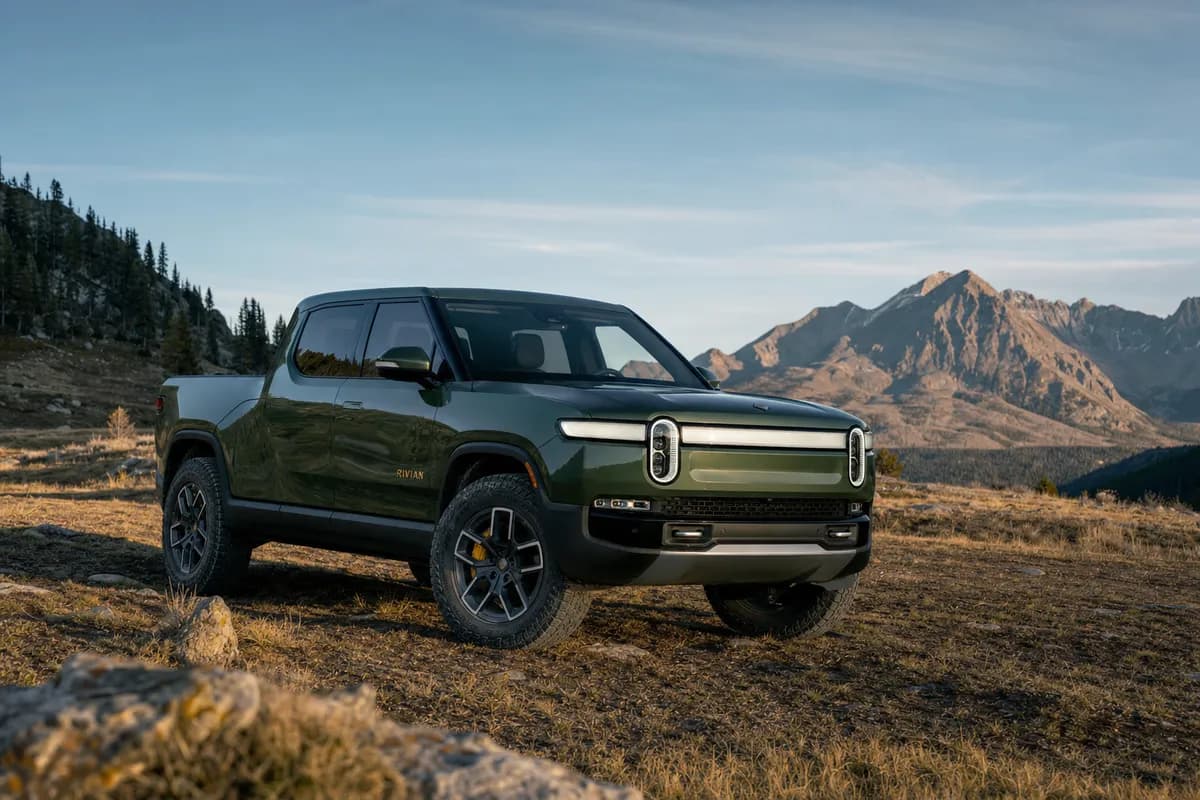
The 2025 Rivian R1T is what happens when an electric truck stops trying to cosplay as a gas pickup and leans into being something stranger, smarter, and far more interesting.
The 2025 Rivian R1T is what happens when an electric truck stops trying to cosplay as a gas pickup and leans into being something stranger, smarter, and far more interesting. After living with the refreshed R1T through highway slogs, charging-station purgatory, muddy trails, school runs, hardware-store errands, and one deeply smug campsite arrival, the verdict is clear: this is still the benchmark adventure EV truck. Not the best work truck. Not the cheapest electric pickup. Not the one you buy because your uncle has a fleet account. But if your weekends involve bikes, dogs, dirt, tents, boats, snowboards, or an irrational desire to silently humiliate expensive SUVs on a fire road, the R1T remains the truck to beat.
What We Tested: 2025 Rivian R1T, Refreshed and Rewired
Our long-term 2025 Rivian R1T was a Gen 2 Adventure model equipped with the Performance Dual-Motor setup and Max battery pack, the configuration that best captures the R1T’s real-world sweet spot. Rivian’s headline-grabbing Tri-Motor and upcoming Quad-Motor variants are quicker, louder in the spec-sheet sense, and better for cocktail-party acceleration brags. But for actual ownership, the Performance Dual Max is the grown-up choice: big range, serious punch, and enough off-road hardware to make most “trail-rated” SUVs look like shopping carts in hiking boots.
For 2025, Rivian didn’t just give the R1T a new color palette and call it innovation. The Gen 2 truck gets a reworked electrical architecture with fewer electronic control units, updated battery packs, revised suspension hardware, new in-house drive units, improved thermal management, a heat pump, sharper software, and upgraded camera/radar hardware for driver-assistance features. Translation: less complexity, better efficiency, and fewer excuses.
- Tested configuration: 2025 Rivian R1T Adventure Performance Dual-Motor Max Pack
- Output: 665 hp and 829 lb-ft of torque
- Estimated 0-60 mph: 3.4 seconds
- EPA range: up to around 410 miles depending on wheels and tires
- Towing capacity: up to 11,000 pounds
- Maximum ground clearance: up to 14.9 inches
- Water fording depth: up to 43.1 inches
- Bed length: 54.1 inches with the tailgate up
- Key rivals: Ford F-150 Lightning, Tesla Cybertruck, Chevrolet Silverado EV, GMC Hummer EV Pickup
Pricing depends heavily on battery and motor choice, but a sensibly equipped Max Pack R1T still pushes well into premium territory. Think upper-$80,000s to mid-$90,000s before options depending on exact spec. That is a lot of money for a pickup with a short bed and no dealer network. It is also less silly than paying six figures for a GMC Hummer EV that weighs roughly the same as a minor moon and corners like a refrigerator on roller skates.
On the Road: Absurd Speed, Real Refinement
The first thing you notice in the 2025 R1T is not the speed. It is the calm. The old R1T was quick, capable, and occasionally a little busy over rough pavement. The revised Gen 2 chassis feels more composed, with better body control and less of the nervous patter that could make early trucks feel like they were constantly reminding you about their 7,000-pound curb weight.
Then you press the accelerator, and the calm is replaced by a quiet act of violence.
With 665 hp and 829 lb-ft, the Performance Dual-Motor R1T does not “accelerate” so much as issue a correction to the horizon. Rivian quotes 0-60 mph in 3.4 seconds, and that feels entirely believable. It is not as unhinged as the Tri-Motor R1T, which Rivian says can do the sprint in about 2.9 seconds, but unless your commute includes a runway and a medic, the Performance Dual is more than enough. It will dust a Ford F-150 Lightning Lariat, embarrass a Ram TRX from a roll, and make most sports sedans look like they forgot to RSVP.
The steering is accurate if not chatty. You do not get Porsche Cayenne levels of feedback, but you do get a truck that places itself cleanly and resists the nautical slop that haunts big pickups. The air suspension is the star: it raises for trail work, hunkers down at speed, and gives the R1T a bandwidth that no leaf-sprung gas truck can match. Around town, it rides firmly but expensively. On the highway, it settles into a quiet, long-legged cruise.
Noise levels are excellent, though the all-terrain tires add a faint thrum on coarse pavement. Wind noise is well controlled considering the R1T has the aerodynamic silhouette of a designer toolbox. Rivian’s cabin isolation is better than the Ford F-150 Lightning and miles ahead of the Tesla Cybertruck, which still feels like it was acoustically tuned inside a stainless-steel elevator shaft.
The regenerative braking is strong and predictable, though Rivian still leans heavily into one-pedal driving. Once you acclimate, it becomes natural. If you are coming from a traditional truck, you may spend the first day bobbing your passengers’ heads like dashboard ornaments. By day three, you will wonder why every pickup does not drive this way.
Off-Road: This Is Where the Rivian Earns Its Swagger
Plenty of electric trucks are quick. Fewer are genuinely good when the road gives up. This is where the R1T separates itself from the F-150 Lightning and Chevrolet Silverado EV. Those trucks are excellent electric pickups in the conventional sense. The Rivian is an adventure tool that happens to have a bed.
Ground clearance of up to 14.9 inches is not brochure fluff. It matters when you are picking across rocks, descending rutted trails, or trying to avoid the soul-cracking sound of battery armor meeting geology. The R1T’s approach, breakover, and departure angles depend on ride height and tire setup, but the truck consistently feels less cumbersome off-road than its size suggests. At 217.1 inches long, it is not a Jeep Wrangler. But it also does not feel like a Silverado EV trying to salsa dance in hiking boots.
The dual-motor setup lacks the individual wheel control theater of Rivian’s original Quad-Motor system, but the software calibration is excellent. Torque delivery is smooth, traction control intervenes intelligently, and the truck rarely feels flustered. In loose dirt, sand, and snow, the R1T’s instant torque is a cheat code. In rockier terrain, the precision of electric propulsion makes crawling almost comically easy. There is no torque converter shuffle, no throttle lag, no transmission hunting for dignity.
The air suspension gives you useful adjustability, and the underbody protection inspires confidence. Rivian’s drive modes are not gimmicks, either. All-Purpose is the default for a reason, but Off-Road settings noticeably alter throttle response, ride height, and traction behavior. The truck feels engineered by people who actually go outside, not just people who wear fleece vests in investor presentations.
The R1T’s secret is not that it can go off-road. Lots of trucks can. Its secret is that it makes difficult terrain feel easy without turning the experience into a tractor pull.
The short bed remains both a limitation and part of the charm. At 54.1 inches with the tailgate up, it is not swallowing full sheets of plywood flat like a traditional full-size pickup. But Rivian counters with genuinely useful storage: the front trunk, the brilliant gear tunnel behind the cab, under-seat cubbies, and a lockable bed. The gear tunnel remains one of the best packaging ideas in modern truck design. It is perfect for muddy boots, recovery gear, backpacks, charging cables, or anything you do not want sliding around the cabin.
Range, Charging, and Towing: The Adventure Tax Is Real
Range is the reason to choose the Max Pack. Rivian estimates up to about 410 miles of EPA range in certain Dual-Motor Max configurations, though wheel and tire choice matter. Fit aggressive all-terrain rubber and expect that number to drop. In mixed long-term driving, including highway miles, cold mornings, dirt-road excursions, and enthusiastic throttle use, real-world efficiency landed in the broad zone you would expect from a large electric truck: impressive for what it is, but still physics-bound.
On steady highway runs, the R1T is happiest below 75 mph. Push faster and the range falls with the blunt honesty of a brick in a wind tunnel. That is not unique to Rivian; the F-150 Lightning and Hummer EV suffer the same problem, and the Hummer solves it by carrying a battery pack large enough to power a county fair. The Silverado EV is the range champ among electric trucks when properly equipped, with some versions exceeding 440 miles EPA, but it feels more like an electric workhorse than an alpine escape pod.
DC fast charging peaks at over 200 kW under ideal conditions, and the improved thermal management helps maintain better consistency than early trucks. A 10-80 percent charge still depends heavily on station quality, battery temperature, and whether the charger you picked has decided to become a decorative object. Rivian’s own Adventure Network chargers are excellent when you can find them: reliable, clean, logically placed near outdoor routes, and blissfully less chaotic than many public charging sites.
The elephant in the campsite is towing. Rivian rates the R1T to tow up to 11,000 pounds, matching serious pickup territory on paper. But tow a heavy trailer and range takes a chainsaw to your plans. Expect roughly 40 to 50 percent range loss depending on trailer weight, aerodynamics, temperature, and speed. This is not a Rivian-specific scandal; it is an electric-truck reality. A Ford F-150 Lightning pulling a tall camper suffers the same fate. The difference is that with the Rivian Max Pack, you start with more cushion.
If you tow a boat 30 miles to the lake, the R1T is superb. If you regularly haul 9,000 pounds across three states, buy a diesel and stop pretending electrons are magic. The R1T can tow. It cannot bend energy density to your vacation itinerary.
Cabin, Tech, and Daily Life: Premium, Clever, Occasionally Too Clever
Inside, the 2025 R1T feels expensive in a distinctly Rivian way: clean design, sustainable materials, big screens, clever storage, and a calm aesthetic that suggests Patagonia hired a Scandinavian architect. The seats are supportive over long distances, visibility is good, and the driving position feels more SUV than farm equipment. Rear-seat space is adult-friendly, though not cavernous like an F-150 crew cab.
The infotainment system is attractive and quick, but Rivian’s insistence on screen-based controls remains irritating. Adjusting vents through a touchscreen is one of those ideas that should have been stopped in a meeting by someone with a spine. The interface is generally better than Tesla’s in visual polish and worse than traditional buttons in common sense. Rivian does not offer Apple CarPlay or Android Auto, which is still a self-inflicted wound. Built-in apps and navigation are decent, but buyers spending this much should not have to negotiate with a car company over how they use their phone.
Driver-assistance features are improved for 2025 thanks to new hardware and computing power, though Rivian’s system still trails GM’s Super Cruise in hands-free polish. Highway Assist works well on mapped roads, lane centering is smooth, and adaptive cruise is generally confident. It is not a robot chauffeur, and thankfully Rivian does not market it like one. Looking at you, Tesla.
Build quality in our test truck was notably better than early R1Ts, with tighter trim fit, fewer squeaks, and more consistent software behavior. Over-the-air updates remain one of Rivian’s strengths. The truck you buy today can improve meaningfully over time, which is still one of the best arguments for a software-defined EV when the software is not actively trying to ruin your morning.
Daily usability is excellent if your life fits the R1T’s shape. The frunk is huge and practical. The gear tunnel is genius. The bed is short but useful. The powered tonneau cover, where equipped, is convenient, though owners should still treat any complex powered truck-bed gadget with a healthy suspicion. Payload capacity varies by configuration, but the R1T is generally stout enough for camping gear, tools, bikes, and weekend abuse. It is not the truck I would choose for a masonry business. It is exactly the truck I would choose for disappearing into the mountains with two friends and too much coffee.
Verdict: The Best Adventure EV Truck, With Caveats You Should Actually Understand
So, is the 2025 Rivian R1T the ultimate adventure electric truck? Yes. And unlike most automotive “yes, but” verdicts, the “but” here is not cowardice. It is context.
The R1T is more capable off-road than the Ford F-150 Lightning, more refined and cohesive than the Tesla Cybertruck, far more wieldy than the GMC Hummer EV Pickup, and more lifestyle-ready than the Chevrolet Silverado EV. It blends sports-car acceleration, luxury-SUV comfort, serious trail capability, and genuinely clever packaging in a way no rival quite matches.
But it is expensive. Public charging still requires planning. Towing range remains a hard limitation. The bed is not full-size-truck practical. And Rivian’s touchscreen-first philosophy occasionally makes simple tasks feel like software chores. If you need a jobsite mule, buy an F-150 PowerBoost, Silverado HD, or a gas half-ton and sleep peacefully. If you need maximum EV range and a bigger bed, the Silverado EV deserves a hard look. If you want attention at every traffic light and enjoy explaining panel gaps to strangers, the Cybertruck exists.
For everyone else with the budget and the lifestyle to match, the 2025 Rivian R1T is still the electric truck I would take home. Not because it is perfect. Because it is the rare EV pickup that understands its mission. It is fast without being childish, rugged without being crude, premium without being precious, and clever without completely disappearing up its own app menu.
Final verdict: The 2025 Rivian R1T is the best adventure-focused electric truck on sale. Choose the Dual-Motor Max Pack if you value range and usability, the Tri-Motor if you want supercar-baiting madness, and skip it only if your truck life revolves around heavy towing or full-size-bed work. For trails, travel, and everyday electric swagger, the R1T remains the one to beat.
Affiliate disclosure: This article contains affiliate links. RevvedUpCars may earn a small commission on qualifying purchases at no extra cost to you.