The electric pickup wars have mostly been fought with party tricks: drag-strip launches, giant screens, onboard outlets, and range claims with enough asterisks to look like a loan contract.
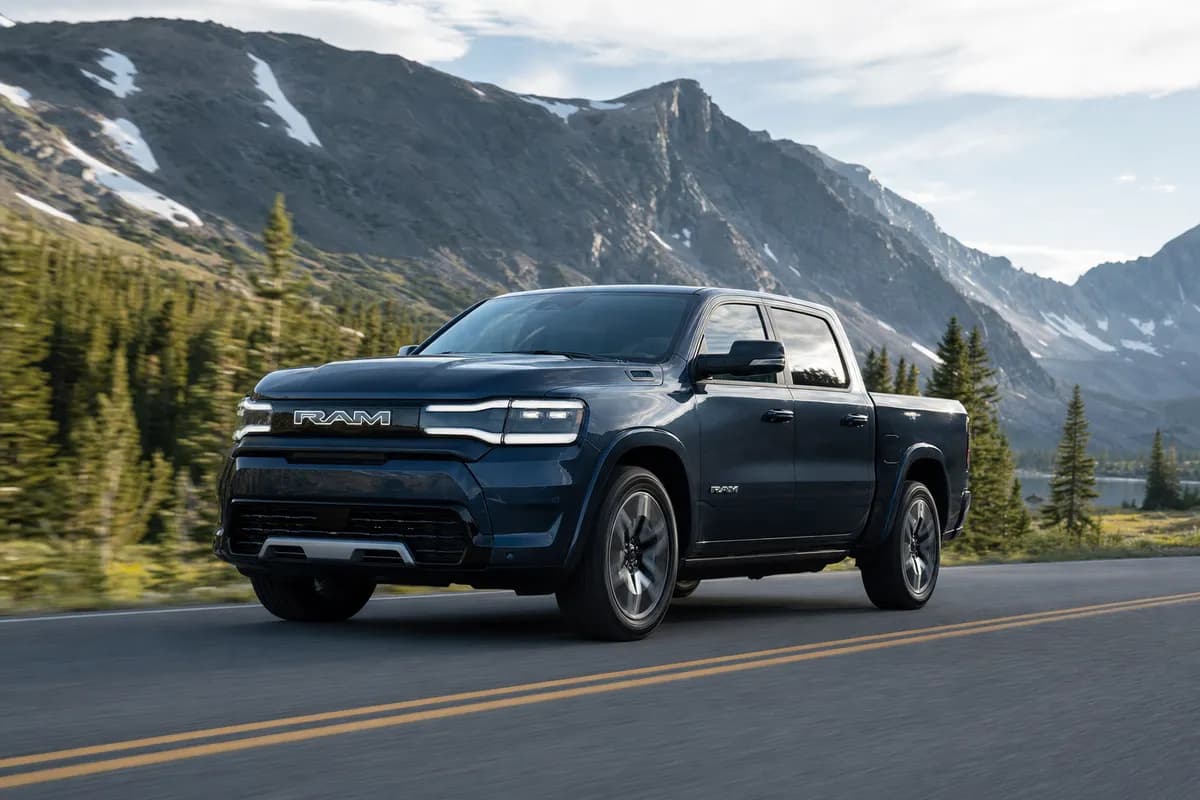
The electric pickup wars have mostly been fought with party tricks: drag-strip launches, giant screens, onboard outlets, and range claims with enough asterisks to look like a loan contract. The 2025 Ram 1500 EV — officially the Ram 1500 REV — arrives with a different kind of swagger. It doesn’t just want to be quick, quiet, and vaguely eco-conscious. It wants to tow 14,000 pounds, haul 2,700 pounds, recharge at 350 kW, and make a Ford F-150 Lightning look like it brought a butter knife to a bar fight. After a first drive in a pre-production truck, the headline is simple: Ram has built the most convincing electric pickup for people who still expect a pickup to behave like a truck.
Big Battery, Bigger Intentions
Ram has been late to the electric pickup party, but it has not arrived empty-handed. The 2025 Ram 1500 REV rides on Stellantis’ STLA Frame architecture, a body-on-frame EV platform built specifically for large trucks and SUVs. That matters. This isn’t a crossover in boots, and it doesn’t feel like one.
The numbers are suitably ridiculous. Ram says the 1500 REV will offer up to 654 horsepower and 620 lb-ft of torque from dual electric drive modules, with all-wheel drive standard. The estimated 0-60 mph time is 4.4 seconds, which is deeply unserious behavior for something shaped like a shipping container with headlights.
Two battery packs are planned. The standard pack is a massive 168-kWh unit targeting up to 350 miles of range. The big-boy pack is a colossal 229-kWh battery targeting up to 500 miles. That figure, if Ram delivers it in the real world, would put the REV well ahead of the Ford F-150 Lightning Extended Range, which is EPA-rated up to 320 miles, and in the conversation with the Chevrolet Silverado EV, which has posted GM-estimated range figures around the 440-mile mark in some configurations.
Of course, range claims in electric trucks are like gym selfies: flattering, selective, and not always representative of hard labor. Tow a large trailer at highway speeds and every EV pickup bleeds range brutally. But starting with 500 miles instead of 300 gives you a much bigger cushion before physics comes around with a shovel.
Charging is equally aggressive. The REV uses an 800-volt electrical architecture and supports DC fast charging up to 350 kW. Ram claims it can add about 110 miles of range in roughly 10 minutes under ideal conditions. That is not quite gas-station quick, despite what the EV evangelists will tell you after their third oat-milk latte, but it is genuinely useful — especially for contractors, fleet drivers, and road-trippers who don’t want their lunch stops to become lease agreements.
First Drive: Quiet Violence, Proper Truck Manners
The first thing you notice is not the speed. It is the silence. Ram’s gasoline 1500 has long been the polished one in the full-size pickup class, especially with its coil-spring rear suspension and upscale cabin tuning. The REV takes that refinement and removes the last bit of mechanical background noise. No V8 thrum, no turbo-six growl, no transmission hunting, no driveline clunks. Just a faint electric whirr and a lot of mass moving very quickly.
Stab the accelerator and the 1500 REV surges forward with the familiar EV shove, but it’s not twitchy or cartoonishly aggressive. Ram has tuned the throttle with unusual restraint. There’s immediate torque, yes, but it’s delivered with the confidence of a heavy-duty tool rather than a YouTube stunt vehicle. A Tesla Cybertruck Cyberbeast may be quicker, and a Rivian R1T Quad-Motor will still feel more like a rally car with a bed, but the Ram’s power delivery is better suited to daily use. It doesn’t try to turn every merge lane into a legal deposition.
The steering is light but accurate, and the truck tracks cleanly at speed. There’s no hiding the mass — especially with the larger battery pack, which is basically a small studio apartment made of lithium — but the weight sits low, and that helps. Body roll is controlled better than you expect from a full-size pickup, and the REV feels planted through long sweepers. It is not sporty. Don’t be daft. But it is composed, predictable, and less floaty than many gasoline half-tons.
Ride quality is a Ram strength, and the EV keeps that tradition alive. The battery weight actually helps the truck feel settled over rough pavement, and the suspension does a fine job smoothing out broken surfaces without turning the cabin into a bounce house. The F-150 Lightning is also impressively comfortable, but the Ram feels denser and more premium from behind the wheel. The Chevy Silverado EV has a clever platform and huge range potential, but its cabin ambience — depending on trim — can feel more “fleet future” than “luxury truck.” Ram, as usual, understands that truck buyers like nice things and will pay handsomely for them.
Regenerative braking offers meaningful deceleration, though Ram wisely avoids making the truck feel like a science project. One-pedal driving is useful in town, particularly in traffic, but the brake pedal tuning is the more important achievement. Blended braking in EVs often feels like stepping on a damp sponge attached to a laptop. In the REV, pedal response is linear enough that most drivers won’t think about it after the first mile. That is the goal.
Capability: The Numbers Are Not Subtle
Here is where Ram takes its biggest swing. The 1500 REV is targeting a maximum towing capacity of 14,000 pounds and maximum payload of 2,700 pounds. Those figures matter because they beat or match key rivals on paper.
- Ram 1500 REV: up to 14,000 pounds towing, 2,700 pounds payload
- Ford F-150 Lightning: up to 10,000 pounds towing, around 2,235 pounds payload depending on configuration
- Chevrolet Silverado EV: commonly quoted at up to 10,000 pounds towing in RST form, with higher-capability versions promised
- Tesla Cybertruck: up to 11,000 pounds towing, up to 2,500 pounds payload
- Rivian R1T: up to 11,000 pounds towing, with lower payload than the Ram
That 14,000-pound tow rating is the kind of number truck buyers actually notice. Whether they tow that much regularly is another matter — most don’t — but capability sells. It also builds credibility. Nobody wants an electric truck that feels like it needs a permission slip to pull a trailer.
Ram has also given the REV a front trunk with about 15 cubic feet of storage, turning the space where an engine used to live into a weather-protected gear locker. It is not a gimmick. Frunks are genuinely useful in pickups because the bed is often dirty, wet, exposed, or full of actual truck stuff. Put tools, charging cables, luggage, or groceries up front and enjoy not having your bread flattened by a ratchet strap.
Onboard power is another major selling point. The REV is designed to provide exportable electricity for tools, campsites, and emergency backup use. This is where electric pickups make brutally practical sense. A silent job-site power source is better than listening to a generator rattle away like a lawn mower full of bolts. Ford got there early with Pro Power Onboard in the Lightning and hybrid F-150. Ram needed to match that utility, and it has.
Water fording is rated at up to 24 inches, and Ram says the truck will retain legitimate off-road capability. Will most 1500 REV buyers rock-crawl their expensive EV pickup? Absolutely not. But they will drive down muddy access roads, snowy lanes, camp trails, and flooded streets. The important part is confidence, and the REV has the hardware and stance to provide it.
Cabin Tech: Ram Remembers People Have Eyes and Hands
Inside, the 2025 Ram 1500 REV feels familiar in the right ways. Ram did not throw away its excellent cabin playbook just because the powertrain changed. The driving position is commanding, the materials in upper trims feel expensive, and the layout avoids the “one screen to rule them all” disease that has infected far too many EVs.
Available tech includes a 14.5-inch central touchscreen, a 12.3-inch digital instrument cluster, an available 10.25-inch passenger display, and an available digital rearview mirror. Upper trims such as Limited and Tungsten push the cabin into luxury territory, with the kind of leather, trim finishes, and audio hardware that make traditional luxury SUVs look nervously at their lease residuals.
The available 23-speaker Klipsch audio system is exactly the sort of over-the-top feature truck buyers pretend not to care about until they demonstrate it to every passenger within 30 seconds of startup. Uconnect 5 remains one of the better infotainment systems in the business: quick, logical, and less hostile than some screen-first systems that seem designed by people who have never driven over a pothole while changing climate settings.
Ram is also expected to offer the REV across a broad trim ladder, including work-focused and luxury-focused versions. That is critical. Ford’s Lightning has done well by offering everything from Pro fleet trucks to Platinum luxury models. Ram cannot simply build a six-figure showroom queen and call it a revolution. The electric pickup market needs volume trims, not just status symbols with charging ports.
Visibility is good, seat comfort is excellent, and storage is abundant. In other words, it behaves like a Ram 1500. That sounds obvious, but it is not. Too many EVs treat basic ergonomics as old-world clutter. Ram seems to understand that full-size truck owners do not want to relearn how to operate a vehicle just to save electrons.
Verdict: The Electric Pickup With the Fewest Excuses
The 2025 Ram 1500 REV is not the first electric pickup, and in some ways that has helped it. Ford proved there is demand with the F-150 Lightning. Rivian proved electric trucks can be genuinely exciting. Chevrolet proved giant batteries can deliver giant range. Tesla proved stainless steel can create arguments in every parking lot in America.
Ram appears to have watched all of them, taken notes, and built the truck that attacks the category’s weak spots: range anxiety, towing credibility, charging speed, and cabin comfort. The claimed 500-mile range, 14,000-pound towing capacity, 2,700-pound payload, and 350-kW charging capability are not decorative figures. They are a direct shot at the biggest reasons truck buyers hesitate to go electric.
There are still caveats. Final pricing will matter enormously. Real-world towing range will matter even more. Battery availability, charging infrastructure, cold-weather performance, and production timing could all turn Ram’s big promise into either a breakthrough or a very expensive brochure flex. And yes, the biggest battery pack will likely make this truck heavy, pricey, and about as environmentally delicate as a private jet made of good intentions.
But as a first drive, the Ram 1500 REV makes a very strong case for itself. It is fast without being juvenile, refined without being soft, practical without feeling like a compromise, and capable enough to make traditional truck buyers pause before defaulting to gasoline. The F-150 Lightning is still the established player, the Silverado EV is the long-range bruiser, the Rivian R1T is the enthusiast’s choice, and the Cybertruck is the rolling comment section. The Ram? The Ram feels like the electric pickup built for people who actually like pickups.
Verdict: If Ram delivers the promised range, towing, and charging performance at a sane price, the 2025 Ram 1500 REV will not merely join the electric truck race — it will reset the scoreboard.
Affiliate disclosure: This article contains affiliate links. RevvedUpCars may earn a small commission on qualifying purchases at no extra cost to you.