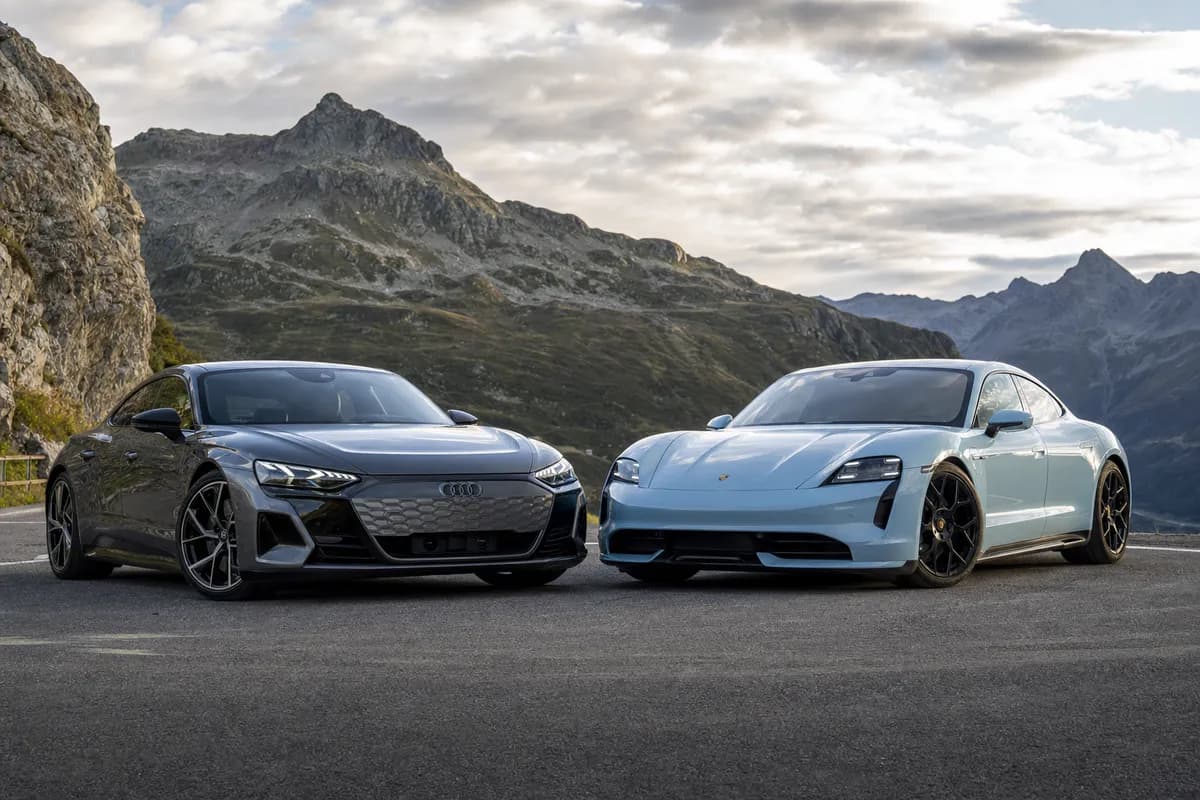
The 2025 Porsche Taycan and Audi RS e-tron GT are the same high-voltage idea wearing different suits: one in Stuttgart war paint, the other in Ingolstadt tailoring.
The 2025 Porsche Taycan and Audi RS e-tron GT are the same high-voltage idea wearing different suits: one in Stuttgart war paint, the other in Ingolstadt tailoring. Both sit on the Volkswagen Group’s J1 electric performance architecture, both use an 800-volt electrical system, both can inhale electrons at up to 320 kW, and both make the average gasoline sports sedan feel like it’s dragging an anchor. But do not mistake them for twins. The Taycan is the sharper tool, the one with lap times in its teeth. The RS e-tron GT is the grander machine, a four-door electric missile that would rather demolish continents than chase apexes with white-knuckled obsession. The question is not which one is fast. They’re both absurdly fast. The question is which one deserves your money.
Same Platform, Very Different Personalities
On paper, the 2025 Porsche Taycan and the 2025 Audi RS e-tron GT are platform relatives. Underneath, they share the broad strokes: dual-motor all-wheel drive, two-speed rear transmission, an 800-volt electrical system, air suspension, active thermal management, and a large lithium-ion battery pack. For 2025, both benefit from major updates that matter in the real world: more power, faster charging, better range, improved efficiency, and smarter chassis tuning.
The Porsche Taycan range is broader and more aggressive. The updated lineup includes the rear-drive Taycan, Taycan 4, 4S, Turbo, Turbo S, and the headline-stealing Taycan Turbo GT. Battery capacity rises substantially, with the larger Performance Battery Plus now rated at 105 kWh gross, with about 97 kWh usable. Charging peaks at up to 320 kW, and Porsche claims a 10-to-80 percent charge can take as little as 18 minutes under ideal conditions.
Audi’s updated RS e-tron GT uses the same larger 105-kWh gross battery and 320-kW peak charging capability. In Europe, Audi has split the refreshed e-tron GT family into S e-tron GT, RS e-tron GT, and RS e-tron GT performance variants. The RS e-tron GT produces up to 844 hp, while the RS e-tron GT performance pushes as high as 912 hp. That is not a typo. We are now living in a world where an Audi luxury sedan can outgun a Ferrari 296 GTB on peak horsepower while massaging your back.
But character counts. The Porsche feels like it was benchmarked against physics and then told physics to come back with a better offer. The Audi feels like it was developed by people who wanted the same explosive drivetrain but wrapped in velvet, carbon fiber, and a bit more emotional detachment. The Taycan is a weapon. The RS e-tron GT is a very fast gentleman with a concealed-carry permit.
Performance: Taycan Has the Killer Instinct
Let’s stop pretending these cars are “quick.” A Volkswagen Golf GTI is quick. These things launch like they’ve been rear-ended by a freight train made of lightning.
The 2025 Porsche Taycan Turbo S produces up to 938 hp with overboost and can hit 60 mph in a claimed 2.3 seconds. The even more deranged Taycan Turbo GT raises the ceiling to 1,019 hp, or up to 1,092 hp for short bursts with Attack Mode. Porsche claims 0-60 mph in 2.2 seconds for the standard Turbo GT and 2.1 seconds with the Weissach Package. The quarter-mile? Porsche quotes 9.6 seconds for the Weissach car. That is drag-strip lunacy with license plates and four doors.
The Audi RS e-tron GT is hardly bringing a butter knife to a gunfight. The refreshed RS e-tron GT makes up to 844 hp and can sprint from 0-62 mph in about 2.8 seconds. The RS e-tron GT performance, where offered, drops that to a claimed 2.5 seconds with up to 912 hp. That puts it firmly in supercar territory, and in normal road use, the difference between 2.5 and 2.1 seconds to 60 mph is less “measurable gap” and more “did your passenger’s soul leave their body before or after the speedometer became unreadable?”
Still, numbers only tell part of the story. The Taycan’s throttle calibration is more immediate, more eager, more feral. It punches out of corners with the violent confidence of a car that knows exactly where its torque is going. Porsche’s two-speed rear transmission gives it a distinct second shove at higher speeds, and the car feels more alive when you are deep into the accelerator at illegal velocities. It is not just fast off the line; it stays fast, which is where lesser EVs start wheezing into their thermal-management spreadsheets.
The Audi is calmer. It still hits brutally hard, but its delivery feels more polished and less manic. In the RS e-tron GT, the acceleration is served like a Michelin-starred steak: beautifully presented, expertly cooked, and still capable of starting a small fire. The Porsche throws the steak at your chest and asks why you are crying.
Performance verdict: The Audi RS e-tron GT is monstrously fast. The Porsche Taycan, especially Turbo S and Turbo GT, is the one that feels engineered by people who keep stopwatch apps open during family dinners.
Handling and Ride: Porsche Dances, Audi Devours Distance
This is where the duel gets interesting, because raw acceleration is now the cheap trick of expensive EVs. The harder part is making a 5,000-pound electric sedan feel like something other than a luxury refrigerator with launch control.
Porsche does it better.
The updated Taycan gets revised suspension hardware and calibration, and Porsche’s Active Ride system is the showpiece. It can keep the body freakishly flat under braking, acceleration, and cornering, while still allowing impressive compliance over bad pavement. In fast bends, the Taycan feels smaller than it is. The steering is crisp, the front axle bites hard, and the car rotates with a fluency that makes its mass seem like a rumor. You are aware of the weight only when you do something stupid, and even then the electronics and chassis are usually several chess moves ahead.
The Taycan also benefits from Porsche’s obsessive approach to braking feel. Regenerative braking is strong, but the pedal blending between regen and friction braking is superb. That matters. Too many EVs have brake pedals that feel like they were tuned by someone wearing ski boots. The Taycan’s pedal is progressive, firm, and trustworthy when you are braking late into a corner. In a car this heavy and fast, that is not a luxury. It is survival equipment.
The Audi RS e-tron GT is also excellent, but it aims differently. The steering is accurate, the all-wheel-drive system is clever, and the adaptive air suspension gives it real composure. It can be hustled hard, and it will not embarrass itself on a technical road. But compared with the Taycan, the Audi feels wider, calmer, and less interested in being grabbed by the scruff of the neck. It flows rather than attacks.
That makes the Audi better at the tedious parts of ownership. Broken highway? Long commute? Three hours of fast interstate with a passenger who does not share your affection for lateral g-force? The RS e-tron GT is a magnificent answer. It is quieter in mood, smoother in behavior, and less insistent that every roundabout is a Nürburgring sector.
Speaking of the Nürburgring, Porsche has receipts. The Taycan Turbo GT with Weissach Package recorded a 7:07.55 lap of the Nordschleife, a deeply silly time for a four-door electric car. That is quicker than plenty of purpose-built sports cars and proof that Porsche did not just bolt in more battery and call it engineering. The Taycan has stamina, cooling, brakes, and chassis discipline. The Audi has pace, but Porsche has bloodlust.
Range, Charging, and Everyday Usability
Here is where the old Taycan used to take a punch. Early Taycans were spectacular to drive but not always spectacular at going far between charges, at least compared with the best long-range EVs. The 2025 update fixes much of that. With improved battery capacity, better thermal management, more efficient motors, and revised software, the updated Taycan is substantially more usable.
EPA range varies by trim and wheel choice, but the 2025 Taycan lineup stretches into the low-300-mile zone in its most efficient forms. Porsche’s official figures depend heavily on configuration, and big wheels will punish range because physics remains annoyingly undefeated. Still, this is no longer a car that forces you to plan every weekend trip like a polar expedition.
The Audi RS e-tron GT also benefits from the larger battery and improved charging hardware. It can accept up to 320 kW at a compatible DC fast charger, just like the Taycan, and Audi says the 10-to-80 percent charge can be done in roughly 18 minutes in optimal conditions. That is excellent. If the charger is working, the battery is warm, and the EV gods are not busy mocking you, both cars can add serious range during a coffee stop.
In daily use, the Audi has the easier personality. The cabin feels more conventional, the controls are less fussy, and the overall driving position is grand tourer rather than low-slung electric missile silo. Audi interiors have not all been perfect lately, but the RS e-tron GT is one of the brand’s stronger efforts: beautifully finished, sensibly arranged, and expensive without screaming about it like a crypto bro in a leased Lamborghini.
The Porsche’s cabin is more driver-focused and more minimalist. It looks fantastic, but Porsche will cheerfully charge you extra for things that should probably be included on a car costing six figures. Want the perfect spec? Bring patience and a willingness to be mugged by the options list. The seating position is excellent, the wheel is perfect, and the screens are sharp, but the Taycan’s interior can feel more technical than warm.
Neither car is a packaging miracle. These are low, sleek electric performance sedans, not family crossovers. Rear-seat space is acceptable rather than limo-like, trunk space is useful but not vast, and the low roofline means taller passengers may develop strong opinions about German styling priorities. The Audi feels a touch more relaxed for passengers; the Porsche feels more like everyone has been invited into the driver’s obsession.
- Porsche Taycan strengths: sharper handling, broader model range, class-leading performance variants, brilliant brake feel, stronger track credibility.
- Audi RS e-tron GT strengths: smoother grand-touring character, gorgeous design, easier daily demeanor, explosive performance without Porsche’s intensity.
- Shared strengths: 800-volt architecture, up to 320-kW charging, dual-motor all-wheel drive, serious build quality, and acceleration that makes internal-combustion nostalgia look a bit silly.
- Shared weaknesses: high prices, expensive options, limited rear-seat practicality, range that still depends heavily on wheels, weather, and driving style.
Price and Value: Pick Your Flavor of Financial Violence
Neither of these cars is remotely cheap, and if you expected value in the normal sense, welcome to the wrong neighborhood. The 2025 Porsche Taycan starts much lower than the serious performance trims, but the versions people cross-shop with the Audi RS e-tron GT are the Taycan 4S, Turbo, Turbo S, and possibly the Turbo GT if they have recently sold a company or won a lawsuit.
The Taycan 4S gives you a strong blend of performance and usability, and for many buyers it is the sweet spot. Step into the Turbo and Turbo S, and you get genuinely outrageous performance. The Turbo GT is the halo car: incredible, unnecessary, and therefore exactly the sort of thing Porsche does best. Add Porsche options, though, and prices climb with the enthusiasm of a caffeinated mountain goat.
The Audi RS e-tron GT generally plays the role of high-spec grand tourer from the start. It is expensive, but it often feels more complete as delivered. Audi’s options can still bite, but the car’s identity is less dependent on chasing the perfect configuration. You buy the RS e-tron GT because you want the looks, the badge, the thrust, and the luxury cruiser attitude in one polished package.
Against outside rivals, both Germans face real pressure. The Lucid Air Grand Touring offers vastly better range and huge power, though it lacks the Porsche’s chassis magic and the Audi’s cohesive grand-touring polish. The Tesla Model S Plaid remains the straight-line bargain monster, with 1,020 hp and a claimed 1.99-second 0-60 mph time with rollout subtracted, but its interior and steering yoke-era weirdness have never felt as special as its drivetrain. The Mercedes-AMG EQE is quick and luxurious, but dynamically it feels heavier and less athletic. The BMW i5 M60 is a superb daily performance EV, yet it is not in the same exotic performance-sedan league as the Taycan or RS e-tron GT.
So value depends on what you value. If you want maximum range per dollar, buy a Lucid. If you want maximum launch violence per dollar, buy a Model S Plaid. If you want the best driver’s EV sedan on sale, you buy the Porsche. If you want a stunning electric GT with supercar pace and less track-day cosplay, you buy the Audi.
Verdict: The Taycan Wins the Duel, But the Audi Makes a Better Escape Car
The 2025 Audi RS e-tron GT is a sensational machine. It looks expensive from 200 yards away, drives with tremendous composure, charges quickly, and accelerates with the sort of force that rearranges loose change and neck muscles. It is the better long-distance companion, the more relaxed daily luxury car, and arguably the prettier object. If your life is fast highways, client dinners, and the occasional empty on-ramp ambush, the Audi is superb.
But the 2025 Porsche Taycan is the better sports car. No caveats, no tortured both-sides verdict. The Taycan has sharper steering, better body control, superior braking feel, more focused chassis tuning, and a deeper performance bench. In Turbo S form, it is vicious. In Turbo GT form, it is one of the most serious electric performance cars ever built. Porsche has taken the shared hardware and wrung more emotion, precision, and violence from it.
The Audi RS e-tron GT is what happens when engineers build an electric grand tourer that happens to be devastatingly fast. The Porsche Taycan is what happens when engineers build an electric sports car and grudgingly add rear doors.
Final call: Buy the Audi RS e-tron GT if you want the smoother, sexier, more relaxed electric GT. Buy the Porsche Taycan if you care how a car feels when the road gets interesting. In this German electric sports car duel, the Audi is brilliant. The Porsche is better.
Affiliate disclosure: This article contains affiliate links. RevvedUpCars may earn a small commission on qualifying purchases at no extra cost to you.