The 2024 Nissan Rogue is the compact SUV that shows up to a neighborhood barbecue wearing a blazer. Underneath, it is still a sensible five-seat crossover with a CVT, a small turbocharged engine, and enough cupholders to hydrate a Little League team.
The 2024 Nissan Rogue is the compact SUV that shows up to a neighborhood barbecue wearing a blazer. Underneath, it is still a sensible five-seat crossover with a CVT, a small turbocharged engine, and enough cupholders to hydrate a Little League team. But climb into a well-optioned SL or Platinum and you get Google built-in, a 12.3-inch touchscreen, quilted leather, a head-up display, a hands-free liftgate, and driver-assist tech that would have looked premium-brand five years ago. The question is not whether the Rogue has big-car features. It does. The question is whether Nissan has wrapped them around a compact SUV that is good enough to beat the Honda CR-V, Toyota RAV4, Hyundai Tucson, Kia Sportage, Mazda CX-5, and Subaru Forester. Spoiler: it gets closer than the badge snobs think.
What’s New for 2024: Sharper Suit, Smarter Cabin
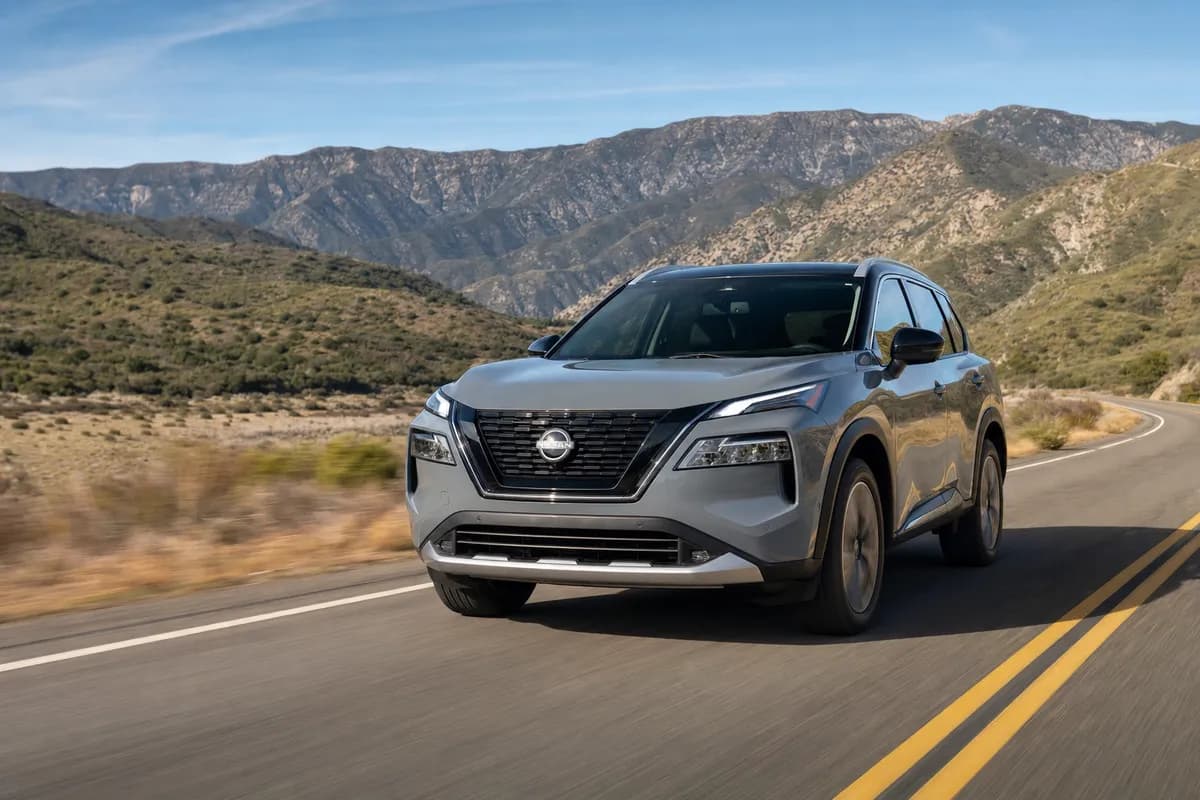
Nissan gave the Rogue a meaningful refresh for 2024, and thankfully it did not involve fake vents the size of pizza boxes. The front end is cleaner and more assertive, with a wider grille, revised lighting signatures, and tidier bumper detailing. The rear gets updated taillamps and trim changes, while new wheel designs and colors keep the Rogue from looking like last year’s rental-counter special.
The bigger news is inside. Higher trims now offer a 12.3-inch infotainment touchscreen with Google built-in, including Google Maps, Google Assistant, and Google Play. That matters because most factory navigation systems have the personality and accuracy of a damp road atlas. Here, the interface feels modern, fast, and properly integrated. You also get wireless Apple CarPlay and wireless Android Auto on the larger-screen setup, plus available wireless charging.
The lineup remains familiar: S, SV, SL, and Platinum. Pricing starts at about $28,320 for the S front-wheel-drive model before destination, with all-wheel drive adding roughly $1,500. The loaded Platinum front-driver sits around $39,100 before destination, which means an AWD Platinum can wander into the low-$40,000 range once fees and options are finished nibbling at your wallet.
That sounds steep for a Nissan Rogue, and it is. But the compact SUV class has gone upscale while no one was looking. A loaded Honda CR-V Hybrid Sport Touring, Toyota RAV4 Limited, Hyundai Tucson Limited, or Kia Sportage SX Prestige Hybrid can all flirt with or pass $40,000. The Rogue is not uniquely expensive; it is just playing in a segment where “compact” now apparently means “priced like an old luxury car.”
Powertrain and Driving: The Tiny Turbo Has Muscles, But It Still Sings the CVT Blues
Every 2024 Nissan Rogue uses the same engine: a 1.5-liter turbocharged variable-compression three-cylinder producing 201 horsepower and 225 lb-ft of torque. That output is legitimately strong for the class. The Honda CR-V’s standard 1.5-liter turbo makes 190 hp and 179 lb-ft. The Toyota RAV4’s 2.5-liter four-cylinder has 203 hp but only 184 lb-ft. The Subaru Forester wheezes along with 182 hp. On paper, the Rogue brings a surprisingly sturdy right hook.
The variable-compression tech is clever. Nissan’s VC-Turbo engine can alter its compression ratio depending on load, chasing efficiency when cruising and torque when you ask for more. In the real world, that translates to a Rogue that feels eager around town. The torque comes in early, and the SUV pulls away from lights with more urgency than you expect from a three-cylinder crossover. This is not a hot rod, but it is not a slug.
Independent tests have put recent Rogue models with this engine in the mid-to-high seven-second range from 0 to 60 mph, depending on drivetrain and conditions. That is quicker than a non-hybrid CR-V and broadly competitive with the gas RAV4. The RAV4 Hybrid and Tucson Hybrid still feel more immediate thanks to electric torque, but the Rogue’s little turbo is no embarrassment.
Then there is the transmission. Nissan pairs the engine with an Xtronic continuously variable transmission, and this is where the Rogue’s polish starts to smudge. Around town, the CVT is mostly smooth and well behaved. Ask for hard acceleration, though, and it can hold the engine at an unlovely drone while speed builds in a way that feels more efficient than exciting. Nissan has improved its CVTs significantly over the years, but no one climbs out of a Rogue saying, “You know what I loved? The gearbox.”
Steering is light, accurate, and mostly forgettable, which is exactly what many buyers want and exactly what Mazda CX-5 owners will mock over coffee. The Rogue is easy to place, easy to park, and calm at highway speeds. Body control is decent, though quick transitions remind you this is tuned for comfort, not corner-carving. The Mazda CX-5 still feels more connected, the Honda CR-V feels more mature, and the Toyota RAV4 feels more rugged. The Rogue splits the difference: refined enough, quiet enough, and never pretending it wants a track day.
Ride comfort is one of its strengths. On the 19-inch wheels fitted to upper trims, sharp impacts can thud through the cabin, but the Rogue generally absorbs broken pavement well. Wind and road noise are respectably contained, especially on SL and Platinum trims, where the richer cabin materials help sell the illusion that you bought something a class larger.
Fuel Economy and Practicality: Sensible Numbers, Serious Space
The Rogue’s best party trick is efficiency. With front-wheel drive, EPA ratings reach up to approximately 30 mpg city, 37 mpg highway, and 33 mpg combined, depending on trim. All-wheel-drive models typically land around 28 mpg city, 35 mpg highway, and 31 mpg combined, with some upper trims slightly lower. That is excellent for a gas-only compact SUV with 201 horsepower.
Compare that with the Toyota RAV4 gas model at up to 30 mpg combined, the Honda CR-V 1.5T at around 30 mpg combined, and the Mazda CX-5 at 26 to 28 mpg combined depending on drivetrain. The Rogue is one of the more efficient non-hybrid choices in the segment. Of course, the hybrid rivals change the math. A Toyota RAV4 Hybrid hits up to 40 mpg combined, and the CR-V Hybrid can manage around 37 to 40 mpg combined depending on configuration. Nissan still does not offer a Rogue Hybrid in the U.S., and that omission is starting to look like showing up to a sword fight with a salad fork.
Practicality, however, is excellent. The Rogue offers up to 36.5 cubic feet of cargo room behind the second row and up to 74.1 cubic feet with the rear seats folded when equipped with the Divide-N-Hide cargo system. That puts it right in the thick of the class. The Honda CR-V is roomier overall, with up to 76.5 cubic feet, and the Hyundai Tucson and Kia Sportage also feel cavernous. But the Rogue’s cargo area is square, useful, and thoughtfully finished.
The rear doors open wide, which parents will appreciate when wrestling child seats into place without performing yoga in a parking lot. Rear legroom is about 38.5 inches, enough for adults to sit comfortably behind adults. The seating position is upright, visibility is good, and the rear bench is supportive enough for actual road trips rather than just rides to brunch.
Towing capacity is limited to 1,500 pounds. That is fine for a small utility trailer, a pair of dirt bikes, or a tiny boat, but if you regularly tow, buy something burlier. The Rogue is a lifestyle SUV, not a Labrador-shaped pickup truck.
Interior and Technology: This Is Where the Rogue Makes Its Case
The cabin is the Rogue’s strongest argument, particularly in SL and Platinum trims. Nissan’s Zero Gravity seats remain some of the best in the mainstream business, offering proper thigh support and long-haul comfort without feeling overstuffed. The driving position is natural, the controls are mostly logical, and the center console has useful storage rather than decorative nonsense.
Material quality varies by trim, as expected. The S is honest and durable but not glamorous. The SV is the sweet spot for many buyers, adding comfort and convenience features without detonating the budget. The SL is where the Rogue starts feeling genuinely upscale, while the Platinum brings quilted semi-aniline leather-appointed seating, ambient lighting, a digital gauge cluster, and available premium audio.
The available 12.3-inch digital instrument cluster and 12.3-inch center touchscreen transform the cabin. Lower trims use an 8-inch screen, which is adequate but hardly dazzling. The larger display looks crisp and responds quickly, and the Google integration is a real advantage over clunkier systems in some rivals. Toyota’s latest infotainment is much improved, Honda’s interface is clean but less flashy, and Hyundai/Kia still do big screens very well. Nissan now belongs in that conversation.
Available features include a 10.8-inch head-up display, wireless charging, tri-zone automatic climate control, heated front and rear seats, a heated steering wheel, panoramic moonroof, remote start, and a motion-activated power liftgate. In other words, yes, the Rogue absolutely qualifies as a compact SUV with big-car features. A loaded Platinum feels less like an economy crossover and more like a junior near-luxury SUV, minus the German repair invoices and badge-based smugness.
Still, not everything is perfect. Some glossy trim pieces attract fingerprints like a crime lab. The CVT shifter area looks more premium than it feels. And if you are spending over $40,000, the absence of a hybrid option becomes harder to ignore. Luxury touches are lovely, but fuel economy gains from electrification are not exactly a fringe concept in 2024.
Safety, Driver Assistance, and Trims: Which Rogue Should You Buy?
Nissan fits every 2024 Rogue with Safety Shield 360, which includes automatic emergency braking with pedestrian detection, blind-spot warning, rear cross-traffic alert, lane-departure warning, rear automatic braking, and high-beam assist. That is a strong standard package and one of the reasons the Rogue works well as a family SUV.
The available ProPILOT Assist system is also worth having. It combines adaptive cruise control with lane-centering assistance, reducing fatigue on highway drives. Upper trims offer ProPILOT Assist with Navi-link, which can use navigation data to help adjust speed for curves, junctions, and exits. It is not hands-free, and it does not turn the Rogue into a robot chauffeur, despite what your overconfident uncle may think after one YouTube video. But it is smooth, predictable, and genuinely useful.
Trim choice matters. Here is the blunt version:
- Rogue S: Buy it if you want the lowest price and do not care about frills. It has the core safety kit and same engine, but it feels basic.
- Rogue SV: The smart buy. It adds the features most people actually want, including better convenience tech and available packages, while staying reasonable.
- Rogue SL: The best balance if you want the big-screen tech, nicer cabin, and premium feel without going full Platinum.
- Rogue Platinum: The showpiece. Lovely inside, loaded with features, and also expensive enough to make you test-drive a CR-V Hybrid Sport Touring before signing anything.
My pick is the Rogue SL AWD. It gets the key luxury and technology upgrades, the stronger infotainment system, and all-weather traction without pushing quite as hard into “am I buying a Nissan or funding a yacht?” territory. The SV is the value choice, but the SL is where the Rogue’s big-car-features argument really clicks.
Verdict: A Genuinely Premium-Feeling Compact SUV, Held Back by One Big Missing Piece
The 2024 Nissan Rogue is comfortable, efficient, roomy, and impressively well equipped. It is not the sportiest compact SUV, and the CVT still has all the charisma of airport carpeting, but as a daily driver with upscale features, it is one of Nissan’s most convincing products.
The Rogue succeeds because it understands its audience. Most compact SUV buyers do not want Nürburgring steering feel or a transmission that snaps off shifts like a touring car. They want comfort, safety, good fuel economy, easy tech, useful space, and enough premium frosting to make the monthly payment feel justified. The 2024 Rogue delivers all of that.
Against the Honda CR-V, the Rogue feels more feature-rich for the money in upper trims, though the Honda has a better hybrid option and a more polished overall demeanor. Against the Toyota RAV4, the Rogue is quieter and more refined, while the Toyota offers tougher styling, better resale, and excellent hybrid choices. Against the Mazda CX-5, the Nissan wins on cargo space and efficiency, but loses badly on driving enjoyment. Against the Hyundai Tucson and Kia Sportage, it faces two tech-heavy rivals with available hybrids and longer warranties.
So, is the 2024 Nissan Rogue a compact SUV with big-car features? Absolutely. In SL and Platinum form, it brings the screens, comfort, driver assistance, and cabin polish buyers used to associate with larger, pricier SUVs. But Nissan needs a hybrid. Not eventually. Now. The gas Rogue is efficient, but the market has moved, and the best rivals are already cashing in on electrified torque and 40-mpg bragging rights.
Still, judged as a gas-powered compact SUV, the Rogue is easy to recommend. Buy the SL AWD if you want the sweet spot. Consider the SV if budget matters. Skip the Platinum unless you are deeply in love with quilted leather and Google Maps in factory form. The 2024 Rogue is not thrilling, but it is quietly excellent where it counts — and in this segment, that wins more driveways than drama ever will.
Affiliate disclosure: This article contains affiliate links. RevvedUpCars may earn a small commission on qualifying purchases at no extra cost to you.