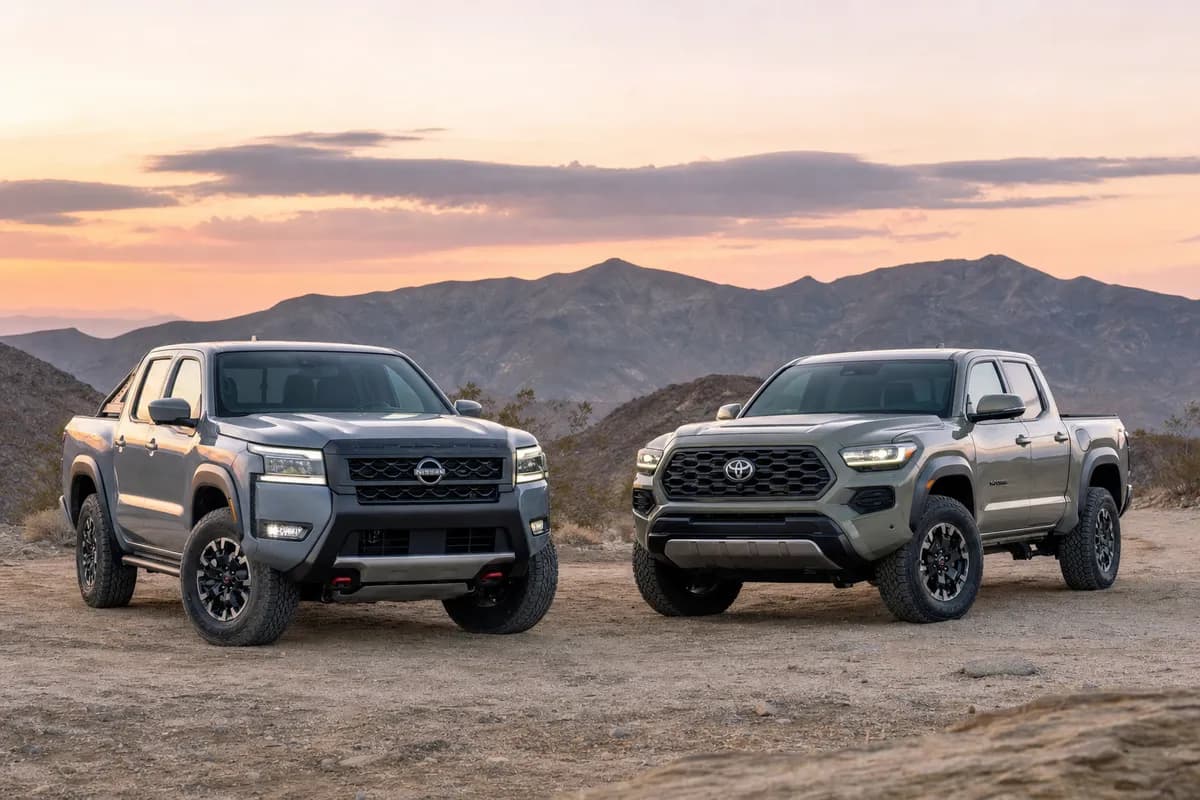
The 2025 Nissan Frontier vs Toyota Tacoma fight is the midsize truck grudge match buyers actually care about: old-school V6 toughness against Toyota’s shiny new turbocharged platform.
On paper, the hybrid Tacoma absolutely body-slams the Frontier for torque. In real-world driving, it feels like it too. The i-FORCE MAX launches hard, climbs grades with less fuss, and makes the Frontier’s V6 feel a generation behind when you need low-rpm shove. But the Nissan’s engine has character Toyota’s turbo-four can’t fake. It revs cleanly, sounds better, and doesn’t have that slightly appliance-like turbo drone under load.
Fuel economy is where Toyota claws back ground. The Frontier typically lands around 18 mpg city, 24 highway, and 20 combined in rear-drive form, with 4x4 models closer to 17/22/19 mpg. The Tacoma’s turbo models can do better, with some rear-drive automatic versions rated up to roughly 21 city, 26 highway, and 23 combined, while many 4x4 versions sit around the low-20s combined. Hybrid Tacomas generally return about 22 city, 24 highway, and 23 combined, which is impressive given the torque on tap, though not exactly Prius-with-a-bed magic.
Powertrain verdict: The Frontier wins for simplicity and standard V6 goodness. The Tacoma wins if you want modern torque, better efficiency, or the hybrid hammer. Personally? The Tacoma hybrid is the best engine here, but Nissan’s one-engine-for-all approach is refreshingly honest.
Driving Feel: One Truck Feels New, The Other Feels Right
The 2025 Tacoma rides on Toyota’s TNGA-F truck platform, shared in spirit with the Tundra, Sequoia, and Land Cruiser. That sounds fancy because it is. The new chassis is stiffer, the steering is more accurate, and the truck feels more substantial than the previous Tacoma, which, let’s be blunt, often rode like a filing cabinet falling down stairs.
Toyota also now offers different rear suspension setups depending on trim. Lower trims still use leaf springs, but many higher trims get coil springs. The coil-spring Tacomas ride better over broken pavement and washboard trails, with less rear-axle hop and a more planted feel when empty. The TRD Off-Road and Limited feel markedly more sophisticated than the old truck. The TRD Pro and Trailhunter go even harder with serious off-road hardware, but we’ll get to that.
The Frontier uses a more traditional body-on-frame layout with hydraulic-feeling honesty baked in. It is not as refined as the Tacoma. It does not isolate impacts as well. It can feel busy over cracked city roads, especially in PRO-4X trim. But the Frontier has a charming directness. The steering has decent weight, the V6 responds predictably, and the 9-speed automatic is mostly smooth once it stops hunting for the perfect ratio like a golden retriever looking for a tennis ball.
In acceleration, neither gas-only truck is a sports car, but the Frontier’s 310-hp V6 gives it strong midrange performance. Expect 0-60 mph in the high-7-second range for many 4x4 versions. A non-hybrid Tacoma with the 278-hp turbo is broadly similar, though it feels punchier down low thanks to extra torque. The Tacoma hybrid can dip into the mid-6-second range depending on configuration, which is properly quick for a midsize pickup on all-terrain rubber.
Braking and handling favor the Tacoma. Toyota’s new platform feels more settled at highway speeds and more composed during emergency maneuvers. The Nissan feels narrower, simpler, and more maneuverable in town, but at 75 mph with a crosswind and a bed full of gear, the Tacoma is the calmer tool.
Driving verdict: Tacoma feels newer because it is newer. Frontier feels tougher and more analog, but Toyota has finally made a Tacoma that doesn’t punish your spine for choosing adventure.
Cabins And Tech: Toyota Goes Big-Screen, Nissan Goes Sensible
This is where the generational gap is obvious. The 2025 Tacoma cabin looks and feels like a modern truck cockpit. Depending on trim, you get an 8-inch or 14-inch touchscreen, available 12.3-inch digital gauge cluster, wireless Apple CarPlay and Android Auto, available JBL audio, and a clean horizontal dashboard design. The driving position is vastly improved over the old Tacoma, which forced taller drivers into a weird legs-out posture like they were sitting in a kayak.
The Tacoma also offers clever features such as an available removable JBL speaker, multiple camera views, digital key capability, and Toyota’s latest infotainment interface. It is not perfect. Some materials in mid-level trims still feel stubbornly utilitarian, and Toyota’s pricing ladder gets steep fast. But the Tacoma’s interior now feels competitive with the Chevrolet Colorado, GMC Canyon, and Ford Ranger. Finally.
Nissan updated the 2025 Frontier in meaningful ways. The big improvement is the available 12.3-inch touchscreen, replacing the older smaller display on upper trims. A telescoping steering wheel is now available, which sounds minor until you remember the previous Frontier driving position was apparently designed around one specific Nissan engineer’s elbows. Wireless Android Auto joins wireless Apple CarPlay on more trims, and the cabin gets revised trim details.
Still, the Frontier interior is simpler and older. The buttons are large. The menus are easy. The seats are comfortable, particularly Nissan’s excellent Zero Gravity front seats, and visibility is good. But the cabin doesn’t have the Tacoma’s sense of occasion. The Tacoma feels like a truck launched in the mid-2020s. The Frontier feels like a very good truck from the early 2020s that got a tech injection and a stern talking-to.
Rear-seat comfort is a mixed bag. Both trucks offer crew-cab layouts, but neither is a limousine. The Tacoma Double Cab has improved packaging, yet the rear bench remains upright compared with something like a Honda Ridgeline. The Frontier Crew Cab is serviceable for adults on shorter drives, but the rear space is not generous. If you regularly haul full-size humans in the second row, buy a half-ton or the Ridgeline and stop pretending you need rock rails to visit Costco.
Safety tech is strong in both. Toyota includes Toyota Safety Sense 3.0 with features such as pre-collision braking, adaptive cruise control, lane departure alert, and road sign assist. Nissan offers its Safety Shield 360 suite on many Frontier trims, with automatic emergency braking, blind-spot warning, rear cross-traffic alert, lane departure warning, and high-beam assist depending on model. Toyota’s system is smoother and more comprehensive; Nissan’s is easier to live with if you hate overbearing driver aids.
Cabin verdict: Tacoma wins on tech, screens, and modern design. Frontier wins on straightforward usability and seat comfort. If you like buttons, Nissan has your back. If you like pixels, Toyota is already holding your deposit.
Towing, Payload, And Off-Road Gear: The Numbers Are Closer Than The Hype
Midsize truck buyers love to argue capability numbers online, usually right after using their trucks to haul one mountain bike and a cooler. Still, the data matters.
- 2025 Nissan Frontier max towing: up to about 7,150 pounds when properly equipped.
- 2025 Toyota Tacoma max towing: up to about 6,500 pounds with gas models; hybrid versions are generally rated lower, around 6,000 pounds depending on trim.
- Frontier max payload: roughly up to 1,620 pounds.
- Tacoma max payload: up to about 1,705 pounds, configuration dependent.
That means the Nissan actually has the stronger peak tow rating. Yes, the Toyota hybrid has far more torque, but towing ratings are about cooling, chassis, brakes, gearing, and certification—not just how hard the engine punches at 2,000 rpm. If you’re towing near 6,500 pounds regularly, I’d still point you toward a full-size pickup. But for boats, small campers, utility trailers, and weekend toys, both trucks are legitimate.
For 2025, Nissan also expands availability of the 6-foot bed on Crew Cab models, including trims where buyers actually want it. That matters. The Frontier’s bed is practical, square, and available with Nissan’s Utili-track channel system, spray-in bedliner, and 120-volt outlet depending on trim. Toyota offers 5-foot and 6-foot bed configurations on Double Cab models, plus composite bed construction, available power outlets, and good tie-down flexibility.
Off-road is where Toyota throws the biggest punches. The Tacoma TRD Off-Road brings a locking rear differential, Bilstein shocks, Multi-Terrain Select, Crawl Control, skid plates, and serious trail software. The TRD Pro adds Fox internal-bypass shocks, aggressive tires, added clearance, and wild IsoDynamic Performance front seats designed to reduce body movement off-road. The Trailhunter is Toyota’s overlanding special, with Old Man Emu hardware, high-clearance bits, and expedition-ready attitude straight from the factory.
The Frontier PRO-4X counters with Bilstein off-road shocks, an electronic locking rear differential, skid plates, all-terrain tires, and a more compact, old-school feel that is genuinely lovable on tight trails. It does not have the Tacoma’s catalog of electronic terrain wizardry, nor the same extreme trim spread. But the Nissan is predictable, tough, and less precious. You feel less ridiculous scratching a Frontier against brush than you do scraping a Tacoma TRD Pro that can cost luxury-SUV money.
Ground clearance varies by trim, but off-road Tacomas generally offer more sophisticated geometry and more specialized equipment at the top end. The Frontier PRO-4X is best thought of as a strong factory trail package, not a desert-running cosplay machine. The Tacoma TRD Pro and Trailhunter are more capable from the showroom, but also dramatically more expensive.
The uncomfortable truth: A Frontier PRO-4X will do 90 percent of what most Tacoma TRD Pro buyers actually do, for a lot less money and with fewer people asking if your monthly payment came with oxygen.
Capability verdict: Frontier wins peak towing value and no-nonsense trail toughness. Tacoma wins off-road sophistication, trim variety, and high-end capability.
Pricing And Value: Toyota Charges For The Legend
Here’s where the Nissan starts sharpening its knife. The 2025 Frontier generally starts in the low-$30,000 range before options and destination charges, with popular SV and PRO-4X models landing in the high-$30,000s to mid-$40,000s depending on configuration. The refreshed SL trim adds more comfort and tech without turning the truck into a rolling mortgage application.
The 2025 Tacoma also starts around the low-$30,000s, but that number is mostly bait. Once you move into the trims people actually want—SR5, TRD Sport, TRD Off-Road, Limited, TRD Pro, Trailhunter—the price climbs quickly. Hybrid models command even more. A well-equipped TRD Off-Road can push into the mid-$40,000s. TRD Pro and Trailhunter models can sail well past $60,000. Sixty grand. For a midsize pickup. Somewhere, a 1998 Tacoma with 312,000 miles and a rusted frame just laughed itself into another decade of resale value.
Toyota’s defense is resale value, and it’s a strong one. Tacomas historically hold value absurdly well, and the new generation is unlikely to change that dramatically. Toyota also has a huge aftermarket, broad dealer network, and a reputation for durability that buyers trust even when the truck itself is completely new. The hybrid system adds complexity, but Toyota knows hybrid hardware better than anyone in the business.
Nissan’s resale value is weaker, but that can work in your favor if you’re buying. Frontier discounts are more realistic, dealer markups are less common, and you can often get more equipment for the money. The V6 is proven, the 9-speed has matured, and the truck’s relative simplicity should appeal to owners who keep vehicles long after the finance office has forgotten their name.
Against the wider field, the Chevrolet Colorado and GMC Canyon offer strong turbo torque and excellent off-road trims like the ZR2 and AT4X. The Ford Ranger brings a stout 2.3-liter turbo and the excellent Ranger Raptor with a 405-hp twin-turbo V6. The Honda Ridgeline remains the best daily driver for people honest enough to admit they don’t need a ladder frame. But in this specific fight, Nissan and Toyota represent two very different philosophies: proven simplicity versus modern capability.
Verdict: Tacoma Is The Better Truck, Frontier Is The Smarter Buy
If you want the most advanced midsize truck here, buy the 2025 Toyota Tacoma. Its platform is newer, its tech is better, its cabin is more modern, and the i-FORCE MAX hybrid delivers the kind of torque the Frontier simply cannot match. The Tacoma TRD Off-Road, TRD Pro, and Trailhunter also offer a deeper bench of serious off-road equipment than Nissan provides. Toyota finally built a Tacoma that feels like it belongs in this decade, not one that survived into it by reputation alone.
But if you want the truck I’d recommend to the buyer spending their own money carefully, the 2025 Nissan Frontier makes a brutally strong case. It gives you a standard 310-hp V6, strong towing numbers, useful 2025 tech upgrades, available 6-foot Crew Cab configurations, and honest truck manners without the Toyota tax. It is not as polished. It is not as clever. It will not impress the same crowd at the trailhead. Good. Those people are exhausting.
The Tacoma wins the comparison on outright ability, especially in hybrid and off-road trims. But the Frontier wins on value, simplicity, and emotional honesty. It feels like a truck built for people who need a truck, not a lifestyle accessory with recovery boards bolted on for brunch.
Final call: Buy the Tacoma if you want the best tech, strongest torque, and most capable off-road variants. Buy the Frontier if you want a durable, powerful, properly priced midsize pickup that skips the hype and gets to work. In the 2025 Nissan Frontier vs Toyota Tacoma tussle, Toyota lands the flashier knockout punch—but Nissan wins the bar fight on value.
Affiliate disclosure: This article contains affiliate links. RevvedUpCars may earn a small commission on qualifying purchases at no extra cost to you.