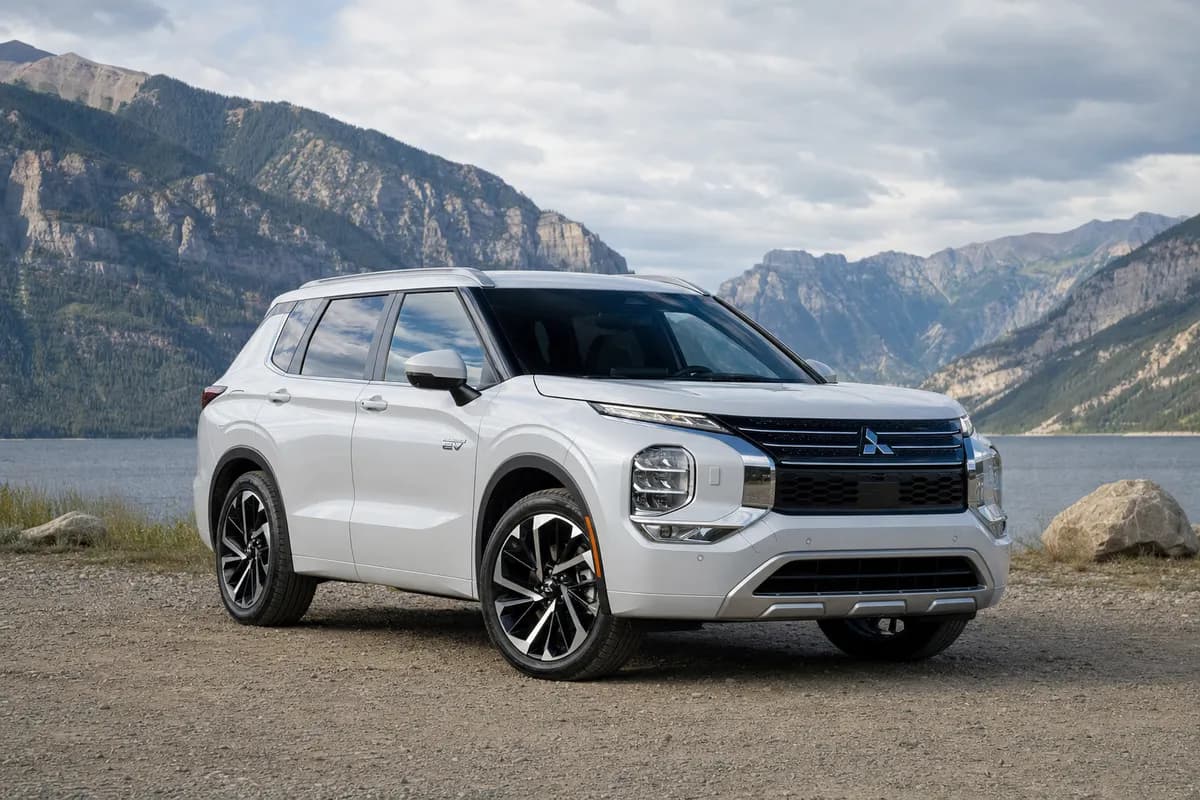
The 2024 Mitsubishi Outlander PHEV is what happens when a sensible family SUV quietly joins a rally gym. It plugs in, runs up to 38 miles on electricity , seats up to seven in a pinch, and uses Mitsubishi’s excellent Super All-Wheel Control system to make bad weather feel less…
The 2024 Mitsubishi Outlander PHEV is what happens when a sensible family SUV quietly joins a rally gym. It plugs in, runs up to 38 miles on electricity, seats up to seven in a pinch, and uses Mitsubishi’s excellent Super All-Wheel Control system to make bad weather feel less like a crisis and more like a mild inconvenience. Is it the sharpest, fastest, or most luxurious plug-in SUV on sale? No. But it is one of the few electrified family crossovers that can genuinely handle school runs, gravel roads, Costco raids, and a weekend escape without asking you to live like a spreadsheet.
Powertrain, Range, and Efficiency: The Numbers Actually Matter Here
The 2024 Mitsubishi Outlander PHEV uses a 2.4-liter four-cylinder engine paired with two electric motors, one at the front and one at the rear. Total system output is 248 horsepower and 332 lb-ft of torque, which is plenty for a compact-to-midsize family SUV that weighs roughly two tons depending on trim. It is not a rocket ship, but it does not wheeze like some overburdened eco-box either.
Independent testing has put the Outlander PHEV’s 0-60 mph time in the mid-to-high six-second range, which makes it respectably brisk for the class. That is slower than the Toyota RAV4 Prime, which packs 302 horsepower and can run to 60 mph in about 5.7 seconds, but the Mitsubishi feels punchier around town than the raw figures suggest. Electric torque does that wonderful thing where it makes gaps in traffic look wider than they are.
The real headline is the battery. Mitsubishi fits a 20.0-kWh lithium-ion battery, giving the Outlander PHEV an EPA-rated 38 miles of electric range. That is enough for most commutes, school runs, and grocery loops without burning gasoline. Drive it like a grown-up, plug in at home, and you can go days using the engine only as an occasionally grumbling backup singer.
EPA efficiency checks in at 64 MPGe combined when using electricity and gasoline, and 26 mpg combined once the battery is depleted. That latter number is not brilliant. A regular Toyota RAV4 Hybrid does far better at around 40 mpg combined, and the RAV4 Prime returns 38 mpg combined after its battery is spent. This is where the Mitsubishi’s extra weight and three-row packaging come home to nibble at your fuel budget.
Charging is flexible, though slightly quirky. On a Level 2 home charger, the Outlander PHEV takes roughly 6.5 hours to refill. On a standard household outlet, expect an overnight-and-then-some experience. Oddly, Mitsubishi also includes DC fast-charging capability via CHAdeMO, which can take the battery to 80 percent in about 38 minutes. That sounds impressive until you remember CHAdeMO is the Betamax of American charging ports: technically functional, increasingly rare, and not something I would plan a road trip around.
- Power: 248 hp combined
- Torque: 332 lb-ft combined
- Battery: 20.0 kWh lithium-ion
- EPA electric range: 38 miles
- EPA rating: 64 MPGe combined, 26 mpg combined on gasoline
- Drivetrain: Standard plug-in hybrid all-wheel drive
On the Road: Smooth, Confident, and Better Than It Needs to Be
The Outlander PHEV’s best trick is how normal it feels. Plenty of plug-in hybrids drive like two powertrains arguing in a broom closet. The Mitsubishi does not. Around town, it leans heavily on electric drive, gliding away from stoplights with a polished hush that makes the four-cylinder engine feel almost rude when it finally joins the conversation.
There are selectable drive modes, including Normal, Eco, Power, Tarmac, Gravel, Snow, and Mud, depending on trim. That may sound like menu bloat, but the Outlander PHEV’s Super All-Wheel Control system is not marketing confetti. Mitsubishi has decades of rally-bred know-how baked into its torque management, and while this is not an Evo in hiking boots, it has more composure on wet pavement and loose surfaces than most family crossovers.
Turn-in is tidy, body control is respectable, and the steering has a clean, predictable weight. Nobody will mistake it for a Mazda CX-50 on a back road, but it is far from the soggy appliance some buyers might expect. The low-mounted battery helps the Outlander feel planted, and the dual-motor AWD system can shuffle power quickly enough to keep the chassis settled when the road gets greasy.
The brake pedal is decent by plug-in hybrid standards, which is a low bar but still worth noting. Regenerative braking can be adjusted using steering-wheel paddles, and Mitsubishi also provides an Innovative Pedal mode that increases regen for near one-pedal driving in many situations. It is not as seamless as a dedicated EV, but once you acclimate, it makes commuting smoother and slightly more satisfying. Saving energy while judging traffic flow becomes its own little nerd sport.
Ride quality is generally comfortable, especially on smaller wheels. Higher trims with 20-inch wheels look sharper but introduce more impact harshness over broken pavement. That is the old SUV fashion tax: big wheels for the Instagram lot, bruised sidewalls for real life. Wind and road noise are controlled well enough at highway speed, though the gasoline engine can sound coarse when working hard with a depleted battery and a loaded cabin.
The Outlander PHEV is not thrilling in the tail-out, tire-smoking sense. It is thrilling in the “my family, dog, luggage, and questionable weekend plans all fit, and I used no gas getting across town” sense. Different dopamine. Still valid.
Interior, Tech, and Family Practicality: Mostly Clever, Occasionally Compromised
Inside, the 2024 Outlander PHEV punches above Mitsubishi’s old reputation. This is not the bargain-bin cabin some shoppers still associate with the brand. The dashboard design is clean, the materials are respectable, and upper trims can be genuinely handsome with quilted leather, contrast stitching, and a panoramic sunroof. The Nissan-Mitsubishi alliance bones are apparent here, and in this case, that is a good thing.
Front-seat comfort is strong, visibility is good, and the driving position feels SUV-commanding without being bus-driver awkward. The second row is spacious enough for adults, with generous legroom and easy access. The third row, however, deserves honesty: it is a children-only, short-trip, emergency-use third row. If your teenagers are over five feet tall, they will treat it like a punishment cell.
Still, the fact that the Outlander PHEV offers any third row at all is a key differentiator. The Toyota RAV4 Prime, Hyundai Tucson Plug-In Hybrid, and Ford Escape Plug-In Hybrid are strictly two-row SUVs. The Kia Sorento Plug-In Hybrid is the closer rival, with three rows and a more conventional family layout, but the Mitsubishi offers more electric range: 38 miles versus the Sorento PHEV’s 32 miles.
Cargo space is useful but not cavernous with all seats deployed. You get around 11.7 cubic feet behind the third row, about 33.5 cubic feet behind the second row, and up to roughly 78.5 cubic feet with the rear seats folded. Translation: fine for a family road trip with the third row down, tight with seven occupants and luggage, and not minivan practical no matter what the brochure’s camera angle tries to imply.
Technology is straightforward. Depending on trim, the Outlander PHEV offers a 9.0-inch touchscreen, wireless Apple CarPlay, Android Auto, a 12.3-inch digital instrument cluster, head-up display, navigation, and a Bose audio system. The infotainment system is not the slickest in the business, but it is legible and easy enough to use. Crucially, Mitsubishi has not buried every basic function inside a touchscreen labyrinth. There are still physical controls for climate and volume, because apparently someone in product planning has driven a car while wearing gloves.
Safety tech is also robust. Standard and available features include forward collision mitigation, blind-spot warning, rear cross-traffic alert, lane departure warning, adaptive cruise control, lane-keeping assist, and Mitsubishi’s MI-PILOT Assist system on higher trims. It is not hands-free wizardry, but it reduces fatigue on long highway slogs.
Pricing and Rivals: The Mitsubishi Makes Its Case, But Not Quietly
The 2024 Mitsubishi Outlander PHEV starts in the low $40,000 range before destination, with higher trims climbing toward $50,000. That puts it directly in the path of some serious machinery. The Toyota RAV4 Prime is quicker, more efficient once the battery is empty, and likely stronger on resale. The Kia Sorento Plug-In Hybrid has a more adult-friendly cabin layout. The Mazda CX-90 PHEV is larger, more premium, and more powerful, with up to 323 horsepower, though its EPA electric range is lower at about 26 miles. The Chrysler Pacifica Plug-In Hybrid is vastly more practical for families, because minivans are what SUVs pretend to be after three drinks.
But the Mitsubishi has a distinct lane. It gives you standard AWD, a genuinely useful electric range, a compact footprint, and that occasional third row. It is easier to park than a CX-90, more versatile than a RAV4 Prime, and less soul-crushingly minivan than a Pacifica. For families who want adventure-ish capability without buying a giant fuel-swilling three-row SUV, the Outlander PHEV is more persuasive than its badge snobbery problem suggests.
There are caveats. Because the Outlander PHEV is built in Japan, it generally does not qualify for the federal EV tax credit when purchased outright under current U.S. rules, though lease incentives can vary. That matters. A discounted lease can make this thing look clever; a fully loaded purchase near $50,000 requires more careful cross-shopping.
The RAV4 Prime remains the efficiency and performance benchmark. If you do not need a third row and can actually find one without dealer nonsense stapled to the window sticker, the Toyota is the smarter long-term bet. The Kia Sorento PHEV is the more conventional family choice if you need six seats more often. But the Mitsubishi counters with a more interesting AWD system, a longer EV range than the Kia, and a cabin that feels far better than the brand’s old bargain reputation.
Verdict: A Plug-In Family SUV With Mud on Its Shoes and Sense in Its Head
The 2024 Mitsubishi Outlander PHEV is not perfect, but it is refreshingly useful. It is efficient when you plug it in, confident when the weather turns nasty, comfortable enough for daily family duty, and versatile enough to make spontaneous weekend plans feel less like logistical warfare. The third row is tiny, the gas-only fuel economy is merely average, and CHAdeMO fast charging is a weird little fossil from the charging-standard wars. But none of those flaws sink the package.
What matters is this: the Outlander PHEV does the plug-in hybrid thing properly. It gives you enough electric range to change your weekly fuel habits, not just decorate the spec sheet. It gives you AWD that actually feels engineered, not merely added. It gives families a practical shape without forcing them into an enormous SUV. And it does all of this with more polish than Mitsubishi has any right to deliver at this point in its comeback arc.
Buy the Toyota RAV4 Prime if you want the quickest and most efficient two-row plug-in SUV. Buy the Kia Sorento PHEV if you need a more usable three-row layout. Buy the Mazda CX-90 PHEV if you want premium manners and more space. But if your life involves short commutes, kids, weather, dirt roads, and a healthy dislike of burning fuel for no reason, the 2024 Mitsubishi Outlander PHEV deserves a serious look.
Final verdict: The Outlander PHEV is an eco-friendly family adventure SUV with real electric range, real AWD talent, and just enough weird Mitsubishi character to keep it from becoming another anonymous crossover pod. It is not the class valedictorian, but it might be the one you actually want to spend a weekend with.
Affiliate disclosure: This article contains affiliate links. RevvedUpCars may earn a small commission on qualifying purchases at no extra cost to you.