The executive sedan is supposed to be the car for grown-ups who still care. Not a crossover with delusions of grandeur, not an electric suppository wearing 22-inch wheels, but a proper four-door with a long hood, a quiet cabin, a serious badge, and enough power to make the…
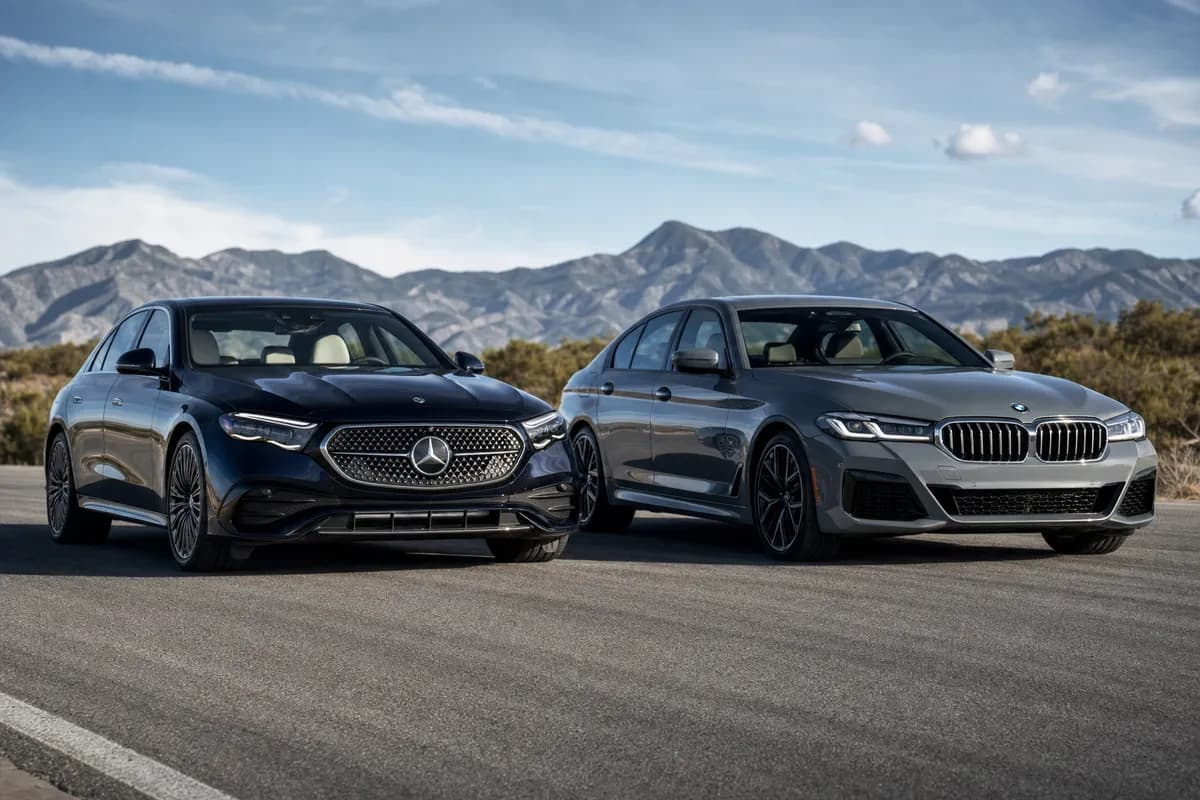
The executive sedan is supposed to be the car for grown-ups who still care. Not a crossover with delusions of grandeur, not an electric suppository wearing 22-inch wheels, but a proper four-door with a long hood, a quiet cabin, a serious badge, and enough power to make the commute feel less like court-ordered community service. For 2025, the Mercedes-Benz E-Class and BMW 5 Series both arrive as freshly redesigned heavyweights, and they approach the same job from opposite sides of the boardroom. The Mercedes wants to calm your pulse. The BMW wants to prove it still has one.
This is the duel that matters: 2025 Mercedes-Benz E-Class versus 2025 BMW 5 Series. Not because either is the cheapest luxury sedan you can buy — Genesis and Audi will happily undercut or sidestep them — but because these two define the segment. The E-Class is the traditional benchmark for comfort, polish, and cabin theater. The 5 Series is the perennial driver’s pick, now bulked up, digitized, and trying to reconcile its old sport-sedan soul with modern luxury-car expectations. One of them does the executive sedan job better. The other one is trying a little too hard.
Lineup and Pricing: BMW Starts Lower, Mercedes Feels Pricier Immediately
On paper, the BMW 5 Series lands the first jab. The 2025 BMW 530i starts around $58,700, with the 530i xDrive adding all-wheel drive at roughly $61,000. The six-cylinder 540i xDrive starts around $65,800. There is also the plug-in hybrid 550e xDrive, with a turbo inline-six and electric assistance, priced in the low-to-mid $70,000s. If you want full electric, BMW offers the related i5, but that’s another fight entirely.
The 2025 Mercedes-Benz E-Class is less interested in bargain theater. The E 350 4MATIC starts at about $63,600, while the more desirable E 450 4MATIC sits around $69,000 before options. In the U.S., Mercedes keeps all-wheel drive standard on the mainstream E-Class sedans, which helps explain the higher entry point. It also means the base E-Class is better equipped for buyers in wet or snowy states without making them click through the option sheet like they’re filing taxes.
But beware both configurators. This is where German luxury brands turn reasonable people into subscription-based revenue streams. Want the best stereo, better leather, driver-assistance tech, upgraded lighting, massaging seats, or flashier wheels? Start adding packages. A well-optioned E 450 can punch past $80,000 without breaking a sweat. A loaded 540i xDrive can do the same. Neither car is cheap, but the BMW gives you more financial breathing room at the front door.
- Best value entry model: BMW 530i or 530i xDrive
- Sweet-spot luxury spec: Mercedes-Benz E 450 4MATIC
- Best six-cylinder buy: BMW 540i xDrive, narrowly, thanks to price and punch
- Most likely to become absurdly expensive with options: Both, because Germany
Powertrains and Performance: The Six-Cylinder Cars Are the Ones You Want
The base-engine comparison is almost suspiciously symmetrical. The Mercedes-Benz E 350 4MATIC uses a 2.0-liter turbocharged inline-four with a 48-volt mild-hybrid system, rated at 255 horsepower and 295 lb-ft of torque. The BMW 530i uses a 2.0-liter turbocharged inline-four, also with 48-volt mild-hybrid assistance, producing 255 horsepower and 295 lb-ft. Both are paired with smooth automatic transmissions: a 9-speed automatic in the Mercedes and an 8-speed automatic in the BMW.
In the real world, the BMW’s base four-cylinder feels a touch more alert. The 530i is lighter on its feet, and the ZF 8-speed automatic remains one of the great transmissions of modern motoring — quick, intuitive, and rarely caught napping. BMW quotes the 530i xDrive at about 5.8 seconds to 60 mph. The E 350 4MATIC is typically quoted around 6.1 seconds. That’s not a yawning gap, but it’s enough that the BMW feels keener when you squirt through traffic or take the long freeway ramp because you are, allegedly, “checking road conditions.”
Now, forget the four-cylinders if your budget allows. The real cars are the sixes.
The Mercedes-Benz E 450 4MATIC uses a 3.0-liter turbocharged inline-six with mild-hybrid assist, rated at 375 horsepower and 369 lb-ft of torque. It’s silky, muscular, and deeply in character for an E-Class. The electric assistance fills in low-speed torque nicely, and the engine never sounds strained. Mercedes quotes roughly 4.4 to 4.5 seconds to 60 mph, which is plenty fast for a car that looks like it should be delivering a vice president to a climate summit.
The BMW 540i xDrive also runs a 3.0-liter turbocharged inline-six with 48-volt mild-hybrid tech, producing 375 horsepower and a stronger 398 lb-ft of torque. BMW quotes 0-60 mph in 4.4 seconds, and it feels every bit that quick. The B58 engine remains one of the best mainstream performance engines on sale: smooth, torquey, tunable, and somehow still eager near the top of the rev range. If engines had résumés, this one would arrive embossed.
Fuel economy depends heavily on drivetrain and spec, but expect the four-cylinder cars to land in the high-20s combined under EPA-style driving, while the six-cylinder mild hybrids hover in the mid-20s combined. The plug-in hybrid BMW 550e xDrive is the outlier, offering electric-only driving for short commutes and a combined system output of 483 horsepower. It’s quick, clever, and heavy. For some buyers, it is the smartest 5 Series. For purists, it is a fast science project.
Performance verdict: The BMW 540i xDrive has the sharper drivetrain and more urgent character. The Mercedes E 450 is smoother and more elegant, but the BMW’s inline-six still has the better right foot.
Ride, Handling, and Refinement: Mercedes Cruises, BMW Hustles
This is where the personalities split. The 2025 Mercedes-Benz E-Class is built around serenity. It has the better luxury ride, the quieter overall demeanor, and the more convincing impression that the outside world has been cancelled. On the highway, the E-Class settles into a flowing, expensive glide. Expansion joints are softened, road roar is subdued, and the body control is disciplined without becoming fussy. This is what Mercedes still does better than almost anyone: making speed feel dignified.
The 2025 BMW 5 Series is more athletic, but not as naturally engaging as its ancestors. The G60-generation 5 Series is a big car — about 199.2 inches long, with a 117.9-inch wheelbase. That makes it noticeably larger than the E-Class, which measures roughly 194.9 inches long on a 116.6-inch wheelbase. The BMW’s extra size gives it road presence and cabin space, but it also means this is no lightweight sports sedan in a tailored suit. It is a large luxury sedan that can move very quickly when prodded.
Still, BMW tunes the 5 Series with more steering weight, better front-end bite, and a more connected feel through fast corners. The 540i xDrive, especially with the right wheel-and-suspension package, is the car you’d choose for a mountain road. It rotates more willingly, masks its mass better, and feels more interested in your inputs. The E-Class can hustle, but it doesn’t enjoy being grabbed by the lapels. Push it hard and it remains composed, but slightly aloof — like a maître d’ who knows you’re not dressed well enough for the room.
The Mercedes claws back points in urban driving. Its ride quality is more forgiving over broken pavement, and its isolation makes stop-and-go traffic feel less punishing. The BMW can be quiet and comfortable, but it lets more of the road into the cabin, particularly on larger wheels and run-flat tires. If your commute includes battered city streets, the Mercedes will age your spine more gently.
- Best ride comfort: Mercedes-Benz E-Class
- Best steering and handling: BMW 5 Series
- Best highway cruiser: Mercedes-Benz E 450 4MATIC
- Best back-road choice: BMW 540i xDrive
The boring-but-important bit: both cars are extremely stable at speed, both offer strong brakes, and both deliver the kind of high-speed confidence that makes 75 mph feel like 45. The difference is attitude. The Mercedes asks, “Would you like to arrive refreshed?” The BMW asks, “Would you like to take the long way and pretend this meeting matters less than it does?”
Interior and Technology: The E-Class Puts on a Show, the 5 Series Gets to Work
Step inside the Mercedes-Benz E-Class and you get theater. The dashboard is dominated by glass, ambient lighting, turbine-like vents, and available screens that can make the cabin feel less like a car and more like a business-class lounge designed by someone with a mild obsession with nightclubs. The optional MBUX Superscreen adds a passenger display alongside the central touchscreen and digital instrument cluster. It’s dramatic, flashy, and absolutely catnip for buyers who want their car to feel new every time they sit in it.
The E-Class cabin also does luxury better in the old-fashioned ways. Materials are rich, the seats are excellent, and the cabin design has warmth that the BMW sometimes lacks. The Mercedes front seats are especially good for long drives, with available heating, ventilation, massage, and enough adjustment to accommodate everyone from gym-bro CFOs to people who sit like a question mark. Rear-seat space is generous, though not quite S-Class lavish. Trunk capacity is strong, at roughly 19 cubic feet, depending on market and measurement method.
The BMW 5 Series interior is cleaner, more businesslike, and less emotionally persuasive. It uses BMW’s Curved Display, combining a 12.3-inch digital instrument cluster with a 14.9-inch central touchscreen running iDrive 8.5. The system is quick, crisp, and powerful, but BMW has buried too many climate and vehicle functions in the screen. Yes, voice control helps. No, that does not excuse making simple tasks less tactile than they were ten years ago. Progress, apparently, means tapping a menu to change airflow direction while doing 70 mph.
That said, BMW’s tech is excellent once you learn it. Navigation is sharp, wireless Apple CarPlay and Android Auto are standard, and the available driver-assistance features are deeply capable. BMW’s Highway Assistant, where equipped, allows hands-free driving on approved highways at speeds up to 85 mph. Mercedes offers its own advanced driver-assistance systems, including adaptive cruise control, lane centering, automatic lane-change capability in certain conditions, and excellent augmented-reality navigation. Both are strong. BMW’s interface feels more methodical; Mercedes feels more dazzling.
Space is where the BMW uses its size well. The 5 Series has a roomy cabin and a sizable trunk of about 18.4 cubic feet. Rear passengers get generous legroom, and the seating position feels more open than in the Mercedes. The E-Class feels more intimate and cocooned. The BMW feels airier and more upright. Choose your flavor: private club or modern office.
Interior verdict: Mercedes wins on ambience, seat comfort, and luxury feel. BMW wins on cabin space and a slightly more straightforward driving environment. If you care how the car makes you feel at night, buy the E-Class.
Ownership, Safety, and Daily Use: Both Are Excellent, Neither Is Cheap to Keep
Both the 2025 Mercedes-Benz E-Class and 2025 BMW 5 Series come from brands that understand the executive-sedan buyer: quiet cabins, strong warranty coverage, premium dealer networks, and options lists long enough to qualify as novellas. Basic warranty coverage is broadly similar, with 4 years or 50,000 miles for both brands in the U.S. BMW typically includes complimentary scheduled maintenance for 3 years or 36,000 miles, which is a real advantage over Mercedes, where prepaid maintenance is usually an added cost.
Reliability? Let’s be adults. These are complex, turbocharged, mild-hybrid luxury sedans loaded with screens, sensors, cameras, motorized everything, and software that will occasionally need updates to fix things that should not have been broken in the first place. If you are buying new and keeping it through the warranty, fine. If you are shopping certified pre-owned in three years, buy the best warranty you can and avoid the most complicated option combinations unless you enjoy financial cliff diving.
Safety equipment is comprehensive in both. Expect standard automatic emergency braking, blind-spot monitoring, lane-keeping assistance, parking sensors, and surround-view camera availability. The Mercedes has a superb suite of semi-automated features when properly equipped, and its driver-assistance tuning tends to feel smooth and natural. BMW’s systems are also excellent and, with Highway Assistant, arguably more relaxing on long freeway runs. Neither car is short on safety; the question is how much of the best hardware is standard versus bundled into packages.
Daily usability is superb across the board. The E-Class has the better ride and easier luxury rhythm. The 5 Series has the larger footprint, better base price, and broader powertrain menu, especially with the 550e plug-in hybrid and i5 electric variants orbiting the same showroom. If you live in a dense city, the Mercedes feels slightly less bulky. If you routinely carry adults in the rear seats, the BMW’s larger shell pays dividends.
Verdict: The E-Class Is the Better Luxury Sedan, the 5 Series Is the Better Driver’s Car
Here’s the clean answer: if you want the best executive luxury sedan, buy the 2025 Mercedes-Benz E 450 4MATIC. It is the car that most convincingly understands the assignment. It rides better, feels richer, isolates you more completely, and delivers its performance with the polished confidence that made the E-Class famous in the first place. It is expensive, yes. It is also the one that feels like a proper Mercedes instead of a spreadsheet with ambient lighting.
But if you still care about driving — genuinely care, not just “I once owned a manual E46” care — the 2025 BMW 540i xDrive is the sharper tool. Its inline-six is brilliant, its transmission is better, its body control is tighter, and it has more appetite when the road gets interesting. It is not as delicately communicative as old 5 Series legends, and the new car’s size is impossible to ignore, but it still has enough BMW DNA to make the Mercedes feel a bit too detached when you’re in the mood.
The base-model fight goes to BMW. The 530i and 530i xDrive are better value than the E 350 4MATIC, and the BMW’s four-cylinder powertrain feels marginally more responsive. The plug-in hybrid fight also goes to BMW because Mercedes does not currently give the U.S. E-Class lineup an equivalent mainstream PHEV sedan rival. The cabin-quality and long-distance-comfort fight goes to Mercedes, decisively.
- Buy the Mercedes-Benz E-Class if: you want the quieter, more luxurious, more elegant executive sedan.
- Buy the BMW 5 Series if: you want sharper handling, better value, and the superior six-cylinder drivetrain.
- Best overall pick: Mercedes-Benz E 450 4MATIC
- Best enthusiast pick: BMW 540i xDrive
- Best budget-conscious pick: BMW 530i xDrive
My verdict? The 2025 Mercedes-Benz E-Class wins this duel by being the better executive sedan — more comfortable, more luxurious, and more special from behind the wheel when you’re not driving like you’re late to defuse a bomb. The BMW 5 Series remains the one I’d take for a fast Sunday morning, especially in 540i xDrive form, but the Mercedes is the one I’d want for the other six days of the week. And in this class, that matters. An executive sedan should make life feel smoother, not just make corners feel shorter.
Affiliate disclosure: This article contains affiliate links. RevvedUpCars may earn a small commission on qualifying purchases at no extra cost to you.