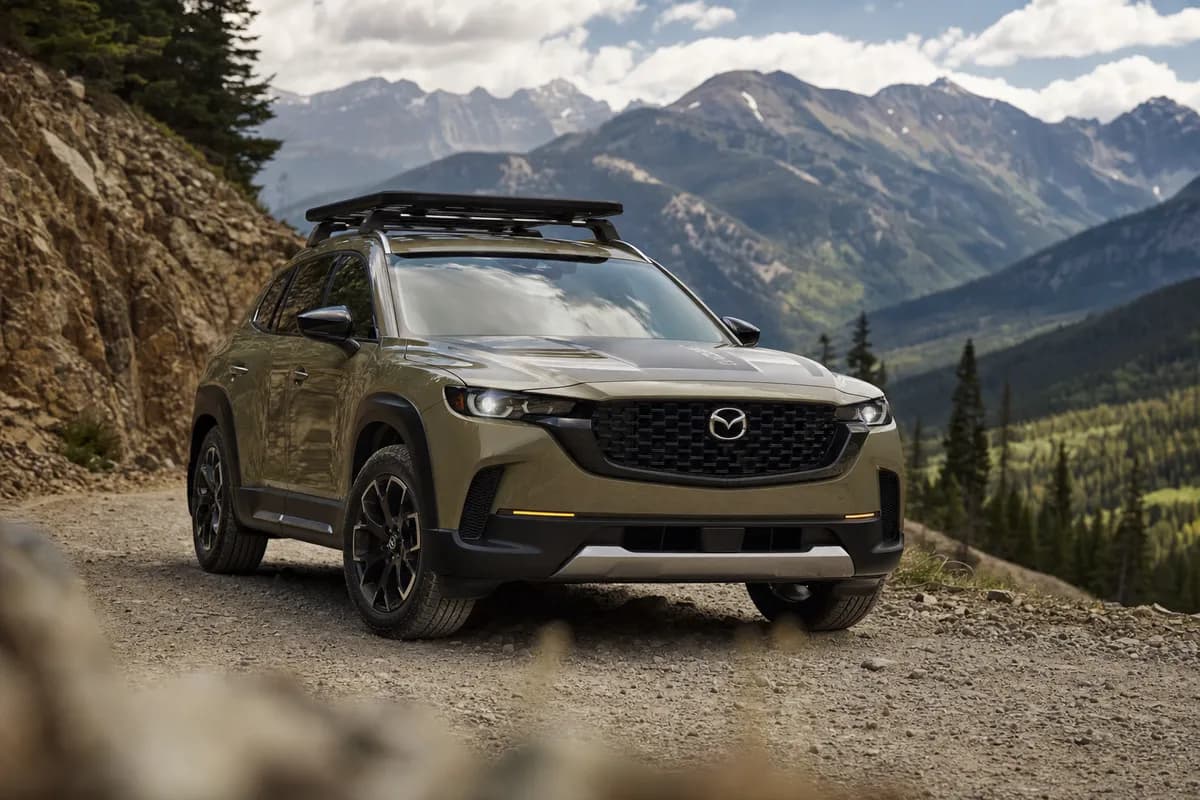
The 2024 Mazda CX-50 should have been an easy target: another compact crossover wearing hiking boots it will mostly use to climb mall curbs. I expected lifestyle cosplay, some plastic cladding, a gravel-road drive mode, and a brochure full of people pretending to enjoy camping.
The 2024 Mazda CX-50 should have been an easy target: another compact crossover wearing hiking boots it will mostly use to climb mall curbs. I expected lifestyle cosplay, some plastic cladding, a gravel-road drive mode, and a brochure full of people pretending to enjoy camping. Instead, the CX-50 turned out to be one of the rare crossovers that actually feels engineered by people who still like driving. It is wider, lower, and tougher-looking than the CX-5, but the surprise is not the image. The surprise is that the thing has bite.
After a first drive across broken pavement, fast two-lanes, freeway stretches, and just enough dirt to annoy the tires, the 2024 Mazda CX-50 outperformed expectations by doing what most rivals refuse to do: it made the practical choice feel like the emotional one. The Subaru Outback is roomier and more relaxed. The Honda CR-V is more efficient and more sensible. The Toyota RAV4 sells because America has collectively decided thinking is optional. But the CX-50? This one has a pulse.
The CX-50 Is Not Just A CX-5 In A Flannel Shirt
Mazda already had the excellent CX-5, so the obvious question is whether the CX-50 is necessary or just marketing with mud on its boots. The answer: necessary, but not for everyone.
The CX-50 is longer, wider, and more planted than the CX-5. It measures 185.8 inches long, rides on a 110.8-inch wheelbase, and stretches 75.6 inches wide. That gives it a stance the CX-5 simply does not have. The roofline is lower, the body is more squared-off, and the cabin feels like it sits down into the chassis rather than perched on top of it. In an era of crossovers shaped like swollen kitchen appliances, that matters.
Ground clearance is useful rather than theatrical: up to 8.6 inches depending on trim and wheel package. That is enough for rutted access roads, snowy driveways, and trailheads that would make a low-slung sedan beg for mercy. It is not Jeep Wrangler territory, and if you try to use it like one, nature will invoice you.
Cargo space lands at 31.4 cubic feet behind the rear seats and 56.3 cubic feet with them folded. That trails boxier rivals like the Subaru Outback and Honda CR-V, but the load floor is broad and low, which makes it easy to shove in bikes, coolers, dogs, and the other evidence of an active life. Mazda also gave the CX-50 roof strength suitable for heavier-duty accessories, including rooftop tents, which is a neat bit of credibility in a segment drowning in fake adventure badges.
Inside, the CX-50 feels more expensive than its price tag suggests. Mazda continues to do interiors better than nearly everyone in the mainstream class. The dashboard is clean, the driving position is excellent, and the materials have that quietly premium texture Mazda does so well. It is not flashy. It is not covered in piano-black fingerprint traps like a crime scene. It just works.
The 10.25-inch infotainment display is controlled primarily by Mazda’s rotary knob, which remains divisive. I like it because it keeps your eyes closer to the road and your fingerprints off the screen. People who want to stab icons like they are ordering fast food will grumble. Wireless Apple CarPlay and Android Auto are available, and in CarPlay, Mazda allows touchscreen use. Progress, even if delivered with Mazda’s usual reluctance to follow the herd.
The Turbo Engine Is The One That Wakes The Car Up
The 2024 Mazda CX-50 comes with two versions of Mazda’s familiar 2.5-liter four-cylinder engine, both paired with a six-speed automatic transmission and standard i-Activ all-wheel drive. Standard AWD is a proper advantage here, especially against front-drive base versions of the Honda CR-V, Toyota RAV4, Hyundai Tucson, and Kia Sportage.
- 2.5-liter naturally aspirated four-cylinder: 187 horsepower and 186 lb-ft of torque
- 2.5-liter turbocharged four-cylinder: 227 horsepower and 310 lb-ft on regular fuel
- Turbo output on premium fuel: 256 horsepower and 320 lb-ft of torque
- Transmission: six-speed automatic
- Drivetrain: standard all-wheel drive
- Maximum towing: 2,000 pounds for the base engine, 3,500 pounds for the turbo
The base engine is fine in the way oatmeal is fine. It moves the CX-50 without drama, returns solid fuel economy, and will satisfy buyers who drive like the right lane was invented specifically for them. EPA ratings are 24 mpg city, 30 mpg highway, and 27 mpg combined. That is respectable, though not class-leading. The CR-V hybrid and RAV4 hybrid will humiliate it at the pump.
But the turbo is the engine that makes the CX-50 feel like a Mazda instead of just another crossover with ambitious wheel arches. With 310 lb-ft available on regular gas, it delivers muscular low-end shove without needing to scream. Feed it premium and output rises to 256 horsepower and 320 lb-ft, which is proper punch for a compact SUV. Published instrumented tests have put turbocharged CX-50 models in the mid-six-second range to 60 mph, while non-turbo versions usually sit closer to the high-eights. That gap is not academic. You feel it every time you merge, pass, or climb a grade with people and luggage aboard.
The six-speed automatic sounds old on paper because, frankly, it is. Rivals are using eight-speeds, CVTs, dual-clutches, hybrid e-CVTs, and other alphabet soup gearboxes. Yet Mazda’s six-speed is calibrated with more intelligence than most of those newer units. It does not hunt like a caffeinated squirrel. It holds gears when you are pressing on. It responds crisply enough in Sport mode. Would an eight-speed improve highway economy and acceleration? Probably. Is the current gearbox a dealbreaker? Absolutely not.
Fuel economy for the turbo is rated at 23 mpg city, 29 mpg highway, and 25 mpg combined. That is the price of torque, and you will pay it. If your life is 40 miles of commuting per day, the naturally aspirated version makes more financial sense. If your life includes mountain roads, towing a small trailer, or simply wanting your crossover not to feel sedated, get the turbo and stop pretending you will be happy with less.
On The Road, It Drives Like Mazda Still Cares
This is where the CX-50 starts embarrassing some rivals. Most compact SUVs drive as if their engineers were given three commands: make it quiet, make it numb, make sure nobody notices anything. The Mazda does not follow that dreary script.
The steering is the first tell. It has real weight, a clean buildup off center, and enough precision that you place the CX-50 rather than merely suggest a direction. It is not a sports sedan in platform shoes, so let us not get ridiculous. But compared with a RAV4, which steers with the enthusiasm of a shopping cart, the CX-50 feels alert and deliberate. Compared with a Honda CR-V, it is less airy and more connected. Compared with a Subaru Outback, it feels lower and more disciplined.
The chassis is genuinely sorted. Mazda uses a torsion-beam rear suspension here, which usually makes enthusiasts reach for the complaint department. Yet the tuning is good enough that most drivers will not care. Body control is tight, the front end bites cleanly, and the CX-50 resists the floaty, top-heavy sensation that plagues many rivals. On fast sweepers, it settles into a confident stance and lets you lean on the outside tires without feeling like the whole cabin is about to slide off the chassis.
There is a trade-off: ride comfort. On 20-inch wheels, the CX-50 can feel firm over sharp impacts and patched urban pavement. Not punishing, not brittle, but definitely taut. The CX-5 feels a little more polished in certain situations, and the Subaru Outback is softer over long-distance highway abuse. If your roads look like they were shelled, avoid the biggest wheels. The Meridian Edition’s 18-inch wheels and all-terrain rubber fit the CX-50’s personality better anyway, even if they add some tire noise and soften ultimate response.
Mazda’s Mi-Drive system includes Normal, Sport, Off-Road, and on turbo models equipped for it, Towing mode. This is not some magic rock-crawling system, but it does alter throttle response, transmission behavior, traction control, and AWD logic. On loose surfaces, the CX-50 feels composed and predictable. The all-wheel-drive system does not wait until the front tires are flailing before sending help rearward. It gives the car a more settled, rear-assisted feel under power, which is exactly what you want when the road turns dusty or wet.
The brakes are progressive and easy to modulate, the pedal placement is good, and visibility is generally strong despite the low roofline. The hood edges are easier to place than in many crossovers, which helps both on tight roads and when nosing around uneven trails. This is not just style; the shape makes the car easier to drive precisely.
How It Stacks Up Against The Usual Suspects
The compact SUV segment is a knife fight in sensible shoes, so the CX-50 cannot survive on charm alone. It needs to justify itself against brutally competent rivals.
Subaru Outback
The Outback is the obvious outdoorsy comparison. It has standard AWD, more wagon-like cargo practicality, and a loyal fan base that treats dogs as co-signers. Its available 2.4-liter turbo makes 260 horsepower and 277 lb-ft, and it is genuinely capable on rough roads. But Subaru’s CVT saps joy like a wet blanket over a campfire. The Mazda feels sharper, more premium inside, and vastly more enjoyable on pavement. If you prioritize space and softness, buy the Outback. If you still enjoy steering, buy the Mazda.
Honda CR-V
The CR-V is the rational overachiever. The hybrid is excellent, efficient, and roomy, with up to 40 mpg city in front-drive form. It is easier to recommend to your accountant. But the Honda does not have the CX-50’s steering feel, turbo torque, or upscale cabin vibe. The CR-V is the better appliance. The Mazda is the better car.
Toyota RAV4
The RAV4 is the sales titan, and the hybrid lineup gives it a huge efficiency advantage. The RAV4 Hybrid is rated up to 41 mpg city, and the plug-in RAV4 Prime is legitimately quick. But mainstream RAV4 models feel coarse, loud, and less composed than the Mazda. Toyota will win on resale, hybrid choice, and dealership ubiquity. Mazda wins on refinement, dynamics, and not making every drive feel like a mandatory training video.
CX-5
The in-house rival may be the toughest. The CX-5 is still wonderful: quieter, more traditionally premium, and slightly easier to live with in tight city spaces. But the CX-50 has the stance, the cargo shape, the adventure hardware, and the more interesting attitude. If you want plush, pick CX-5. If you want tougher and more engaging, pick CX-50.
Verdict: The CX-50 Is The Crossover For People Who Hate Settling
The 2024 Mazda CX-50 outperformed expectations because it did not take the lazy route. It could have been a CX-5 with cladding and a roof rack. Instead, Mazda built a wider, more purposeful crossover that feels genuinely distinct. It looks rugged without becoming cartoonish, drives with uncommon precision, and offers enough practicality to make sense Monday through Friday while still feeling ready for Saturday trouble.
It is not perfect. The ride can be firm, especially on 20-inch wheels. The base engine is merely adequate. Fuel economy trails the best hybrids. Rear-seat and cargo space are good, not class-leading. And if your idea of adventure is mostly Costco, a CR-V Hybrid will probably serve you better and drink less fuel while doing it.
But cars are not bought on spreadsheets alone, no matter what the internet’s joyless comparison charts suggest. The CX-50 brings something rare to this segment: character backed by competence. The turbo engine gives it real shove. The chassis gives it real confidence. The cabin gives it real polish. And the standard AWD gives it real all-weather credibility.
My pick is the CX-50 2.5 Turbo, ideally on the smaller wheel package if ride quality matters where you live. The Meridian Edition looks the part and makes sense if you actually use dirt roads, but the Turbo Premium trims strike the best balance between power, equipment, and everyday refinement. Budget buyers should look at the naturally aspirated 2.5 S Preferred or Premium, but only if they are honest about not needing extra punch.
Final verdict: The 2024 Mazda CX-50 is not the most spacious, not the most efficient, and not the cheapest compact SUV. Good. It is the one that feels like it was built by people who believe driving still matters. In a segment full of sensible answers, the CX-50 is the rare crossover that makes the emotional choice feel smart.
Affiliate disclosure: This article contains affiliate links. RevvedUpCars may earn a small commission on qualifying purchases at no extra cost to you.