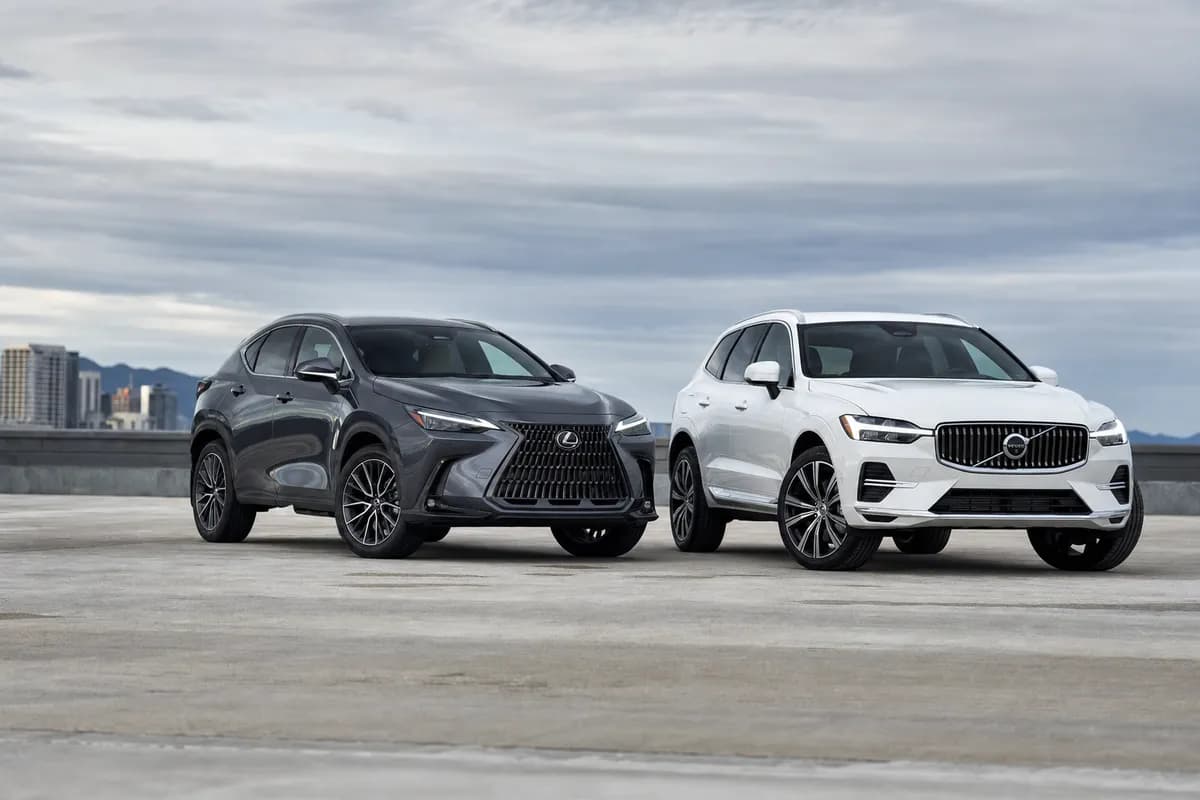
The 2024 Lexus NX 450h+ and Volvo XC60 Recharge are what happens when sensible family SUVs discover caffeine and a wall plug. Both promise weekday EV commuting, weekend road-trip freedom, all-wheel drive, premium cabins, and enough badge polish to make the neighbors notice.
The 2024 Lexus NX 450h+ and Volvo XC60 Recharge are what happens when sensible family SUVs discover caffeine and a wall plug. Both promise weekday EV commuting, weekend road-trip freedom, all-wheel drive, premium cabins, and enough badge polish to make the neighbors notice. But they do the job very differently. The Lexus is the slick, efficient, Toyota-bred long-game machine. The Volvo is the brawny Scandinavian with a gym membership and a slightly alarming right hook. If you’re cross-shopping these two plug-in hybrid SUVs, the choice isn’t subtle: buy the Lexus if you want efficiency, refinement, and ownership peace of mind; buy the Volvo if you want power, space, and a little mischief in your school-run appliance.
Powertrain And Performance: The Volvo Punches Harder, The Lexus Thinks Smarter
The 2024 Lexus NX 450h+ uses a 2.5-liter naturally aspirated four-cylinder engine paired with front and rear electric motors, a continuously variable automatic transmission, and standard all-wheel drive. Total system output is 304 horsepower, which is plenty in a compact luxury SUV that would otherwise be expected to spend its life gliding between Trader Joe’s and the orthodontist.
Lexus quotes 0-60 mph in about 6.0 seconds, and that feels honest. The NX 450h+ doesn’t explode off the line, but the electric torque gives it the kind of immediate, clean shove that makes city driving feel effortless. The powertrain is smooth, quiet, and beautifully integrated. It never feels like three different propulsion systems arguing over a conference call.
The 2024 Volvo XC60 Recharge, meanwhile, arrives wearing a tailored suit with brass knuckles in the pocket. Its T8 plug-in hybrid setup combines a turbocharged 2.0-liter four-cylinder engine with an electric motor for a massive 455 horsepower and 523 lb-ft of torque. That is not “eco crossover” power. That is “accidentally embarrass a hot hatch” power.
Volvo claims 0-60 mph in 4.5 seconds, and the XC60 Recharge feels every bit that quick. Plant your right foot and it launches with a thick, immediate wallop from the rear electric motor before the gas engine piles on. It’s not a sports SUV in the Porsche Macan sense — the steering is too relaxed and the body too comfort-biased for that — but in a straight line, the Volvo absolutely bullies the Lexus.
Here’s the catch: the Lexus powertrain is more polished. The Volvo’s drivetrain can feel muscular but occasionally less seamless as it blends gas and electric power, especially when the battery is low or you’re asking for sudden acceleration. It’s not clumsy, but compared with the Lexus, it has a bit more mechanical theater. Some drivers will call that character. Others will call it “why did my $65,000 SUV just hesitate?”
- Lexus NX 450h+: 304 hp, AWD, roughly 6.0-second 0-60 mph, smoother hybrid calibration.
- Volvo XC60 Recharge: 455 hp, 523 lb-ft, AWD, roughly 4.5-second 0-60 mph, much stronger acceleration.
- Performance winner: Volvo, decisively.
- Refinement winner: Lexus, by a clear margin.
On the road, the Lexus feels lighter on its feet than the numbers suggest. The steering is accurate if not particularly chatty, the ride is composed, and the F Sport Handling trim adds adaptive dampers that sharpen responses without turning the NX into a brittle mess. It is not thrilling, but it is impressively sorted. Lexus has mastered the art of making “uneventful” feel expensive.
The Volvo rides with a more relaxed, grand-tourer attitude. It feels wider, heavier, and calmer. The XC60 Recharge has the better highway presence and the more authoritative passing power, but it doesn’t shrink around the driver the way the best compact luxury SUVs do. Push it on a back road and it reminds you that 455 hp does not repeal physics. It leans, it manages, it goes quickly — but it does not dance.
Electric Range, Fuel Economy, And Charging: Lexus Wins The Efficiency Fight
Plug-in hybrid SUVs live or die by how often they let you avoid using gasoline. On that front, the Lexus NX 450h+ is excellent. It carries an 18.1-kWh lithium-ion battery and delivers an EPA-estimated 37 miles of electric range. That number matters. For many commuters, 37 miles means the gas engine stays asleep Monday through Friday.
The Volvo XC60 Recharge is close, but not quite as efficient. Its extended-range plug-in hybrid system is rated at 35 miles of electric range. That’s still genuinely useful, and far better than the token 15-to-20-mile PHEVs that used to litter the segment. But in real-world commuting, the Lexus tends to use its electrons more frugally and transition into hybrid operation more gracefully.
EPA ratings tell the story. The Lexus NX 450h+ is rated at 84 MPGe combined when using electric and gas power, and about 36 mpg combined once the battery is depleted. The Volvo XC60 Recharge is rated at about 63 MPGe combined and 28 mpg combined after the battery is depleted. That is a significant gap, especially if you frequently take long trips after the battery runs down.
In plain English: if you plug in every night and mostly drive short distances, both SUVs can slash fuel use. If you regularly drive beyond the EV range, the Lexus becomes much cheaper to run. The Volvo’s big power comes with a bar tab.
- Lexus NX 450h+ electric range: 37 miles EPA.
- Volvo XC60 Recharge electric range: 35 miles EPA.
- Lexus efficiency: 84 MPGe combined, 36 mpg combined on gas.
- Volvo efficiency: 63 MPGe combined, 28 mpg combined on gas.
- Efficiency winner: Lexus, and it is not close once the battery is depleted.
Charging also favors the Lexus, depending on your setup. The NX 450h+ offers a 6.6-kW onboard charger, allowing a full charge on a Level 2 home charger in roughly 2.5 hours. That makes it very easy to come home, plug in, eat dinner, and head back out with a full battery.
The Volvo XC60 Recharge uses a slower onboard charger, and a Level 2 charge typically takes around five hours. For overnight charging, that’s fine. For opportunistic midday top-ups, the Lexus is better. Neither vehicle supports DC fast charging, which is normal for plug-in hybrids. If you want road-trip fast-charging, buy a full EV — and prepare to learn which charging networks are held together by hope and a QR code.
The key question is how you drive. If your daily round trip is under 30 miles and you charge at home, either SUV can behave like an EV most days. But if you care about squeezing maximum efficiency from every kilowatt-hour and gallon, the Lexus is the sharper tool.
Interior, Tech, And Practicality: Volvo Brings Space, Lexus Brings Sanity
Inside, the Lexus NX 450h+ and Volvo XC60 Recharge take very different approaches to luxury. The Lexus cabin is tightly assembled, quiet, and modern, with soft-touch materials, excellent seats, and the kind of build quality that makes every switch feel like it was approved by a committee of obsessive engineers.
The NX gets Lexus’ current infotainment system, usually displayed on a large 14.0-inch touchscreen in higher trims. It is a massive improvement over the old Lexus touchpad horror show, which deserved to be sealed in concrete and dropped into the Pacific. Wireless Apple CarPlay and Android Auto are available, the graphics are crisp, and the interface is generally straightforward. There are still too many screen-based controls, but at least Lexus remembered that volume knobs are not a crime.
The Volvo interior is cooler, airier, and more architectural. The XC60 Recharge has that Swedish showroom vibe: clean lines, handsome materials, available wool-blend upholstery, driftwood trim, and seats so good they could make a dentist’s waiting room feel like business class. If the Lexus feels like a luxury product engineered to last 15 years, the Volvo feels like a boutique hotel suite with a turbocharger.
Volvo’s Google built-in infotainment system is powerful, especially for navigation and voice control. Google Maps integration is excellent, and the native Google Assistant is genuinely useful. But the portrait-oriented center screen buries too many functions, and some drivers will miss physical controls for basic tasks. It looks minimal. It sometimes behaves like minimalism designed by someone who never had to change the climate settings while merging.
Practicality tilts toward Volvo. The XC60 offers about 22.4 cubic feet of cargo space behind the rear seats and up to roughly 63.3 cubic feet with them folded. The Lexus NX 450h+ has about 22.7 cubic feet behind the second row, but only around 46.9 cubic feet maximum. The Lexus is fine for groceries, luggage, strollers, and normal family duty, but the Volvo is the better hauler.
Towing is another Volvo advantage. The XC60 Recharge is rated to tow up to 3,500 pounds, while the Lexus NX 450h+ is rated at 2,000 pounds. If you have a small trailer, a pair of dirt bikes, or a lightweight camper, the Volvo makes more sense.
- Best seats: Volvo XC60 Recharge.
- Best infotainment usability: Lexus NX 450h+.
- Best cargo space: Volvo XC60 Recharge.
- Best towing capacity: Volvo XC60 Recharge.
- Best perceived durability: Lexus NX 450h+.
Passenger space is close, with both SUVs offering adult-friendly front and rear accommodations. The Volvo feels roomier because of its cabin shape and glass area, while the Lexus feels more cocooned. Families with rear-facing child seats should test both, but the Volvo’s slightly more open cabin gives it the nod for daily family use.
Price, Trims, Safety, And Ownership: Lexus Plays The Long Game
Pricing is where this comparison gets spicy. The 2024 Lexus NX 450h+ starts at roughly $59,000 to $60,000 before options, depending on trim and destination. It is not cheap, especially considering the NX lineup starts much lower with conventional hybrid and gas models. But the 450h+ comes well equipped, and Lexus does not make you climb through seventeen trim ladders like you’re applying for a mortgage.
The 2024 Volvo XC60 Recharge starts in the same general neighborhood, around the low-$60,000 range for Core and Plus versions, while Ultimate and Polestar Engineered models can push well beyond $70,000. The Volvo can feel like the stronger value if you focus on horsepower-per-dollar, because 455 hp in a luxury SUV at this price is, frankly, rude. But options and upper trims inflate the sticker quickly.
Both SUVs come with strong safety credentials and long lists of driver-assistance tech. The Lexus NX includes the Lexus Safety System+ suite, with features such as adaptive cruise control, lane tracing assist, automatic emergency braking, pedestrian detection, road sign assist, and blind-spot monitoring availability depending on configuration. The Volvo brings its own reputation for safety, with Pilot Assist, collision mitigation, blind-spot monitoring, lane keeping aid, and excellent crash-structure engineering baked into the brand’s DNA.
But ownership confidence favors Lexus. Lexus reliability remains one of the strongest arguments in the premium market, and the NX 450h+ benefits from Toyota’s deep hybrid experience. This is not Lexus experimenting in public; this is Lexus applying decades of hybrid know-how to a luxury compact SUV. The NX 450h+ also shares major conceptual DNA with the Toyota RAV4 Prime, one of the most proven and efficient plug-in hybrid SUVs on sale.
Volvo’s plug-in hybrid system is vastly improved compared with earlier versions, especially with the larger battery and stronger rear motor introduced in recent model years. Still, long-term complexity is higher. Turbocharged engine, high-output hybrid system, premium electronics, air-suspension availability on some configurations — none of that screams “cheap to own after warranty.” The Volvo is desirable, but it is not the one I’d choose if my plan involved 150,000 miles and a spreadsheet.
Warranty coverage is broadly competitive. Lexus provides a 4-year/50,000-mile basic warranty, a 6-year/70,000-mile powertrain warranty, and a 10-year/150,000-mile hybrid battery warranty. Volvo offers a 4-year/50,000-mile basic warranty and typically includes complimentary scheduled maintenance for the first 3 years/36,000 miles, with hybrid battery coverage generally at 8 years/100,000 miles. Check exact terms with your dealer, because warranty fine print has the charisma of wet cardboard but can save you real money.
Alex’s take: The Volvo is the one you want on the test drive. The Lexus is the one you want five years after the test drive.
Verdict: Buy The Lexus For Efficiency, Buy The Volvo For Muscle
The 2024 Lexus NX 450h+ wins this comparison for the buyer who actually wants a plug-in hybrid to behave like a smart, efficient, low-drama daily driver. It has better real-world efficiency, quicker Level 2 charging, excellent electric range, superb powertrain polish, and the kind of ownership reputation that makes used-car managers breathe easier. It is not the most exciting SUV here, but it is the more complete plug-in hybrid.
The 2024 Volvo XC60 Recharge is the more charismatic machine. It is quicker, roomier, stronger for towing, and more stylish inside. Its 455-hp powertrain turns a responsible luxury crossover into something with genuine shove. If you value performance and Scandinavian design over maximum efficiency, the Volvo is deeply tempting. It makes the Lexus feel a little buttoned-up, like it irons its socks.
But the numbers matter. The Lexus gives you 37 miles of EV range, 84 MPGe, and 36 mpg after the battery is depleted. The Volvo gives you 35 miles of EV range, 63 MPGe, and 28 mpg on gas. That gap is too big to ignore in a plug-in hybrid comparison. A PHEV should be efficient first and muscular second. The Lexus understands the assignment better.
If I were leasing for three years and wanted the more entertaining, upscale, and powerful SUV, I’d take the Volvo XC60 Recharge and enjoy every boosted overtake. If I were buying with my own money and planning to keep it past the warranty period, I’d take the Lexus NX 450h+ without much hesitation.
Final verdict: The Volvo XC60 Recharge is the faster and flashier plug-in hybrid SUV, but the Lexus NX 450h+ is the better all-around buy. It is more efficient, more refined, easier to charge quickly at home, and more convincing as a long-term ownership proposition. The Volvo wins your right foot. The Lexus wins your wallet, your commute, and probably your mechanic’s respect.
Affiliate disclosure: This article contains affiliate links. RevvedUpCars may earn a small commission on qualifying purchases at no extra cost to you.