The 2025 Lamborghini Huracán versus Ferrari F8 Tributo is not just a spec-sheet slap fight between two Italian mid-engine peacocks. It is a philosophical cage match: Lamborghini’s naturally aspirated V10, all induction howl and razor-edged theatre, against Ferrari’s twin-turbo…
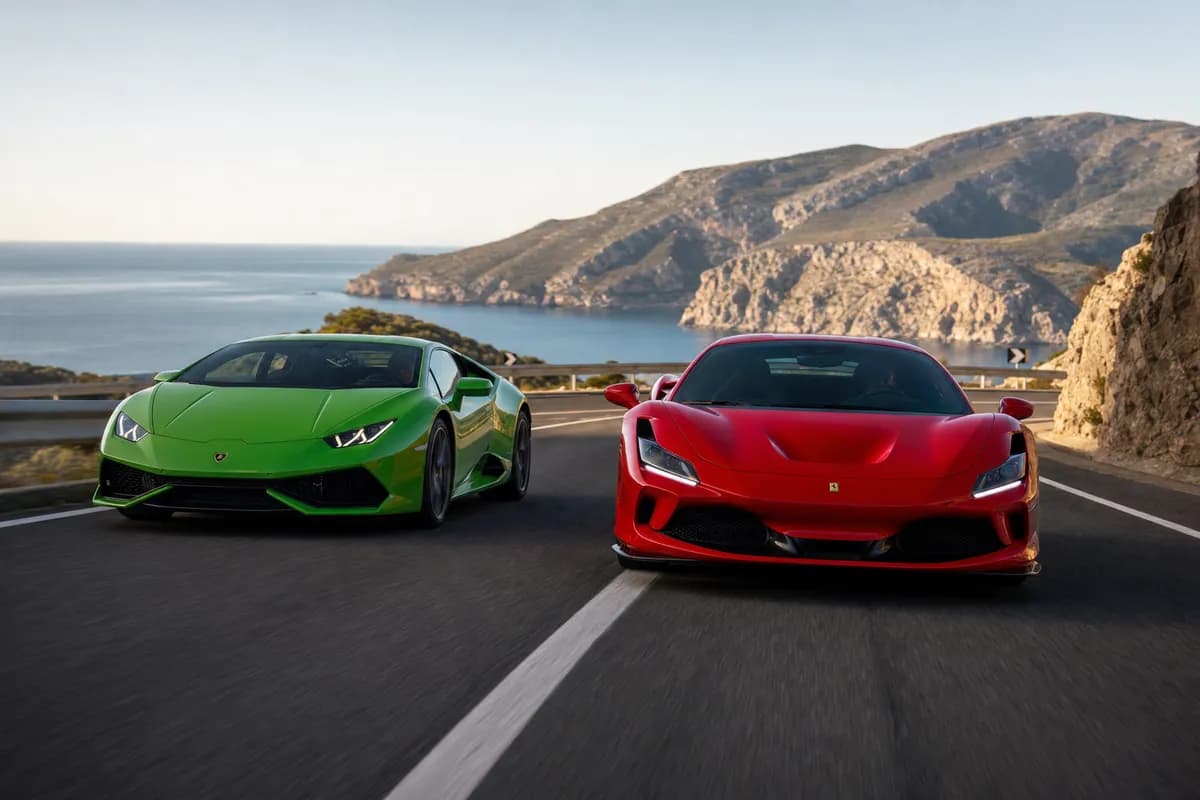
The 2025 Lamborghini Huracán versus Ferrari F8 Tributo is not just a spec-sheet slap fight between two Italian mid-engine peacocks. It is a philosophical cage match: Lamborghini’s naturally aspirated V10, all induction howl and razor-edged theatre, against Ferrari’s twin-turbo V8, a 710-hp scalpel with a Maranello badge and the sort of acceleration that makes your internal organs file a complaint. One is the last great screaming Lambo of its kind. The other is Ferrari’s last mainstream mid-engine V8 before the hybrid era took over. Both are absurd. Only one is the better supercar to actually buy.
Quick verdict: The Ferrari F8 Tributo is faster, sharper, and more complete at the limit. The Lamborghini Huracán is louder, more emotional, and easier to love. If you want the best driver’s tool, buy the F8. If you want the supercar experience turned up until the neighbors start a petition, buy the Huracán.
The Matchup: A Final-Call Lamborghini Meets Ferrari’s V8 Masterpiece
First, a necessary reality check. The Lamborghini Huracán is at the end of its life. Lamborghini has already moved toward the hybrid V8-powered Temerario as the Huracán’s successor, while the Ferrari F8 Tributo is also out of production, replaced in spirit by the plug-in hybrid 296 GTB. So this comparison lives where many great supercar decisions now live: low-mileage used cars, final allocations, dealer inventory, and collectors arguing over options while pretending carbon cup holders matter.
For the cleanest fight, we are putting the most relevant road-focused Lamborghini Huracán against the Ferrari F8 Tributo coupe. In Lamborghini terms, that means the Huracán Tecnica, the rear-drive, 631-hp sweet spot that borrowed attitude from the STO without making you wear a helmet to buy milk. The STO is even more aggressive, the Evo AWD is more secure, and the Sterrato is a glorious dirt-flinging lunatic, but the Tecnica is the most direct rival to the Ferrari.
The headline numbers look like this:
- Lamborghini Huracán Tecnica: 5.2-liter naturally aspirated V10, 631 hp, 417 lb-ft, 7-speed dual-clutch, rear-wheel drive, 0-62 mph in 3.2 seconds, top speed 202 mph.
- Ferrari F8 Tributo: 3.9-liter twin-turbo V8, 710 hp, 568 lb-ft, 7-speed dual-clutch, rear-wheel drive, 0-62 mph in 2.9 seconds, top speed 211 mph.
- Typical U.S. pricing: Huracán Tecnica roughly $250,000-plus when new before options; F8 Tributo originally around $280,000-plus, now commonly trading well above or around original MSRP depending on mileage and specification.
On paper, Ferrari lands the first punch with 79 more horsepower and a chunky 151 lb-ft torque advantage. In the real world, the gap feels even bigger once the F8’s turbos wake up and punt the car down the road like it has discovered a personal grudge against distance. But numbers do not tell the whole story, because the Huracán’s V10 delivers its performance with a violence and soundtrack the Ferrari simply cannot replicate.
Powertrains: Turbocharged Precision vs Naturally Aspirated Drama
The Ferrari F8 Tributo’s engine is one of the great modern V8s. It is derived from Ferrari’s award-winning 3.9-liter twin-turbo unit, closely related to the motor in the 488 Pista, and produces 710 hp at 8,000 rpm. That is not just a big number. It is a big number delivered with surgical confidence. The F8 does the classic turbocharged Ferrari trick: minimal lag, savage midrange, and an upper-rev rush that feels more exotic than most boosted engines have any right to feel.
Ferrari claims 0-62 mph in 2.9 seconds and 0-124 mph in 7.8 seconds. Those numbers are not marketing confetti. Independent testing of F8s and closely related Ferrari V8 models has consistently shown brutally quick real-world performance. The car hooks, squats, and fires itself forward with the composure of a ballistic missile that went to finishing school.
The Lamborghini Huracán Tecnica answers with something rarer and, frankly, more romantic: a 5.2-liter naturally aspirated V10 spinning to a sky-high redline and making 631 hp without a pair of turbos huffing in the background. Torque is only 417 lb-ft, which looks modest next to the Ferrari’s 568 lb-ft, but that misses the point. The Lamborghini makes you work for it. It rewards revs. It builds tension. It turns every tunnel into a poor life choice.
The Huracán’s 7-speed dual-clutch gearbox is quick and decisive, though Ferrari’s transmission calibration still feels more telepathic in aggressive driving. In the Ferrari, shifts are part of the car’s seamless forward attack. In the Lamborghini, they are more theatrical, more percussive, more “yes officer, I did hear that too.”
If you measure engines by outright effectiveness, the Ferrari wins. The F8’s V8 is stronger everywhere that matters for lap times and overtakes. If you measure engines by goosebumps, the Lamborghini fights back hard. The V10 is one of the last naturally aspirated supercar engines left standing, and its sound alone may be worth 30 horsepower in the court of emotional truth.
On the Road and Track: The Ferrari Is Faster, the Lamborghini Is Wilder
Drive the Ferrari F8 Tributo quickly and the first thing you notice is not the power. It is the chassis intelligence. Ferrari’s Side Slip Control system, E-Diff, F1-Trac traction management, and magnetorheological dampers work together with eerie smoothness. The F8 lets you drive absurdly fast without turning every corner entry into a negotiation with the afterlife.
The steering is ultra-quick, classic modern Ferrari: light, immediate, maybe too twitchy if you are coming from a Porsche 911 GT3 or McLaren 720S. But once your brain recalibrates, the F8 becomes devastating. It changes direction like it has no interest in physics as a concept. The front end bites hard. The rear stays playful but managed. In Race mode, it flatters. In CT Off, it starts asking whether you are actually good or merely wealthy.
The Huracán Tecnica is less polished but more visceral. Lamborghini sharpened the front end compared with older Huracán models, fitted rear-wheel steering, and tuned the chassis to feel more alive than the previous Evo RWD. It is a much better driver’s car than the early Huracán, which could feel like a very expensive engine display case attached to competent handling. The Tecnica has balance, feedback, and bite.
Still, it cannot quite match the Ferrari’s depth. The F8 has broader limits, better power delivery out of corners, and a more sophisticated stability-control safety net. The Lamborghini asks more from you and occasionally rewards you with bigger grins, but the Ferrari covers ground faster with less fuss. On a proper road, the F8 is a rapier. The Huracán is a switchblade with a flamethrower zip-tied to it.
Braking is excellent in both cars. Carbon-ceramic brakes are standard fare at this level, and both deliver huge stopping power. The Ferrari’s pedal feel is slightly more progressive, while the Lamborghini’s setup can feel more aggressive at first bite. Neither will leave you wanting unless you are doing repeated track sessions, in which case tire choice, alignment, and brake cooling become more important than internet bragging rights.
What About the Huracán STO?
The Huracán STO deserves a special mention because it is the Lamborghini that most directly challenges Ferrari’s track-day credibility. It uses the same basic 631-hp V10 but strips weight, adds aggressive aero, and feels dramatically more focused. It is louder, stiffer, sharper, and less forgiving. It is also more compromised on real roads. Against an F8 Tributo, the STO has more theatre and track-day attitude, but the Ferrari still has the more powerful engine and the more polished road manners. Against a 488 Pista, the STO fight gets nastier. Against a standard F8, it becomes a question of personality versus pace.
Cabin, Usability, and Daily Pain Management
No one buys either of these because they need a sensible commuter. That said, there are levels of ridiculousness. The Ferrari F8 Tributo is surprisingly usable for something shaped like a predator fish. Visibility is decent for a mid-engine supercar, the ride is firm but livable with the bumpy-road damper mode engaged, and the cabin feels focused without becoming hostile. The infotainment is not Ferrari’s finest work, because Ferrari interfaces often feel like they were designed by someone who considers menus a moral weakness, but the driving position is excellent.
The F8’s cabin is driver-centric to the point of obsession. The steering wheel carries major controls including indicators, drive modes, wipers, and the engine start button. Some love it. Some find it like operating a spaceship while someone throws gravel at the windshield. Materials are gorgeous if properly optioned, though Ferrari’s options list can turn a rich person into a slightly poorer rich person with terrifying efficiency.
The Lamborghini Huracán cabin is more dramatic. The fighter-jet starter flap is silly, theatrical, and absolutely correct. The driving position is low, the windshield view is cinematic, and every control feels designed to remind you that subtlety was not invited to the meeting. Audi DNA helps with build quality and switchgear logic, though older infotainment architecture means it is not as slick as newer supercars. Apple CarPlay availability depends on year and configuration, and you will want to inspect option sheets carefully.
Practicality? Let us not insult ourselves. Both have small front trunks. Both can handle a weekend if you pack like a minimalist monk. Both scrape on steep driveways unless equipped and used carefully with front-axle lift systems. The Ferrari is the easier car to drive smoothly in traffic. The Lamborghini is the one that makes every fuel stop feel like an unplanned Cars and Coffee event.
Ownership, Values, and the Cars You Should Cross-Shop
Depreciation is where this comparison gets spicy. The Ferrari F8 Tributo has held value strongly because it is the last non-hybrid, mid-engine V8 Ferrari coupe and because Ferrari built fewer than the internet would like to pretend. Low-mileage, high-spec cars can command serious premiums, especially in desirable colors and with carbon-heavy builds. Maintenance is not cheap, but Ferrari’s seven-year maintenance program applied from new, which matters if you are buying a car still within coverage.
The Lamborghini Huracán has also become more interesting as production winds down. The V10 is dead in the successor line, replaced by a twin-turbo hybrid V8 in the Temerario. That instantly gives the Huracán a collector-friendly narrative: last naturally aspirated V10 Lamborghini junior supercar. The best specs, especially Tecnica, STO, Performante, and Sterrato, are likely to stay desirable. Ordinary early Huracán LP610-4 models are more vulnerable, but even those now benefit from the “they don’t make them like this anymore” effect.
Running costs are high but not absurd by supercar standards. Tires disappear quickly if you drive properly. Carbon-ceramic brakes are expensive if abused. Annual servicing, insurance, paint protection film, and warranty coverage should all be budgeted before purchase. If you are stretching to buy either car, stop. These machines can smell financial optimism and punish it.
Key rivals include:
- McLaren 720S: Faster than both in a straight line, lighter-feeling, and dynamically sensational, but ownership confidence varies more than with Ferrari or Lamborghini.
- McLaren 750S: Even sharper and newer, a monster choice if you want raw pace and do not need Italian badge theatre.
- Ferrari 296 GTB: Hybrid V6, 819 hp, shockingly quick, and technically superior to the F8, though less emotionally traditional.
- Porsche 911 GT3 RS: Not as exotic in layout, but as a track weapon it is a scalpel dipped in caffeine.
- Lamborghini Huracán STO: The extrovert’s track car; less rounded than the F8, but unforgettable.
For buyers, the decision should come down to intent. If you want the most complete road-and-track supercar in this pairing, the F8 Tributo is the smarter weapon. If you want the last call for a naturally aspirated Lamborghini V10, the Huracán has the stronger emotional and historical pull.
Verdict: Ferrari Wins the Stopwatch, Lamborghini Wins the Goosebumps
The Ferrari F8 Tributo is the better performance car. There, said it. It is faster, more composed, more sophisticated, and more capable when you start leaning hard on the chassis. Its 710-hp twin-turbo V8 gives it a meaningful advantage over the Huracán Tecnica, and Ferrari’s electronics are so well calibrated they make heroic driving feel almost suspiciously easy. If this head-to-head is decided by lap time, acceleration, and breadth of ability, the F8 takes the trophy and barely looks sweaty.
But the Lamborghini Huracán is the one that crawls under your skin. The V10 is magnificent, not because it is the most powerful engine here, but because it is so alive. It howls, snarls, and demands revs in a way modern turbocharged and hybrid supercars increasingly avoid. The Huracán feels like an event at 35 mph. The Ferrari needs space to show its full genius; the Lamborghini brings confetti to the driveway.
So here is the blunt buying advice. Choose the Ferrari F8 Tributo if you want the sharper, quicker, more technically accomplished supercar. It is the serious driver’s pick and one of the finest V8 Ferraris ever made. Choose the Lamborghini Huracán Tecnica if your heart is louder than your lap timer and you want a naturally aspirated V10 before extinction turns it into mythology.
Alex Torque’s pick: I would buy the Ferrari F8 Tributo if I had to win the argument. I would buy the Lamborghini Huracán if I wanted to remember every single drive. The Ferrari is the better car. The Lamborghini is the better story.
Affiliate disclosure: This article contains affiliate links. RevvedUpCars may earn a small commission on qualifying purchases at no extra cost to you.