The 2025 Kia Telluride lands with the confidence of a three-row SUV that knows it has already beaten half the segment before breakfast. Kia has not reinvented its family-hauling flagship for 2025, and frankly, it did not need to.
The 2025 Kia Telluride lands with the confidence of a three-row SUV that knows it has already beaten half the segment before breakfast. Kia has not reinvented its family-hauling flagship for 2025, and frankly, it did not need to. The Telluride still looks expensive, drives with grown-up polish, seats actual humans in all three rows, and avoids the tragic “minivan in hiking boots” energy that haunts too many rivals. This is a refresh in the sensible sense: light polish, familiar hardware, and the same core formula that made the Telluride one of the most convincing family SUVs on sale.
What’s New for the 2025 Kia Telluride?
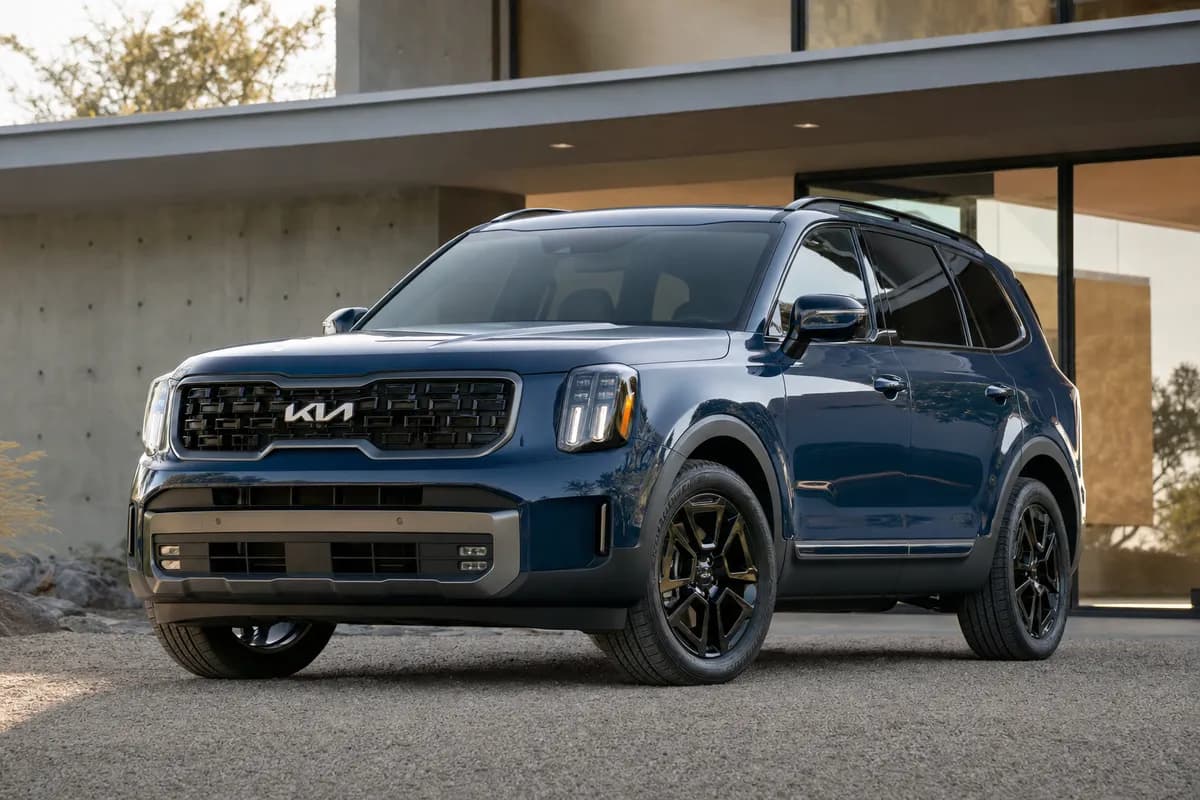
Let’s get the big truth out of the way: the 2025 Kia Telluride is not an all-new generation. The major facelift arrived earlier, bringing the sharper front end, revised lighting, larger screens, X-Line and X-Pro trims, and the more squared-off outdoorsy attitude Kia now leans on heavily. For 2025, the Telluride continues that look rather than tearing up the playbook.
That is not a criticism. The Telluride’s design still works because it avoids trying too hard. The upright grille, confident stance, broad shoulders, and clean surfacing give it the road presence of something pricier than its badge suggests. Park it next to a Volkswagen Atlas and the VW looks like it was styled by a committee armed with a ruler. Park it next to a Toyota Grand Highlander and the Kia looks more premium, even if the Toyota has the advantage in hybrid efficiency.
The 2025 lineup remains broad, with familiar trims such as LX, S, EX, SX, SX Prestige, and the more rugged-looking X-Line and X-Pro variants. Pricing starts in the mid-$36,000 range before destination and climbs into the low-to-mid $50,000s for a loaded SX Prestige X-Pro. That puts the Telluride right in the thick of the three-row SUV fight, but its equipment levels continue to make it feel like strong value rather than a bargain-bin special.
The X-Line models bring the visual attitude: raised ride height, gloss-black exterior trim, unique wheels, roof rails, and standard all-wheel drive. The X-Pro goes a little further with smaller 18-inch wheels wrapped in all-terrain tires and a higher tow rating. Is it a rock crawler? Absolutely not. If you want to bash through Moab, buy a 4Runner, bring patience, and cancel your chiropractor. But for snow, gravel roads, campsites, and suburban theatrics outside a REI, the X-Pro has enough substance to back up the costume.
The short version: Kia did not mess with the Telluride because the Telluride did not need messing with. This is still one of the best-looking, best-packaged family SUVs in America.
Powertrain and Driving: Smooth, Strong Enough, Not Sporty
Every 2025 Kia Telluride uses the same engine: a naturally aspirated 3.8-liter V6 producing 291 horsepower and 262 lb-ft of torque. It is paired with an eight-speed automatic transmission, with front-wheel drive standard on lower trims and all-wheel drive available or standard depending on the model.
In a world increasingly stuffed with turbocharged four-cylinders, hybrid systems, and plug-in trickery, the Telluride’s V6 feels almost old-school. That is partly good. It is smooth, predictable, and free of the rubber-band mood swings you get from some turbo engines and continuously variable transmissions. The eight-speed automatic shifts cleanly and does not hunt like a lost tourist on a roundabout.
Performance is perfectly adequate rather than exciting. Independent testing has put the Telluride around the 7.0-second mark from 0-60 mph, depending on trim and drivetrain. That is quick enough for merging, passing, and fleeing the school pickup line before someone asks you to volunteer for a committee. It is not quick enough to make a Mazda CX-90 Turbo S nervous, and the Toyota Grand Highlander Hybrid Max, with 362 horsepower, will absolutely walk away from it in a straight line.
But the Telluride’s real strength is composure. It rides with a settled, expensive-feeling calm that many mainstream three-row SUVs still fail to match. The suspension rounds off ugly pavement without floating, and highway stability is excellent. Steering is accurate but light, and body control is respectable for something this size. No one will mistake it for a sports SUV, but it does not lurch around like a fully loaded appliance cart either.
Fuel economy is the one area where the Kia starts to show its age. EPA estimates sit around 20 mpg city, 26 mpg highway, and 22 mpg combined for front-wheel-drive models, while all-wheel-drive versions typically come in around 18 mpg city, 24 mpg highway, and 20 mpg combined. That is acceptable for a V6 three-row SUV, but acceptable is not the same as impressive.
The Toyota Grand Highlander Hybrid can deliver up to the mid-30-mpg range depending on configuration, and that matters if your family calendar looks like a rideshare route. Kia badly needs a hybrid Telluride, and the fact that it still does not offer one is the vehicle’s most obvious weakness. The V6 is pleasant, but gasoline is not getting nostalgic just because the engine is.
Towing capacity is 5,000 pounds for most Telluride models when properly equipped, while the X-Pro raises that to 5,500 pounds. That beats the needs of most families hauling small boats, utility trailers, or a pair of dirt bikes. For serious towing, buy a body-on-frame SUV or a pickup. For normal recreational use, the Kia is comfortably in the zone.
Interior, Space, and Tech: This Is Why It Wins
The cabin is where the 2025 Telluride continues to punch rivals directly in the cupholder. Kia understands that families do not need fake ruggedness as much as they need usable space, intuitive controls, durable materials, and enough charging points to keep peace in the second row.
The Telluride seats seven or eight depending on configuration. Second-row captain’s chairs are available and make access to the third row easier, while the bench seat gives you maximum people-moving capacity. Unlike some three-row SUVs that treat the third row as a punishment chamber for children who misbehaved, the Telluride’s rearmost seats are genuinely usable. Adults can fit back there for shorter trips, and kids will have no complaints unless they are the sort of kids who complain about everything, in which case the SUV is not the problem.
Cargo space is another major strength. The Telluride offers about 21 cubic feet behind the third row, around 46 cubic feet behind the second row, and roughly 87 cubic feet with the rear seats folded. Those numbers put it right among the most practical vehicles in the class. The Honda Pilot offers similar maximum cargo volume and slightly more rugged packaging in TrailSport form, but the Kia’s interior looks and feels richer. The Volkswagen Atlas is huge inside, but its cabin ambience varies wildly by trim. The Hyundai Palisade, the Telluride’s corporate sibling, is equally practical and a bit more lounge-like, but the Kia wears the sharper suit.
Up front, the Telluride’s dashboard remains clean and easy to use. The wide digital display setup gives the cabin a modern feel, and upper trims feature a 12.3-inch digital instrument cluster paired with a 12.3-inch infotainment screen. Graphics are crisp, menus are logical, and Kia wisely keeps physical controls for climate and key functions. That matters. Touchscreen-only climate controls are the work of people who apparently adjust temperature only while parked in a laboratory.
Available features include heated and ventilated front seats, heated and ventilated second-row seats, Nappa leather upholstery, a head-up display, surround-view camera, Harman Kardon audio, dual sunroofs, digital key functionality, and a very useful blind-spot camera display on upper trims. The blind-spot camera is one of those features that sounds like a gimmick until you use it once in traffic and immediately want it in every vehicle you own.
There are a few annoyances. Smartphone integration and software polish are good, but not class-redefining. Some rivals now offer more advanced Google-based infotainment systems or slicker over-the-air update capability. Also, the gloss-black interior trim found in some modern vehicles remains a fingerprint shrine. Still, compared with the buttonless nonsense and menu-diving distractions infecting the industry, the Telluride’s cabin is refreshingly sane.
Safety and Family Use: Built for the Daily Grind
The Telluride’s family-SUV credibility is not just about space. It is about making daily driving less exhausting. Standard and available driver-assistance features include forward collision avoidance, lane-keeping assist, blind-spot monitoring, rear cross-traffic alert, adaptive cruise control, safe-exit assist, parking sensors, a surround-view monitor, and Kia’s Highway Driving Assist system on higher trims.
Highway Driving Assist is not a hands-free magic carpet, and you should treat any system like this as assistance rather than autonomy. But it does a good job reducing fatigue on long freeway drives by helping with lane centering and adaptive cruise control. It is especially useful in the kind of stop-and-go traffic that makes you question every life decision leading to your commute.
Visibility is good for a large SUV, the seating position is commanding, and the squared-off body makes the Telluride easier to place than swoopier rivals. Parents will appreciate wide-opening doors, easy child-seat access, multiple USB ports, and a cabin layout that does not require an engineering degree to operate before coffee.
Compared with the Honda Pilot, the Kia feels more premium and slightly less utilitarian. Compared with the Toyota Grand Highlander, it has more style and a more cohesive interior, though Toyota wins the efficiency argument if you choose a hybrid. Compared with the Mazda CX-90, the Telluride is less engaging to drive but far more straightforward as a three-row family tool. The Mazda wants to be a rear-drive luxury crossover with a third row attached. The Kia wants to make your life easier. Guess which one most families actually need?
- Best strengths: handsome design, roomy cabin, strong feature value, smooth V6, excellent practicality.
- Main weaknesses: no hybrid option, merely average fuel economy, not especially exciting to drive.
- Best trim sweet spot: EX or SX, depending on how much tech and luxury you want.
- Best image trim: X-Line, because it looks tougher without making you pay for capability you may not use.
- Best functional trim: X-Pro, if you tow or regularly deal with rough roads, snow, or campsite access.
Verdict: Still the Benchmark, But Kia Needs a Hybrid
The 2025 Kia Telluride remains one of the easiest three-row SUVs to recommend because it gets the important stuff right. It looks good, feels substantial, carries people and cargo properly, drives with maturity, and offers luxury-grade features without luxury-brand pricing. It is not the newest idea in the class, but it is still one of the best-executed.
Its biggest flaw is not subtle: the lack of a hybrid powertrain. The Toyota Grand Highlander gives buyers more efficient options, and that advantage will matter more every year. The Mazda CX-90 offers more powertrain sophistication, especially with its inline-six and plug-in hybrid models. The Honda Pilot TrailSport has more authentic soft-road credibility. The Hyundai Palisade gives you nearly the same goodness with a slightly plusher personality.
And yet, the Telluride still feels like the one you would recommend to a friend who does not want to become an amateur product planner just to buy a family SUV. It is polished, practical, handsome, and honest. The V6 will not thrill you, but it will not annoy you. The cabin will not dazzle like a six-figure luxury car, but it will make every school run, road trip, airport haul, and grocery assault easier.
If you want maximum fuel economy, buy the Grand Highlander Hybrid. If you want the sharpest driving manners, look at the Mazda CX-90. If you want the best all-around three-row SUV for normal families with normal chaos and a healthy dislike of overcomplication, the 2025 Kia Telluride is still the one to beat.
Final verdict: The 2025 Kia Telluride does not rewrite the family SUV rulebook, because it wrote much of the current one. Kia’s leader stays sharp, spacious, and deeply convincing. Add a hybrid, and it would be close to untouchable.
Affiliate disclosure: This article contains affiliate links. RevvedUpCars may earn a small commission on qualifying purchases at no extra cost to you.