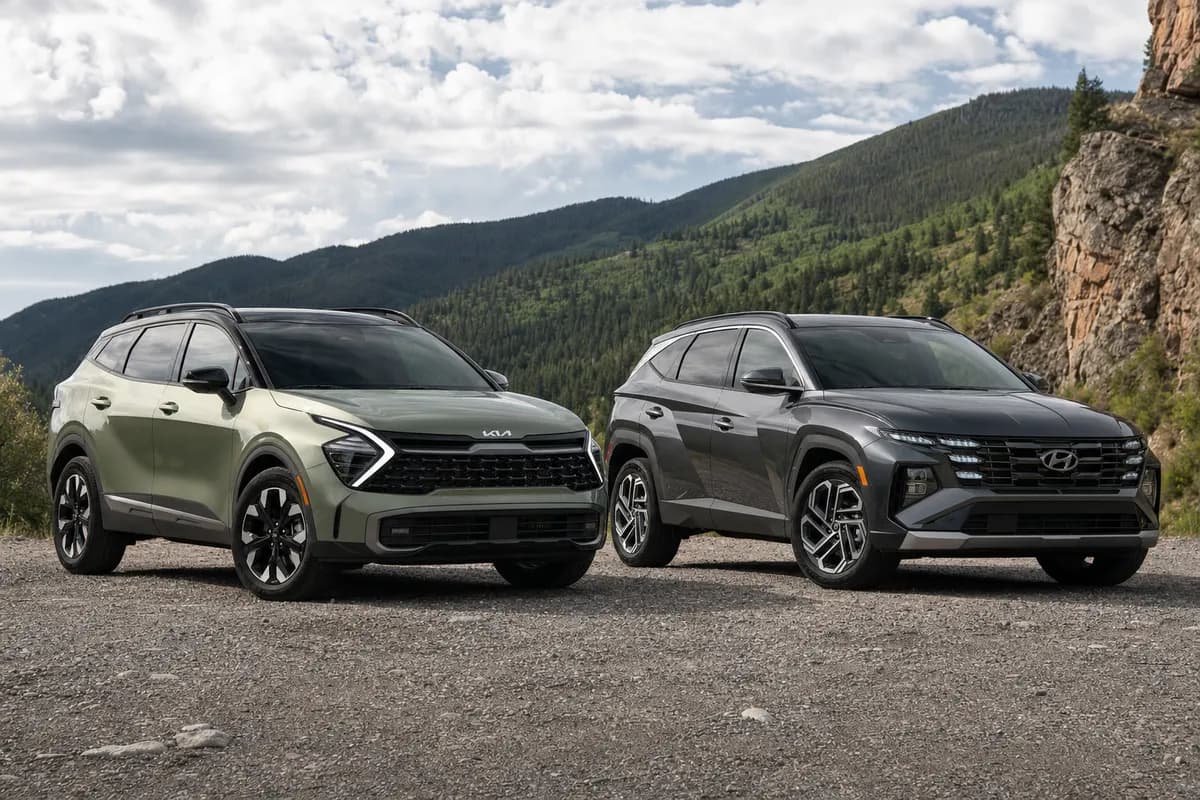
The 2025 Kia Sportage Hybrid and 2025 Hyundai Tucson Hybrid are corporate cousins wearing different gym clothes. Same basic platform, same 1.6-liter turbocharged hybrid recipe, same excellent warranty, same “why are people still buying non-hybrid compact SUVs?” energy.
The 2025 Kia Sportage Hybrid produces 227 horsepower and 258 lb-ft of torque. The 2025 Hyundai Tucson Hybrid, updated for 2025, nudges output to 231 horsepower and 258 lb-ft of torque. Four horsepower is not the stuff of pub arguments, unless your pub is very dull, but the Tucson does feel a touch more alert around town thanks to updated calibration.
Neither is a sports SUV, despite what the swollen grilles and “Sport” drive modes want you to believe. But both are properly quick for the class. Expect 0-60 mph in the mid-7-second range, depending on trim and conditions. That makes them quicker than a Toyota RAV4 Hybrid, which is efficient but has the personality of a laminated tax form, and competitive with the Honda CR-V Hybrid, which is smoother but less eager off the line.
- 2025 Kia Sportage Hybrid: 1.6L turbo hybrid, 227 hp, 258 lb-ft, 6-speed automatic
- 2025 Hyundai Tucson Hybrid: 1.6L turbo hybrid, 231 hp, 258 lb-ft, 6-speed automatic
- Key difference: Tucson feels slightly more polished; Sportage feels a little lighter on its feet
The Kia’s advantage is that it still offers a front-wheel-drive LX Hybrid, which helps efficiency and price. Hyundai makes all 2025 Tucson Hybrids all-wheel drive with HTRAC. That’s excellent if you live somewhere with weather. It’s less excellent if you live in Arizona and just want the cheapest hybrid SUV with good mpg.
Push either one hard and the similarities show. The turbo engine can get gravelly when summoned urgently, and the transmission occasionally pauses before deciding which gear best suits your bad decision. But compared with the average compact SUV hybrid, both feel satisfyingly muscular. There is none of the rubber-band mooing that makes some hybrids feel like appliances with wheels.
Fuel Economy and Driving Range: Kia Lands the Efficiency Punch
If this fight were decided strictly by mpg, the Kia would be grinning in the winner’s circle.
The 2025 Kia Sportage Hybrid LX with front-wheel drive is rated at up to 42 mpg city, 44 mpg highway, and 43 mpg combined. That is excellent for a compact SUV this roomy. Add all-wheel drive or move up to heavier trims like the EX and SX-Prestige, and the rating drops to around 38 mpg combined.
The 2025 Hyundai Tucson Hybrid, with standard all-wheel drive, is rated at up to about 38 mpg combined in Blue trim, while higher trims such as SEL Convenience, N Line, and Limited sit closer to 35 mpg combined. That’s still good, but it gives away a meaningful advantage to the Kia if you’re comparing base trims.
- Sportage Hybrid LX FWD: up to 43 mpg combined
- Sportage Hybrid AWD trims: about 38 mpg combined
- Tucson Hybrid Blue AWD: about 38 mpg combined
- Tucson Hybrid higher trims: about 35 mpg combined
In the real world, both tend to reward relaxed driving. Keep your right foot civilized and you’ll see high-30s without trying too hard. Drive like you’re late to a custody hearing, and the turbo engine will happily torch your carefully planned efficiency.
The Kia’s front-drive option is the key. It gives buyers in mild climates a genuine high-mpg configuration that Hyundai no longer matches. The Tucson counters by making AWD standard, which is the better fit for buyers in Colorado, Vermont, Michigan, or any place where winter arrives with a personal vendetta.
Compared with rivals, both look strong. The Toyota RAV4 Hybrid is still the efficiency benchmark, with trims commonly rated around 40 mpg combined, but its power delivery is less refined. The Honda CR-V Hybrid is rated up to 40 mpg combined in front-drive form, but AWD versions typically land lower. The Kia hits a sweet spot: punchy turbo response plus excellent economy if you choose the right trim.
Alex’s take: If you want the best mpg number and don’t need AWD, the Sportage Hybrid LX FWD is the nerdy hero. If AWD is non-negotiable, the Tucson Hybrid’s efficiency is good enough, and its standard hardware makes more sense.
Interior, Tech, and Practicality: Tucson Gets the 2025 Glow-Up
This is where Hyundai makes its strongest case. The 2025 Tucson received a meaningful interior update, and it feels like the more modern vehicle from the driver’s seat. The biggest improvement is the cabin layout: Hyundai backed away from some of its overly touch-sensitive nonsense and brought back more physical controls. Praise be. Nobody wants to adjust fan speed through a glossy fingerprint altar while merging onto I-95.
The Tucson now offers a cleaner panoramic display arrangement, available dual 12.3-inch screens, and Hyundai’s latest infotainment interface. It also feels more mature in materials and noise isolation, particularly in Limited trim. The Sportage still looks futuristic, with its sweeping curved display and dramatic dashboard design, but Hyundai’s update gives the Tucson a more intuitive cockpit.
That said, the Kia fights back with space. The Sportage Hybrid is one of the roomiest compact SUVs in the class. It offers around 39.5 cubic feet of cargo room behind the second row and up to roughly 73.7 cubic feet with the seats folded. The Tucson Hybrid is nearly as generous, with about 38.7 cubic feet behind the rear seats and up to roughly 74.5 cubic feet maximum. In plain English: both will swallow a stroller, camping gear, flat-pack furniture, or the emotional baggage of a youth soccer tournament.
- Kia Sportage Hybrid cargo space: about 39.5 cu ft behind rear seats; 73.7 cu ft max
- Hyundai Tucson Hybrid cargo space: about 38.7 cu ft behind rear seats; 74.5 cu ft max
- Rear-seat room: excellent in both; adults fit comfortably behind adults
- Cabin winner: Tucson for usability and polish; Sportage for visual drama
The Sportage interior is bolder. The Tucson interior is better sorted. Kia gives you the concept-car theater; Hyundai gives you the interface that annoys you less after six months. For actual ownership, I’ll take the less annoying one.
Trim walk matters here. A Sportage Hybrid SX-Prestige is loaded with features: ventilated front seats, panoramic sunroof, Harman Kardon audio, surround-view camera, blind-spot view monitor, and a big curved display. The Tucson Hybrid Limited matches that feature set with its own upscale touches, including ventilated seats, surround-view monitor, remote smart parking assist, heated rear seats, and a more premium-feeling dashboard after the refresh.
The Tucson also adds an N Line Hybrid trim for buyers who want sportier looks without actual sports-SUV consequences. It gets aggressive styling and cabin trim, but don’t expect a Hyundai Kona N in hiking boots. It’s a styling package with hybrid manners, not a back-road weapon.
Ride, Handling, and Safety: Sensible Shoes, Better Laces
On the road, the Tucson Hybrid feels slightly more composed. Hyundai has tuned it for calm: good body control, comfortable damping, and a planted feel that suits family-SUV duty. It’s not exciting, but it is reassuring, and in this class that counts for more than fake steering weight and a “Sport” badge slapped on like a gym sticker.
The Sportage Hybrid feels a bit livelier. It has sharper initial responses and a touch more eagerness, especially in lighter trims. But it can also feel busier over rough pavement, and the steering doesn’t communicate much beyond “yes, the wheels are turning.” Still, compared with the gas-only Sportage, the hybrid is the one to buy. The electric torque fills in the low-speed gaps beautifully, and the chassis feels better matched to the stronger powertrain.
Both SUVs are better than their non-hybrid counterparts because the hybrid system adds effortless low-end torque. Around town, that means smoother launches and fewer frantic downshifts. On the highway, passing power is respectable rather than theatrical. You won’t embarrass a BMW X3, but you also won’t get trapped behind a box truck contemplating your life choices.
Safety tech is strong across both lineups. Expect standard or widely available features such as:
- Forward collision avoidance assist
- Lane keeping assist and lane following assist
- Blind-spot collision warning or avoidance
- Rear cross-traffic collision avoidance
- Adaptive cruise control with stop-and-go capability
- Highway Driving Assist on upper trims
- Surround-view camera and blind-spot view monitor on premium trims
Kia and Hyundai have become extremely good at democratizing driver-assist tech. You no longer need to buy the loaded trim just to get features that should frankly be standard in every family car. The Tucson’s updated interface makes using these systems easier, but the Sportage’s available blind-spot camera display remains one of the best little daily-use features in the segment.
Then there’s warranty coverage, where both kneecap much of the competition. You get a 5-year/60,000-mile basic warranty and a 10-year/100,000-mile powertrain warranty. Hybrid battery coverage is also strong. Toyota and Honda have excellent reputations, yes, but Kia and Hyundai’s warranty still reads like a manufacturer willing to put chips on the table.
Price and Value: Kia Is the Bargain, Hyundai Is the Better Loaded Buy
Here’s where the sibling rivalry gets spicy. The Kia Sportage Hybrid generally starts lower because of that front-wheel-drive LX model. Expect the 2025 Sportage Hybrid lineup to begin around the high-$20,000s before destination, with AWD and higher trims pushing into the mid-to-high $30,000s. The SX-Prestige lands near the upper end of the range but still undercuts plenty of luxury-adjacent compact SUVs while offering more equipment than some of them dare to include.
The 2025 Hyundai Tucson Hybrid starts higher because AWD is standard and the refreshed lineup has moved upmarket. The Blue trim typically begins in the low-$30,000s before destination, with SEL Convenience, N Line, and Limited trims moving through the mid-$30,000s and into roughly $40,000 territory.
- Best value trim: Kia Sportage Hybrid EX AWD
- Best efficiency trim: Kia Sportage Hybrid LX FWD
- Best all-around trim: Hyundai Tucson Hybrid SEL Convenience
- Best luxury-lite trim: Hyundai Tucson Hybrid Limited
The Kia’s value equation is brutally simple: more mpg for less money if you choose the LX FWD, and a strong equipment list if you choose EX. The EX AWD is probably the sweet spot for most buyers, with the right blend of features, efficiency, traction, and price. The SX-Prestige is tempting, but once you creep near $40,000, the Tucson Limited starts making a stronger case with its improved cabin and standard AWD personality.
The Hyundai asks for more money, but it feels more expensive. That matters. A lot of buyers keep these SUVs for seven or eight years, and cabin usability ages more visibly than horsepower. The Tucson’s 2025 interior update gives it an advantage that won’t show up on a spec sheet but will show up every time you change climate settings or use the infotainment system before coffee.
Against the broader class, both are smart buys. The Toyota RAV4 Hybrid remains the safe resale-value champion, but it feels older inside and less refined under acceleration. The Honda CR-V Hybrid is polished and roomy, but it can get pricey quickly and lacks the punchy turbo character of the Koreans. The Ford Escape Hybrid is efficient but not as spacious or premium-feeling. The Mazda CX-50 Hybrid brings style and Toyota-sourced hybrid hardware, but it’s not as cargo-friendly.
Alex’s take: The Sportage Hybrid is the deal. The Tucson Hybrid is the one you’d rather sit in every day. Decide whether your wallet or your fingertips get the vote.
Verdict: The Tucson Leads, But the Sportage Is the Smarter Cheap Seat
The 2025 Hyundai Tucson Hybrid wins this comparison by a narrow but real margin. Its refreshed interior, standard AWD, improved tech layout, mature ride quality, and slightly stronger hybrid output make it the better compact SUV overall. It feels more resolved, more premium, and less like a vehicle designed to win showroom drama at the expense of daily usability.
But the 2025 Kia Sportage Hybrid is the one I’d recommend to value hunters without hesitation. The LX FWD’s 43-mpg combined rating is outstanding, the cabin is huge, the warranty is excellent, and the EX AWD trim gives you most of what matters without demanding luxury-SUV money. If you don’t need the Tucson’s standard AWD or updated cabin polish, the Kia is the rational buy.
Here’s the clean breakdown:
- Buy the Kia Sportage Hybrid if you want the lowest price, the best fuel economy, bold styling, and huge cargo space.
- Buy the Hyundai Tucson Hybrid if you want standard AWD, a more polished cabin, better controls, and the more complete 2025 package.
- Skip both only if you prioritize Toyota resale value above all else or prefer the Honda CR-V Hybrid’s smoother, quieter personality.
Final call? The 2025 Hyundai Tucson Hybrid leads. It’s the more refined compact hybrid SUV and the better all-weather family tool. But the Kia Sportage Hybrid is close enough to nip its bumper all day long — and in front-wheel-drive form, it drinks less fuel while costing less money. That’s not losing. That’s just choosing a different way to be annoyingly good.
Affiliate disclosure: This article contains affiliate links. RevvedUpCars may earn a small commission on qualifying purchases at no extra cost to you.