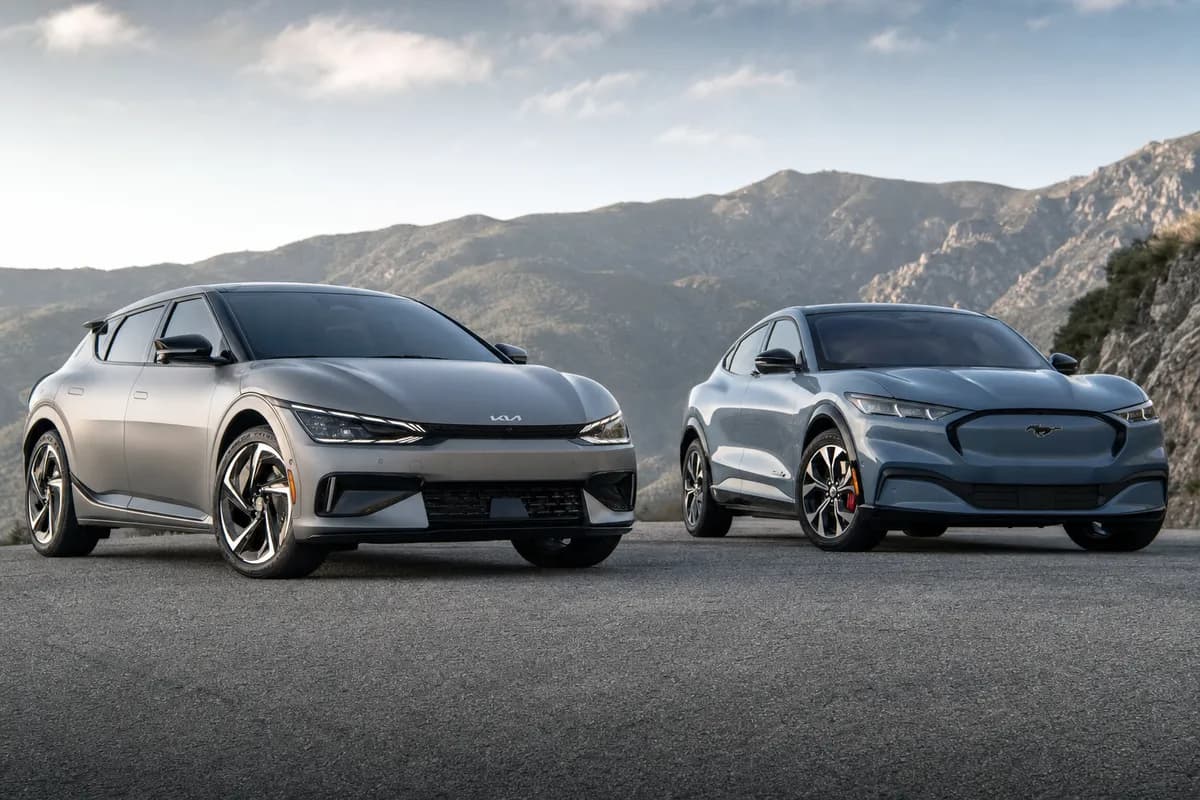
The 2024 Kia EV6 and 2024 Ford Mustang Mach-E are two electric SUVs with wildly different personalities. The Kia is a low-slung Korean moonshot with 800-volt charging tech, sports-wagon reflexes, and the kind of design that makes gas stations look like ruins.
The 2024 Kia EV6 and 2024 Ford Mustang Mach-E are two electric SUVs with wildly different personalities. The Kia is a low-slung Korean moonshot with 800-volt charging tech, sports-wagon reflexes, and the kind of design that makes gas stations look like ruins. The Ford is Dearborn’s battery-powered muscle crossover, trading on Mustang attitude, big cargo space, and one of the best hands-free driver-assist systems in the business. Both are clever. Both are quick. But only one feels like the sharper EV innovation play in 2024.
Design and Packaging: Spaceship Versus Muscle Sneaker
The Kia EV6 still looks like it landed from a more interesting planet. It is technically a crossover, but visually it sits somewhere between hot hatch, shooting brake, and concept car that escaped the auto show circuit. At 184.8 inches long with a 114.2-inch wheelbase, the EV6 uses Hyundai-Kia’s E-GMP electric platform, the same basic architecture underneath the Hyundai Ioniq 5 and Genesis GV60. The result is a car with a compact exterior footprint and genuinely useful cabin space.
The Ford Mustang Mach-E is larger and more conventionally SUV-like. It stretches to about 186 inches long with a 117.5-inch wheelbase, and it makes better use of its height and roofline for luggage. Ford also deserves credit for the Mach-E’s stance. The long hood, pinched tail, tri-bar lighting, and swollen haunches are shamelessly Mustang-adjacent, even if the lack of a V8 soundtrack still makes some purists clutch their vintage key fobs in horror.
Inside, the EV6 feels lower, more cockpit-like, and more driver-focused. The dual 12.3-inch displays are crisp, the floating center console is genuinely cool, and the driving position has a quasi-GT feel. Material quality is solid rather than plush, but the design has intent. Kia also gives you physical-ish controls for climate and audio via a clever switchable touch panel, which is useful until you prod it at the wrong moment and change the temperature when you meant to turn up the volume. Innovation, meet irritation.
The Mach-E counters with a massive 15.5-inch vertical touchscreen and a cleaner, more Tesla-like dashboard. Ford’s SYNC 4A system is easy to understand, and the physical volume knob embedded into the screen is a small victory for civilization. The digital instrument cluster is smaller than the Kia’s but effective. The cabin feels airier, and the Mustang’s higher roofline helps rear passengers.
- Kia EV6 cargo space: 24.4 cubic feet behind the second row, 50.2 cubic feet with seats folded.
- Ford Mustang Mach-E cargo space: 29.7 cubic feet behind the second row, 59.7 cubic feet with seats folded.
- Frunk advantage: Ford, easily. The Mach-E offers a useful front trunk of about 4.7 cubic feet, while the EV6’s front storage is tiny, especially on AWD models.
If you regularly haul strollers, bikes, dogs, Costco evidence, or the emotional baggage of modern life, the Mach-E is the more practical box. If you want your family EV to feel like it was designed by people who occasionally enjoy corners, the EV6 has the more interesting shape and seating position.
Powertrains and Performance: The Kia Dances, the Ford Punches
Both EVs offer rear-wheel drive and all-wheel drive, multiple battery options, and performance variants that can embarrass plenty of gasoline sports sedans. But they deliver speed differently.
The 2024 Kia EV6 lineup starts with the Light RWD model using a smaller 58.0-kWh battery and a 167-hp rear motor. That one is the sensible shoe of the range. The version most buyers should care about is the long-range 77.4-kWh pack. In rear-drive form, it makes 225 hp and 258 lb-ft of torque. With all-wheel drive, output jumps to 320 hp and 446 lb-ft. Then there’s the EV6 GT, which brings 576 hp, 545 lb-ft, adaptive dampers, an electronic limited-slip rear differential, and a properly unhinged 0-60 mph time in the mid-3-second range. Kia claims 3.4 seconds, and independent tests have put it right there.
The 2024 Ford Mustang Mach-E has been sharpened for 2024 with revised rear motor hardware and better acceleration. Standard-range models use a 72-kWh battery, while extended-range versions use a 91-kWh pack. Depending on configuration, the Mach-E ranges from roughly 264 hp in base rear-drive form to 480 hp in GT models. The GT’s torque climbs to 600 lb-ft, and with Ford’s available Performance Upgrade, torque rises to 700 lb-ft. Ford says the 2024 Mustang Mach-E GT with that upgrade can hit 60 mph in 3.3 seconds. That is not “quick for an SUV.” That is “your passenger just made a noise they didn’t authorize” quick.
But straight-line speed is only the loudest part of the story. The EV6 is the better driver’s car in the bends. Its lower seating position, quick steering, and more tied-down body control make it feel lighter than it is. The AWD EV6 Wind or GT-Line is the sweet spot: fast enough to make merging a non-event, balanced enough to enjoy a back road, and not so absurdly stiff or range-compromised as the GT.
The Mach-E has improved over the years, and the 2024 GT finally feels more serious. It has huge thrust, strong traction, and a broad-shouldered road presence. But you always know you are driving a taller, heavier crossover. The steering is less communicative than the Kia’s, and the ride can get busy on rough pavement, especially with larger wheels. It muscles through corners; the EV6 flows through them.
Alex’s take: The Mach-E GT throws a better haymaker. The EV6 AWD throws combinations. Unless your commute includes a drag strip and a cheering section, the Kia is the more satisfying machine to drive daily.
Range and Charging: Kia Lands the Knockout
This is where the EV6 stops being merely stylish and starts being properly clever. The Kia’s 800-volt electrical architecture is the kind of technology that makes everyday EV ownership less annoying. On a high-power DC fast charger, the EV6 can charge from 10 to 80 percent in about 18 minutes, with peak charging rates around 235 kW under ideal conditions. That is excellent, and it remains one of the EV6’s biggest advantages over nearly everything in its price class, including the Mustang Mach-E, Volkswagen ID.4, Nissan Ariya, and even many luxury EVs.
The Ford Mustang Mach-E is better than it used to be, but it is still playing catch-up. For 2024, Ford improved fast-charging times, and extended-range models can charge from 10 to 80 percent in roughly 32 minutes. Peak DC charging is around 150 kW. That is acceptable. It is not exceptional. In EV terms, the difference between 18 minutes and 32 minutes is the difference between grabbing coffee and wondering whether the person in the next stall has started a new life.
Range is closer. The 2024 Kia EV6 with the long-range battery reaches up to an EPA-estimated 310 miles in RWD form. AWD versions generally sit around 282 miles, while the fire-breathing EV6 GT drops to 206 miles. That GT figure is the price of horsepower and sticky tires; physics still sends invoices.
The 2024 Mustang Mach-E can do up to an EPA-estimated 320 miles in extended-range rear-wheel-drive form, giving Ford a slight maximum-range advantage. Extended-range AWD versions are around 300 miles, while the GT is rated around 280 miles and the Rally about 265 miles. In other words, if you want a fast model with decent range, Ford has an edge over the EV6 GT. If you want the best charging experience, Kia wins by a mile.
- Best max range: Ford Mustang Mach-E Extended Range RWD, about 320 miles.
- Best charging speed: Kia EV6, 10-80 percent in about 18 minutes on a suitable DC fast charger.
- Best performance-range balance: Ford Mustang Mach-E GT at around 280 miles, or Kia EV6 AWD at around 282 miles if you do not need GT lunacy.
- Worst compromise: Kia EV6 GT, because 576 hp is hilarious but 206 miles of range is not.
The charging-network picture complicates things. Ford has been aggressive about access to Tesla’s Supercharger network via adapters for compatible vehicles, and that is a major real-world advantage as the industry transitions to the NACS standard. Kia is also moving toward NACS, but for 2024 buyers using CCS, the EV6’s raw charging hardware remains superb when plugged into a charger that can actually deliver. That last clause matters, because America’s non-Tesla charging infrastructure still has the emotional reliability of a vending machine in a bus station.
Technology, Safety, and Daily Use: Ford Has the Better Copilot
The EV6 and Mach-E both come well-equipped, but their strengths diverge. Kia focuses on charging tech, cabin design, and a generous features list. Ford leans harder into software, over-the-air updates, and driver assistance.
The EV6 offers available features such as dual panoramic displays, augmented-reality head-up display on higher trims, vehicle-to-load functionality, heated and ventilated front seats, heated rear seats, a Meridian audio system, surround-view camera, remote smart parking assist, and Highway Driving Assist. The vehicle-to-load function is especially useful: the EV6 can power small appliances, tools, camping gear, or a laptop setup. During a blackout, it becomes the world’s most stylish emergency battery.
The Mach-E’s killer app is BlueCruise. Ford’s hands-free highway driving system works on approved mapped roads and is one of the best systems available from a mainstream automaker. It is not autonomous driving, despite what your most overconfident neighbor will call it, but it reduces fatigue beautifully on long highway slogs. The system handles lane centering and adaptive cruise smoothly, and Ford continues to improve it through software updates.
Ford’s infotainment screen is larger and easier for EV newcomers to understand, though some functions are buried too deeply. Kia’s interface is faster and more traditional, with better integration of key driving information across its dual screens. Both support Apple CarPlay and Android Auto, though neither makes the experience feel as seamless as it should in a modern EV.
On safety, both vehicles perform strongly. The Kia EV6 has earned excellent crash-test results in previous model years, including IIHS Top Safety Pick recognition when properly equipped. The Mustang Mach-E has also performed well in federal and insurance-industry testing. Both offer automatic emergency braking, blind-spot monitoring, lane-keeping assistance, rear cross-traffic alert, and adaptive cruise availability.
For daily livability, the Ford is the easier family tool. It has more cargo space, a bigger frunk, a more upright cabin, and better long-distance driver assistance. The Kia feels more premium in motion, charges quicker, and has a more interesting cabin layout. The Ford is the better appliance. The Kia is the better machine.
Pricing and Verdict: Buy the EV6 Unless You Need the Ford’s Space
Pricing moves around with incentives, dealer behavior, and federal tax-credit rules, so the sticker is only part of the story. As of the 2024 model year, the Kia EV6 starts in the low-$40,000 range, with long-range trims typically climbing through the mid-$40,000s and $50,000s. The EV6 GT lands above $60,000 before discounts. The Ford Mustang Mach-E starts just under $40,000 for the Select, with Premium trims in the mid-$40,000 range and GT models in the mid-$50,000s before options. The Rally version pushes higher.
Ford has been especially aggressive with price cuts, and that makes the Mach-E dangerous. A well-priced Mach-E Premium Extended Range is one of the better family EV buys on the market. It gives you strong range, more cargo room than the Kia, a useful frunk, and access to BlueCruise. If your EV life is mostly commuting, school runs, road trips, and hauling stuff, the Ford makes a compelling case.
But innovation is not just screen size and a famous badge. It is how effectively the car moves the EV experience forward. And here, the Kia EV6 has the more advanced bones. Its 800-volt platform, 18-minute fast-charging capability, polished road manners, and distinctive design make it feel like the more purpose-built electric vehicle. It is less practical than the Ford, yes. But it is also more cohesive, more engaging, and more technically impressive where EVs need to be impressive.
The EV6 GT is a riot, but I would not buy it unless I had home charging, short commutes, and a deep need to humiliate unsuspecting sports cars. The smarter pick is the EV6 Wind AWD or GT-Line AWD with the 77.4-kWh battery. You get 320 hp, all-weather traction, roughly 282 miles of range, and charging speed that makes most rivals look like they are sipping electrons through a cocktail straw.
For the Mach-E, the sweet spot is the Premium Extended Range, especially in rear-wheel drive if maximum range matters or all-wheel drive if winter traction matters. The GT is finally quick enough to justify its badge, but it still feels more like a very fast crossover than an electric Mustang in spirit. The Rally is fun theater, but most buyers do not need plastic cladding cosplay with their battery pack.
Final verdict: The 2024 Ford Mustang Mach-E is the more practical electric SUV and the better road-trip assistant. But the 2024 Kia EV6 is the more innovative EV, the better driver’s car, and the one I would park in my own garage. Ford built a very good electric crossover with a Mustang costume. Kia built the future with a hatch, a sneer, and an 800-volt right hook.
Winner: 2024 Kia EV6. Choose the Mach-E if you need cargo space, BlueCruise, or the best maximum range. Choose the EV6 if you want faster charging, sharper dynamics, and an electric SUV that still feels exciting after the novelty of silent acceleration wears off.
Affiliate disclosure: This article contains affiliate links. RevvedUpCars may earn a small commission on qualifying purchases at no extra cost to you.