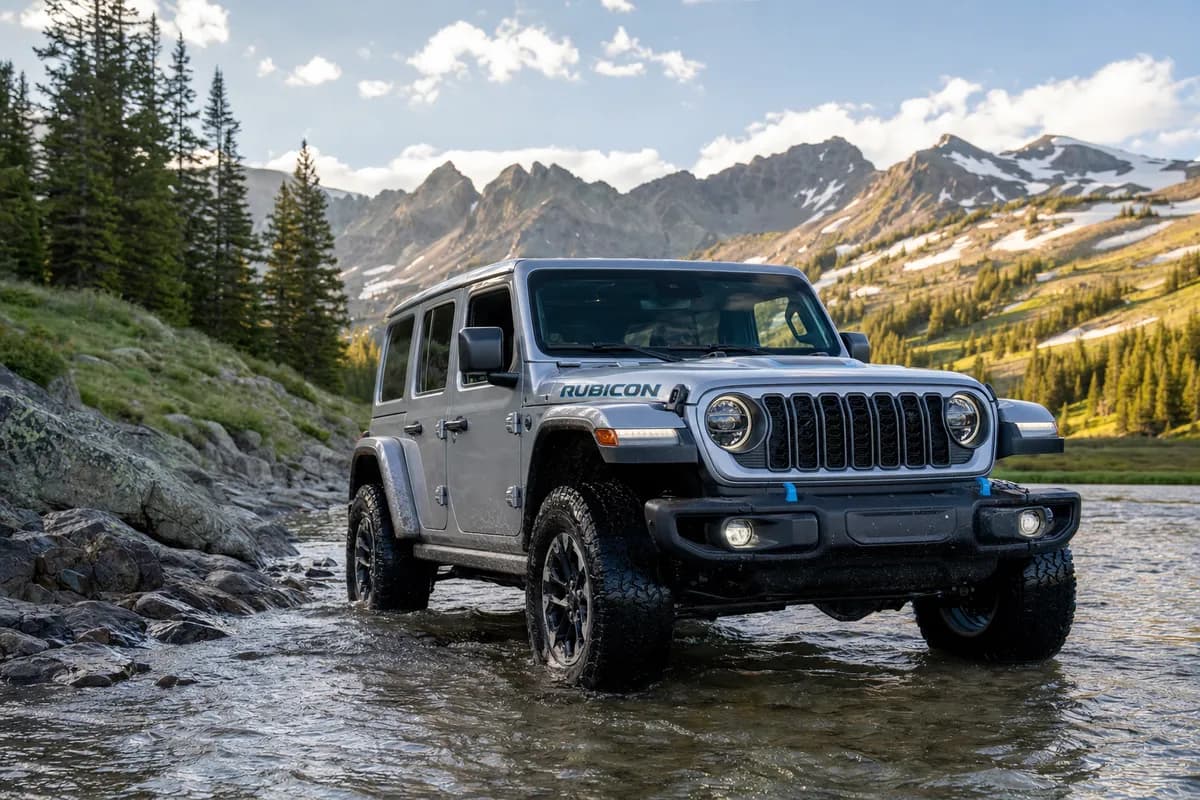
The 2025 Jeep Wrangler 4xe is what happens when Jeep bolts a charge port onto a trail icon and somehow makes the whole thing more ridiculous in exactly the right way.
The 2025 Jeep Wrangler 4xe is what happens when Jeep bolts a charge port onto a trail icon and somehow makes the whole thing more ridiculous in exactly the right way. This plug-in hybrid Wrangler can creep through the woods in near silence, punch out 470 lb-ft of torque like a diesel with better manners, and still remove its doors when the weather app says “go on, be irresponsible.” It is not the most efficient plug-in hybrid SUV you can buy. It is not the quietest, cheapest, or most polished. But if your weekend plans involve mud, rocks, snow, sand, or embarrassing a Ford Bronco owner at a trailhead, the Wrangler 4xe remains the most compelling electrified off-roader in America.
What You Get: A Wrangler With a Wall Plug and a Right Hook
The 2025 Jeep Wrangler 4xe uses a 2.0-liter turbocharged four-cylinder engine paired with electric motors and a 17.3-kWh lithium-ion battery pack. Total output is 375 horsepower and 470 lb-ft of torque, routed through an eight-speed automatic transmission and Jeep’s proper four-wheel-drive hardware. That torque figure is the headline. It matches the old 6.4-liter Wrangler Rubicon 392’s number, and in the 4xe it arrives with the syrupy immediacy only electric assistance can deliver.
Jeep offers the 2025 Wrangler 4xe in several familiar flavors, including Sport S 4xe, Willys 4xe, Sahara 4xe, Rubicon 4xe, and Rubicon X 4xe. The one serious buyers should focus on is the Rubicon 4xe. It gets the hardware that makes a Wrangler feel like a cheat code off-road: locking front and rear differentials, an electronic front sway-bar disconnect, a Rock-Trac transfer case, 33-inch all-terrain tires, and serious axle articulation. The Sahara is prettier, the Willys is the value play, but the Rubicon is the one with dirt under its fingernails.
For 2025, the Wrangler continues with the updated cabin architecture introduced recently, including a standard 12.3-inch Uconnect touchscreen with wireless Apple CarPlay and Android Auto. Jeep has also been pushing more standard convenience features across the Wrangler lineup, and the 4xe benefits from that broader move toward making the cabin feel less like a washable shed and more like a modern SUV. Do not mistake that for luxury. The doors still come off. The roof still comes off. The windshield can still fold down if you enjoy bugs at dental-drill velocity.
- Powertrain: 2.0-liter turbocharged inline-four plug-in hybrid
- Total output: 375 hp and 470 lb-ft
- Transmission: Eight-speed automatic
- Battery: 17.3-kWh lithium-ion pack
- EPA electric range: about 21 miles
- EPA rating: 49 MPGe combined, about 20 mpg combined on gasoline
- Towing capacity: up to 3,500 pounds when properly equipped
On the Road: Quick, Heavy, and Still Very Much a Wrangler
The Wrangler 4xe is fast in the way a refrigerator falling down stairs is fast: surprising, slightly alarming, and not especially graceful. Jeep claims 0-60 mph in around six seconds, and that feels believable. The electric motor fills in the turbo lag beautifully, so the Wrangler 4xe lunges away from stoplights with a smug little shove that makes the regular 3.6-liter V6 feel old and the standard turbo-four feel unfinished.
The plug-in hybrid system offers three drive modes: Hybrid, Electric, and eSave. Hybrid is the default and the best daily setting, blending engine and motor power without much drama. Electric mode lets you run on battery power alone when there is enough charge, and eSave preserves battery for later or can use the engine to maintain charge. That last mode is useful if you want to save the quiet electric crawl for a trail instead of wasting it in a grocery-store parking lot next to a dented Nissan Altima.
But physics remains undefeated. The 4xe hardware adds weight, and depending on trim, the Wrangler 4xe can push well beyond 5,000 pounds. You feel that mass in braking, cornering, and over sharp pavement impacts. The steering remains slow and vague, because Wrangler steering has always been more of a suggestion box than a command structure. At highway speeds, the solid front axle wanders, the tires hum, and the removable roof lets wind noise in like it paid rent.
Still, compared with older Wranglers, the 2025 model is remarkably livable. The eight-speed automatic is smooth, the turbo engine is less coarse than expected, and the electric assist gives the 4xe a premium shove that no non-hybrid Wrangler can match outside the outrageous V8 Rubicon 392. That V8 is louder, angrier, and more theatrical, but the 4xe is the smarter everyday weapon. It delivers nearly the same torque figure with far better commuting manners and the ability to do short errands without burning fuel.
Against the Ford Bronco, the Wrangler 4xe has one enormous advantage: Ford still does not sell a plug-in hybrid Bronco. The Bronco rides better on-road, especially in versions with independent front suspension, and it feels more settled at speed. But the Jeep’s hybrid torque and electric trail capability give it a unique card Ford cannot play. Toyota’s new 2025 4Runner i-Force Max hybrid brings 326 hp and 465 lb-ft, but it is not a plug-in and it cannot match the Wrangler’s open-air character. The Toyota RAV4 Prime is vastly more efficient and quicker to 60 mph, but comparing it to a Wrangler Rubicon on a rocky trail is like bringing a Peloton to a bar fight.
Off-Road: Electric Torque Makes the Wrangler Better, Not Softer
This is where the Wrangler 4xe stops being a fuel-economy compromise and starts being genuinely clever. Electric motors are brilliant off-road because they deliver torque instantly and precisely. In low-speed technical terrain, that means the Wrangler 4xe can ease over rocks and roots with less throttle stabbing, less wheelspin, and less mechanical clatter. In Electric mode, the experience is almost eerie: tire scrub, suspension creaks, gravel pinging off skid plates, and no engine roar drowning out your questionable line choice.
The Rubicon 4xe is the star. With its locking differentials, disconnecting front sway bar, low-range gearing, and stout axle setup, it remains one of the most capable showroom-stock SUVs on the planet. Approach, breakover, and departure angles vary by trim and tire package, but the Rubicon 4xe retains the serious geometry that has always made the Wrangler a trail monster. Ground clearance is roughly 10 inches depending on configuration, and Jeep rates water fording at up to 31.5 inches when properly equipped. That is not a suggestion to drive into a flooded underpass, Captain YouTube, but it does mean creek crossings and sloppy trails are comfortably within its brief.
The battery pack is mounted under the rear seat area and protected for off-road use. Jeep designed the 4xe system with sealed high-voltage components, and the hybrid hardware does not turn the Wrangler into a delicate science project. The system has been on sale for years now, and the Wrangler 4xe has become one of America’s best-selling plug-in hybrids precisely because buyers are actually using it like a Jeep, not just like a commuter with knobby tires.
The secret is not that the Wrangler 4xe is greener than a normal Wrangler. The secret is that the plug-in hybrid system makes it a better Wrangler.
There are caveats. The added weight is noticeable in deep mud and on soft sand, where mass is the enemy and momentum becomes your friend. The brake pedal can also feel inconsistent as it blends regenerative and friction braking. And if you are planning remote multi-day overlanding without charging access, the 4xe becomes a heavy turbocharged Wrangler once the battery is depleted. It still works, but the magic trick fades.
Even then, the hybrid system never fully disappears. Jeep preserves electric assist for low-speed use, and the system can recharge through engine operation and regenerative braking. You are not stranded with a dead battery like a laptop in the woods. You just lose the full benefit of plugging in.
Range, Charging, and Real-World Efficiency
The EPA rates the Wrangler 4xe at about 21 miles of electric driving range. In the real world, expect 18 to 25 miles depending on temperature, tire choice, speed, and how often you treat the throttle like a personal grievance. Around town, that range is genuinely useful. If your commute is short and you charge nightly, the 4xe can handle weekday driving with very little gasoline use.
Charging is simple. On a Level 2 home charger, the battery can be refilled in roughly 2 to 2.5 hours. On a standard household outlet, you are looking at overnight charging. There is no DC fast-charging capability, and there does not need to be. This is a plug-in hybrid with a modest battery, not a full EV trying to cross Nebraska on electrons and optimism.
The official combined rating is 49 MPGe when using gas and electric power, and about 20 mpg combined once the battery is depleted. That second number matters. If you never plug it in, you have bought a heavier, more expensive Wrangler that drinks fuel like a regular one. The 4xe only makes financial and environmental sense if you charge it frequently. Plug it in every night and it can be impressively frugal for something shaped like a filing cabinet in hiking boots. Ignore the cord and the joke is on you.
Compared with conventional plug-in hybrid SUVs, the Wrangler 4xe is inefficient. A Toyota RAV4 Prime can travel an EPA-rated 42 miles on electricity and returns far better fuel economy. A Kia Sportage Plug-In Hybrid is cheaper, quieter, and more civilized. But neither has solid axles, removable doors, a low-range transfer case, or the ability to make a campsite feel like a destination rather than a parking spot.
Pricing is not gentle. The Wrangler 4xe typically starts around the low-$50,000 range before destination, with Rubicon and Rubicon X models climbing well into the $60,000s and beyond once optioned. Some buyers may qualify for a federal plug-in vehicle tax credit, but eligibility and amounts can change based on battery sourcing rules, income limits, and purchase versus lease structure. Translation: check the current IRS list and do not trust a showroom balloon taped to a windshield.
Interior and Daily Use: Better Tech, Same Wrangler Compromises
The 2025 Wrangler 4xe’s cabin is much improved over the old days, but it is still a Wrangler cabin. The upright windshield, flat dash, exposed hardware, and chunky controls all feel authentic. The new-generation Uconnect interface is quick and easy to use, and the 12.3-inch screen is one of the best upgrades Jeep has made to the Wrangler in years. Wireless smartphone integration works well, and available trail mapping features give the system real off-road utility rather than just another glossy menu to poke while parked.
Front-seat space is good, rear-seat space is acceptable, and cargo room is useful but not outstanding. The battery packaging does not ruin the interior, though the 4xe’s rear seat area is slightly compromised compared with non-hybrid Wranglers. The Wrangler remains easier to live with in four-door Unlimited form, which is also the only body style available for the 4xe.
Ride comfort depends heavily on trim and tires. Sahara models are the friendliest daily drivers. Willys models look fantastic and have useful off-road upgrades, but their tires add noise. Rubicon models are the most capable and the most compromised, because serious off-road hardware is rarely subtle. If you want a quiet family SUV, buy a Grand Cherokee 4xe. If you want a vehicle that makes the school run feel like the first leg of an expedition, buy the Wrangler.
Safety tech has improved, but Jeep still charges extra for some features on certain trims that mainstream crossovers include as standard. Available driver assists include adaptive cruise control, blind-spot monitoring, rear cross-path detection, forward collision warning, and automatic emergency braking. The Wrangler’s fundamental structure and removable-body design mean it will never feel as cocooned as a unibody crossover. That is part of the bargain. You get freedom, visibility, and trail toughness; you give up isolation and some refinement.
Verdict: The Best Wrangler for Most People Who Will Actually Plug It In
The 2025 Jeep Wrangler 4xe is not a perfect plug-in hybrid, and it is not trying to be. It is too heavy, too noisy, too expensive, and too thirsty when the battery is empty. A RAV4 Prime is a better appliance. A Bronco is better behaved on pavement. A Grand Cherokee 4xe is more comfortable. All true. Also, none of them deliver the same blend of electric torque, removable-roof theater, and legitimate Rubicon-grade trail ability.
The Wrangler 4xe works because electrification enhances the Jeep experience rather than sanitizing it. Silent trail driving is addictive. Instant torque is useful. The ability to commute on electricity during the week and crawl over rocks on Saturday is not marketing fluff; it is the entire point of this machine.
Buy the Rubicon 4xe if you want the maximum capability and will use it. Buy the Sahara 4xe if you care more about commuting comfort and style. Consider the Willys 4xe if you want the look and some added grit without paying Rubicon money. But do not buy any Wrangler 4xe unless you can charge at home or work. Without regular charging, it is just an expensive way to carry around battery weight.
Final call: the 2025 Jeep Wrangler 4xe is the most interesting Wrangler in the showroom and one of the few plug-in hybrids with a personality larger than its spec sheet. It is flawed, expensive, and occasionally crude. Good. So is adventure.
Affiliate disclosure: This article contains affiliate links. RevvedUpCars may earn a small commission on qualifying purchases at no extra cost to you.