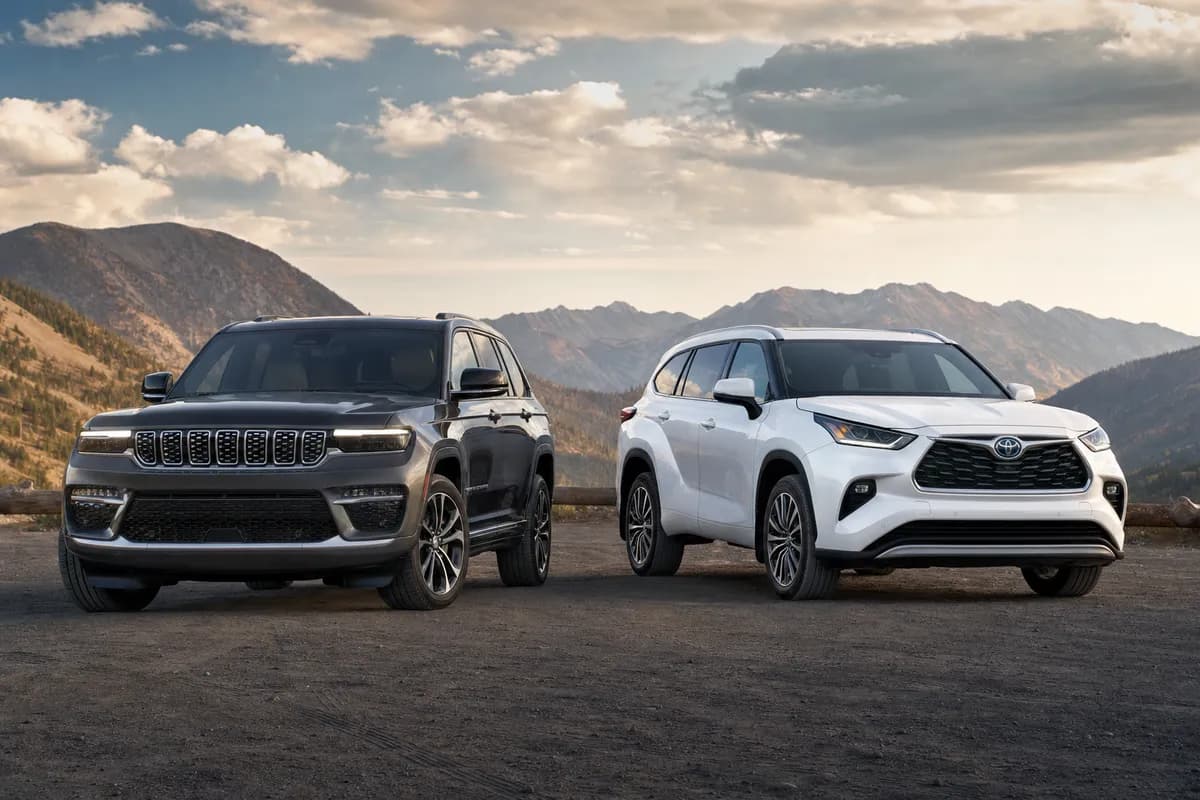
The 2025 Jeep Grand Cherokee L and 2025 Toyota Highlander are both three-row SUVs, but they arrive at the family-hauling problem with completely different attitudes. The Toyota shows up with a spreadsheet, a hybrid badge, and a packed lunch.
The 2025 Jeep Grand Cherokee L and 2025 Toyota Highlander are both three-row SUVs, but they arrive at the family-hauling problem with completely different attitudes. The Toyota shows up with a spreadsheet, a hybrid badge, and a packed lunch. The Jeep arrives wearing hiking boots, towing a boat, and asking whether the road is optional. One is the smarter appliance. The other is the more interesting machine. If you’re shopping with actual money and actual children involved, the difference matters.
The Basic Numbers: Jeep Brings Size, Toyota Brings Efficiency
Let’s start with the cold stuff, because cold numbers are good at exposing warm marketing nonsense. The 2025 Jeep Grand Cherokee L is the larger SUV here. It stretches about 204.9 inches long on a 121.7-inch wheelbase, which makes it meaningfully bigger than the Toyota Highlander, at roughly 194.9 inches long with a 112.2-inch wheelbase. That extra Jeep length is not decorative chrome. It shows up in cabin stretch, road presence, and towing stability.
The Highlander counters with better fuel economy, especially if you choose the hybrid. Toyota knows its audience: school runs, Costco missions, airport pickups, and the occasional 600-mile holiday slog. For that, burning less fuel beats having a macho grille every single week.
- 2025 Jeep Grand Cherokee L engine: 3.6-liter Pentastar V6, 293 hp, 260 lb-ft, 8-speed automatic
- 2025 Toyota Highlander gas engine: 2.4-liter turbocharged four-cylinder, 265 hp, 310 lb-ft, 8-speed automatic
- 2025 Toyota Highlander Hybrid: 2.5-liter hybrid four-cylinder system, 243 total system hp, eCVT
- Jeep towing capacity: up to 6,200 pounds
- Toyota Highlander towing capacity: up to 5,000 pounds for gas models, 3,500 pounds for the hybrid
- Jeep cargo space: 17.2 cubic feet behind the third row, 46.9 behind the second, 84.6 max
- Toyota cargo space: about 16.0 cubic feet behind the third row, 48.4 behind the second, 84.3 max
On paper, cargo volume is closer than the exterior dimensions suggest. In practice, the Jeep feels broader, longer, and more substantial. The Toyota is easier to place in tight parking lots and suburban lanes. The Jeep feels like it was designed to cross Colorado. The Toyota feels like it was designed to cross a Trader Joe’s parking lot without drama. That is not an insult. Drama is expensive.
Performance and Driving: The Jeep Has Grit, the Toyota Has Punch
The Grand Cherokee L’s 3.6-liter V6 is familiar, durable, and perfectly adequate. That is reviewer-speak for: it gets the job done, but nobody is buying champagne after the test drive. With 293 horsepower, the Jeep is not slow, but it is hauling a large body, and independent testing has typically put V6 Grand Cherokee L models around the 8-second mark to 60 mph. The 8-speed automatic is smooth, and the V6 sounds better than the Toyota’s turbo four when pushed, but it does not feel especially urgent.
The Toyota Highlander’s 2.4-liter turbocharged four is less romantic but more effective in ordinary driving. Its 310 lb-ft of torque arrives earlier than the Jeep’s V6 shove, so the Highlander feels more responsive leaving stoplights and climbing grades. Gas Highlanders have been tested in the low-7-second range to 60 mph, which makes them noticeably quicker than the V6 Jeep in everyday acceleration. The engine note, however, is all business-class leaf blower. It pulls well, but it does not charm.
The Highlander Hybrid is the grown-up in the room. It sacrifices outright towing and some highway passing authority, but its EPA ratings are the knockout punch: up to 36 mpg combined for front-drive versions and about 35 mpg combined with all-wheel drive. The gas Highlander returns about 25 mpg combined with front-wheel drive and 24 mpg combined with all-wheel drive. The Jeep Grand Cherokee L V6 sits around 21 mpg combined, depending on drivetrain. Over five years, that gap is not theoretical. It is vacation money.
Where the Jeep earns back respect is chassis feel. The Grand Cherokee L has a rear-wheel-drive-based architecture, and it feels more planted and substantial than the Highlander when the road gets ugly. It has a smoother, heavier, more premium gait. Add available Quadra-Trac four-wheel-drive systems and, on upper trims, the Quadra-Lift air suspension, and the Jeep moves into territory the Highlander simply does not enter. Ruts, snow, muddy trails, steep gravel driveways, boat ramps: this is Jeep country.
The Toyota’s available all-wheel drive is useful and efficient, especially in bad weather, but let’s not cosplay here. A Highlander is not an off-roader. It is a comfortable crossover with traction help. The Jeep is a genuine SUV with real hardware. If your idea of adventure involves more than a roof box and a state park parking permit, the Grand Cherokee L is the one you want.
Driving verdict: The Highlander gas model is quicker and the hybrid is vastly more efficient. The Grand Cherokee L is more composed, more capable, and far more convincing when the pavement ends.
Interior, Comfort, and Family Use: Toyota Is Practical, Jeep Feels Premium
Inside, the Toyota Highlander does what Toyota does best: it makes everything easy. The controls are logical, the seating position is friendly, visibility is good, and the cabin is built to survive spilled juice, cleats, backpacks, and whatever sticky horror children hide in cupholders. Depending on trim, the Highlander offers either a bench or captain’s chairs in the second row, allowing seating for up to eight. The front seats are comfortable, and the second row is family-friendly.
The third row, though, is the Highlander’s weak handshake. It exists. Children fit. Adults tolerate it briefly. If you regularly carry six-foot passengers in row three, you should be looking at a Toyota Grand Highlander, Honda Pilot, Kia Telluride, Hyundai Palisade, or the Jeep in this comparison. The standard Highlander’s third row is fine for emergency duty, school pickup overflow, and smaller kids. It is not where you put Uncle Mike for a three-hour highway run unless you want to be written out of the will.
The Jeep Grand Cherokee L has a more upscale cabin, especially in Limited, Overland, Summit, and Summit Reserve trims. Materials are richer, the dashboard design is more architectural, and the available technology suite feels more premium. Jeep’s Uconnect 5 infotainment system remains one of the better systems in the business: quick responses, clean menus, wireless Apple CarPlay and Android Auto, and available large screens that do not feel like afterthought tablets glued to the dash.
The Jeep can also be had with properly plush features: available massaging front seats, a McIntosh audio system, night vision, a front passenger interactive display, ventilated rear seats, and a high-end leather treatment that makes the Highlander look a bit rental-counter honest by comparison. Toyota interiors are durable. Jeep interiors, in the right trim, are desirable.
But here is the trap: desirable gets expensive fast. A well-equipped Grand Cherokee L can climb deep into luxury-brand money, and once you are staring at Summit Reserve pricing, the Genesis GV80, Acura MDX, and even some German metal start elbowing into the conversation. The Toyota Highlander stays more grounded. It may not wow you at the valet stand, but it also does not ask you to finance your ego.
Infotainment and Tech
The Highlander offers a straightforward tech package, including available 12.3-inch displays, wireless smartphone integration on most trims, multiple USB ports, and Toyota’s generally intuitive infotainment interface. It is not flashy, but it works. Toyota has also improved screen quality and response time compared with its older systems, which used to feel like they were powered by a fax machine and regret.
The Jeep’s tech is more ambitious. Higher trims offer more screens, more visual drama, and more luxury-grade features. Uconnect is also easier to live with than many premium-brand interfaces. If you like tech toys, Jeep wins. If you want the system to disappear into the background while you get on with your life, Toyota is extremely good at that.
Safety, Reliability, and Ownership Costs: Toyota Lands the Body Blow
This is where the Highlander starts quietly sharpening the knife. Toyota’s reputation for long-term reliability is not folklore; it is resale-value physics. Highlanders historically hold value well, cost less to run than most rivals, and enjoy strong owner loyalty. The hybrid system, in particular, is one of Toyota’s great weapons. It is not exciting, but it is proven, efficient, and exactly the sort of thing you want when your SUV becomes the family’s default transportation device for the next decade.
The 2025 Highlander comes with Toyota Safety Sense technology, including features such as pre-collision assist, adaptive cruise control, lane departure alert, lane tracing assist, road sign assist, and automatic high beams. Blind-spot monitoring and rear cross-traffic alert are also widely available or standard depending on trim. Toyota makes safety feel baked in rather than bolted on.
The Grand Cherokee L also offers a strong safety and driver-assistance menu, including adaptive cruise control, blind-spot monitoring, lane-keeping assistance, forward collision warning, available surround-view camera systems, and available hands-on or hands-free-style highway assist features depending on trim and package. The Jeep can be very well equipped, but many of its best features live higher up the trim ladder.
Ownership cost is the more uncomfortable conversation. The Jeep is heavier, thirstier, more complex in high trims, and historically less bulletproof than the Toyota. That does not mean it is doomed to strand you next to a cornfield. But if you are the sort of buyer who keeps a vehicle for 10 years and 180,000 miles, Toyota is the safer bet. The Highlander Hybrid is especially ruthless here: fewer fuel stops, strong resale, and Toyota’s hybrid credibility. It is the financial advisor of SUVs, only with cupholders.
The Jeep’s counterargument is capability and character. It tows more. It feels more substantial. It offers genuine four-wheel-drive systems. It can be optioned into near-luxury territory. It makes a Highlander feel a little like a very competent refrigerator. But refrigerators are useful, and they rarely ask for premium fuel, special tires, or patience.
Which One Should You Buy?
If you are choosing purely as a family vehicle, the 2025 Toyota Highlander is the smarter buy for most households. Get the Highlander Hybrid if fuel economy matters, which it should unless you own an oil well or enjoy donating to gas stations. It is efficient, easy to drive, easy to park, likely to be dependable, and sensible in that annoyingly effective Toyota way. The hybrid’s 35-plus mpg combined capability makes the Jeep’s low-20s combined economy look like a drinking problem.
If you need a genuinely roomy, more premium-feeling SUV with real towing ability and real bad-road confidence, the 2025 Jeep Grand Cherokee L is the better machine. It has more presence, more capability, and more personality. It is the SUV you buy when your weekends involve trailers, snow, cabins, trails, or simply the desire to drive something that does not feel like it was focus-grouped into submission.
The catch is that the Jeep makes the most sense when you actually use its strengths. If you never tow, never go off-road, and only need three rows twice a month, the Grand Cherokee L’s extra weight, thirst, and cost are hard to justify. In that case, the Toyota will quietly beat it every week at the pump and every year at resale time.
There is also a bigger elephant in the Toyota showroom: the Toyota Grand Highlander. If you love the Highlander formula but want a genuinely adult-friendly third row, the Grand Highlander is the more direct rival to the Jeep Grand Cherokee L. The standard Highlander is smaller and more efficient; the Grand Highlander is the one that squares up better on family space. Still, between the two vehicles in this fight, the regular Highlander remains the rational champ.
Final verdict: The 2025 Toyota Highlander wins this comparison for most buyers because it is more efficient, easier to own, and better aligned with how three-row SUVs are actually used. But the 2025 Jeep Grand Cherokee L is the one I would rather drive into a snowstorm, tow with, or spec in a rich upper trim. Buy the Toyota with your head. Buy the Jeep if your life actually demands its muscle — or if your head could use a little throttle-induced therapy.
Affiliate disclosure: This article contains affiliate links. RevvedUpCars may earn a small commission on qualifying purchases at no extra cost to you.