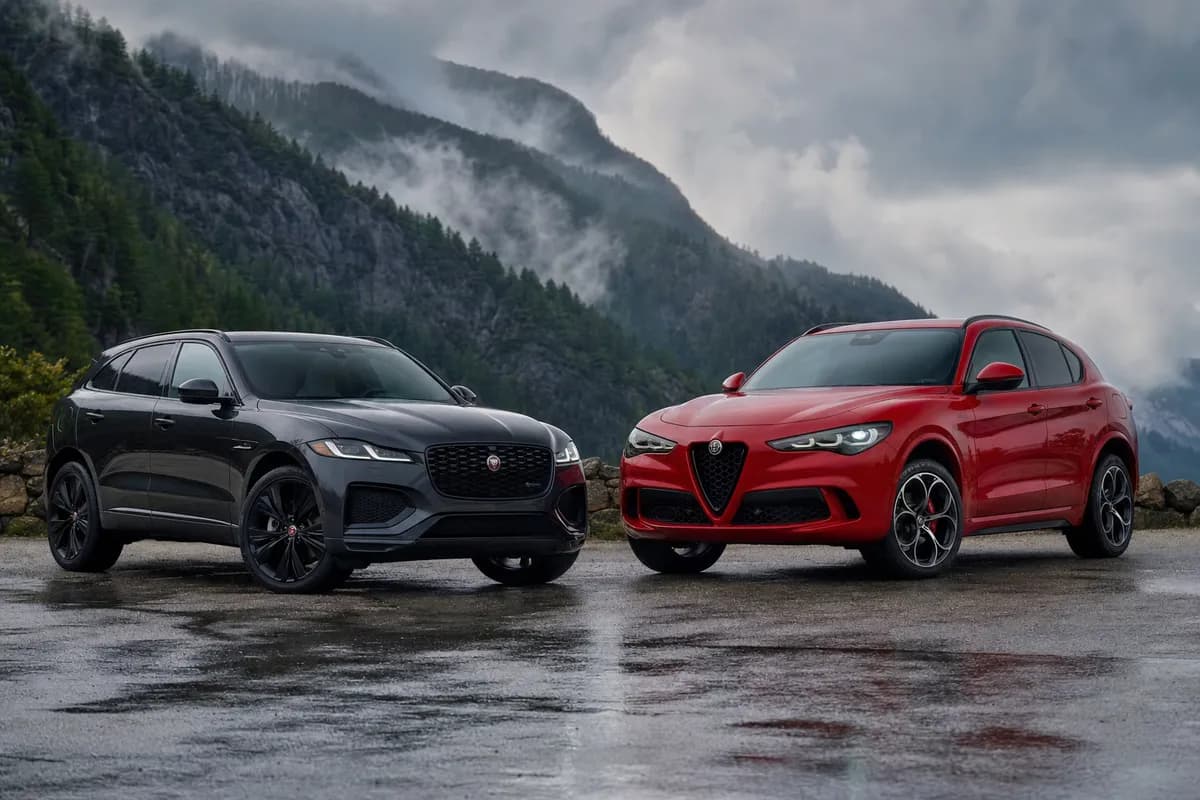
The 2025 Jaguar F-Pace and 2025 Alfa Romeo Stelvio are luxury crossovers for people who still remember what steering feel is. They are not the sensible, beige answer like a Lexus NX, nor the default German subscription service that is a BMW X3 or Mercedes-Benz GLC.
The 2025 Jaguar F-Pace and 2025 Alfa Romeo Stelvio are luxury crossovers for people who still remember what steering feel is. They are not the sensible, beige answer like a Lexus NX, nor the default German subscription service that is a BMW X3 or Mercedes-Benz GLC. These two have pulse. The Alfa flicks into corners like it has caffeine in the brake fluid. The Jaguar counters with broader shoulders, richer cabin manners, more cargo space, and, if you tick the right box, a supercharged V8 that makes polite society feel terribly overrated.
So which one rules the road? Easy answer: the Jaguar F-Pace is the better all-round luxury crossover. But the Alfa Romeo Stelvio remains the sharper driver’s tool in base four-cylinder form. The difference is this: the Stelvio charms you in the first corner; the F-Pace keeps making sense after the road straightens, the family climbs aboard, and the luggage starts multiplying like rabbits.
Engines and Performance: Jaguar Brings the Bigger Hammer
The 2025 Jaguar F-Pace offers a proper spread of powertrains. In U.S.-spec form, the lineup typically starts with the P250, using a 2.0-liter turbocharged four-cylinder producing 246 hp and 269 lb-ft of torque. It runs through an eight-speed automatic and standard all-wheel drive, with Jaguar quoting 0-60 mph in about 6.9 seconds. That is adequate, not exciting. Think “swift airport transfer,” not “back-road hooligan.”
The sweet spot is the F-Pace P400. Its 3.0-liter turbocharged and electrically supercharged mild-hybrid inline-six delivers 395 hp and 406 lb-ft, also through an eight-speed automatic and all-wheel drive. Jaguar quotes 0-60 mph in 5.1 seconds, and the engine has the polished shove luxury buyers expect. It does not just accelerate; it gathers the horizon with expensive calm.
Then there is the F-Pace SVR 575 Edition, the glorious lunatic in the blazer. Its 5.0-liter supercharged V8 produces 567 hp and 516 lb-ft, good for 0-60 mph in roughly 3.8 seconds and a top speed around 178 mph. In a world of muted turbo-fours and fake speaker noise, the SVR’s bellow feels like an act of civil disobedience. It is not subtle. It is not cheap. It is magnificent.
The 2025 Alfa Romeo Stelvio keeps things simpler. With the Quadrifoglio effectively out of the 2025 new-car conversation in many markets, the core Stelvio runs a 2.0-liter turbocharged four-cylinder producing 280 hp and 306 lb-ft of torque. It pairs with the excellent ZF eight-speed automatic and rear-wheel drive or Alfa’s Q4 all-wheel drive, depending on trim and market. Alfa quotes 0-60 mph in about 5.4 seconds, which is genuinely quick for the class and comfortably quicker than the base F-Pace P250.
- Jaguar F-Pace P250: 246 hp, 269 lb-ft, 0-60 mph in about 6.9 seconds
- Jaguar F-Pace P400: 395 hp, 406 lb-ft, 0-60 mph in about 5.1 seconds
- Jaguar F-Pace SVR 575: 567 hp, 516 lb-ft, 0-60 mph in about 3.8 seconds
- Alfa Romeo Stelvio 2.0T: 280 hp, 306 lb-ft, 0-60 mph in about 5.4 seconds
On numbers alone, the Alfa beats the base Jag but gets demolished once the F-Pace P400 or SVR enters the room. The Stelvio’s four-cylinder is lively and eager, but Jaguar’s engine range simply has more bandwidth. If you want a luxury crossover that can do refined commuting on Monday and launch like a scalded grand tourer on Saturday, the F-Pace has the muscle.
Handling and Road Feel: Alfa Dances, Jaguar Dominates
This is where the Alfa Romeo Stelvio bares its teeth. The Stelvio is one of the best-steering SUVs ever sold, full stop. The rack is quick, the front end bites early, and the whole vehicle rotates with an agility that makes rivals feel like they’re asking for permission before changing direction. Alfa’s relatively low curb weight, near-balanced chassis tuning, and famously responsive controls give the Stelvio a sports-sedan flavor that most crossovers only fake in Sport mode.
There is real hardware helping here, too. The Stelvio uses a sophisticated double-wishbone front suspension and Alfa’s lightweight Giorgio platform, shared in spirit with the Giulia sedan. The eight-speed automatic snaps through gears cleanly, and the big column-mounted shift paddles on higher trims remain some of the best in the business. They feel like they belong in a car driven by someone who knows what an apex is, not just where the nearest oat-milk latte is.
The Jaguar F-Pace is not as sharp at first touch. It is a larger, heavier crossover, and you feel that mass when you start really leaning on it. But do not confuse less twitchy with dull. The F-Pace has beautifully judged high-speed composure, strong body control, and the kind of planted confidence that makes a fast road feel shorter. The P400 is especially well balanced: enough power to wake the chassis up, not so much that every throttle input feels like a legal consultation.
The SVR is a different beast. It is heavier, louder, thirstier, and less delicate than the Stelvio, but it has theater in industrial quantities. The steering is meaty, the rear-biased all-wheel-drive system lets the car feel alive, and the V8 soundtrack turns tunnel runs into personal holidays. It is not as scalpel-sharp as the Alfa; it is more like a velvet-wrapped sledgehammer. Sometimes that is exactly what you want.
Road verdict: The Stelvio is the purer driver’s crossover. The F-Pace is the better long-distance weapon, and the SVR is the one you buy when subtlety has failed you.
Compared with rivals, the Alfa still has the edge over a Mercedes-Benz GLC 300 for steering feel and over a base BMW X3 for sheer enthusiasm. But Jaguar’s P400 and SVR trims give the F-Pace performance depth the Stelvio no longer matches in 2025. If Alfa still had a new Stelvio Quadrifoglio on the board, this fight would be bloodier. Without it, Jaguar lands the heavier punches.
Cabin, Tech, and Practicality: F-Pace Feels More Expensive
Open the doors and the Jaguar immediately makes its case. The F-Pace cabin is more spacious, more mature, and more convincingly luxurious. Materials are richer, the driving position is excellent, and the overall ambience feels closer to a Range Rover Sport’s urbane cousin than a warmed-over compact SUV. The dashboard layout is clean without being sterile, and Jaguar’s 11.4-inch curved Pivi Pro touchscreen is one of the better interfaces in the class when it behaves. Wireless Apple CarPlay and Android Auto are expected, and the graphics look sharp.
The Alfa Stelvio’s cabin is more intimate and driver-focused. The seating position is low for an SUV, the wheel feels terrific, and the analog-emotional layout has charm. But charm only gets you so far when plastics in less visible areas feel a grade below Jaguar’s, and the infotainment system lacks the polish of the newest German and British systems. The available digital cluster helps, and the controls are easy enough to use, but the Stelvio’s interior no longer feels fresh. It feels lovable. There is a difference.
Practicality is a decisive Jaguar win. The F-Pace offers about 31.5 cubic feet of cargo space behind the rear seats and roughly 69.1 cubic feet with them folded. The Stelvio offers about 18.5 cubic feet behind the second row and around 56.5 cubic feet folded. That is not a small gap; that is the difference between packing for a ski weekend and playing luggage Tetris while your passengers silently judge you.
- Jaguar F-Pace cargo space: about 31.5 cu ft seats up, 69.1 cu ft seats folded
- Alfa Romeo Stelvio cargo space: about 18.5 cu ft seats up, 56.5 cu ft seats folded
- F-Pace towing capacity: up to roughly 5,291 pounds when properly equipped
- Stelvio towing capacity: generally around 3,000 pounds where rated
Rear-seat room also favors the Jaguar. The F-Pace is longer and feels broader inside, with better accommodation for adults in the second row. The Stelvio is not cramped, but it is more compact and more compromised. If you use your luxury crossover as a family car, road-trip hauler, dog transporter, or weekend gear mule, the Jaguar is simply more useful.
Safety and driver assistance features are competitive in both, with available adaptive cruise control, blind-spot monitoring, lane-keeping assistance, parking sensors, and surround-view camera systems depending on trim. But again, the Jaguar integrates the luxury experience more convincingly. The Alfa feels like a driver’s car that happens to have SUV practicality. The Jaguar feels like a luxury SUV that can still hustle.
Pricing, Fuel Economy, and Ownership Reality
The Alfa Romeo Stelvio has the lower entry price. Depending on trim and equipment, the 2025 Stelvio generally starts in the high-$40,000 to low-$50,000 range, with better-equipped Veloce and special-edition models moving into the mid-to-high-$50,000s. That makes it tempting against the Jaguar, which typically starts closer to the upper-$50,000s and climbs quickly. The F-Pace P400 pushes into the $60,000s, while the SVR 575 lives in serious-money territory, often around the $90,000 mark before options.
Value depends on what you want. If you want the best steering feel per dollar, buy the Stelvio and enjoy annoying Porsche Macan owners on twisty roads. If you want richer materials, more cargo room, stronger warranty coverage, and available six- or eight-cylinder power, the F-Pace justifies the premium more convincingly than many luxury SUVs do.
Fuel economy is closer than you might expect in the mainstream versions. The Stelvio 2.0T typically returns around 22 mpg city and 28-29 mpg highway, depending on rear- or all-wheel drive configuration. The F-Pace P250 lands in a similar zone at roughly 22 mpg city and 27 mpg highway. The P400 drops to around 19 mpg city and 25 mpg highway. The SVR? Expect about 15 mpg city and 21 mpg highway, because physics hears your concerns and continues not caring.
- Most efficient choice: Alfa Romeo Stelvio 2.0T or Jaguar F-Pace P250
- Best performance-efficiency balance: Jaguar F-Pace P400
- Most emotionally irresponsible choice: Jaguar F-Pace SVR 575
- Best budget driver’s pick: Alfa Romeo Stelvio Veloce or equivalent 2.0T sport trim
Ownership confidence is a mixed bag, because neither brand is Toyota in a nice jacket. Jaguar counters with a strong ownership package in many markets, including a 5-year/60,000-mile limited warranty and complimentary scheduled maintenance in the U.S. Alfa Romeo typically offers a 4-year/50,000-mile warranty, with more limited complimentary maintenance. That matters. Luxury repairs are not priced in human currency; they are priced in mild chest pains.
Depreciation also deserves a raised eyebrow. Both the F-Pace and Stelvio can lose value more quickly than German rivals or a Lexus. That is bad news if you buy new and sell fast, but excellent news if you are shopping certified pre-owned. For a new 2025 purchase, the Jaguar’s stronger warranty and broader usability make it the safer long-term bet. The Alfa is the heart purchase. The Jaguar is the heart purchase that remembered to bring a spreadsheet.
Verdict: The Jaguar F-Pace Rules, But the Alfa Stelvio Still Charms
The 2025 Alfa Romeo Stelvio is the crossover I would choose for a deserted mountain road in perfect weather. It has faster steering, lighter reactions, and a sense of mischief that most luxury SUVs lost somewhere between the focus group and the cupholder redesign. The 280-hp turbo-four is strong, the transmission is excellent, and the chassis still feels special. If you mostly drive alone, care deeply about steering feel, and want a compact luxury crossover with Italian bite, the Stelvio remains a brilliant left-field choice.
But the 2025 Jaguar F-Pace is the crossover I would actually recommend to more buyers. It has the better cabin, more cargo room, more rear-seat space, stronger towing ability, and a far wider performance range. The P250 is fine, the P400 is excellent, and the SVR 575 is a dying-breed muscle opera with leather seats. Jaguar gives you more ways to configure the car you actually want, while Alfa asks you to accept one excellent engine in one aging but still charismatic package.
Winner: 2025 Jaguar F-Pace.
Not by a polite nose, either. The Alfa Stelvio wins the handling argument among four-cylinder trims, and it remains the more playful machine. But the F-Pace wins the luxury crossover war. It is faster in upper trims, more practical every day, more premium inside, and more satisfying over distance. The Stelvio is the dancer. The F-Pace is the ruler: composed, powerful, and just flamboyant enough to remind you that cars are supposed to stir something below the neck.
If your budget stops around $55,000 and you want maximum driver engagement, buy the Alfa Romeo Stelvio. If you want the better luxury crossover overall, stretch to the Jaguar F-Pace P400. And if you can afford the SVR 575, stop pretending this is a rational decision. Buy the V8 while such wonderfully antisocial things still exist.
Affiliate disclosure: This article contains affiliate links. RevvedUpCars may earn a small commission on qualifying purchases at no extra cost to you.