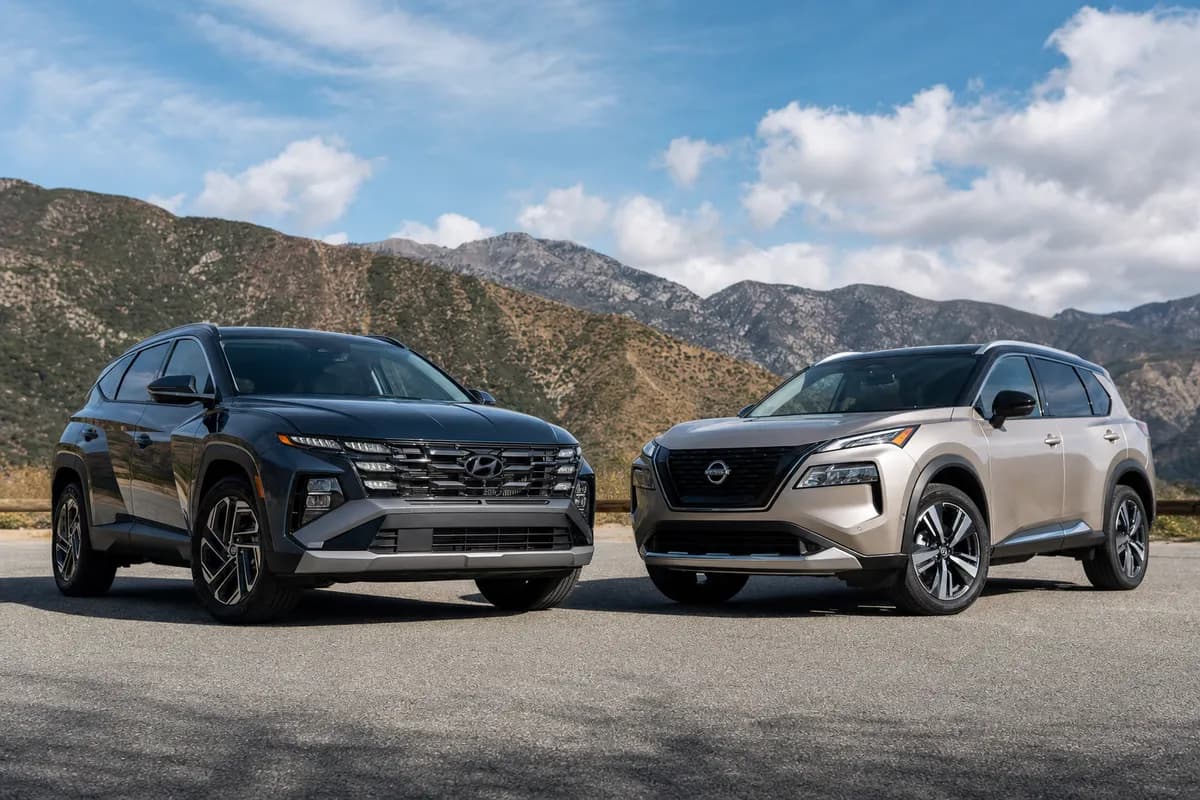
The 2025 Hyundai Tucson and 2025 Nissan Rogue are exactly the kind of compact SUVs people actually buy: roomy, efficient, reasonably priced, and blessedly not pretending to be Nürburgring weapons. But they go about the job differently.
The 2025 Hyundai Tucson and 2025 Nissan Rogue are exactly the kind of compact SUVs people actually buy: roomy, efficient, reasonably priced, and blessedly not pretending to be Nürburgring weapons. But they go about the job differently. The Rogue is the fuel-sipping extrovert with a clever turbo three-cylinder and a practical cabin. The Tucson is the better-rounded operator, especially after its 2025 refresh, with sharper tech, a nicer interior, and—crucially—hybrid options Nissan still refuses to offer in the U.S. If you’re shopping Honda CR-V, Toyota RAV4, Mazda CX-5, Kia Sportage, or Subaru Forester territory, this faceoff matters. One of these SUVs feels like a smart appliance. The other feels like the better long-term buy.
Powertrains and Performance: Rogue Punches First, Tucson Hits Harder With Hybrid
Let’s start under the hood, because this is where the Nissan Rogue makes its strongest opening argument. Every 2025 Rogue uses a 1.5-liter VC-Turbo three-cylinder engine making 201 horsepower and 225 lb-ft of torque. That torque figure is the headline. It beats the gas-only Tucson’s 187 hp and 178 lb-ft from its naturally aspirated 2.5-liter four-cylinder, and you feel it in everyday driving. The Rogue steps away from lights with more urgency and has less of that “please wait while I consider your request” behavior common in base compact SUVs.
But then Nissan pairs that clever engine with a continuously variable transmission. Yes, Nissan’s CVT tuning is better than it used to be. No, that does not mean it has become fun. Under mild throttle, it behaves well enough. Ask for a quick merge, though, and the Rogue still does the familiar CVT groan-and-hold routine, like it’s reading a legal disclaimer before accelerating. It gets the job done, but the soundtrack is more leaf blower than sport sedan.
The Tucson’s standard gas engine is slower, and there’s no point sugarcoating it. With the 2.5-liter and eight-speed automatic, the Tucson feels smooth but not eager. Expect 0-60 mph in the high-eight-second range depending on trim and drivetrain. The Rogue is typically closer to the high-sevens. If you only compare base gas models, Nissan wins the stopwatch and the seat-of-the-pants test.
Then Hyundai brings out the real weapon: the Tucson Hybrid. For 2025, the Tucson Hybrid pairs a 1.6-liter turbocharged four-cylinder with electric assistance for 231 combined horsepower, routed through a six-speed automatic rather than a moaning CVT. That matters. The hybrid doesn’t just save fuel; it makes the Tucson feel fundamentally better. It’s quicker, smoother off the line, and more relaxed in traffic. The Tucson Plug-in Hybrid is stronger still at 268 combined horsepower, with useful electric-only range for commuters who can charge at home.
Nissan currently offers no Rogue Hybrid in the U.S. market. That is not a small omission. In a segment where Toyota sells the RAV4 Hybrid by the boatload and Honda’s CR-V Hybrid is arguably the best version of the CR-V, Nissan is showing up to a knife fight with a nicely sharpened spoon.
- 2025 Nissan Rogue: 1.5-liter turbo three-cylinder, 201 hp, 225 lb-ft, CVT, FWD or AWD
- 2025 Hyundai Tucson gas: 2.5-liter four-cylinder, 187 hp, 178 lb-ft, eight-speed automatic, FWD or AWD
- 2025 Hyundai Tucson Hybrid: 1.6-liter turbo hybrid, 231 combined hp, standard AWD
- 2025 Hyundai Tucson Plug-in Hybrid: 268 combined hp, standard AWD, useful EV commuting range
If you want the quickest affordable version, buy the Tucson Hybrid. If you’re comparing only gas engines, the Rogue feels livelier. If you care about refinement, the Tucson’s conventional automatic and hybrid drivetrain give Hyundai the broader win.
Fuel Economy: Nissan Wins Gas-to-Gas, Hyundai Wins the Bigger Game
The Rogue’s best defense is efficiency. With front-wheel drive, the 2025 Nissan Rogue earns up to about 30 mpg city, 37 mpg highway, and 33 mpg combined, depending on trim. All-wheel-drive versions typically land around 28 mpg city, 35 mpg highway, and 31 mpg combined. Those are excellent numbers for a non-hybrid compact SUV with more than 200 horsepower.
The gas-only Tucson can’t match that. A front-drive 2025 Tucson with the 2.5-liter engine is rated around 25 mpg city, 33 mpg highway, and 28 mpg combined, while all-wheel-drive models dip to roughly 24 mpg city, 30 mpg highway, and 26 mpg combined. In real-world commuting, the Rogue’s advantage is obvious. If you rack up highway miles and don’t want a hybrid, the Nissan saves fuel and money.
But once again, Hyundai’s hybrid lineup changes the outcome. The Tucson Hybrid can return up to about 38 mpg combined in its most efficient configuration, with other trims commonly landing in the mid-30s. The plug-in hybrid adds the ability to handle short commutes on electric power before operating like a regular hybrid. That’s the modern compact-SUV playbook, and Hyundai is running it properly.
Here’s the blunt version: the Rogue is impressively efficient for a gas SUV, but the Tucson gives buyers more ways to be efficient. Nissan has optimized one powertrain. Hyundai gives you three.
Fuel-economy verdict: Rogue is the better gas-only commuter. Tucson Hybrid is the better overall efficiency play, especially for city drivers and anyone tired of watching fuel prices behave like crypto.
Interior, Space, and Tech: Tucson Feels Newer, Rogue Feels Sensible
The 2025 Tucson received a meaningful cabin update, and it shows. Hyundai has moved away from the previous touch-sensitive-control obsession—an era I hope gets buried in the same landfill as fake exhaust tips—and brought back more useful physical controls. The dashboard now looks cleaner and more premium, with an available panoramic curved display combining a 12.3-inch digital instrument cluster and 12.3-inch infotainment screen. Wireless Apple CarPlay and Android Auto are available, and the interface is quick, crisp, and less fussy than before.
The Rogue’s cabin is practical, comfortable, and intelligently laid out. Higher trims get a 12.3-inch touchscreen, available 12.3-inch digital gauge cluster, and Google built-in functionality on upper models. Lower trims use a smaller screen, but the basics are easy to operate. Nissan also deserves credit for excellent front seats. Its Zero Gravity chairs remain among the best in the segment for long drives. If your commute is 70 miles and your spine files complaints with HR, the Rogue will treat you well.
Space is close, but Hyundai has the edge on paper. The Tucson offers about 41.3 inches of rear legroom, which is excellent for the class and genuinely adult-friendly. The Rogue’s rear legroom is around 38.5 inches, still fine, but less limousine-like. Cargo space is also slightly better in the Tucson: about 38.7 cubic feet behind the second row and 74.8 cubic feet with the rear seats folded. The Rogue counters with roughly 36.5 cubic feet behind the second row and up to 74.1 cubic feet folded.
Those numbers are close enough that your stroller, Costco haul, dog crate, or weekend luggage won’t care. But the Tucson’s rear-seat space advantage is real, especially if you regularly carry teenagers or adults. The Rogue fights back with thoughtful family touches: wide-opening rear doors, a flexible cargo floor on some trims, and an airy cabin that feels easy to live with.
Material quality? Tucson wins. The Hyundai’s upper trims feel closer to near-premium territory, especially in Limited and hybrid trims. The Rogue Platinum is nicely finished, but some lower cabin plastics remind you that Nissan’s accountants own calculators and know how to use them.
- Best rear seat: Hyundai Tucson
- Best front seats: Nissan Rogue
- Best infotainment layout: Hyundai Tucson after the 2025 refresh
- Best cargo flexibility: Close, but Rogue has clever packaging touches
- Best overall cabin feel: Hyundai Tucson
Driving Feel, Safety, and Ownership: The Hyundai Advantage Adds Up
Neither of these SUVs is pretending to be a Mazda CX-5, and thank heavens neither has been cursed with fake track-day ambition. These are family crossovers. The job is to be quiet, stable, comfortable, and predictable when a semi blasts past you in a rainstorm. On that front, both are competent—but the Tucson feels more composed.
The Tucson has a calmer ride, better isolation, and a more substantial feel over broken pavement. It doesn’t sparkle in corners, but it tracks cleanly and doesn’t get flustered. The steering is light, the brake pedal is easy to modulate, and the hybrid’s electric torque makes urban driving feel polished. The gas version is less inspiring, but even there, the eight-speed automatic gives it a more traditional and refined driving character than the Rogue’s CVT.
The Rogue is lighter on its feet and easier to place in tight spaces. Its steering is quick enough, and the turbo engine gives it decent midrange pull. But rougher roads expose more cabin noise, and the three-cylinder can sound gritty when pushed. It’s not bad. It’s just less refined. The Rogue feels like it was engineered to score well on the spreadsheet. The Tucson feels like someone spent more time asking, “Will people actually enjoy living with this thing?”
On safety tech, both are well equipped. The Rogue offers Nissan Safety Shield 360 features including automatic emergency braking with pedestrian detection, blind-spot warning, rear cross-traffic alert, lane-departure warning, and high-beam assist. Available ProPILOT Assist with Navi-link is one of Nissan’s better tricks, helping with steering assist and adaptive cruise control on highways.
The Tucson counters with Hyundai SmartSense features including forward collision-avoidance assist, lane keeping assist, lane following assist, blind-spot collision warning, rear cross-traffic collision-avoidance assist, and adaptive cruise control on many trims. Available Highway Driving Assist gives the Tucson strong semi-automated highway manners. Hyundai’s driver-assistance tuning is generally smooth and confidence-inspiring, without the overcaffeinated lane corrections some systems still suffer from.
Ownership is where Hyundai lands a heavy punch. Hyundai’s warranty coverage remains one of the best in the business: 5 years/60,000 miles basic and 10 years/100,000 miles powertrain. Nissan’s coverage is the industry-standard 3 years/36,000 miles basic and 5 years/60,000 miles powertrain. For buyers planning to keep their SUV beyond the first loan cycle, Hyundai’s warranty is not just marketing glitter. It is real financial armor.
Pricing depends heavily on trim and drivetrain, but both start in the high-$20,000 range before climbing into the upper-$30,000s and low-$40,000s for loaded models. The Rogue lineup typically runs from S to SV, SL, and Platinum. The Tucson lineup includes SE, SEL, XRT, Limited, plus Hybrid and Plug-in Hybrid variants. The Tucson Hybrid costs more than the base gas model, obviously, but it also makes the Tucson a much better vehicle. Spend the extra money if your budget allows. The gas Tucson is acceptable. The Tucson Hybrid is the one Hyundai should put under bright lights.
Verdict: Buy the Tucson Hybrid, Unless Gas MPG Is Your Only Religion
The 2025 Nissan Rogue is not a bad SUV. In fact, it’s a very good one if your priorities are fuel economy, comfortable front seats, useful cargo space, and a strong standard engine. Its 1.5-liter VC-Turbo delivers better punch than the gas Tucson, and its EPA numbers are excellent for a non-hybrid compact crossover. If you drive mostly highway miles, want simple gasoline ownership, and can tolerate the CVT’s occasional lawn-equipment impression, the Rogue makes a strong case.
But the 2025 Hyundai Tucson is the better compact SUV family overall. It has the nicer cabin, roomier rear seat, better warranty, more polished road manners, and a far broader powertrain lineup. The standard gas Tucson is merely fine, and I would not buy it over a Rogue if performance and fuel economy were the only metrics. But the Tucson Hybrid changes everything. It’s quicker, smoother, more efficient in the real world, and more pleasant to drive. The plug-in hybrid gives Hyundai another advantage Nissan simply cannot answer.
Final verdict: Choose the 2025 Nissan Rogue if you want the best gas-only fuel economy and a punchy standard engine. Choose the 2025 Hyundai Tucson Hybrid if you want the best SUV here. That’s the one I’d park in my driveway—and unlike the Rogue’s CVT, I wouldn’t complain about it every time I merged onto the freeway.
In this compact SUV faceoff, Nissan wins the gas-engine skirmish. Hyundai wins the war.
Affiliate disclosure: This article contains affiliate links. RevvedUpCars may earn a small commission on qualifying purchases at no extra cost to you.