The electric off-road war has officially gone from “interesting” to “somebody call engineering.” On one side sits the 2025 GMC Hummer EV SUV, a 9,000-pound moon buggy with four-wheel steering, air suspension, removable roof panels, and the subtlety of a brick through a…
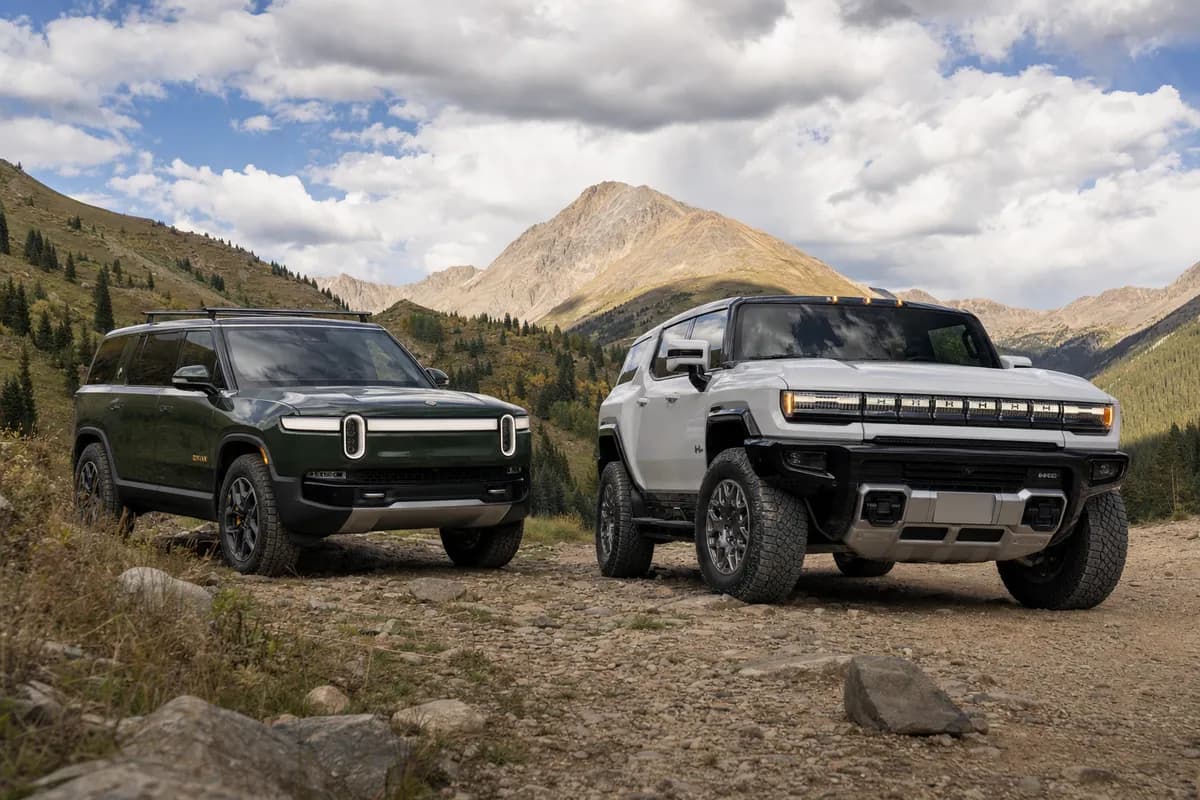
The electric off-road war has officially gone from “interesting” to “somebody call engineering.” On one side sits the 2025 GMC Hummer EV SUV, a 9,000-pound moon buggy with four-wheel steering, air suspension, removable roof panels, and the subtlety of a brick through a jewelry-store window. On the other is the 2025 Rivian R1S, the Patagonia-wearing assassin: quicker than most sports cars, genuinely trail-capable, packed with clever storage, and able to haul seven humans without turning every parking garage into a hostage negotiation. Both claim electric off-road dominance. Only one actually deserves your money.
Big Numbers, Bigger Personalities
Let’s establish the obvious: neither of these machines is a rational purchase in the traditional sense. A Toyota Land Cruiser will outlast civilization, a Jeep Wrangler Rubicon is cheaper to bend on rocks, and a Ford Bronco Badlands is easier to thread through trees. But rationality left the chat the moment automakers decided 800-hp electric SUVs should climb boulders in near silence.
The 2025 GMC Hummer EV SUV is the extrovert. In 3X trim, it uses a three-motor setup rated at 830 horsepower, with GMC quoting a cartoonish 11,500 lb-ft of wheel torque. That number is not directly comparable to conventional engine torque, but the result is not imaginary: GMC says the Hummer EV SUV can hit 0-60 mph in about 3.5 seconds using Watts to Freedom launch mode. That is absurd for something with the frontal area of a garden shed.
The Rivian R1S fights with a broader lineup. For 2025, Rivian’s second-generation R1S offers Dual-Motor, Performance Dual-Motor, Tri-Motor, and eventually Quad-Motor configurations. The sweet-spot Performance Dual-Motor makes 665 horsepower and 829 lb-ft of torque, good for a claimed 0-60 mph in 3.4 seconds. Step up to the Tri-Motor Max and you get 850 horsepower and 1,103 lb-ft, with Rivian claiming 0-60 mph in 2.9 seconds. The forthcoming Quad-Motor version is expected to push the lunacy to 1,025 horsepower and a claimed 2.6-second sprint.
That means the Rivian is not merely “quick for an SUV.” It is quick, full stop. The Hummer feels dramatic because it hurls mass at the horizon like a freight elevator with anger issues. The Rivian feels sharper, cleaner, and more athletic because it is not carrying quite as much geological ballast.
- GMC Hummer EV SUV 3X: 830 hp, three motors, about 3.5 seconds to 60 mph, up to roughly 312 miles of range depending on configuration.
- Rivian R1S Performance Dual-Motor: 665 hp, 829 lb-ft, 3.4 seconds to 60 mph, available with Large or Max battery packs.
- Rivian R1S Tri-Motor Max: 850 hp, 1,103 lb-ft, 2.9 seconds to 60 mph, EPA range around 371 miles.
On paper, the Hummer looks like the monster. In practice, the Rivian is the better athlete. The GMC is a cannonball. The Rivian is a cannonball with steering feel.
Off-Road Hardware: Hummer Brings Theater, Rivian Brings Precision
If you judge an off-roader by its party tricks, the Hummer EV SUV wins before the first tire touches dirt. Its headline feature is four-wheel steering, including the now-famous CrabWalk mode, which turns the front and rear wheels in the same direction so the vehicle can move diagonally at low speed. It looks ridiculous. It is also genuinely useful when squeezing around obstacles or repositioning on tight trails.
The Hummer also offers adaptive air suspension, an available Extract Mode that can raise the body for up to 15.9 inches of ground clearance, underbody armor, rock sliders, front and rear e-locker-style capability through its e4WD system, and UltraVision cameras with underbody views. Its off-road camera system is not a gimmick; when the hood is the size of a tennis court and the front corners are somewhere in another zip code, seeing what is beneath you matters.
The Hummer EV SUV’s off-road geometry is serious. GMC quotes up to roughly 49.6 degrees of approach angle, 49.0 degrees of departure angle, and 34.4 degrees of breakover angle in its most aggressive suspension settings. It can ford around 32 inches of water. Those are numbers that make most luxury SUVs quietly reverse back to the winery.
The Rivian R1S is less theatrical but more elegant. It uses an independent air suspension with up to about 14.9 inches of ground clearance, multiple drive modes, excellent torque control, and a very composed chassis on loose surfaces. Its approach angle is around 35.6 degrees, departure angle about 34.3 degrees, and breakover angle roughly 29.6 degrees. It can wade through up to around 43 inches of water, which is deeply impressive and also a good way to make every insurance adjuster in the county start sweating.
The R1S also benefits from being narrower and less obscenely heavy. The Hummer EV SUV is roughly 86.7 inches wide without mirrors and weighs in the neighborhood of 8,600 to 8,900 pounds depending on spec. That is not curb weight; that is a small building with Bluetooth. The Rivian R1S is still heavy at roughly 7,000 pounds, but compared with the Hummer, it feels like a rally car with a third row.
Off-road truth: The Hummer has the better extreme hardware. The Rivian is easier to place, easier to live with, and less likely to make you pucker every time the trail narrows between two pine trees.
On open desert tracks, the Hummer feels unstoppable. It pounds over ruts with sci-fi confidence, its air suspension and immense footprint soaking up abuse. On technical rock sections, four-wheel steering gives it a hilarious advantage, shrinking its turning circle and letting you pivot this battery-powered bunker in places where it has no business fitting.
But the Rivian has finesse. Its throttle calibration is beautifully judged, its body control is tighter, and its torque delivery feels more intuitive. In a Hummer, you are commanding a machine. In a Rivian, you are driving one.
Range, Charging, and Efficiency: Rivian Lands the Body Blow
Here is where the Hummer’s chest-thumping starts to sound a little winded. The GMC Hummer EV SUV uses GM’s Ultium battery architecture, and depending on trim and wheel/tire package, it offers up to about 312 miles of EPA-rated range. That is respectable until you remember the battery is enormous. The SUV’s pack is around the 170-kWh class, which means it consumes electricity with the restraint of a Vegas buffet line.
Charging is a strength, at least on the right hardware. The Hummer EV can take advantage of high-voltage DC fast charging, with GMC claiming up to 300 kW capability and the ability to add roughly 100 miles in about 14 minutes under ideal conditions. That sounds fantastic, but ideal conditions include a working high-power charger, a properly conditioned battery, and the gods of public charging not laughing at you.
The Rivian R1S is more efficient and offers better range options. The 2025 R1S Dual-Motor with Standard battery is rated around 270 miles. Large pack models can reach about 330 miles, while Max pack versions stretch up to around 410 miles in certain Dual-Motor configurations. The Tri-Motor Max sits around 371 miles. That is a meaningful advantage if your adventures involve more than posing near a trailhead with a $300 cooler.
Rivian’s peak DC fast-charging rate is lower than the Hummer’s best-case number, at roughly 220 kW, but the network story is increasingly strong. Rivian owners have access to the Rivian Adventure Network, and newer support for Tesla Superchargers via adapter changes the road-trip equation dramatically. A peak number on a spec sheet is nice; reliable places to plug in are nicer.
- Range advantage: Rivian R1S, especially with the Max battery.
- Peak fast-charging advantage: GMC Hummer EV, when using compatible high-power DC chargers.
- Efficiency advantage: Rivian R1S, by a comfortable margin.
- Road-trip confidence: Rivian, thanks to better range and improving charging access.
The Hummer can charge impressively fast, but it also drinks electrons like a speedboat. The Rivian simply goes farther on less energy. That matters on pavement. It matters even more off-road, where elevation, tire pressure, temperature, and terrain can turn optimistic range estimates into comedy.
Cabin, Practicality, and Daily Use: One Is a Family SUV, One Is a Rolling Event
The GMC Hummer EV SUV has an undeniably cool cabin. The upright dashboard, chunky controls, removable Infinity Roof panels, big screens, and lunar-module vibe all fit the mission. It feels special every time you climb in. That matters when the price tag can push past $100,000 without trying very hard.
But the Hummer is a five-seater. The Rivian R1S is a three-row SUV. That single fact will end the debate for many buyers before horsepower, torque, or approach angles get a vote. The R1S can carry seven passengers, swallow family gear, and still feel premium without cosplaying as a military prototype.
Cargo space is also more family-friendly in the Rivian. The R1S offers a large rear cargo area, a usable third row, a front trunk, and clever storage throughout. Fold the seats and it becomes a very convincing camping platform. The Hummer has useful space too, including a power eTrunk and a broad cargo hold, but its interior packaging is less efficient because so much of the vehicle is devoted to stance, structure, and spectacle.
Towing is close. The Hummer EV SUV is rated to tow up to about 7,500 pounds. The Rivian R1S is rated up to about 7,700 pounds. Neither will tow that much without range taking a brutal hit, because physics remains undefeated and deeply unsympathetic. If you regularly tow long distances, buy a diesel truck and stop pretending.
On-road, the Rivian is the clear winner. Its steering is more natural, its body motions are better controlled, and it feels smaller than it is. The 2025 second-generation updates brought revised electronics, improved motors, updated suspension tuning, and a cleaner software architecture. It feels like a company learning quickly.
The Hummer is comfortable and hilarious, but never lets you forget its mass. It leans, heaves, and occupies a lane with imperial entitlement. Yes, the four-wheel steering helps dramatically in parking lots, and its turning radius is far better than its dimensions suggest. But width is width. In city traffic, the Hummer feels like wearing shoulder pads to a dinner table.
Pricing sharpens the contrast. The Rivian R1S starts in the mid-$70,000 range for Dual-Motor Standard models, climbs through the $80,000s and $90,000s with bigger batteries and Performance hardware, and reaches six figures in Tri-Motor Max form. The Hummer EV SUV typically lives near or above the $100,000 mark in desirable trims. In other words, the Rivian can be expensive. The Hummer starts expensive and then asks if you would like to add more expensive.
Verdict: The Hummer Wins the Poster, the Rivian Wins the Purchase
If your definition of electric off-road dominance is maximum drama, wild hardware, and the ability to make every trailhead look like a Mars landing site, the 2025 GMC Hummer EV SUV is your champion. It is outrageous in the best and worst ways: brutally powerful, absurdly capable, genuinely innovative, and so heavy it should come with its own gravitational warning label. Four-wheel steering and CrabWalk are not just marketing nonsense. They make the Hummer uniquely capable in tight, technical situations. When the terrain gets weird, the Hummer gets interesting.
But if you are actually buying one of these as an electric SUV to use every week, the 2025 Rivian R1S is the smarter and better vehicle. It has more range, better efficiency, three-row practicality, sharper road manners, and enough off-road ability to embarrass almost anything wearing all-season tires and a luxury badge. It is not as theatrical as the Hummer, but it is more complete. And unless you spend your weekends crawling over boulders for an audience, complete beats theatrical.
The Hummer EV SUV is the one I want for a ridiculous day in Moab with cameras rolling. The Rivian R1S is the one I would actually tell a friend to buy.
Final call: For pure electric off-road spectacle, the GMC Hummer EV SUV takes the crown. For real-world electric off-road dominance — range, usability, speed, capability, and family practicality — the Rivian R1S wins. The Hummer is the monster truck of the EV age. The Rivian is the future of the adventure SUV.
Affiliate disclosure: This article contains affiliate links. RevvedUpCars may earn a small commission on qualifying purchases at no extra cost to you.