The 2025 Genesis G80 and 2025 Lexus ES are both luxury sedans for people who have outgrown badge-chasing but not standards. One is a rear-drive-based Korean executive sedan with turbocharged muscle, a spectacular new OLED cockpit, and enough presence to make a BMW 5 Series…
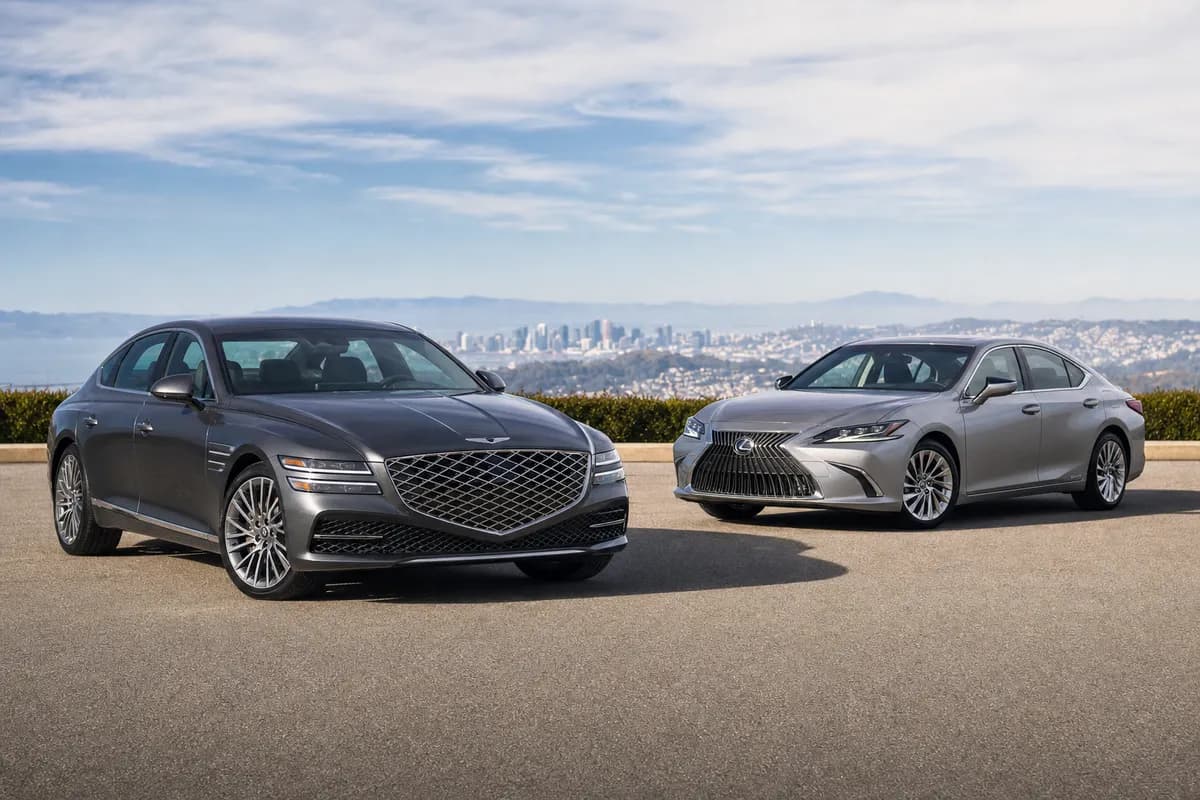
The 2025 Genesis G80 and 2025 Lexus ES are both luxury sedans for people who have outgrown badge-chasing but not standards. One is a rear-drive-based Korean executive sedan with turbocharged muscle, a spectacular new OLED cockpit, and enough presence to make a BMW 5 Series glance over its shoulder. The other is Lexus doing what Lexus does best: serene, efficient, quietly indestructible transportation with a cabin that whispers rather than shouts. Same broad mission, wildly different personalities. If you’re cross-shopping them, here’s the blunt truth: the Genesis G80 is the luxury car you want to drive; the Lexus ES is the luxury car you want to own for 12 years without drama.
What They Are: Real Luxury vs Sensible Luxury
The 2025 Genesis G80 is the more traditional luxury sedan of this pair. It uses a rear-wheel-drive-based platform, though all U.S.-market 2025 G80 models come with all-wheel drive. It’s roughly the same size as the Lexus ES, but its proportions are more premium: long hood, pushed-back cabin, formal stance. It looks like it belongs in the same parking row as a Mercedes-Benz E-Class, BMW 5 Series, Audi A6, and Volvo S90.
For 2025, Genesis gives the G80 a meaningful refresh. The grille is sharper, the lighting signature is cleaner, and the interior gets the big headline: a 27-inch OLED display spanning the gauge cluster and infotainment system. It’s not a gimmick. It looks expensive because it is expensive, and it makes the Lexus cabin feel a generation older.
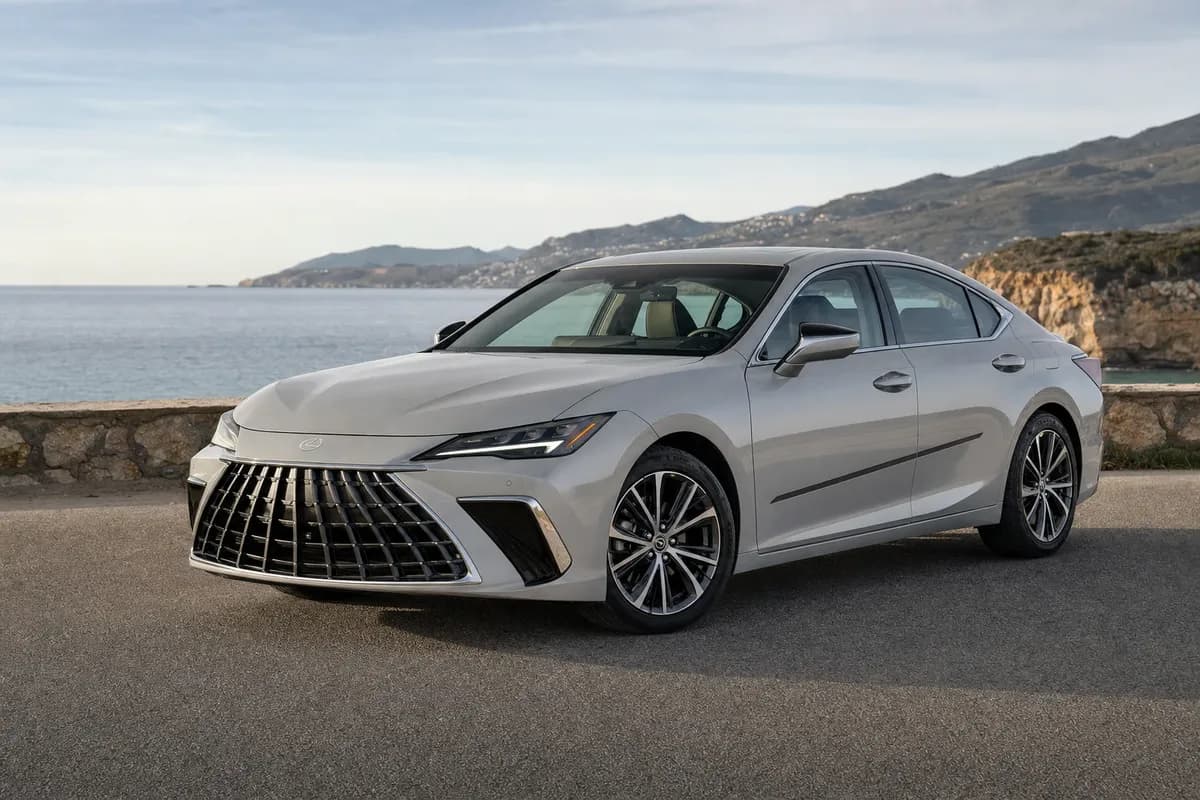
The Lexus ES, meanwhile, plays a different game. It is based on a front-wheel-drive architecture shared broadly with Toyota’s excellent TNGA-K family, and it prioritizes comfort, space, fuel economy, and reliability over driving theater. The ES lineup includes the ES 250 AWD, ES 350, and ES 300h hybrid. Lexus also offers F Sport Design and F Sport Handling trims, though let’s not pretend the ES becomes a sport sedan because someone sprinkled black trim and firmer dampers on it. It doesn’t. It becomes a slightly tauter ES.
Key positioning difference:
- Genesis G80: More expensive, more powerful, more stylish, more premium-feeling, and more dynamically sophisticated.
- Lexus ES: Less expensive, more efficient, easier to live with, and backed by Lexus’ granite-solid reputation.
The Genesis is the car you buy because you still care how a sedan feels. The Lexus is the car you buy because you’ve discovered inner peace, or at least a really good accountant.
Performance: The G80 Brings Horsepower, The ES Brings Manners
This fight gets lopsided the moment you press the start button. The 2025 Genesis G80 offers two turbocharged engines: a 2.5-liter turbocharged four-cylinder producing 300 horsepower and 311 lb-ft of torque, and a 3.5-liter twin-turbo V6 producing 375 horsepower and 391 lb-ft. Both use an 8-speed automatic transmission and all-wheel drive.
The Lexus ES counters with three powertrains. The ES 250 AWD uses a 2.5-liter four-cylinder with 203 horsepower and 184 lb-ft. The ES 350 uses a 3.5-liter naturally aspirated V6 with 302 horsepower and 267 lb-ft. The ES 300h hybrid combines a 2.5-liter four-cylinder with electric assistance for 215 total system horsepower. The ES 250 gets all-wheel drive, while the ES 350 and ES 300h are front-wheel drive.
On paper, the Lexus ES 350 is not weak. A 302-hp V6 in a comfortable sedan is perfectly adequate, and its smooth naturally aspirated delivery is one of the best things about the car. But compared with the Genesis G80, especially the 3.5T, the Lexus feels like it brought a nicely sharpened pencil to a knife fight.
Independent testing has typically put the Genesis G80 3.5T in the high-4-second range to 60 mph, with the 2.5T around the mid-5s. The Lexus ES 350 generally lands around the low-6-second mark. The ES 300h and ES 250 are closer to the 8-second zone, which is fine if your idea of urgency is merging without spilling a latte.
The bigger difference is not just acceleration. It is chassis behavior. The G80 feels planted, composed, and genuinely premium at speed. Its rear-drive-based balance gives it a more natural feel through corners, and the available electronically controlled suspension helps keep body motions tidy without turning the ride brittle. The steering is not exactly Porsche-communicative, but it has better weight and more confidence than the Lexus.
The ES is softer, quieter, and less interested in your heroic apex-hunting nonsense. It rolls more in corners, pushes wide sooner, and communicates less through the wheel. The F Sport Handling model improves body control with adaptive dampers, but it still cannot escape the ES’ front-drive roots. This is not an Acura TLX Type S rival. It is a luxury sedan that happens to tolerate corners.
Where the Lexus punches back is refinement. The ES 350’s V6 is smooth and old-school satisfying. The ES 300h is spectacularly calm in everyday driving, especially in traffic, where the hybrid system glides along with the kind of serenity that makes turbocharged rivals seem fussy. The Genesis engines are stronger, but the four-cylinder can sound a little coarse under load, and the V6’s appetite is very real.
Fuel economy is where the Lexus lands a clean uppercut. EPA estimates for the ES 300h are around 43 mpg city, 44 mpg highway, and 44 mpg combined. The ES 350 is rated around 22 mpg city, 32 mpg highway, and 26 mpg combined, while the ES 250 AWD returns roughly 25 mpg city, 34 mpg highway, and 28 mpg combined. The Genesis G80 2.5T AWD is typically around 19 mpg city, 27 mpg highway, and 22 mpg combined, while the 3.5T AWD drops to about 16 mpg city, 24 mpg highway, and 19 mpg combined.
Translation: the G80 is quicker and more satisfying. The ES 300h will make fewer visits to the pump and smugly enjoy every one of them.
Interior And Technology: Genesis Has The Wow Factor
The 2025 Genesis G80 wins the cabin beauty contest decisively. The new 27-inch OLED display is the centerpiece, and it looks properly high-end rather than tacked-on. Genesis has become dangerously good at interior design: elegant materials, clean switchgear, tasteful lighting, and just enough visual drama to make German rivals look oddly conservative.
The G80’s front seats are supportive, the driving position is excellent, and upper trims can feel properly opulent with features such as Nappa leather, premium audio, heated and ventilated seats, heated rear seats, a head-up display, and advanced driver-assistance tech. Genesis also gets the little stuff right: the door thunk, the metal-look controls, the richness of the upholstery. It feels like a luxury car designed by people trying to prove something.
The Lexus ES cabin is less theatrical but extremely well executed. Materials are high quality, controls are mostly logical, and the whole environment has a soothing, low-stress quality. Lexus’ available 12.3-inch touchscreen is far better than the brand’s old remote-touchpad dark age, and Apple CarPlay and Android Auto support keep the system livable. The available Mark Levinson audio system remains excellent, delivering crisp, balanced sound without turning every song into a bass contest outside a vape shop.
Space is close, but the Lexus has a practical edge. The ES rides on a 113.0-inch wheelbase and offers generous rear legroom, making it terrific for passengers. The Genesis G80 has a longer 118.5-inch wheelbase and a more premium rear-seat ambience, but its sloping roofline and drivetrain layout make it feel a little less airy. Trunk space also favors Lexus slightly: the ES offers about 13.9 cubic feet, while the G80 has around 13.1 cubic feet.
Interior comparison highlights:
- Best dashboard: Genesis G80, by a mile. The OLED setup makes the Lexus look older.
- Best long-distance calm: Lexus ES, especially ES 300h. It is nearly medicinal.
- Best rear-seat luxury feel: Genesis G80, though the Lexus is roomier and easier to use.
- Best audio option: Close call, but Lexus’ Mark Levinson system remains one of the segment benchmarks.
- Best interface: Genesis feels newer; Lexus feels simpler. Pick your poison.
If you want to impress passengers, buy the Genesis. If you want every control to work exactly as expected for the next decade, buy the Lexus.
Price, Warranty, And Ownership: Lexus Plays The Long Game
Here’s where the Lexus ES starts looking brutally rational. The 2025 Lexus ES typically starts in the low-$40,000 range before options, with the ES 250 AWD, ES 350, and ES 300h all clustered close enough that powertrain choice matters more than price. Well-equipped Luxury and Ultra Luxury trims can push into the low-to-mid $50,000s, but even then the ES generally undercuts the Genesis G80.
The 2025 Genesis G80 starts around the upper-$50,000 range for the 2.5T AWD and climbs toward the $70,000 neighborhood for the 3.5T Sport Prestige-style configurations. That is serious money. The G80 still looks like strong value compared with a similarly equipped BMW 530i xDrive, Mercedes-Benz E 350 4Matic, or Audi A6, but against the Lexus ES, it is clearly the pricier machine.
Genesis counters with one of the best warranties in the business:
- Genesis basic warranty: 5 years or 60,000 miles.
- Genesis powertrain warranty: 10 years or 100,000 miles.
- Lexus basic warranty: 4 years or 50,000 miles.
- Lexus powertrain warranty: 6 years or 70,000 miles.
On warranty length, Genesis wins. On reputation, Lexus still walks in wearing the crown. The ES has a long track record for reliability, resale value, and low-stress ownership. It is the sort of car that makes mechanics lonely. The Genesis warranty is excellent, but the brand’s dealer network and service experience remain less consistent than Lexus’. Some Genesis retailers are superb; others still feel too Hyundai-adjacent for a luxury transaction. That matters when you are spending $60,000-plus.
Depreciation is another key difference. Lexus ES models, especially hybrids, traditionally hold value well because used buyers trust them. Genesis has improved dramatically, but luxury Genesis sedans still tend to depreciate more aggressively than Lexus equivalents. That can be great news if you’re buying used in three years. If you’re buying new and trading early, it stings.
Running costs also favor the Lexus, particularly the ES 300h. Better fuel economy, proven hybrid hardware, strong resale value, and broad dealer coverage make it the grown-up financial choice. The Genesis offers more car, more power, and more glamour, but it asks you to pay for the privilege up front and at the pump.
Which One Should You Buy?
Let’s stop pretending this is a neat tie. It isn’t. These cars serve different buyers, and one will fit your life better than the other.
Buy the 2025 Genesis G80 if you want a true luxury sedan experience. It looks more expensive, drives better, accelerates harder, and feels more special from behind the wheel. The 3.5T AWD in particular is the enthusiast’s pick here, with real thrust and a chassis that does not collapse into pudding when the road gets interesting. Even the 2.5T is strong enough for most drivers and brings the same elegant design and excellent warranty. If you are considering a BMW 5 Series or Mercedes-Benz E-Class but want more equipment for the money, the G80 deserves a serious test drive.
Buy the 2025 Lexus ES if your priorities are comfort, efficiency, reliability, and value. The ES 300h is the smartest version by far, delivering luxury-sedan quiet with compact-car fuel bills. The ES 350 is the one to get if you want the smooth V6, but the hybrid is the better long-term play. Skip the ES 250 unless all-wheel drive is mandatory and you can live with modest acceleration. It is competent, but 203 horsepower in a luxury sedan this size is not exactly champagne and fireworks.
Verdict: The Genesis G80 is the better luxury sedan. The Lexus ES is the better ownership proposition. If you care about driving, design, and premium feel, buy the G80. If you care about fuel economy, reliability, resale value, and never having to explain a weird warning light to your spouse, buy the ES 300h.
My pick? The 2025 Genesis G80 3.5T AWD, because life is too short for luxury sedans that drive like upholstered appliances. It has the power, the stance, the cabin, and the character to make every commute feel a bit more first-class. But if I were advising a family member who keeps cars for 10 years and thinks “spirited driving” means beating the Costco crowd on a Saturday morning, I’d tell them to buy the Lexus ES 300h and never look back.
That’s the faceoff in one sentence: the Genesis wins your heart, the Lexus wins your spreadsheet. For once, both are right.
Affiliate disclosure: This article contains affiliate links. RevvedUpCars may earn a small commission on qualifying purchases at no extra cost to you.