The 2024 Acura Integra arrives carrying a nameplate with more baggage than an airport carousel after a thunderstorm. Say “Integra” to anyone who remembers the GS-R and Type R days, and their eyes glaze over with visions of VTEC wails, thin pillars, featherweight steering, and…
The 2024 Acura Integra arrives carrying a nameplate with more baggage than an airport carousel after a thunderstorm. Say “Integra” to anyone who remembers the GS-R and Type R days, and their eyes glaze over with visions of VTEC wails, thin pillars, featherweight steering, and front-drive mischief. Say it to Acura, and you get a modern five-door liftback with turbo power, a six-speed manual, premium trimmings, and — finally — a 320-hp Type S that gives this badge the bite it needed from day one.
So, has Acura revived an icon or merely stapled a famous name to a Civic in a nice blazer? After a first drive in both the standard 2024 Integra A-Spec with Technology Package and the new Integra Type S, the answer is satisfyingly messy: the regular Integra is a clever, polished, slightly soft daily driver with enthusiast seasoning. The Type S is the one that feels like it was built by people who remember what the Integra name used to mean.
The Integra Formula: Civic Bones, Acura Manners
Let’s get the obvious bit out of the way: yes, the 2024 Acura Integra shares its platform and plenty of hardware with the Honda Civic. That is not an insult unless you think “one of the best front-drive chassis on sale” is somehow a problem. The latest Civic is excellent. Acura simply starts with that foundation and adds a more premium cabin, liftback practicality, richer equipment, sharper exterior styling, and available adaptive dampers on higher trims.
The standard Integra uses Honda’s familiar 1.5-liter turbocharged inline-four, producing 200 horsepower and 192 lb-ft of torque. That is exactly the output you get in the Honda Civic Si, and it is enough to make the Integra feel brisk rather than genuinely quick. Acura pairs it with either a continuously variable transmission or, praise be to the gods of clutch pedals, a six-speed manual transmission on the A-Spec with Technology Package.
The 2024 lineup starts around the low-$30,000 range, with the A-Spec Tech manual landing in the mid-$30,000s. That puts it uncomfortably close to some very good metal: the Volkswagen GTI, Mazda3 Turbo, Audi A3, and even Acura’s own certified pre-owned TLX models. But none of those combine a hatchback-style liftgate, a premium cabin, a manual gearbox, and Honda-grade running costs quite like this.
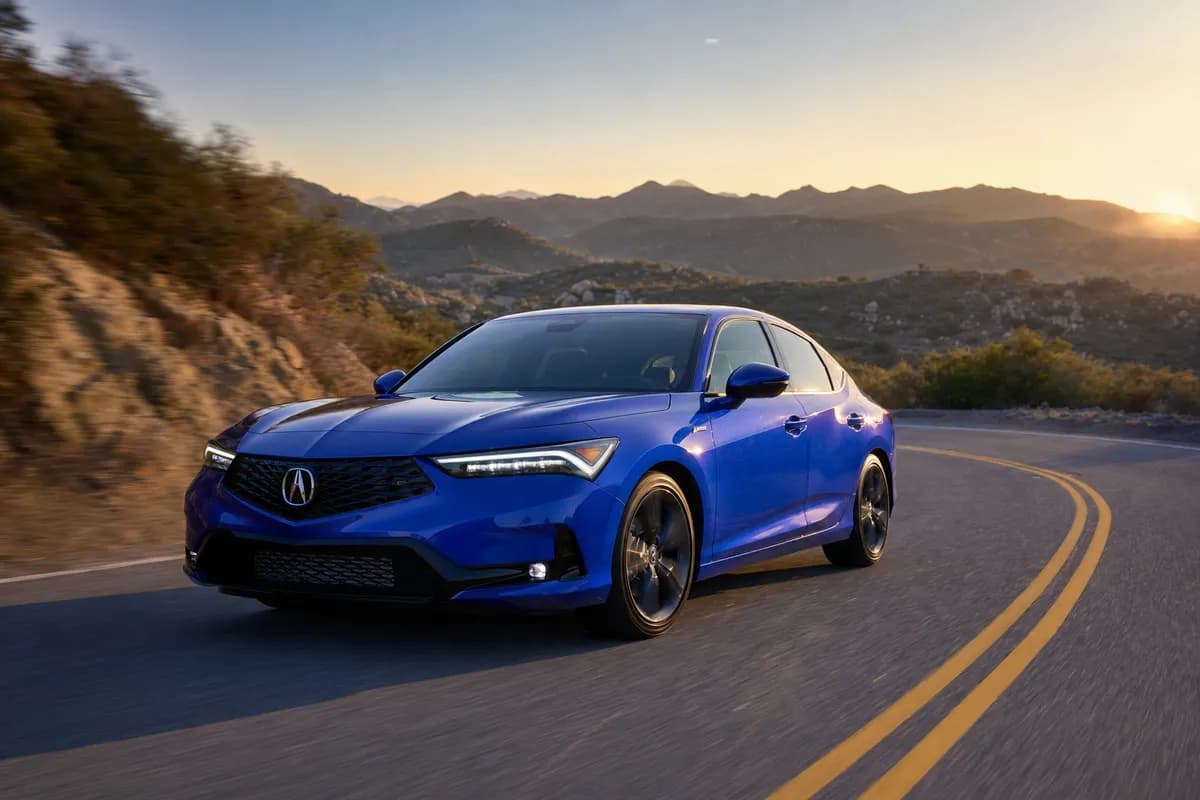
The Integra’s design deserves credit for not trying too hard. It has the long, low liftback silhouette Acura promised with the prototype, a crisp front end, frameless-feeling side glass, and just enough aggression in A-Spec trim to avoid looking like an HR department company car. It is not the wedge-shaped 1990s coupe that purists hallucinated into existence during the announcement cycle, but it looks better in person than in photos — especially in Liquid Carbon Metallic or Performance Red Pearl.
On the Road: Polished, Playful, and Just a Bit Too Well Behaved
The standard Integra A-Spec Tech with the six-speed manual is the sweet spot for anyone who wants a grown-up Civic Si without the boy-racer theater. The shifter is excellent: short, light, precise, and mechanical enough to remind you that Honda still knows how to build a manual gearbox better than almost anyone. The clutch is forgiving, the rev-matching system is slick, and the whole setup makes commuting feel like a small act of rebellion against the beige crossover apocalypse.
The 1.5-liter turbo is flexible and cheerful, with peak torque arriving early enough that you do not have to wring its neck everywhere. But let’s not pretend this engine is a spiritual successor to the screaming B18C. It makes useful midrange torque, not fireworks. Contemporary road tests put the manual Integra around the 7.0-second mark from 0-60 mph, which is perfectly adequate and also slower than a Mazda3 Turbo, Volkswagen GTI, or even a well-launched Hyundai Elantra N.
Where the Integra claws back respect is in the chassis. The steering is quick and accurate, body control is tidy, and the front end bites with more enthusiasm than most entry-luxury sedans can manage. Acura’s adaptive dampers, included with the Technology Package, give the car a broader personality than the Civic Si. Comfort mode softens the ride nicely for broken city pavement, while Sport tightens the body motions without turning the car into a dental instrument.
Still, the standard Integra is not as spicy as its name suggests. Push hard into a decreasing-radius corner and you find grip, balance, and competence — but not much drama. The Civic Si feels a little more raw. The Volkswagen GTI punches harder. The Hyundai Elantra N is louder, faster, and more unhinged, like a touring car that got loose in a suburban leasing office. The Integra, by contrast, wears loafers with its track jacket.
That is not necessarily a bad thing. Acura’s brief here was not to build a stripped-out weekend toy. It was to build a daily-driver sport compact with premium polish. On that score, the car works. Road noise is present but better controlled than in a Civic. The seats are supportive without being punishing. The driving position is excellent. Visibility is good. The liftback cargo area makes the sedan-shaped body far more useful than it looks.
The Type S Changes the Conversation
Then comes the 2024 Acura Integra Type S, and suddenly the whole car stops apologizing.
The Type S swaps the 1.5-liter engine for a 2.0-liter turbocharged inline-four related to the unit in the Honda Civic Type R. In Acura tune, it produces 320 horsepower and 310 lb-ft of torque, sent exclusively through a six-speed manual transmission and a helical limited-slip differential. No automatic. No fake performance trim. No “sport appearance package” nonsense. This is the real one.
It is also not cheap. With a sticker around the low-$50,000 range before options, the Integra Type S costs more than a Civic Type R and wades into dangerous waters occupied by the BMW M235i Gran Coupe, Audi S3, Mercedes-AMG CLA 35, and the Toyota GR Corolla Circuit Edition. Some of those have all-wheel drive. Some wear fancier badges. None feel quite like this.
Compared with the Civic Type R, the Integra Type S is slightly more powerful on paper — 320 hp versus 315 hp — but it is tuned for a broader, more premium feel. It has wider bodywork, a triple-outlet exhaust, big Brembo front brakes, adaptive dampers, and a ride that is more livable than the Honda’s track-rat stiffness. The Type R is the sharper tool. The Type S is the sharper tool that has learned table manners.
On a good road, the Type S is sensational. The 2.0-liter turbo pulls hard from the midrange and keeps charging with real intent. It does not have the old-school naturally aspirated scream that Integra mythology demands, but it has pace — proper, grown-up, license-endangering pace. Independent testing of the closely related Civic Type R has seen 0-60 mph times in the low five-second range, and the Integra Type S feels every bit that quick from the driver’s seat.
The manual gearbox is a joy. Acura’s shift action is among the best in any modern car under $100,000, and I am not adding that qualifier for drama. The throws are crisp, the gates are clean, and the automatic rev-match is so good you may leave it on even if you know how to heel-and-toe. The limited-slip differential does real work, letting you get back on throttle early without dissolving into one-tire nonsense.
Torque steer? Some, yes. This is a 320-hp front-drive car, not a physics exemption certificate. But the Type S manages its power brilliantly. The steering tugs and chatters under hard acceleration, but in a way that feels alive rather than unruly. It talks. It does not throw the phone at your face.
The standard Integra is a smart sport-luxury liftback. The Integra Type S is the car that finally earns the old badge without needing a history lecture to defend itself.
Interior, Tech, and Practicality: Premium Enough, Not Plush
Inside, the Integra walks the same line as the rest of the car: upscale, but not indulgent. The dashboard layout is familiar to anyone who has sat in the latest Civic, though Acura adds nicer materials, different trim, and a more premium presentation. The honeycomb-style vent treatment looks good, the switchgear feels solid, and the driving controls are exactly where they should be.
The Technology Package brings the goodies you want: a 9.0-inch touchscreen, wireless Apple CarPlay and Android Auto, a 16-speaker ELS Studio 3D audio system, wireless charging, a head-up display, and microsuede seat inserts. The ELS stereo is a genuine highlight — crisp, powerful, and far better than the “premium” systems some German brands charge extra for and then apparently tune inside a filing cabinet.
The front seats are comfortable and supportive, though the standard Integra could use a little more bolstering if you regularly drive like you are late for qualifying. The Type S seats do a better job holding you in place, though they still stop short of the serious buckets found in the Civic Type R. That is intentional. Acura wants daily usability, not track-day cosplay.
Rear-seat space is decent for the segment, with adult-friendly legroom but a sloping roofline that can crowd taller passengers. The liftback is the Integra’s secret weapon. Acura quotes 24.3 cubic feet of cargo space behind the rear seats, which trounces most compact luxury sedans and makes the car far more practical than an Audi A3 or Mercedes-Benz CLA. Fold the seats and you can haul bulky gear without surrendering to the crossover industrial complex.
Fuel economy is another advantage for the regular Integra. The CVT model is EPA-rated as high as 30 mpg city, 37 mpg highway, and 33 mpg combined, while the manual lands around 26 mpg city, 36 mpg highway, and 30 mpg combined. The Type S, as expected, drinks more: 21 mpg city, 28 mpg highway, and 24 mpg combined. That is the price of boost, Brembos, and bad decisions made in second gear.
How It Stacks Up Against Rivals
The 2024 Acura Integra lives in a weird but interesting corner of the market. It is not quite a traditional luxury sedan, not quite a hot hatch, and not quite a nostalgic reboot. That makes comparisons tricky — and revealing.
- Honda Civic Si: Cheaper, similarly powered, and a little more raw. The Integra counters with adaptive dampers, better tech, a hatchback body, and a more premium cabin. If money matters, buy the Si. If you want the nicer daily, buy the Acura.
- Volkswagen GTI: More torque, quicker acceleration, and true hatchback heritage. But the Integra’s manual gearbox is better, Acura’s reliability reputation is stronger, and the cabin tech is less infuriating than VW’s touch-sensitive circus.
- Mazda3 Turbo: Punchier with 250 hp and available all-wheel drive, but no manual with the turbo engine and less sharp when driven hard. The Mazda feels more luxurious; the Acura feels more alive.
- Audi A3: More premium badge, available Quattro, and a quieter cabin. Also less engaging, more expensive when optioned, and not available with a manual. The Audi is a very nice appliance. The Acura has a pulse.
- Honda Civic Type R: The benchmark for front-drive performance. It is sharper and cheaper than the Integra Type S, but also more juvenile in appearance and harsher day to day. The Type S is the one you can take to a client meeting without looking like you sell forged wheels out of your garage.
- Toyota GR Corolla: Wilder, all-wheel drive, and wonderfully ridiculous. It is also smaller, louder, and less refined. For all-weather hooliganism, take the Toyota. For daily-driver speed with polish, take the Acura.
The uncomfortable truth for Acura is that the standard Integra’s biggest rival is still the Honda Civic Si. The Acura is nicer, yes, but not massively quicker or more thrilling. The Type S has no such identity crisis. It feels distinct, special, and properly engineered for drivers who care about steering feel, shift quality, and corner-exit traction.
Verdict: The Icon Is Back — But Choose Carefully
The 2024 Acura Integra is not the stripped, screaming, featherweight coupe some purists wanted. That car exists mostly in memory now, parked next to affordable gasoline, cheap insurance, and CDs from bands that should not reunite. The modern Integra is something else: a premium compact liftback with Honda engineering, useful space, strong efficiency, and just enough driver engagement to stand apart from the usual entry-luxury wallpaper.
The standard Integra A-Spec with Technology Package and the six-speed manual is the one to buy if you want a refined, practical, fun daily driver. It is not a bargain-basement performance car, and it will not scare a GTI in a straight line, but it delivers a rare blend: manual gearbox, excellent tech, usable cargo room, and a chassis that still wants to play.
But the Integra Type S is the star. It is expensive, yes. It is not as track-focused as the Civic Type R, also yes. But it has the power, stance, sound, gearbox, and front-drive attitude to make the Integra badge feel alive again. It is fast without being crude, refined without being numb, and practical without being boring. That is a difficult trick, and Acura pulls it off.
Final call: Skip the CVT unless you simply want the badge and the fuel economy. Buy the manual A-Spec Tech if you want the sensible enthusiast’s Integra. Stretch to the Type S if you want the one people will remember. The Integra name deserved more than nostalgia. For 2024, Acura finally gives it some muscle.
Affiliate disclosure: This article contains affiliate links. RevvedUpCars may earn a small commission on qualifying purchases at no extra cost to you.