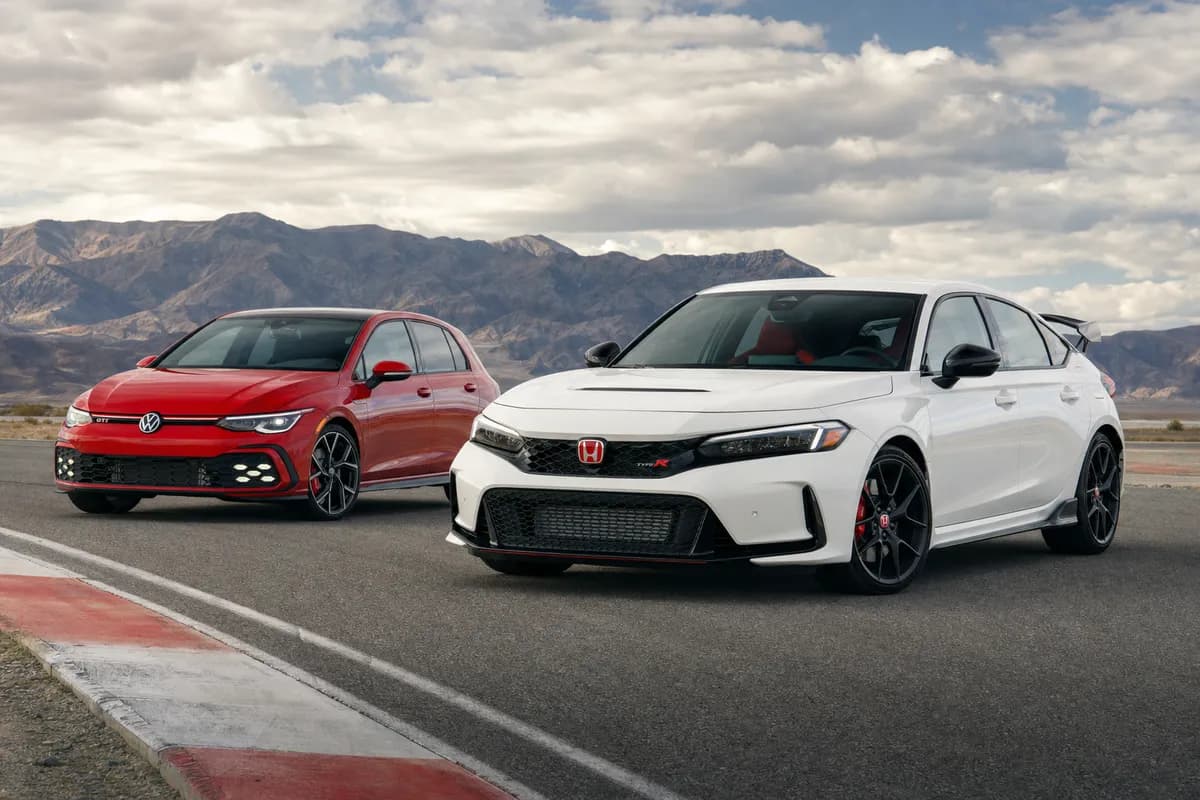
The 2025 Honda Civic Type R and 2025 Volkswagen Golf GTI are both “hot hatches” in the same way a chef’s knife and a Swiss Army knife are both blades. One is a focused instrument built to carve apexes until the tires beg for mercy.
The 2025 Honda Civic Type R and 2025 Volkswagen Golf GTI are both “hot hatches” in the same way a chef’s knife and a Swiss Army knife are both blades. One is a focused instrument built to carve apexes until the tires beg for mercy. The other is the clever everyday hero that makes speed feel easy, tidy, and socially acceptable. If you want the short version: the Civic Type R is the better driver’s car, full stop. The Golf GTI is the easier car to live with, the cheaper car to buy, and the one your spine may thank you for after a week of commuting. But this showdown is not about politeness. It’s about which hatch deserves your money in 2025.
The Combatants: Track Rat vs Daily Assassin
The 2025 Honda Civic Type R remains one of the last great front-drive performance cars with a manual transmission. Under its vented hood sits a 2.0-liter turbocharged four-cylinder making 315 horsepower and 310 lb-ft of torque, sent exclusively to the front wheels through a six-speed manual gearbox and a helical limited-slip differential. No automatic. No all-wheel-drive safety blanket. No fake rugged cosplay. Just boost, grip, and a gear lever that feels like it was machined by people who still care.
The 2025 Volkswagen Golf GTI takes a different approach. It uses a 2.0-liter turbocharged four-cylinder rated at 241 horsepower and 273 lb-ft of torque in U.S. specification, driving the front wheels through a seven-speed DSG dual-clutch automatic. The manual GTI is dead for 2025 in America, which is a sentence I type with the same enthusiasm as reading a parking ticket. Volkswagen has given the updated GTI a sharper infotainment setup, improved interior tech, and, mercifully, a return to more usable steering-wheel controls after the Mk8’s capacitive-touch nonsense tested everyone’s patience.
On paper, these cars are separated by more than horsepower. They’re separated by purpose. The Civic Type R is a homologation-adjacent lunatic hiding behind four doors and a hatch. The GTI is a premium compact with enough turbocharged punch to embarrass lazy V6 crossovers and enough refinement to make you forget it’s still a small Volkswagen.
- 2025 Honda Civic Type R: 315 hp, 310 lb-ft, 6-speed manual, front-wheel drive, limited-slip differential.
- 2025 Volkswagen Golf GTI: 241 hp, 273 lb-ft, 7-speed DSG, front-wheel drive, electronically controlled differential.
- Price gap: The GTI starts in the low-to-mid $30,000 range depending on trim, while the Civic Type R sits around the mid-$40,000 mark before dealer games begin.
- Core difference: Honda sells you a weapon. Volkswagen sells you a very fast appliance with excellent manners.
Performance: The Civic Type R Hits Harder and Talks Louder
Let’s get the obvious out of the way: the Civic Type R is quicker, angrier, and more capable when the road gets interesting. Independent testing has put the current FL5-generation Type R at roughly 4.9 to 5.3 seconds from 0-60 mph, depending on surface, launch, and driver sympathy for the clutch. The GTI DSG is no slug, usually landing around 5.1 to 5.6 seconds to 60 mph in comparable testing. That means the Volkswagen can nip at the Honda’s heels in a straight line, particularly because DSG shifts are faster than any human wrist. But numbers alone flatter the GTI.
The Honda’s advantage arrives the moment you ask more than “how fast to the next traffic light?” Its 265/30ZR19 Michelin Pilot Sport 4S tires, wider track, adaptive dampers, rigid chassis, Brembo front brakes, and limited-slip differential turn front-wheel drive into a legitimate performance philosophy rather than an accounting decision. The Type R digs into corners with spooky commitment. It resists understeer better than physics says it should. Trail the brake, load the nose, and it rotates with the disciplined menace of a touring car.
The GTI is quick, but it is not savage. Its standard tuning prioritizes smoothness, compliance, and accessibility. The DSG snaps through gears cleanly, and the EA888 turbo four delivers torque early, so the Volkswagen feels muscular in daily driving. It punches out of roundabouts, dives into gaps, and makes its driver look competent without demanding much. That’s the GTI trick. It flatters you.
The Civic Type R does not flatter. It challenges, then rewards. Its six-speed manual is one of the best in any production car under six figures, with short throws, a precise gate, and rev-matching that can be switched off if your heel-and-toe ego requires validation. The clutch is light but communicative, and the engine pulls hard to its upper rev range with a seriousness the GTI simply doesn’t match.
The GTI is fast enough to be fun. The Civic Type R is fast enough to make you reconsider your braking points, your tire budget, and several personal decisions.
Braking is another Honda win. The Type R’s hardware and pedal feel are built for repeated abuse. On a hard road, the GTI’s brakes are perfectly adequate. On a track, the Honda feels like it came prepared with a cooler full of data and a second set of pads. The Volkswagen starts asking whether we could maybe all calm down and go get coffee.
Handling and Feel: Honda Still Understands the Assignment
Modern performance cars often confuse speed with engagement. They add power, isolation, screens, drive modes, fake sound, and electronic wizardry until the driver becomes a lightly involved passenger. The Civic Type R avoids that trap better than nearly anything at its price. Steering feel is direct. The front axle is alive. The body control is exceptional. Even in Comfort mode, the car communicates constantly, though on broken pavement it can feel busy. In +R mode, the damping becomes firm enough to make potholes feel like personal insults.
The GTI is more relaxed. Its steering is accurate but less talkative. Its chassis balance is neat, safe, and adjustable at sane speeds, but it doesn’t have the Honda’s hunger. The Volkswagen’s electronically controlled front differential helps put power down cleanly, and the car resists torque steer better than you’d expect from a front-driver with 273 lb-ft. But the whole experience is filtered. Good filtering, mind you. German filtering. Like strong coffee poured through a cashmere sweater.
If you drive mostly in cities, suburbs, and highways, that polish matters. The GTI rides better, particularly on smaller wheels. It is quieter, more forgiving, and less likely to make passengers ask why your “family hatchback” has the suspension temperament of a race-prepped shopping cart. The Civic Type R can do daily duty, but it always feels like a car waiting for a better road. The GTI is happy with the road it has.
Still, when the road opens up, the Type R humiliates the GTI. Not in raw acceleration alone, but in confidence. You can brake later, carry more speed, and lean harder on the front end. Honda’s chassis tuning is not just good for a front-wheel-drive car; it is good, period. Against the GTI, the Type R feels like the car engineered by people who had a stopwatch on the desk. The Volkswagen feels like it was engineered by people who also had an ergonomics meeting afterward.
Interior, Tech, and Practicality: Volkswagen Fights Back
Here’s where the GTI lands its cleanest punches. The Golf remains one of the most sensibly packaged cars on sale. It is compact outside, useful inside, easy to park, and genuinely adult-friendly. Cargo space is strong for the footprint, with around 19.9 cubic feet behind the rear seats and more than 34 cubic feet with them folded, depending on configuration. Rear-seat space is good, visibility is tidy, and the hatch shape is properly practical.
The Civic Type R is based on the larger Civic hatchback, so it is hardly cramped. In fact, it offers excellent rear legroom and a generous cargo area of around 24.5 cubic feet behind the rear seats. But the Type R deletes the Civic’s middle rear seat, making it a four-seater. That may not matter to enthusiasts, but it matters if your life occasionally involves three kids, one airport run, or friends who do not understand why your car has red carpets and no fifth seatbelt.
Inside, the Honda is the more focused environment. The red sport seats are superb: supportive, low-mounted, and comfortable enough for long drives. The driving position is excellent, the metal shift knob feels special, and the instrument display provides useful performance data without turning the cabin into a gaming PC. The materials are good, not luxury-grade, and the whole cabin has a purposeful honesty.
The Volkswagen feels more premium in places, especially in upper trims. The 2025 update brings a larger central touchscreen, improved software, and better overall usability than the early Mk8 GTI, which occasionally felt like it had been designed by someone who hates buttons and joy. The GTI also offers features the Honda either lacks or makes less central: available ventilated front seats on higher trims, a more comfort-oriented cabin, a strong premium audio option, and a generally calmer highway personality.
But Volkswagen still leans too heavily on screen-based controls. Climate adjustments through a touchscreen or touch sliders remain less satisfying than proper knobs, and no amount of ambient lighting can convince me that burying common functions in menus is progress. Honda’s cabin is simpler and more intuitive. Volkswagen’s looks slicker in the showroom; Honda’s works better when you’re actually driving hard.
- Best seats: Civic Type R, easily. The Honda buckets are fantastic.
- Best infotainment polish: GTI, especially with the 2025 update.
- Best daily comfort: GTI.
- Best cargo usefulness: Civic Type R by volume, GTI by compact footprint and five-seat practicality.
- Best control layout: Honda, because buttons are not a moral failure.
Ownership Costs and Value: The GTI Makes the Spreadsheet Smile
The Volkswagen Golf GTI is the value play. It costs thousands less than the Civic Type R, comes with an automatic transmission that broadens its appeal, and delivers most of the real-world speed most drivers will ever use. In traffic, the DSG is a gift. In winter climates, fitting proper tires makes the GTI an easy year-round companion. It is also more discreet. Nobody assumes you are late for a track day when you arrive in a GTI.
The Honda is more expensive and, thanks to demand, often vulnerable to dealer markups or “market adjustment” nonsense. Paying over sticker for a Civic, even one this brilliant, is how enthusiasts end up needing financial counseling. That said, the Type R has historically held value extremely well. Limited supply, manual-only purity, and Honda’s reputation for durability all help. If you buy one properly, avoid modifications that look like they were chosen during a Monster Energy overdose, and keep it maintained, the Type R should remain desirable.
Fuel economy is close enough that it won’t decide the contest, though the GTI generally has the edge in relaxed use. Official figures vary by trim and testing cycle, but expect the GTI to be the thriftier commuter, while the Type R’s economy depends heavily on whether you can resist boost. You cannot. Don’t lie.
Maintenance and tire costs favor the GTI. The Civic’s wide 19-inch performance tires are not cheap, and if you drive it the way Honda intended, you will consume rubber and brake pads with enthusiasm. The GTI is easier on consumables and less intense overall. Insurance can also be friendlier, though that depends heavily on location, driving record, and whether your insurer knows what a Type R is.
Reliability? Honda has the stronger reputation, but Volkswagen’s EA888 engine and DSG are well-known quantities at this point. The key with the GTI is maintenance discipline. Skip services and it may punish your wallet with Germanic precision. Treat it properly and it’s a robust, polished machine.
Verdict: Buy the Type R for Your Soul, the GTI for Your Life
The 2025 Volkswagen Golf GTI is an outstanding everyday performance car. It is quick, refined, practical, and priced sensibly against the Civic Type R. It can commute Monday, handle Costco Tuesday, crush a back road Wednesday, and take your parents to dinner Thursday without anyone complaining about the ride. It is the smarter purchase for most people, especially now that its tech has improved and the DSG remains one of the best automatics in the business.
But “smarter” does not mean “better.”
The 2025 Honda Civic Type R is the sharper, more memorable, more thrilling machine. It has the better gearbox, better steering, better body control, better brakes, and far more serious performance hardware. It feels special every time you drive it, even at legal speeds. On the right road, it stops being transportation and becomes an event. The GTI is a brilliant hot hatch. The Type R is a benchmark.
If you want a fast daily driver that keeps costs reasonable and doesn’t turn every commute into a mini qualifying session, buy the Golf GTI. You’ll be happy, comfortable, and smugly practical. If you want the finest front-wheel-drive performance car on sale, buy the Civic Type R and accept that your ride quality, tire budget, and social subtlety will suffer slightly in the name of greatness.
Final call: The GTI wins as the everyday hot hatch. The Civic Type R wins the showdown. When the road gets good, the Honda doesn’t just beat the Volkswagen — it reminds you why hot hatches became legends in the first place.
Affiliate disclosure: This article contains affiliate links. RevvedUpCars may earn a small commission on qualifying purchases at no extra cost to you.