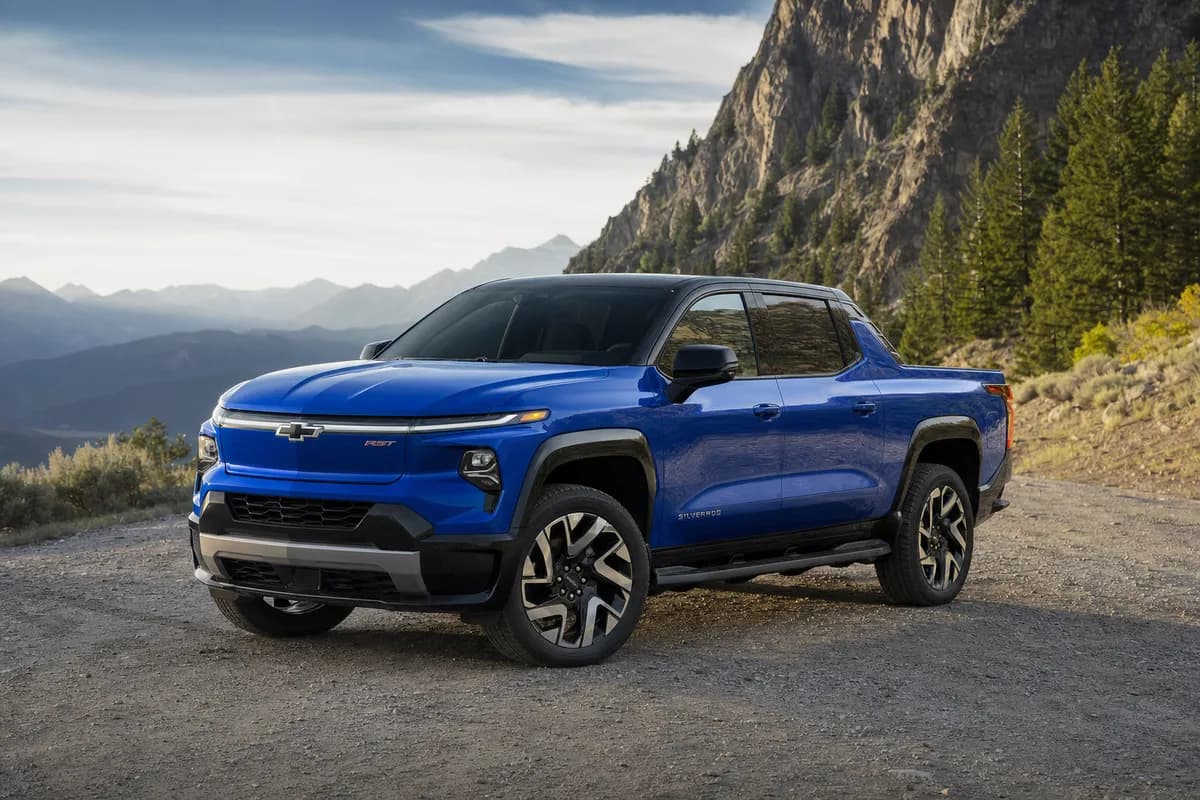
The 2025 Chevrolet Silverado EV does not tiptoe into the electric truck fight. It arrives like a piano dropped from a crane: huge battery, huge torque, huge price, and a driving experience that makes the old small-block-and-ladder-frame formula suddenly feel like it’s wearing…
The 2025 Chevrolet Silverado EV does not tiptoe into the electric truck fight. It arrives like a piano dropped from a crane: huge battery, huge torque, huge price, and a driving experience that makes the old small-block-and-ladder-frame formula suddenly feel like it’s wearing bifocals. After first impressions behind the wheel, the question is not whether Chevy has built a serious electric pickup. It has. The question is whether the Silverado EV is the truck that finally makes the Ford F-150 Lightning look undercooked, the Tesla Cybertruck look like a rolling tech demo, and gasoline Silverados look increasingly like the answer to yesterday’s problem.
What the 2025 Silverado EV Is — and Why It Matters
Let’s clear up the first point: the 2025 Chevrolet Silverado EV is not simply a Silverado 1500 with batteries shoved where the V8 used to live. It rides on GM’s Ultium EV architecture, shares more philosophical DNA with the GMC Hummer EV and Sierra EV than with a conventional Silverado, and uses a body-integrated structure rather than the traditional body-on-frame layout that truck buyers have been worshipping since dinosaurs were still premium fuel.
That matters because it gives Chevy room to do truck things differently. The Silverado EV has an independent rear suspension, available four-wheel steering, a front trunk, a flat-ish cabin floor, and the party trick Chevy fans have been waiting to see return: the Multi-Flex Midgate. Fold the rear wall and seats down, open the bed into the cabin, and the truck can carry items up to roughly 10 feet 10 inches long with the tailgate configured properly. That’s not a gimmick; that’s a surfboard, ladder, lumber, or weekend-project enabler.
For 2025, the lineup broadens beyond the initial high-dollar launch models. Chevrolet has positioned the Silverado EV in several flavors, including Work Truck, LT, and RST versions, with range varying by battery and trim. The headline number is the one that matters most: up to an estimated 492 miles of range in the Work Truck Max Range configuration. That is not just good for an electric pickup. That’s a haymaker.
- Estimated range: up to 492 miles, depending on trim and battery
- RST output: up to 754 horsepower and 785 lb-ft of torque in Wide Open Watts mode
- 0-60 mph: under 4.5 seconds for the RST in maximum-attack mode
- Max towing: up to 10,000 pounds on most consumer configurations
- DC fast charging: up to 350 kW capability, with roughly 100 miles added in about 10 minutes under ideal conditions
- Available features: four-wheel steering, adaptive air suspension, Super Cruise with trailering, Multi-Flex Midgate
The electric truck battlefield is no longer theoretical. The Ford F-150 Lightning has been on sale for years, the Rivian R1T is the enthusiast darling, the Tesla Cybertruck is the stainless-steel circus cannon, and the GMC Sierra EV is the Silverado’s posher cousin in a nicer suit. But the Silverado EV’s range advantage is the first stat that makes you sit up. Ford’s F-150 Lightning tops out around 320 miles. The Rivian R1T can stretch past 400 miles with the right pack. The Cybertruck AWD is rated around the low-to-mid 300-mile mark depending on configuration. Chevy showing up with nearly 500 miles is not subtle. It’s a flex.
On the Road: Shockingly Quick, Mostly Composed, Still Enormous
Electric trucks are absurd. There is no polite way around it. The 2025 Silverado EV RST can shove forward with up to 754 horsepower and 785 lb-ft of torque, and because electric motors do not need to clear their throats before making power, the thing lunges like a startled bison. The Wide Open Watts mode is classic GM theater: a slightly silly name attached to a deeply serious acceleration event.
Under full throttle, the Silverado EV does the electric-truck magic trick: it makes something massive feel briefly weightless. Chevy says the RST can run 0-60 mph in less than 4.5 seconds, and from the driver’s seat that feels entirely believable. It is not as deranged as a Tesla Cybertruck Cyberbeast or a quad-motor Rivian R1T, both of which can make your internal organs file complaints with HR, but it is more than quick enough to humiliate sports sedans and flatten on-ramps.
The more impressive bit is not the acceleration. It’s the composure. Traditional pickups bounce, shimmy, and do that charming unloaded-bed jitter over broken pavement. The Silverado EV’s independent rear suspension and heavy battery pack give it a low center of gravity and a settled ride that feels more premium SUV than jobsite mule. The adaptive air suspension on upper trims helps smooth the sharp stuff, though there’s no hiding the mass. This is a very large, very heavy truck, and physics still sends invoices.
Four-wheel steering is the feature that makes the Silverado EV feel smaller than it is. At low speeds, the rear wheels turn opposite the fronts to tighten the turning circle. In parking lots, it changes the truck from “bring a spotter and a prayer” to “surprisingly manageable.” At higher speeds, the rear wheels turn with the fronts for stability. The system does not make the Silverado EV nimble in the sports-car sense — let’s not drink the battery coolant — but it removes some of the intimidation factor.
Steering feel is accurate if not especially chatty. Brake feel, often the Achilles’ heel of heavy EVs, is acceptable, with regenerative braking doing much of the daily work. One-pedal driving is useful in traffic, and the blended brake system avoids the worst rubber-band weirdness that still plagues some electrified vehicles. Push hard on a back road and the Silverado EV reminds you it is not a Camaro with a bed. It leans, it weighs a ton — several, actually — and its tires are doing heroic labor. But driven like a fast luxury truck, not a canyon toy, it makes a strong case for itself.
Range, Charging, and the Part That Actually Changes the Game
Electric trucks live or die by range. Not touchscreen size. Not frunk capacity. Not whether the startup sound was composed by a DJ in a turtleneck. Range is the thing, because trucks tow, haul, idle, climb, freeze, roast, and get used by people who do not always have the luxury of planning their lives around a charger.
This is where the Silverado EV lands its best punch. The availability of a configuration rated up to an estimated 492 miles gives Chevy a psychological and practical advantage. Even if real-world mixed driving lands lower — and it will, because big tires, winter weather, highway speeds, and human impatience are undefeated — starting near 500 miles changes the conversation. A 70-mph road trip no longer feels like a charger-to-charger scavenger hunt. A long workday with tools, heat, and errands no longer requires range anxiety as a personality trait.
Towing is still the elephant in the trailer. Chevy rates the Silverado EV for up to 10,000 pounds of towing in key configurations, which puts it right in the neighborhood of the F-150 Lightning and below the 11,000-pound claims from Rivian R1T and Tesla Cybertruck. But the issue is not whether an electric truck can pull a trailer. Of course it can. Electric torque is glorious for towing. The issue is how far it can tow before the battery gauge starts falling like a bad stock pick.
Expect range to drop dramatically when towing a tall, heavy trailer at highway speeds. That is not a Silverado-specific flaw; it is an EV-truck reality. The F-150 Lightning suffers the same fate. So does the Rivian. So does the Cybertruck. Aerodynamics, not brand loyalty, writes the rules. The Silverado EV’s advantage is that it begins with a larger range cushion, and that cushion matters.
Charging capability is another win. With up to 350 kW DC fast-charging capacity, the Silverado EV can add roughly 100 miles of range in about 10 minutes in ideal conditions. The phrase “ideal conditions” is doing some work there, because charger reliability, temperature, battery state of charge, and network congestion all matter. Still, the hardware is strong. Compared with the F-150 Lightning’s lower peak charging rate, the Chevy feels more future-proof. Compared with Tesla’s Supercharger ecosystem, GM’s charging experience still depends heavily on access and execution, but the gap is closing as more manufacturers gain access to Tesla’s NACS network and public infrastructure improves.
The Silverado EV’s real breakthrough is not that it is electric. It’s that it has enough range to make being electric feel less like a compromise.
Cabin, Utility, and Daily Livability
Inside, the Silverado EV is a tale of two personalities. In RST form, it wants to be a luxury-tech flagship, with a large 17.7-inch infotainment screen, an 11-inch driver display, a clean dash layout, and enough digital real estate to make a laptop jealous. The interface is generally quick, the graphics are crisp, and the cabin feels far more modern than a regular Silverado 1500. That’s good, because at RST money, “nice for a truck” is not good enough anymore.
The driving position is commanding, visibility is decent for something this large, and storage is predictably abundant. The front trunk is useful, especially for charging cables, muddy gear, or groceries you’d rather not throw into the bed. The cabin floor benefits from the EV layout, and rear-seat space is generous. This is a comfortable family vehicle, not just a work machine with cupholders.
The Midgate remains the Silverado EV’s killer utility feature. Ford has the clever Mega Power Frunk in the Lightning, and it’s excellent. Rivian has the gear tunnel, which is brilliant. Tesla has stainless-steel weirdness and a vault-like bed. Chevy’s answer is flexibility. The ability to expand cargo length through the cabin makes the Silverado EV feel genuinely useful in a way that goes beyond spec-sheet bragging.
Super Cruise with trailering is another major asset. GM’s hands-free highway system remains one of the best driver-assist technologies on sale, and the ability to use it while towing is a meaningful advantage for long-distance haulers. No, it does not turn the Silverado EV into an autonomous truck, and anyone who treats it that way should be sentenced to a month driving a 1998 Cavalier with no air conditioning. But when used properly, it reduces fatigue and works with impressive smoothness on mapped highways.
There are annoyances. The Silverado EV is huge, and no amount of rear-wheel steering changes the fact that American parking spaces were not designed around rolling battery fortresses. The best versions are expensive. Some interior materials, depending on trim, still need to justify the price better. And like many modern GM products, the screen-heavy experience will irritate buyers who prefer physical controls for every function. Touchscreens are great until you’re bouncing down a rough road trying to stab the climate menu like you’re defusing a bomb.
Verdict: Game Changer, But Not for Everyone
So, is the 2025 Chevrolet Silverado EV a game changer in the truck market? Yes — with an asterisk big enough to tow.
It is a game changer because range has been the electric pickup’s biggest weakness, and Chevy attacks it harder than anyone else in the mainstream full-size segment. A Silverado EV with up to an estimated 492 miles of range makes the F-150 Lightning’s maximum range look modest. It makes the Cybertruck’s range claims feel less revolutionary than its bodywork. It makes the Rivian R1T look smaller, sportier, and cooler, but not necessarily more useful for traditional truck buyers who want maximum distance between plugs.
It is also a game changer because it feels like a proper rethink of the pickup. The ride is better than a conventional truck’s. The acceleration is hilarious. The Midgate is genuinely useful. The charging capability is strong. The tech, especially Super Cruise, is not window dressing. This is not an EV conversion wearing a Silverado badge. It is a fundamentally different truck.
But it is not a universal replacement for a gas or diesel pickup. If you tow heavy trailers long distances through rural areas with inconsistent charging, keep your Duramax or V8 for now. If you need a cheap work truck, the Silverado EV still has to prove it can be affordable at scale. If you live in an apartment with no reliable charging, congratulations, you have discovered the part of EV ownership the brochures whisper about.
The best Silverado EV is probably not the flashiest RST, though that’s the one that grabs headlines. The smarter buy may be a long-range Work Truck or LT, where the giant battery, useful bed, and core EV advantages matter more than 24-inch wheels and launch-mode theatrics. The RST is the showboat. The long-range WT is the one that could quietly change fleets, contractors, and high-mileage truck ownership.
Final call: the 2025 Chevrolet Silverado EV is the most convincing electric full-size pickup yet for buyers who value range, comfort, and real-world utility. It is expensive, heavy, and still subject to the towing-range penalty that haunts every electric truck. But judged as a first impression, it feels like Chevrolet stopped trying to defend the old truck playbook and wrote a new chapter instead. Ford should be nervous. Tesla should be paying attention. And gasoline trucks? They’re not dead — but the Silverado EV just made them look a little older.
Affiliate disclosure: This article contains affiliate links. RevvedUpCars may earn a small commission on qualifying purchases at no extra cost to you.