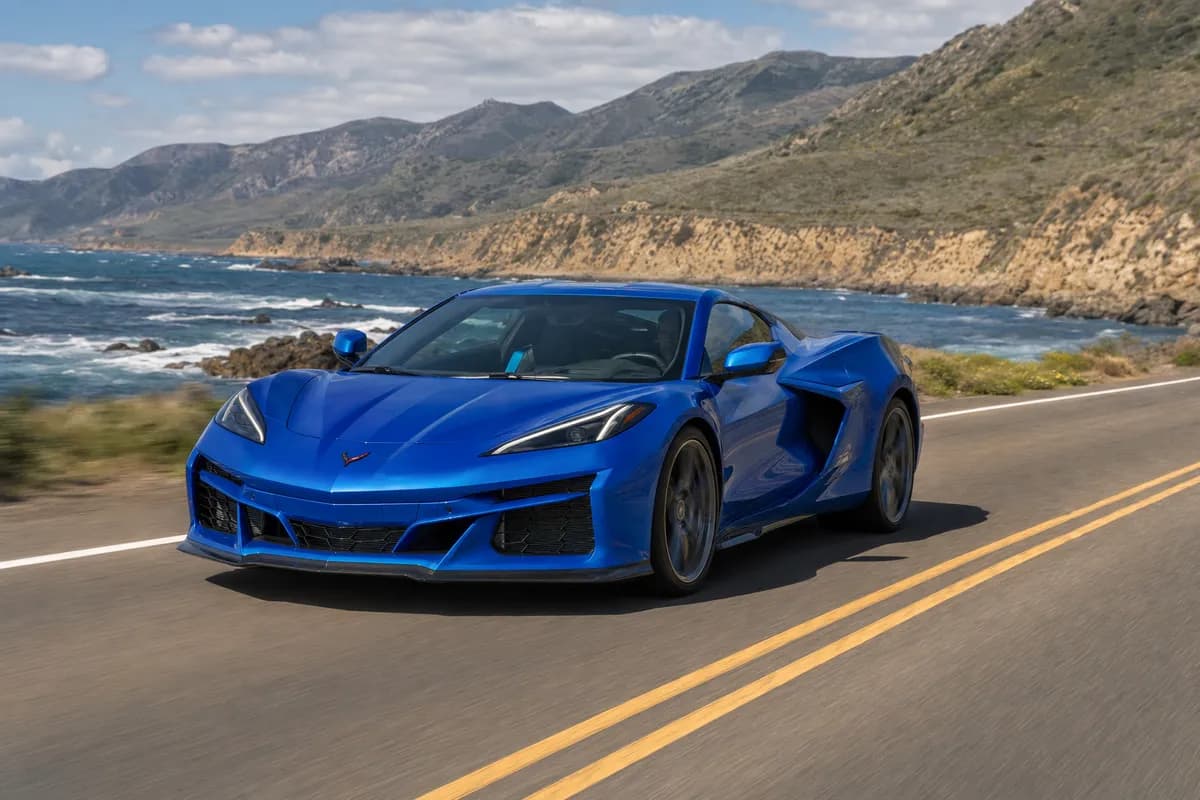
The 2024 Chevrolet Corvette E-Ray arrives with the kind of spec sheet that makes traditionalists clutch their crossed flags and mutter into their New Balance sneakers. A hybrid Corvette? All-wheel drive? Electric motors? Sacrilege, surely. Except it isn’t.
The 2024 Chevrolet Corvette E-Ray arrives with the kind of spec sheet that makes traditionalists clutch their crossed flags and mutter into their New Balance sneakers. A hybrid Corvette? All-wheel drive? Electric motors? Sacrilege, surely. Except it isn’t. The E-Ray is not some apologetic eco-Corvette built to sip electrons and flatter your neighbor’s compost bin. It is a 655-hp, wide-body, V8-powered traction weapon that uses electrification the right way: to make a fast car launch harder, corner nastier, and embarrass pricier metal with cold, clinical efficiency.
This is the first electrified production Corvette in history, but don’t confuse that with softness. The E-Ray sits between the standard Stingray and the shrieking Z06, borrowing the Stingray’s 6.2-liter LT2 V8, adding a front-axle electric motor, and wrapping the whole thing in the wide-body stance of the Z06. The result is a Corvette that does 0-60 mph in a claimed 2.5 seconds and runs the quarter-mile in 10.5 seconds at around 130 mph. That makes it the quickest production Corvette yet. Yes, quicker than the Z06. Let that ruin a few cars-and-coffee arguments.
A Hybrid, But Not the One You’re Thinking Of
The E-Ray’s hybrid system is beautifully simple in intent: more grip, more shove, more speed. There is no plug. There is no giant battery pack eating the trunk. There is no whispery mission statement about saving the planet while wearing recycled loafers. Instead, Chevrolet has fitted a 1.9-kWh lithium-ion battery pack in the center tunnel and an electric motor on the front axle. The rear wheels are driven by the familiar 6.2-liter naturally aspirated LT2 V8, producing 495 hp and 470 lb-ft of torque when equipped with the performance exhaust. The front motor adds 160 hp and 125 lb-ft, bringing total system output to 655 hp.
That front motor is the headline, but the real trick is how it changes the Corvette’s character. The C8 Stingray is already brutally quick for the money, with a 0-60 mph time around 2.9 seconds when fitted with the Z51 package. The Z06 is the glorious lunatic, using a 5.5-liter flat-plane-crank V8 that screams to 8,600 rpm and makes 670 hp. The E-Ray is different. It does not chase the Z06’s operatic top-end violence. It punches the road in the throat from the first inch of movement.
Because the electric motor drives the front axle, the E-Ray becomes the first all-wheel-drive Corvette. And unlike some AWD systems that feel like committee decisions translated into driveline hardware, this one is there to solve one problem: traction. The electric front axle fills in torque while the V8 hammers the rear tires, giving the E-Ray the kind of all-weather launch capability that makes rear-drive supercars look like they’re still checking their mirrors.
There is also a Stealth Mode, allowing the E-Ray to move on electric power at speeds up to 45 mph for short distances. Fine. That’s useful for leaving the neighborhood without waking every dog and HOA vice-president within a quarter mile. But let’s not pretend this is why anyone buys the thing. Stealth Mode is a parlor trick. The real magic is what happens when the V8 and electric motor stop being polite and start bullying physics.
Performance: The Numbers Are Not Subtle
Chevrolet claims the 2024 Corvette E-Ray coupe can hit 60 mph in 2.5 seconds and run the quarter-mile in 10.5 seconds. For context, a Porsche 911 Carrera 4 GTS with PDK makes 473 hp and reaches 60 mph in roughly 3.1 seconds. A 911 Turbo S is quicker still, but it starts deep into six-figure territory, and once you add Porsche options with their usual “would you like paint with that?” pricing philosophy, the numbers get silly fast.
The Acura NSX Type S, another hybrid all-wheel-drive mid-engine sports car, made 600 hp and ran 0-60 mph in about 2.9 seconds. The McLaren Artura brings a twin-turbo V6 hybrid setup with 671 hp and exotic badge appeal, but it costs far more and carries the sort of ownership uncertainty that makes extended warranties feel less like an option and more like adult supervision. The Corvette E-Ray is playing in that technical sandbox while wearing a Chevrolet badge and asking for roughly half the money of some European alternatives.
The E-Ray starts at about $104,000 for the coupe and around $111,000 for the convertible, before options. That is not cheap. Anyone still calling the Corvette a bargain basement sports car has not priced a modern performance car since flip phones were aspirational. But compared with the machinery it can hassle, the E-Ray remains a value missile. A base Stingray starts far lower, around the $70,000 mark, while the Z06 climbs beyond $110,000 before the really tempting boxes get checked. The E-Ray lands in the sweet spot for buyers who want absurd acceleration without committing to the Z06’s high-revving, track-hungry personality.
And yes, the E-Ray is heavier. Chevrolet lists the coupe at roughly 3,774 pounds, which is several hundred pounds above a Stingray and noticeably heavier than the Z06. Weight is the tax you pay for the battery, motor, electronics, and front driveline. But the E-Ray spends that weight wisely. It doesn’t feel like ballast; it feels like ammunition. The front motor helps rotate and stabilize the car, while the extra traction lets you use more of the V8 more often. That matters on real roads, where pavement is imperfect, weather exists, and most drivers are not qualifying for Le Mans between grocery runs.
Chassis, Tires, and the Wide-Body Advantage
The E-Ray wears the wider bodywork associated with the Z06, stretching about 3.6 inches wider than the standard Stingray. That isn’t cosmetic gymwear. The wider track allows more tire, more stance, and more authority. The car runs 20-inch front and 21-inch rear wheels, with massive rubber underneath. Michelin Pilot Sport all-season tires are standard, which sounds odd until you remember that this is the all-weather Corvette. Optional Michelin Pilot Sport 4S summer tires are available for those who live somewhere warm or simply enjoy treating rear tread like a consumable fluid.
Standard carbon-ceramic brakes are another clue that Chevrolet is not phoning this in. Big power is easy. Controlling it lap after lap is where pretenders melt. The E-Ray also gets Magnetic Ride Control 4.0 as standard equipment, and GM’s magnetorheological dampers remain one of the industry’s great pieces of suspension witchcraft. In Tour mode, the Corvette can be civilized enough for a highway slog. In more aggressive settings, it tightens its belt and starts acting like the mid-engine supercar it technically is.
The E-Ray’s cleverness is that it broadens the Corvette’s performance envelope without neutering it. A rear-drive Stingray is already approachable, but it can still become traction-limited when the weather turns or the road surface gets greasy. The Z06 is magnificent, but it demands more from the driver and gives its best when you’re stretching that flat-plane V8 toward the sky. The E-Ray is more immediate. More point-and-fire. More usable, more of the time.
Is it as emotionally explosive as the Z06? No. The Z06’s LT6 engine is one of the greatest production V8s ever fitted to a road car. It sounds like a Ferrari got angry in Kentucky. The E-Ray’s LT2 is deeper, brawnier, and less theatrical. It growls rather than shrieks. If your soul is tuned to rpm and mechanical drama, the Z06 is still the Corvette that will make your ribs vibrate. But if you care about putting power down in the real world, the E-Ray is the sharper weapon.
Interior and Daily Use: Still a C8, For Better and Worse
Inside, the E-Ray is familiar C8 Corvette territory. That means a low-slung driving position, a cockpit wrapped around the driver, a squared-off steering wheel, and that long row of climate-control buttons dividing driver from passenger like a plastic Berlin Wall. Some people hate it. I’ve never minded it. It’s odd, sure, but at least Chevrolet tried something more interesting than another tablet glued to the dashboard like an afterthought.
Material quality is trim-dependent. The 1LZ is serviceable, the 2LZ adds the features most people will want, and the 3LZ brings nicer leather and more visual theater. You still get a surprisingly usable front trunk and rear cargo area, though the E-Ray’s hardware packaging slightly changes the usual Corvette practicality equation. Still, compared with many mid-engine rivals, this remains a car you can actually use without developing a personal relationship with your chiropractor.
Fuel economy is not the main event, but the E-Ray is more sensible than the Z06 at the pump. EPA figures sit around 16 mpg city, 24 mpg highway, and 19 mpg combined, similar to the Stingray and notably better than the thirstier Z06. That’s because this is a performance hybrid, not an economy hybrid. If you buy a 655-hp Corvette and then complain it doesn’t behave like a Prius, the problem is located somewhere between the seat and the steering wheel.
The biggest daily-use win is confidence. All-wheel drive changes the Corvette’s usability in cooler weather and imperfect conditions. It does not turn the E-Ray into a Subaru Outback with a better gym routine, but it does make the car feel less seasonal. For buyers in climates where a rear-drive sports car becomes driveway jewelry for months, this matters. The standard all-season tires reinforce the point: Chevrolet wants the E-Ray to be the Corvette you drive when the forecast is not written by a Californian.
Verdict: The Smart Corvette, Not the Soft One
The 2024 Chevrolet Corvette E-Ray is not a betrayal of the Corvette formula. It is the formula evolving with a very large hammer. It keeps the naturally aspirated V8, adds electric torque where it helps most, and uses all-wheel drive not as a safety blanket but as a launch catapult. It is heavier than a Stingray, less spine-tingling than a Z06, and not as exotic as a Ferrari 296 GTB or McLaren Artura. It is also quicker to 60 mph than every production Corvette before it and dramatically cheaper than most cars that can match its pace.
The E-Ray is the Corvette for the buyer who wants savage speed without the Z06’s track-day intensity. It is for the driver who wants to use 655 hp on a cold morning without performing a one-person ice ballet into a mailbox. It is for the person who understands that electrification does not have to mean sanitization. Sometimes it means torque, traction, and humiliation for anything lined up in the next lane.
Verdict: The 2024 Corvette E-Ray is absolutely a hybrid powerhouse, but not in the smug, silent, virtue-signaling sense. It is a brutally effective performance hybrid that makes the Corvette quicker, more usable, and more modern without ripping out its V8 heart. If the Z06 is the one you buy for the noise, the E-Ray is the one you buy to win.
Would I take it over a Stingray? If the budget allows, yes. The standard C8 remains one of the great performance buys of the century, but the E-Ray’s all-weather traction and extra thrust make it feel like the more complete road car. Would I take it over a Z06? That depends. For track rats and engine romantics, no. The Z06 is still the masterpiece. But for real-world speed, daily usability, and devastating point-to-point pace, the E-Ray might be the best Corvette you can actually live with.
That’s the twist. The first hybrid Corvette is not the cautious one. It’s the clever brute.
Affiliate disclosure: This article contains affiliate links. RevvedUpCars may earn a small commission on qualifying purchases at no extra cost to you.