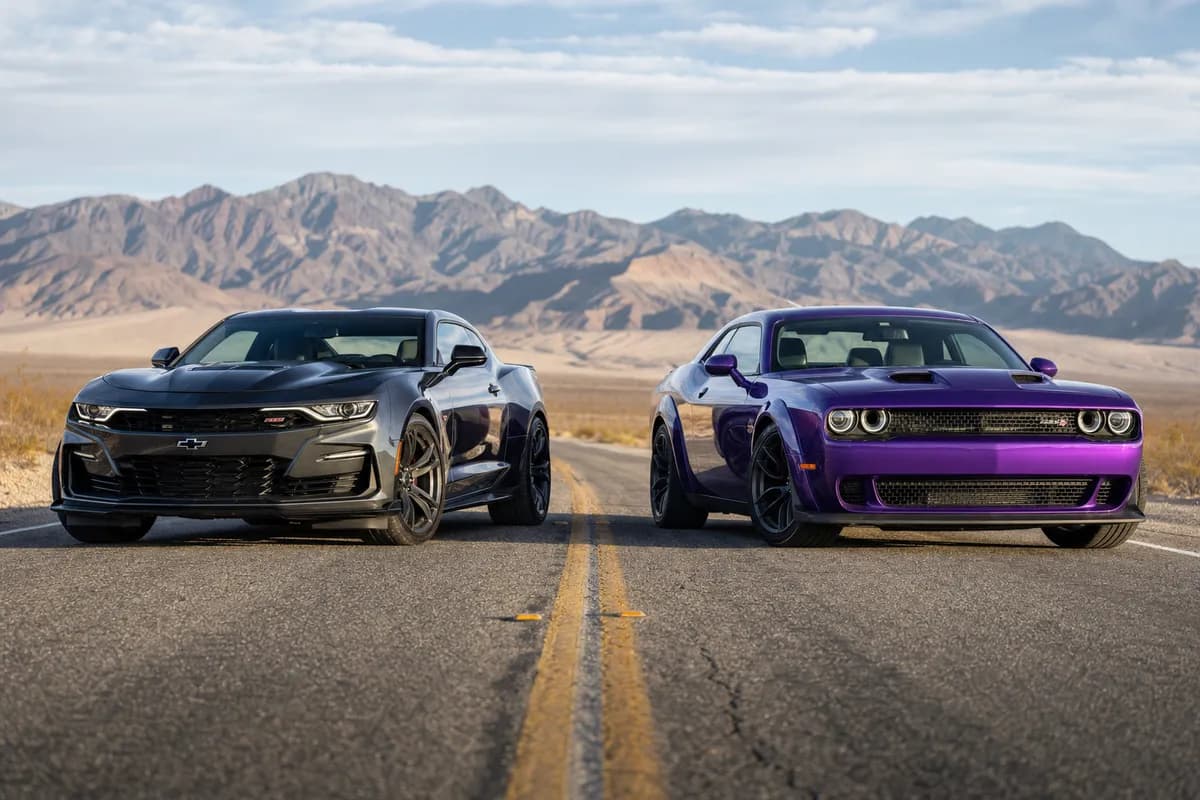
The “2025 Chevrolet Camaro SS vs Dodge Challenger R/T” fight comes with one awkward truth: neither of these V8 brutes is actually being built as a 2025 model-year car.
The “2025 Chevrolet Camaro SS vs Dodge Challenger R/T” fight comes with one awkward truth: neither of these V8 brutes is actually being built as a 2025 model-year car. Chevrolet ended sixth-generation Camaro production in January 2024, and Dodge closed the book on the gasoline Challenger after 2023. But in the real world, where dealer lots, low-mileage leftovers, certified pre-owned cars, and emotionally unstable auction bids all exist, this is still a live battle for anyone shopping classic American muscle in 2025.
And what a battle it is. The Camaro SS is the athlete: lighter, sharper, angrier, and genuinely capable on a road course. The Challenger R/T is the brawler: heavier, roomier, louder in spirit, and built like it learned vehicle dynamics from a bar fight. Both serve up naturally aspirated V8 theatre in an era increasingly ruled by turbo fours, hybrid torque-fill, and silent EV launches. But if you are buying one to actually drive hard, not just park outside a diner while wearing a faded Mopar jacket, the differences are massive.
Short verdict: The Camaro SS is the better performance car by a country mile. The Challenger R/T is the better everyday muscle cruiser. If you want lap times, steering feel, and a chassis that knows where an apex is, buy the Chevy. If you want presence, comfort, and old-school V8 swagger with usable back seats, buy the Dodge.
Powertrains: 6.2-Liter Precision vs 5.7-Liter Thunder
The 2024 Chevrolet Camaro SS, the last of the breed, uses GM’s 6.2-liter LT1 V8. It makes 455 horsepower and 455 lb-ft of torque, and it can be paired with either a Tremec 6-speed manual or a 10-speed automatic. This is basically Corvette-adjacent firepower in a smaller, cheaper, more rebellious wrapper. It revs cleanly, pulls hard from the middle, and sounds like it gargles race fuel for breakfast.
The Dodge Challenger R/T uses the 5.7-liter HEMI V8. With the 6-speed manual, it makes 375 horsepower and 410 lb-ft of torque. With the 8-speed automatic, output drops slightly to 372 horsepower and 400 lb-ft. That is still proper V8 muscle, but let’s not pretend it is playing in the same league as the Camaro SS. The Chevy has an 80-horsepower advantage, less mass to haul around, and a much more focused power delivery.
In straight-line testing, the difference is not subtle. A Camaro SS with the 10-speed automatic can hit 0-60 mph in roughly 4.0 seconds and run the quarter-mile in the low-12-second range, around 12.3 seconds at 115-116 mph depending on conditions and tires. The manual is a tick slower but more involving, typically landing in the low-to-mid 4-second range to 60 mph.
The Challenger R/T, meanwhile, generally runs 0-60 mph in about 5.0 to 5.3 seconds and covers the quarter-mile in the mid-13s. That is quick enough to embarrass plenty of crossovers and lightly tuned German sedans, but against the Camaro SS it feels like bringing a cast-iron skillet to a fencing match.
- Chevrolet Camaro SS: 6.2-liter LT1 V8, 455 hp, 455 lb-ft, 6-speed manual or 10-speed automatic
- Dodge Challenger R/T: 5.7-liter HEMI V8, 372-375 hp, 400-410 lb-ft, 6-speed manual or 8-speed automatic
- Performance edge: Camaro SS, decisively
The Dodge’s 8-speed automatic is excellent, and the manual has a charmingly mechanical feel. But the Camaro’s 10-speed is quicker and smarter when driven hard, while the Tremec manual in the SS is one of the best muscle-car gearboxes ever fitted to a production car. Crisp, tough, and satisfying, it makes the Challenger’s manual feel a little more truckish by comparison.
Handling and Driving Feel: Camaro Goes Hunting, Challenger Goes Cruising
This is where the fight stops being close. The Camaro SS is not just a muscle car; it is a legitimate sports coupe with a big V8 stuffed under the hood. Its Alpha platform is superb, shared in spirit with Cadillac’s better sport sedans, and it gives the Camaro a level of body control and steering precision the Challenger simply cannot match.
The Camaro SS weighs roughly 3,685 to 3,760 pounds depending on transmission and trim. The Challenger R/T is closer to 4,150 to 4,250 pounds. That is not a small gap. That is like asking the Dodge to carry around a full-size refrigerator while the Camaro shows up in track shoes.
On a winding road, the Camaro turns in with confidence. The front end bites, the rear follows obediently, and the car feels compact once you trust it. Add the optional Magnetic Ride Control, available on higher-spec SS models and performance packages, and the Camaro gains a brilliant dual personality: supple enough for the commute, taut enough to attack a back road without wobbling like a shopping cart with a bad wheel.
The Challenger R/T is different. It is built on an older LX-derived platform with roots stretching back to the Mercedes-influenced era of DaimlerChrysler. That sounds like ancient history because, frankly, it is. The car is stable, comfortable, and wonderfully composed on the highway, but it never shrinks around you the way the Camaro does. You steer the Challenger. You wear the Camaro.
Push the Dodge hard and you feel its mass immediately. It leans more, takes longer to settle, and needs earlier braking. It is not incompetent, but it is happier doing smoky exits from wide intersections than clipping apexes with surgical precision. The Camaro, especially with the 1LE package, is one of the few pony cars that can bully European machinery on a track day without needing a paragraph of excuses.
- Best steering: Camaro SS
- Best chassis balance: Camaro SS
- Best ride comfort: Challenger R/T
- Best highway stability: Challenger R/T
- Best track-day foundation: Camaro SS, especially SS 1LE
If your idea of driving pleasure is hammering across an empty desert highway with the V8 humming and the cabin calm, the Challenger makes a strong case. If your idea of driving pleasure involves braking late, rotating the car on throttle, and feeling the steering load up through your palms, the Camaro runs away with it.
Interior, Practicality, and Daily Use: Dodge Actually Lets Humans Inside
The Camaro’s cabin is a contradiction. The driving position is excellent, the wheel feels great, and the controls are sensibly arranged. But visibility? Comically bad. The beltline is high, the roof is low, and the rear three-quarter view is more rumor than reality. Reversing a Camaro SS into a tight parking space feels like docking a submarine through a keyhole.
The Challenger, by contrast, is vast. It feels like a muscle coupe designed by people who have met adult passengers. The front seats are wide, the cabin is airy by comparison, and the rear seats are genuinely usable. Not “technically survivable for children and gymnasts” usable, but actual adults-can-sit-back-there usable.
Trunk space tells the same story. The Camaro coupe offers about 9.1 cubic feet of cargo room, and the opening is awkward. The Challenger gives you around 16.2 cubic feet, which is enormous for a two-door coupe. Road trip? Dodge. Airport run? Dodge. Weekend away with two bags and a partner who refuses to pack like a minimalist monk? Dodge again.
Technology is a mixed bag. Chevrolet’s infotainment system is simple, responsive, and easy to use, with Apple CarPlay and Android Auto widely available. Dodge’s Uconnect system is also one of the better legacy infotainment setups, with clear menus and quick responses. Neither interior feels cutting-edge in 2025 next to a new Ford Mustang GT or a modern EV cockpit, but both are straightforward, and frankly that is a relief. Not every climate control function needs to live inside a touchscreen like a trapped ghost.
Material quality? Fine, not fancy. The Camaro has a cockpit-like feel but plenty of hard plastics. The Challenger has more space and a more relaxed layout, but the design is old enough to remember when “Bluetooth” sounded futuristic. The Chevy feels sportier; the Dodge feels more comfortable. Pick your poison.
- Best driving position: Camaro SS
- Best visibility: Challenger R/T
- Best rear seats: Challenger R/T
- Best trunk: Challenger R/T
- Best infotainment simplicity: Tie
As a daily driver, the Challenger is easier to live with. It rides better, stores more, carries more people, and does not require faith-based lane changes. The Camaro can absolutely be daily driven, but you need to accept its cave-like sightlines and compromised packaging. It is a sports car wearing muscle-car clothes; practicality was invited late and given a folding chair.
Cost, Fuel Economy, and Ownership: The Market Has Opinions
Because neither car is truly a 2025 production model, pricing depends heavily on mileage, condition, specification, and how shameless the seller feels. Late-model Camaro SS coupes commonly trade in the mid-$40,000 to low-$50,000 range for desirable trims and low mileage, with SS 1LE cars often commanding a premium. Dodge Challenger R/T models tend to be a little more affordable, often sitting in the high-$30,000 to mid-$40,000 range, though special “Last Call” cars and unusual specs can push higher.
When new, the Camaro SS and Challenger R/T were similarly priced, but the performance-per-dollar math favored the Chevy. The Camaro SS gave you 455 horsepower and a sophisticated chassis for money that barely got you into the Challenger’s mid-level V8 lineup. To match or beat the Camaro SS on power, Dodge shoppers really needed to step up to the Challenger R/T Scat Pack with the 6.4-liter 392 HEMI making 485 horsepower. That car is a better Camaro SS rival than the 5.7 R/T, but it costs more and still carries the Challenger’s extra mass.
Fuel economy is predictably not Prius-adjacent. The Camaro SS is rated around 16 mpg city and 24-26 mpg highway depending on transmission. The Challenger R/T lands roughly around 15-16 mpg city and 23-25 mpg highway. In real life, both will drink enthusiastically if you use the throttle as intended. Premium fuel is recommended or required depending on configuration and driving style, and rear tires should be considered a consumable item if you have even a trace of immaturity. Which, if you are buying one of these, you do.
Reliability is generally decent for both. The LT1 V8 is proven, stout, and widely supported. The 5.7 HEMI is also well-known and durable when maintained properly. The Dodge’s older platform means parts availability is strong, and the mechanical simplicity is part of the charm. The Camaro’s performance hardware is more sophisticated, especially with Magnetic Ride Control and track-focused packages, so inspections matter. On either car, look for signs of abuse: uneven tire wear, cooked brakes, sketchy modifications, and owners who describe clutch dumps as “spirited driving.”
Insurance can be spicy, especially for younger drivers. These are V8 coupes with reputations, and insurers have seen enough Cars and Coffee exit videos to price accordingly. Budget for tires, brakes, fuel, and the occasional neighbor complaint.
Verdict: Buy the Camaro SS Unless You Need the Challenger’s Space and Swagger
The 2025 Chevrolet Camaro SS vs Dodge Challenger R/T battle is really a philosophical argument with tire smoke. The Camaro SS is the sharper tool, the faster car, and the more rewarding machine when the road gets interesting. It accelerates harder, brakes better, corners flatter, and communicates more clearly. It is not just better than the Challenger R/T dynamically; it is in a different class.
The Challenger R/T fights back with charm. It has the look, the comfort, the trunk, the usable rear seat, and that laid-back HEMI rumble that makes every gas station arrival feel slightly cinematic. It is the better road-trip muscle car and the easier daily companion. It also has a more authentic old-school vibe, mostly because it drives like a big old-school coupe with modern safety gear and cupholders.
But if we are picking a winner, there is no need to perform journalistic yoga. The Chevrolet Camaro SS wins. It is quicker, more capable, more engaging, and far more special from behind the wheel. The Dodge Challenger R/T is lovable, but the Camaro SS is formidable.
Final call: Buy the Camaro SS if you care about performance, handling, and driver involvement. Buy the Challenger R/T if you want space, comfort, and classic boulevard menace. If your heart says Dodge but your right foot wants violence, skip the R/T and find a Scat Pack. Otherwise, the Camaro SS is the muscle car that actually muscles its way around corners.
Affiliate disclosure: This article contains affiliate links. RevvedUpCars may earn a small commission on qualifying purchases at no extra cost to you.