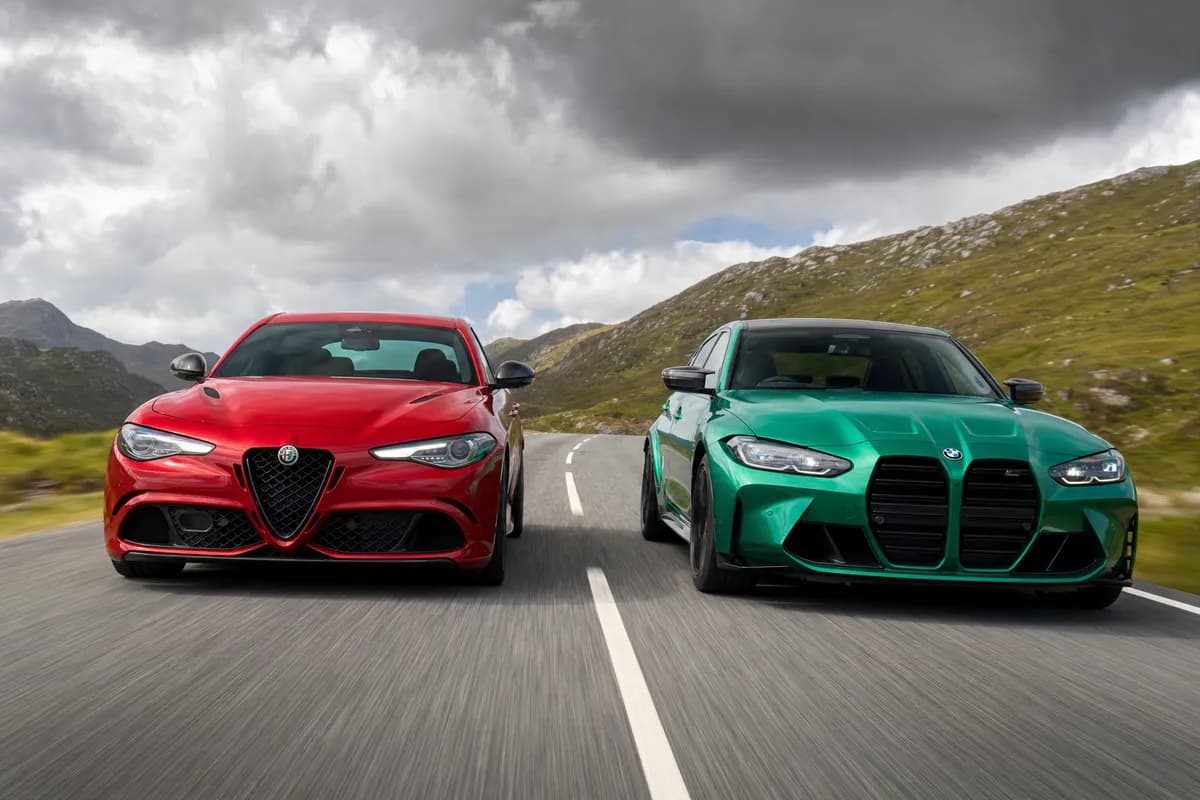
The BMW M3 is the safe answer. The Alfa Romeo Giulia Quadrifoglio is the dangerous one. That has been the shape of this rivalry since Alfa lobbed a 505-hp grenade into the sports-sedan class and reminded Munich that steering feel is not a spreadsheet function.
The BMW M3 offers more choice, because BMW knows exactly how to slice the enthusiast market into profitable little pieces. The 2025 M3 lineup uses the S58 3.0-liter twin-turbo inline-six in three main flavors:
- 2025 BMW M3 manual: 473 hp, 406 lb-ft, rear-wheel drive, six-speed manual
- 2025 BMW M3 Competition: 503 hp, 479 lb-ft, rear-wheel drive, eight-speed automatic
- 2025 BMW M3 Competition xDrive: 523 hp, 479 lb-ft, all-wheel drive, eight-speed automatic
On paper, the Alfa and M3 Competition are close. In practice, the BMW is the drag-strip bully. The M3 Competition xDrive launches like it has personally offended physics, hitting 60 mph in roughly 3.4 seconds by BMW’s own conservative claim, and often quicker in independent testing. The Giulia Quadrifoglio is no slouch at around 3.8 seconds to 60 mph, with a top speed of about 191 mph, but it cannot match the M3 xDrive’s traction-assisted violence off the line.
But numbers are only half the story. The BMW’s S58 engine is a masterpiece of boost management and repeatable performance. It pulls hard, clean, and relentlessly, like a machine calibrated by engineers who drink espresso from titanium beakers. The Alfa’s V6 is more theatrical. It barks, surges, and snarls in a way the BMW simply doesn’t. It feels less like an appliance for speed and more like a living thing with an anger-management issue.
Powertrain verdict: The BMW is faster and more flexible. The Alfa is more exciting. If you live by lap timers and launch control, M3. If you buy cars with your pulse, Quadrifoglio.
Chassis and Handling: The Alfa Still Has the Magic
This is where the Giulia Quadrifoglio continues to embarrass newer, cleverer, heavier machinery. Alfa got the fundamentals right: rear-wheel drive, quick steering, a carbon-fiber driveshaft, adaptive dampers, a clever limited-slip rear differential, and a curb weight generally around the high-3,700 to low-3,800-pound range depending on specification. It feels light on its feet because, by modern performance-sedan standards, it is.
The steering is the headline act. The Giulia’s rack is hyper-quick and alive, almost nervous at first if you’re coming out of something more sedated. But once you calibrate your hands, the Alfa becomes deliciously precise. It dives into corners with a kind of front-end bite that makes most rivals feel like they’re asking permission from a committee.
The BMW M3, meanwhile, is heavier and more serious. Depending on configuration, it sits around the upper-3,800 to roughly 4,000-pound mark, with xDrive versions carrying additional weight. You feel that mass, but you also feel BMW’s astonishing control over it. The M3 has tremendous front-end grip, monstrous traction, and a chassis that can be adjusted from tidy and neutral to properly lairy if you know what you’re doing. The xDrive system even has a rear-drive mode, because BMW understands that some of us are still children with insurance policies.
On a fast road, the Alfa is the sweeter dance partner. It breathes with the surface, rotates eagerly, and communicates more through the wheel and seat. The M3 is more planted, more adjustable at high speed, and more confidence-inspiring in poor conditions. It is not numb — that criticism is lazy — but it is filtered compared with the Alfa. The BMW gives you grip. The Alfa gives you gossip.
On track, the picture changes. The M3 Competition xDrive is brutally effective. It puts power down earlier, brakes repeatedly with impressive stability, and its cooling systems are built for abuse. The Alfa is fast and vivid, but it feels a little more old-school: brilliant when everything is flowing, less idiot-proof when you start overdriving it. That is either a flaw or the whole point, depending on whether you think talent should still matter.
- Best steering: Alfa Romeo Giulia Quadrifoglio
- Best traction: BMW M3 Competition xDrive
- Best road feel: Alfa Romeo Giulia Quadrifoglio
- Best track consistency: BMW M3
- Best drift-tool energy: Tie, but the BMW gives you more settings to misbehave with
Handling verdict: The Alfa is the purist’s car. The BMW is the weapon. I’d take the Giulia for a Sunday morning mountain road and the M3 for a lap time with witnesses.
Daily Driving: The M3 Wins the Boring Stuff — Which Matters
Here is where the BMW starts stacking boring little victories that become very important when you actually own the thing. The 2025 M3 is easier to live with. Its infotainment is better, its driver-assistance tech is more comprehensive, its cabin feels more modern, and its dealership network is not a treasure hunt. It is the car you can drive hard on Saturday and commute in on Monday without wondering which Italian electrical gremlin has been promoted to management.
The 2025 BMW M3 uses BMW’s latest curved display setup, combining a digital instrument cluster with a large central infotainment screen running iDrive 8.5-style software. You get crisp graphics, quick responses, strong navigation integration, and enough menus to make a submarine commander feel underqualified. It is not perfect — physical climate controls are still missed — but it is slick, polished, and deeply featured.
The Alfa’s cabin has improved over the years, particularly with its 12.3-inch digital instrument cluster and updated lighting and trim. The driving position is excellent, the shift paddles are glorious fixed aluminum blades, and the seats provide proper support without punishing your spine. But the tech still trails BMW. The infotainment interface is simpler, the screen experience is less premium, and the cabin materials are a mix of wonderful touches and “wait, this costs how much?” plastics.
Ride quality is more nuanced. The Alfa, on its adaptive dampers, has a lovely suppleness in its softer settings. It does not crash around like a cheap tuner special. The BMW is firmer, especially on aggressive wheel-and-tire packages, but it is better isolated and more refined at highway speeds. The M3 also offers xDrive, which is a massive real-world advantage if you live somewhere with actual weather rather than brochure sunshine.
Fuel economy is not the reason anyone buys either car, but numbers still exist to mock us. Expect the Giulia Quadrifoglio to sit around the high teens combined in real driving if you show restraint, and much worse if you drive it properly. The M3 is similar, with EPA figures varying by configuration, though the manual rear-drive car generally does a little better than the xDrive Competition if driven gently. Of course, driving an M3 gently is like using a chainsaw to slice wedding cake.
- Better infotainment: BMW M3
- Better driving position: Very close, slight Alfa advantage for paddle feel and seating intimacy
- Better refinement: BMW M3
- Better ride character: Alfa for compliance, BMW for isolation
- Better all-weather usability: BMW M3 xDrive, by a mile
Daily-driving verdict: The M3 is the better car to live with. The Alfa is the better car to feel alive in. Annoyingly, your commute probably favors the BMW.
Design and Character: Alfa Wins Before the Engines Start
Look at them. Just look.
The BMW M3 is aggressive, muscular, and unmistakably modern, but that front grille remains a divisive piece of industrial bravado. Some owners have grown to love it. Others say they have, because cognitive dissonance is cheaper than a front-end conversion. The rest of the car is properly athletic: swollen arches, quad exhausts, hunkered stance, and a sense that it has been designed to bully lesser 3 Series models in the parking lot.
The Alfa Romeo Giulia Quadrifoglio is simply prettier. There, said it. Its proportions are cleaner, its surfacing is less fussy, and the triangular shield grille gives it identity without shouting through a megaphone. The hood vents, quad exhaust outlets, carbon-fiber accents, and cloverleaf badges add menace without turning the whole thing into a rolling energy drink.
Inside, BMW claws back ground. The M3’s cabin feels expensive and tech-forward. The optional carbon bucket seats are spectacular to look at and superb on track, though they are also an elaborate test of thigh flexibility and dignity. The standard sport seats are better for normal humans. Build quality is strong, storage is practical, and the rear seat is genuinely usable.
The Alfa’s interior is more emotional but less consistently executed. The analog-era charm remains, even with the digital cluster. The steering wheel feels right, the paddles are among the best in the business, and the whole cockpit wraps around the driver in a pleasingly focused way. But compared with the BMW, it lacks the same sense of expensive polish. The Alfa seduces. The BMW convinces.
Character, though, is not measured in panel gaps. The Giulia Quadrifoglio has it by the barrel. Every drive feels like an event. The start-up, the steering response, the way the rear axle gets involved, the slight sense that the car is enjoying this as much as you are — that is the Alfa’s knockout punch. The M3 is brilliant, but it can feel too competent for its own emotional good. It is a world-class athlete with a tax attorney’s personality until you really lean on it.
Design and character verdict: The M3 looks tough. The Alfa looks timeless. The BMW is more premium. The Alfa has more soul. Soul wins this round.
Price, Value, and Ownership: Reality Enters the Chat
Pricing moves with options, destination charges, and dealer enthusiasm, but the broad picture is clear. The BMW M3 starts in the mid-$70,000 range in the U.S. for the manual rear-drive model, climbs into the low-to-mid $80,000s for Competition variants, and can sail well past $95,000 with carbon buckets, carbon-ceramic brakes, exterior carbon trim, upgraded paint, and every gadget BMW can bolt on without violating aviation law.
The Alfa Romeo Giulia Quadrifoglio has typically lived in a similar neighborhood, often starting in the low-$80,000 range before options. Special editions and final-run cars can cost more, and availability is the real complication. In the U.S., the Quadrifoglio has effectively become a last-call proposition, with Alfa Romeo ending U.S. production of the Giulia Quadrifoglio after the 2024 model year while remaining inventory and market-specific 2025 listings keep the conversation alive elsewhere. Translation: if you want one new, do not spend six months “thinking about it.” The car may make that decision for you.
Depreciation and reliability are where the BMW lands heavy punches. The M3 has strong enthusiast demand, deep aftermarket support, and a much larger service network. It is not cheap to maintain — performance BMWs never are — but the ownership ecosystem is mature. You can find specialists, parts, tuning options, wheel packages, brake upgrades, and forum threads written by people who have already made your mistakes for you.
The Alfa is more of a gamble. Reliability has improved from the bad old stereotype, but the Quadrifoglio remains a complex, low-volume Italian performance car. Parts availability, dealer expertise, and resale confidence vary more widely than with BMW. You might have a wonderful ownership experience. You might also learn your service advisor’s children’s names. That is part of the charm, say Alfa people, usually while waiting for a loaner.
Still, value is not just depreciation. The Giulia Quadrifoglio offers something increasingly rare: a genuinely special internal-combustion sports sedan with rear-drive handling purity and a magnificent engine. As the world moves toward electrified performance, cars like this will not become less interesting. The BMW M3 will likely remain easier to buy, easier to run, and easier to sell. The Alfa may become the one people wish they had bought when they had the chance.
- Best resale confidence: BMW M3
- Best service network: BMW M3
- Best rarity factor: Alfa Romeo Giulia Quadrifoglio
- Best long-term emotional value: Alfa Romeo Giulia Quadrifoglio
- Best rational purchase: BMW M3
Ownership verdict: The BMW is the smart money. The Alfa is the romantic money. Your accountant will prefer the M3. Your obituary should mention the Alfa.
Verdict: Buy the M3 With Your Head, the Giulia Quadrifoglio With Your Heart
The 2025 BMW M3 is the better all-around sports sedan. That is not a diplomatic shrug; it is the truth. It is quicker, more configurable, more modern inside, easier to own, better supported, and devastatingly capable in Competition xDrive form. If you want one car to commute, road-trip, attack a track day, handle winter, and still embarrass actual sports cars at traffic lights, the M3 is the class benchmark for a reason.
But the Alfa Romeo Giulia Quadrifoglio is the car I would keep looking back at. It has the steering, the balance, the noise, the shape, and the sense of occasion that the BMW cannot quite manufacture. It is less perfect, and that is part of why it works. The Alfa feels like it was built to thrill first and justify itself later. The BMW feels like it was engineered to win every category on a comparison chart. It often does. But cars are not only charts.
If you are buying as a daily driver, get the BMW M3 Competition xDrive. It is outrageously fast, usable in all conditions, and polished enough to make its performance seem almost indecently easy. If you are an enthusiast who values involvement over convenience, and especially if you already have a sensible car in the household, get the Alfa Romeo Giulia Quadrifoglio while you still can.
Final call? The BMW M3 wins the comparison. The Alfa Romeo Giulia Quadrifoglio wins the argument you have with yourself at midnight while browsing classifieds. And sometimes, those are the cars that matter most.
Affiliate disclosure: This article contains affiliate links. RevvedUpCars may earn a small commission on qualifying purchases at no extra cost to you.