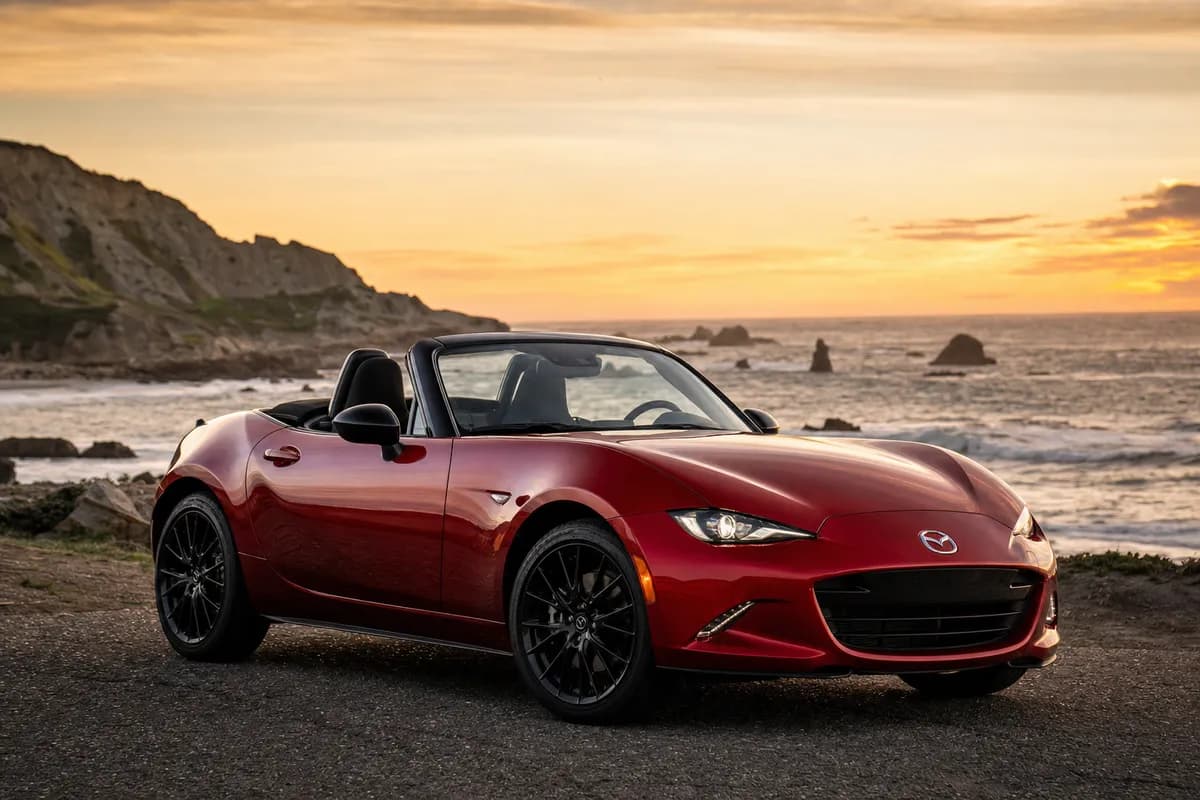
Let’s swat the rumor before it breeds: the 2025 Mazda MX-5 Miata is not the clean-sheet, fifth-generation “NE” roadster the internet keeps trying to manifest into existence. Mazda’s 2025 launch is still built on the ND platform, and frankly, that’s not a crisis.
Let’s swat the rumor before it breeds: the 2025 Mazda MX-5 Miata is not the clean-sheet, fifth-generation “NE” roadster the internet keeps trying to manifest into existence. Mazda’s 2025 launch is still built on the ND platform, and frankly, that’s not a crisis. This is the rare car that doesn’t need more weight, more screens, more fake aggression, or a turbocharger strapped on like a gym bro’s ego. What enthusiasts need to know is simpler: the 2025 Miata remains the lightest, sharpest, most honest new sports car you can buy, with recent ND updates making it more polished without sanding off the personality.
What’s New for the 2025 Mazda MX-5 Miata?
The 2025 MX-5 arrives after Mazda’s meaningful ND3 refresh, which brought the sort of changes real drivers actually notice: a revised electric power steering rack, updated stability control logic, a new asymmetric limited-slip differential on manual Club and Grand Touring trims, fresh lighting, and a more modern infotainment system. No, that is not the kind of “all-new” reboot that gets marketing departments foaming at the mouth. It is better than that: Mazda fettled the car where it matters.
The key upgrades enthusiasts should care about are mechanical and dynamic, not cosmetic. The revised steering calibration gives the front end more natural buildup off-center, and the updated differential helps the rear axle behave with more predictability under load. That matters in a car that lives and dies on driver confidence. The Miata has never been about monster grip; it is about readable grip, and there’s a difference.
The cabin also gets a welcome technology lift with an 8.8-inch center display replacing the old, smaller unit. It supports wireless Apple CarPlay and Android Auto, which means the Miata has finally stopped treating modern phone integration like witchcraft. The screen is still not the point of the car, but the upgrade makes daily use less annoying — and in a roadster with limited storage and cabin space, reducing annoyance counts as a performance feature.
- Platform: ND-generation MX-5, not a full redesign
- Engine: 2.0-liter naturally aspirated inline-four
- Output: 181 horsepower and 151 lb-ft of torque
- Transmissions: 6-speed manual or 6-speed automatic, depending on trim
- Body styles: soft-top Roadster and retractable-fastback RF
- Key enthusiast hardware: available Bilstein dampers, front shock tower brace, Brembo brakes, BBS wheels, Recaro seats, and limited-slip differential
The 2025 Miata’s biggest trick is still the oldest one in the book: it weighs less than almost everything else pretending to be sporty.
Engine, Performance, and the Joy of Not Having Too Much Power
Under the hood sits Mazda’s familiar 2.0-liter Skyactiv-G four-cylinder, producing 181 hp at 7,000 rpm and 151 lb-ft of torque at 4,000 rpm. Those numbers will not terrify a Mustang GT, a Toyota GR Supra, or even a particularly confident Volkswagen Golf R. Good. The Miata is not a drag-strip appliance. It is a precision instrument with license plates.
In the real world, the manual soft-top Miata can hit 60 mph in roughly 5.7 to 6.0 seconds, depending on conditions and test source. The RF is typically a tick slower because it carries more weight. Top speed is around 135 mph, which is more than enough unless your hobbies include court appearances. The numbers are not outrageous, but the delivery is outstanding: crisp throttle response, a genuine redline chase, and a manual gearbox that still shames the industry.
That 6-speed manual remains one of the best transmissions in any new car at any price. Short throws, clean engagement, and a clutch light enough for commuting but communicative enough for heel-and-toe work — it’s the reason you buy the Miata over something faster but duller. The automatic exists, and if you need it, fine. But choosing the automatic Miata is like ordering decaf espresso: technically possible, spiritually questionable.
Against the Toyota GR86 and Subaru BRZ twins, the Mazda gives up power. The Toyota and Subaru use a 2.4-liter flat-four with 228 hp and 184 lb-ft of torque, and they are quicker in some straight-line situations. They also offer fixed-roof rigidity, small rear seats, and more cargo practicality. But they weigh about 2,800 pounds, while a manual soft-top Miata sits in the roughly 2,300-pound range depending on trim. That 500-pound gap is not trivia. It is the difference between wearing running shoes and carrying a microwave up a hill.
Compared with a BMW Z4 sDrive30i, the Miata is much less powerful — the BMW’s turbocharged 2.0-liter makes 255 hp — and the Z4 M40i’s 382-hp inline-six turns the Mazda into an insect in a straight line. But the BMW is heavier, pricier, automatic-only in many configurations, and filtered through layers of luxury-car polish. The Mazda talks. The BMW suggests.
Handling: Why the Miata Still Embarrasses Bigger, Faster Cars
The MX-5’s magic has never been about lap-sheet dominance. It’s about how early, clearly, and cheerfully it tells you what the tires are doing. The car leans more than modern performance-car fashion usually permits, but that body motion is not sloppiness. It is communication. You feel weight transfer build, the front tires key into the pavement, and the rear axle rotate progressively instead of snapping like an irritated crocodile.
The 2025 car benefits from the updates introduced on the latest ND chassis tune. Mazda’s revised steering rack helps give the front end a cleaner sense of initial response, while the asymmetric limited-slip differential available on manual Club and Grand Touring models improves behavior on corner entry and exit. In simple terms: the car rotates more naturally under trail braking and digs out of corners with less inside-wheel nonsense.
Then there’s DSC-Track, Mazda’s more permissive stability-control mode. It does not simply switch the nannies off and hope your insurance is paid up. It allows more slip before intervening, giving skilled drivers room to work while still offering a safety net when enthusiasm outruns talent. On a tight back road or an autocross course, that’s useful. On a wet roundabout outside a shopping center, please grow up.
The best driver’s spec is still the Club with the manual gearbox. That is the enthusiast bullseye: limited-slip differential, sport-tuned Bilstein dampers, front shock tower brace, and the option to add the Brembo/BBS/Recaro package. The Brembo front brakes add better heat tolerance, the forged BBS wheels reduce unsprung mass, and the Recaro seats grip you better when the road starts impersonating spaghetti.
The Grand Touring manual has become more appealing because Mazda gives it much of the important performance hardware while adding more comfort and convenience. Heated leather seats, navigation, adaptive front lighting, and extra driver-assistance tech make it easier to live with. But if you’re the sort of person who knows your favorite road by camber change, the Club remains the one with the sharper edge.
Soft-Top or RF: Which 2025 Miata Should You Buy?
Mazda offers two flavors of MX-5: the classic soft-top Roadster and the RF, short for Retractable Fastback. The soft-top is the purist’s car. It is lighter, simpler, cheaper, and its manual roof can be flicked open from the driver’s seat in seconds. No motors. No choreography. No pretending a roof operation needs to be a Broadway production.
The RF is the more mature choice. Its power-folding hardtop panel gives the car coupe-like style with the roof up and a targa-like experience with it stowed. It is quieter on the highway, better insulated in miserable weather, and more secure if you park on city streets. It is also heavier and more expensive, and with the roof down it does not feel as open as the soft-top. You sit under buttresses, not under the sky.
If this is your weekend toy, buy the soft-top. It delivers the purest MX-5 experience and keeps the car’s defining lightness intact. If this is your only car and you commute through bad weather or park outside, the RF makes sense. It adds civility without completely lobotomizing the experience.
- Best enthusiast pick: MX-5 Miata Club soft-top with 6-speed manual
- Best daily-driver pick: MX-5 Miata Grand Touring RF manual
- Best value pick: Sport soft-top manual, if you can live without the limited-slip differential
- Best “I actually track it” pick: Club manual with Brembo/BBS/Recaro package
One warning: do not casually dismiss the base Sport. It still gets the same 181-hp engine, the same brilliant manual gearbox, and the same core chassis. But the lack of a limited-slip differential matters if you drive hard. For casual cruising, the Sport is charming. For proper back-road work, the Club is worth the stretch.
Interior, Practicality, and the Tiny-Car Tax
The 2025 MX-5 interior is better than it has any right to be, provided you understand the assignment. This is not a grand tourer. This is a small roadster built around two people, a transmission tunnel, and the idea that excess is the enemy. The driving position is low and intimate, the controls are where they should be, and the cabin wraps around you like a well-fitted racing glove.
But there are compromises, and they are not subtle. Tall drivers need to try before buying; six-footers can fit, but helmet clearance for track days can get ugly, especially in the RF. Cabin storage is minimal. There is no glovebox in the conventional sense. The trunk offers about 4.6 cubic feet of cargo space, which is enough for a weekend bag or two if you pack like an adult and not like a touring drummer.
The updated infotainment helps, and Mazda’s physical controls remain preferable to the touchscreen-only nonsense infecting too many modern cars. Climate controls are simple knobs. The manual handbrake remains. The tachometer is central. This is not nostalgia; it is ergonomics. A driver’s car should not make you enter a submenu to do something obvious.
Safety and driver-assistance features include items such as blind-spot monitoring, rear cross-traffic alert, lane-departure warning, and Smart City Brake Support depending on trim and market. That’s enough for the mission. Nobody buying a Miata should be demanding hands-free highway driving. If you want the car to drive itself, congratulations, you have misunderstood the product.
Competitors: GR86, BRZ, Z4, Boxster, and the Reality Check
The 2025 MX-5 sits in a strange but wonderful corner of the market. The Toyota GR86 and Subaru BRZ are its closest philosophical rivals: rear-wheel drive, manual-available, lightweight-ish, and genuinely fun. They are more practical, more powerful, and better for drivers who need rear seats, even if those seats are mostly for backpacks and small regrets. The GR86 is more serious and planted; the Miata is more playful and alive at lower speeds.
The Ford Mustang EcoBoost brings 315 hp and far more straight-line muscle, but it weighs roughly 3,600 pounds and feels enormous by comparison. It is a sports coupe with muscle-car energy; the Miata is a roadster with ballet shoes and a switchblade. Different jobs.
The BMW Z4 and Porsche 718 Boxster are faster, more premium, and much more expensive. A base 718 Boxster makes 300 hp and has superb mid-engine balance, but it starts in a different financial climate entirely. By the time you add options, you may need to sell furniture. The Mazda is not a budget Boxster; it is its own thing. It proves that feel matters more than status, and that horsepower without intimacy is just noise with a payment plan.
That is the Miata’s enduring advantage. It does not try to outgun the field. It out-communicates it. At sane speeds, on real roads, that matters more than another 100 hp you can’t use without attracting blue lights and helicopter footage.
Verdict: The 2025 Miata Is Still the One to Buy — If You Get the Right One
The 2025 Mazda MX-5 Miata is not all-new in the generational sense, and anyone telling you otherwise is either confused or selling SEO snake oil. But it is still newly relevant because the latest updates sharpen the car without corrupting it. Mazda has resisted the industry’s usual disease: adding weight, power, complexity, and price until the original point is buried under “premium” padding.
The engine could use another 15 lb-ft of torque. The cabin is tight. The trunk is tiny. The RF costs enough to make you glance nervously at other options. And yes, a GR86 will make more sense for plenty of buyers. But the Miata delivers something increasingly rare: unfiltered mechanical joy at speeds that will not automatically put your license in a shredder.
Buy the 2025 MX-5 Miata Club soft-top with the manual transmission. Add the Brembo/BBS/Recaro package if you drive hard, skip it if you mostly cruise. Choose the RF Grand Touring manual if you need more refinement and year-round usability. Avoid the automatic unless your left leg has formally resigned.
The 2025 Miata remains the antidote to bloated performance cars and spec-sheet chest-thumping. It is light, rear-drive, naturally aspirated, manual, and hilariously willing. In a market obsessed with bigger numbers and duller sensations, Mazda’s little roadster still feels like an act of rebellion. A small one, yes — but the best revolutions usually start with a good corner and the roof down.
Affiliate disclosure: This article contains affiliate links. RevvedUpCars may earn a small commission on qualifying purchases at no extra cost to you.