The 2025 Honda Pilot arrives with the swagger of a family SUV that has finally stopped apologizing for being practical. It is bigger than the old Pilot, boxier than before, tougher-looking in TrailSport trim, and still powered by a naturally aspirated V6 while half the segment…
The 2025 Honda Pilot arrives with the swagger of a family SUV that has finally stopped apologizing for being practical. It is bigger than the old Pilot, boxier than before, tougher-looking in TrailSport trim, and still powered by a naturally aspirated V6 while half the segment is busy downsizing itself into turbocharged complexity. But here’s the real question: is Honda’s three-row hauler now good enough to scare the Kia Telluride, Toyota Grand Highlander, Hyundai Palisade, Mazda CX-90 and Nissan Pathfinder? Short answer: yes, mostly. Long answer: it depends how badly you want hybrid efficiency or luxury theater.
Bigger and Bolder: Honda Finally Gives the Pilot Some Shoulders
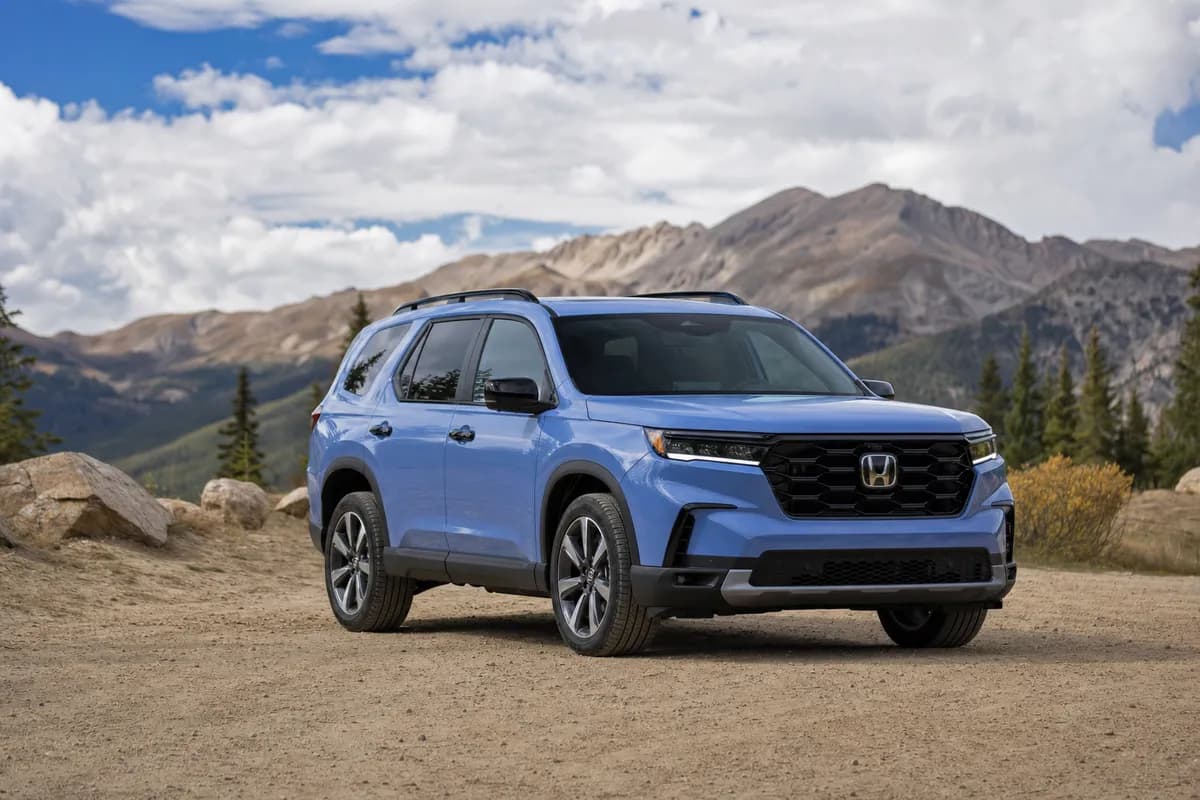
The previous Honda Pilot was many things: roomy, reliable, family-friendly, and about as visually intimidating as a refrigerator wearing loafers. The latest-generation Pilot changed that, and the 2025 model continues with the same squared-off, upright stance that makes it look less like a bloated minivan and more like something that might actually enjoy a muddy campsite.
Dimensionally, the current Pilot is the largest SUV Honda has ever sold in this class. It measures roughly 199.9 inches long, rides on a 113.8-inch wheelbase, and stretches about 78.5 inches wide. That puts it right in the meat of the three-row SUV battlefield. It is longer than the Hyundai Palisade and Kia Telluride, close to the Nissan Pathfinder, and shorter than the Toyota Grand Highlander, which is the cargo-hauling overachiever of the class.
The design is clean in the Honda way: no fake vents the size of pizza boxes, no light bars trying to impersonate Times Square, no grille that looks like it swallowed a garden fence. The front end is bluff, the hood is flatter, and the body sides are more disciplined than dramatic. In TrailSport form, with chunky tires, unique wheels, orange accents, extra ground clearance and functional skid plates, it finally looks like a Pilot with a gym membership.
For 2025, the headline trim news is the return of the Black Edition, sitting at the top of the lineup. Predictably, it blacks out the exterior trim, adds gloss-black 20-inch wheels, and gives the cabin red-accent stitching and Black Edition branding. Is it mechanically transformative? No. Is it exactly the sort of trim buyers ask for when they want their school-run SUV to look mildly villainous? Absolutely.
The 2025 Honda Pilot lineup typically includes:
- Sport — the entry point, but no longer miserably equipped.
- EX-L — the sensible family sweet spot with leather and useful tech.
- Touring — adds more comfort and convenience features.
- TrailSport — the adventure-flavored model with genuine hardware upgrades.
- Elite — premium features, all-wheel drive, and nicer interior appointments.
- Black Edition — the range-topper for buyers who want the Elite with a darker attitude.
Pricing varies by market and final destination charges, but in the U.S. the 2025 Pilot broadly sits in the low-$40,000 range at the bottom and can climb into the mid-to-upper $50,000s in Elite and Black Edition forms. That is not bargain-bin territory. Then again, neither are its rivals anymore. A loaded Telluride, Palisade or Grand Highlander can all make your bank account squeal just as loudly.
Powertrain: The V6 Refuses to Retire, and Good
Under the hood is a 3.5-liter naturally aspirated V6 producing 285 horsepower and 262 lb-ft of torque. It is paired with a 10-speed automatic transmission, and buyers can choose front-wheel drive on some trims or Honda’s i-VTM4 all-wheel-drive system where available or standard, depending on trim.
This engine is not trying to win a spec-sheet arm-wrestling match against turbocharged rivals. The Mazda CX-90’s available turbocharged inline-six can produce up to 340 horsepower on premium fuel. The Toyota Grand Highlander Hybrid Max delivers 362 horsepower and a much bigger torque hit. Even the Kia Telluride and Hyundai Palisade edge the Pilot slightly on paper with 291 horsepower from their 3.8-liter V6.
But Honda’s V6 has something too many modern family SUVs have lost: smoothness without fuss. No lag, no wheezy four-cylinder soundtrack, no transmission hunting like a caffeinated beagle. The Pilot’s 10-speed automatic is generally well-mannered, and the V6 pulls cleanly enough for merging, passing and hauling seven or eight humans plus the emotional baggage of a long road trip.
Independent testing has put current-generation Pilot models around the 6.9-to-7.2-second range from 0-60 mph, depending on trim, tires and conditions. That is quick enough. Nobody buying a three-row Honda needs drag-strip glory, but nobody wants to feel like they are towing a dead planet either. The Pilot clears that bar comfortably.
Towing capacity is competitive but not class-leading. Properly equipped all-wheel-drive models can tow up to 5,000 pounds, while front-wheel-drive versions are typically rated lower, around 3,500 pounds. That matches the Telluride, Palisade and Pathfinder in broad family-SUV terms, though the Pathfinder can tow up to 6,000 pounds, which gives Nissan a useful bragging right for boat owners and people who insist on bringing half their garage camping.
Fuel economy is where the Pilot takes a punch. EPA estimates are generally around 19 mpg city, 27 mpg highway and 22 mpg combined for front-drive models, with all-wheel-drive versions closer to 19/25/21 mpg. The TrailSport, thanks to its all-terrain tires and off-road hardware, lands around 18/23/20 mpg. That is acceptable, not impressive.
The Toyota Grand Highlander Hybrid makes the Pilot look thirsty, with some versions rated around the mid-30s mpg combined. If your commute is long and your calculator is cruel, Honda’s lack of a Pilot hybrid is the biggest hole in the product plan. Honda already knows how to build excellent hybrids. The CR-V Hybrid and Accord Hybrid prove it. So yes, the absence of a Pilot Hybrid feels less like strategy and more like leaving money on the hood.
Cabin and Practicality: This Is Where the Pilot Punches Hard
Honda’s best vehicles are usually the ones that understand humans are awkwardly shaped, frequently tired, and always carrying more stuff than they planned. The 2025 Pilot nails that brief. The cabin is not the flashiest in the class, but it is deeply useful. Buttons are where buttons should be. Storage spaces are abundant. Visibility is good. The driving position is upright and relaxed. It feels designed by people who have actually loaded children, luggage, drinks, cables, snacks, strollers and sports gear into a vehicle before.
The Pilot offers seating for up to eight passengers, depending on configuration. Some trims feature Honda’s clever removable second-row middle seat, allowing owners to switch between a bench and captain’s-chair-style access. It is not glamorous, but it is brilliant. More automakers should steal this idea immediately and send Honda a fruit basket.
Space is a major strength. Cargo capacity comes in at roughly 18.6 cubic feet behind the third row, expanding to about 48.5 cubic feet behind the second row and up to around 87 cubic feet with the rear seats folded. That is excellent for the class, though the Toyota Grand Highlander goes even bigger with up to 97.5 cubic feet of maximum cargo space. If maximum cubic footage is your religion, Toyota has built your cathedral.
The Pilot’s third row is usable by actual humans, not just gym bags with seatbelts. Adults can survive back there for shorter trips, and kids will be perfectly fine. The second row is generous, and the flat floor and wide-opening doors make installation of child seats less of a full-contact sport.
Interior quality depends heavily on trim. The lower models are sturdy and sensible, but not plush. EX-L and Touring trims feel like the sweet spot, while Elite and Black Edition models add the luxury garnish: ventilated front seats, heated rear seats, a head-up display, premium audio, nicer leather and more visual drama. Still, if you climb straight out of a Hyundai Palisade Calligraphy or Mazda CX-90, the Pilot’s cabin can feel a little conservative. Honda does ergonomics better than theater. Hyundai does theater better than Honda.
Tech is good, but not groundbreaking. Available features include a 9-inch touchscreen, wireless Apple CarPlay and Android Auto, wireless phone charging, multiple USB-C ports, a digital instrument display, navigation on higher trims and a Bose premium audio system on select models. The screen is not massive by 2025 standards, but the system is responsive and blessedly easy to use. Bigger screens are not always better; sometimes they are just larger ways to bury the heated-seat controls.
TrailSport: Not a Costume, Not a Rock Crawler
The TrailSport trim is the most interesting version of the 2025 Pilot because it is more than a sticker package. That matters. The market is full of “rugged” trims that amount to dark wheels, orange stitching and marketing departments yelling “adventure” over footage of gravel roads. The Pilot TrailSport actually gets mechanical changes.
Key TrailSport hardware includes:
- Standard i-VTM4 all-wheel drive with torque-vectoring capability.
- Raised suspension for about 8.3 inches of ground clearance.
- All-terrain tires, typically Continental TerrainContact A/T rubber.
- Steel skid plates protecting vulnerable underbody components.
- Recovery points integrated for trail use.
- TrailWatch camera views to help spot obstacles at low speeds.
- Off-road-tuned suspension for better compliance on rough surfaces.
No, it is not a Jeep Wrangler. It is not a Ford Bronco. It is not going to spend weekends clambering over boulders while wearing a roof tent and an Instagram handle. But for forest roads, snow, muddy trailheads, rutted campsites and genuinely ugly access roads, the TrailSport is more capable than most family crossovers need to be.
On pavement, the TrailSport gives up a little refinement. The all-terrain tires add some road noise, and the off-road setup is not as polished as the Touring or Elite on smooth highways. But the trade-off is honest, and I will take honest over cosplay every time. If your idea of adventure is a gravel parking lot at a pumpkin patch, buy the EX-L. If you actually leave pavement, the TrailSport earns its badge.
The Pilot TrailSport is not pretending to be a hardcore off-roader. It is doing something more useful: making a three-row family SUV genuinely competent when the road gets stupid.
Safety, Rivals and the Real Buying Decision
Honda loads the Pilot with its Honda Sensing driver-assistance suite, including features such as collision mitigation braking, adaptive cruise control, lane-keeping assist, road departure mitigation, blind-spot information and traffic sign recognition, depending on trim and market. The current-generation Pilot has also performed strongly in safety testing, including high marks from U.S. safety organizations in recent model years.
But the Pilot does not exist in a vacuum, and this segment is vicious. The Kia Telluride remains the style-and-value benchmark, with a richer cabin feel in upper trims and a more premium vibe for the money. The Hyundai Palisade is even more lounge-like, especially in Calligraphy trim, where it feels like Hyundai accidentally priced a near-luxury SUV as a mainstream one. The Toyota Grand Highlander is the efficiency and space monster, especially with hybrid powertrains. The Mazda CX-90 is the driver’s choice, with rear-drive-based architecture and available inline-six power, though its packaging is not as family-clever as Honda’s. The Nissan Pathfinder is a solid towing pick, but it lacks the Pilot’s all-around polish.
So where does the Honda fit? Right in the practical enthusiast’s sweet spot. It is not the flashiest, not the cheapest, not the most fuel-efficient, and not the most luxurious. But it is one of the best balanced. It drives cleanly, seats people properly, carries cargo easily, uses a proven-feeling V6, and avoids the overwrought gimmickry that infects too many modern SUVs.
The best trim? For most buyers, the EX-L is the smart money because it gets the comfort features families actually want without wandering into “why didn’t I buy an Acura?” pricing. The Touring is the upgrade if you want more tech and convenience. The TrailSport is the emotional pick and, frankly, the coolest one. The Elite and Black Edition are nice, but they push the Pilot into dangerous territory against luxury-adjacent rivals with showier interiors.
Verdict: Bigger, Bolder and Mostly Better
The 2025 Honda Pilot is not revolutionary, and it does not need to be. It is the three-row SUV equivalent of a well-engineered multitool: strong, useful, unpretentious and unlikely to embarrass you when life gets messy. Honda has made it bigger where it matters, bolder where it was previously timid, and better in the areas families actually notice every day.
Its biggest flaw is fuel economy. In 2025, selling a large family SUV without a hybrid option feels like showing up to a knife fight with a fax machine. Toyota has the Grand Highlander Hybrid. Mazda has electrified options. Honda has the engineering talent, but the Pilot still runs purely on gasoline. That will matter to high-mileage families.
Still, as a total package, the Pilot is one of the easiest three-row SUVs to recommend. It is more practical than the Mazda CX-90, more mechanically straightforward than many turbocharged rivals, more genuinely rugged in TrailSport form than most soft-roaders, and less obsessed with flashy nonsense than the Korean twins. The Telluride and Palisade may win the showroom beauty contest. The Grand Highlander may win the spreadsheet. But the Pilot wins the “I have to live with this thing for eight years” argument.
Final verdict: the 2025 Honda Pilot is bigger, bolder and better — with an asterisk for fuel economy. Buy the EX-L if you are sensible, the TrailSport if you are honest about weekend dirt, and the Black Edition if you want your family SUV dressed like it just left a superhero sequel. Just do not wait for it to be exciting in the theatrical sense. The Pilot’s trick is better than that: it is relentlessly competent, and in this class, competence is what survives long after the novelty lighting gets old.
Affiliate disclosure: This article contains affiliate links. RevvedUpCars may earn a small commission on qualifying purchases at no extra cost to you.