The 2024 Chevrolet Trax is the rare budget car that does not feel like an apology. That alone makes it interesting. For years, “cheap crossover” meant a penalty box with lifted shoes: buzzy, narrow, joyless, and built with the emotional warmth of airport furniture.
The 2024 Chevrolet Trax is the rare budget car that does not feel like an apology. That alone makes it interesting. For years, “cheap crossover” meant a penalty box with lifted shoes: buzzy, narrow, joyless, and built with the emotional warmth of airport furniture. The new Trax takes that script, folds it into a tiny origami hat, and flicks it at the Nissan Kicks. Starting at $21,495 including destination, Chevrolet’s smallest front-drive crossover arrives larger, better-looking, more useful, and somehow less expensive than the dreary little thing it replaces. No, it is not fast. No, it does not offer all-wheel drive. But after driving it, the surprise is not what the Trax lacks. It is how little those omissions matter.
A Budget Crossover That Finally Looks Like Someone Tried
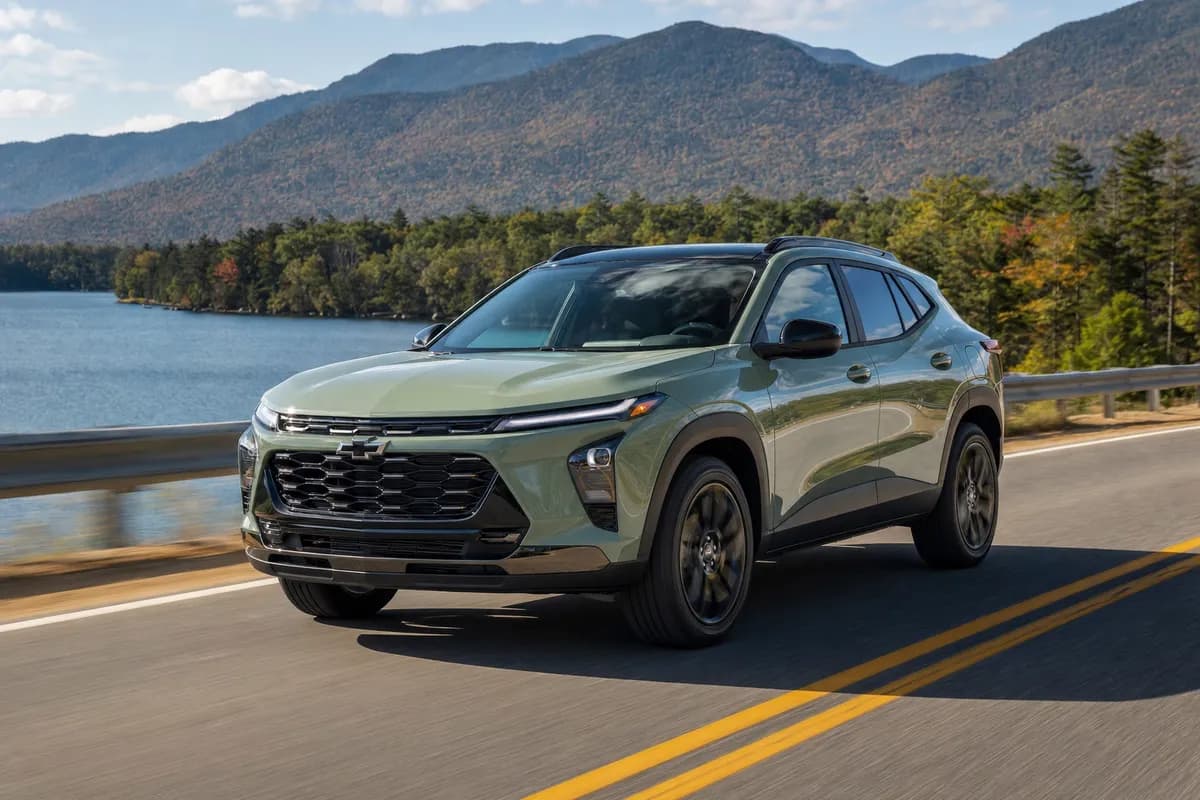
The old Trax looked like it had been designed during a power outage. The 2024 version is different in every direction that matters. It is longer, lower, wider, and much more convincing visually, borrowing the broad-shouldered stance of the larger Chevrolet Blazer without the Blazer’s pricing delusions. The new Trax measures 178.6 inches long, rides on a 106.3-inch wheelbase, and stands just 61.4 inches tall. Compared with the outgoing model, it is nearly 11 inches longer, has a wheelbase stretched by about 6 inches, and sits roughly 4 inches lower.
That dimensional shift changes the whole personality of the car. The old Trax was tall and dorky, a subcompact crossover in the same way a lunchbox is a suitcase. The 2024 Trax feels more like a compact hatchback with useful ride height and sensible packaging. It is not pretending to be a trail rig. It is not wearing fake skid plates and shouting “adventure” while commuting to Costco. It is honest, and honesty looks good on it.
Chevrolet offers five trims: LS, 1RS, LT, 2RS, and Activ. The LS starts at $21,495, the 1RS at around $23,195, the LT at about $23,395, and both the 2RS and Activ land just under $25,000 before options. That pricing is the Trax’s opening haymaker. A Honda HR-V starts higher and feels slower. A Toyota Corolla Cross costs more and looks like it was styled by a committee afraid of paper cuts. A Mazda CX-30 is nicer inside and far better to drive hard, but once you equip it similarly, the Chevrolet is already in another financial zip code.
The sweet spot is the LT. It gets the 11.0-inch infotainment screen, 8.0-inch digital driver display, automatic climate control, nicer cabin finishes, and the right mix of equipment without turning a value play into a self-own. The Activ adds a more rugged appearance, blacked-out trim, and an eight-way power driver’s seat. The 2RS goes sporty with 19-inch wheels and a racier look. Personally, I would take the LT on smaller wheels and pocket the difference. Budget cars get worse when you try too hard to make them “cool.” The Trax is best when it remembers why it exists.
Three Cylinders, Six Gears, Zero Nonsense
Under the hood is Chevrolet’s 1.2-liter turbocharged three-cylinder, making 137 horsepower and 162 lb-ft of torque. That output will not make your pulse climb unless your pulse is connected to a stopwatch and easily disappointed. The Trax is front-wheel drive only, and every version uses a conventional six-speed automatic transmission. There is no CVT. That deserves applause. Not a polite golf clap either. A proper one.
The numbers are modest, but the driving experience is better than the spec sheet suggests. Peak torque arrives low enough to make urban driving feel relaxed, and the six-speed automatic shifts with more common sense than most budget CVTs can manage after a committee meeting and a motivational seminar. Around town, the Trax steps away from lights cleanly, slots through traffic without drama, and does not require a downshift panic attack every time you see a hill.
Push harder and reality arrives. Independent testing has put the 2024 Trax in the neighborhood of 8.8 to 9.5 seconds from 0 to 60 mph, depending on conditions and trim. That is not quick, but it is not catastrophically slow either. A Honda HR-V with its 158-hp 2.0-liter engine often feels more strained despite the bigger number. The Toyota Corolla Cross is similarly uninspiring unless you spend up for the hybrid. The Nissan Kicks is lighter but also weaker, with 122 horsepower and the usual CVT drone. Against that crowd, the Trax is not an athlete, but it is not the asthmatic kid picked last for dodgeball.
There is some three-cylinder thrum when you ask for everything, and at full throttle the engine sounds like a small appliance trying to escape a cabinet. But in normal use it is smooth enough, quiet enough, and surprisingly well-mannered. The transmission deserves much of the credit. It gives the Trax an old-school mechanical directness that makes it feel less cheap than it is. Imagine that: gears doing gear things. Revolutionary.
Fuel economy is rated at 28 mpg city, 32 mpg highway, and 30 mpg combined. That is good, though not class-demolishing. The Corolla Cross Hybrid returns dramatically better numbers, up to 42 mpg combined, but it also costs meaningfully more. The front-drive Hyundai Kona and Kia Seltos are in the same general range depending on engine and trim. For the Trax’s price, size, and usability, 30 mpg combined is a fair bargain.
The Trax is not fast. It is better than fast in this segment: it is predictable, efficient, and not annoying. In a $23,000 crossover, that is practically exotic.
Cabin Space: The Trax’s Sneaky Knockout Punch
The 2024 Trax’s best trick is not its price. It is how much car Chevrolet gives you for that price. Rear-seat space is genuinely impressive, with 38.7 inches of rear legroom. That is more than you get in some vehicles wearing larger price tags and puffier marketing language. Adults fit in the back without making legal threats. Parents dealing with child seats will appreciate the wider door openings and longer cabin. Ride-share drivers on a budget should be paying attention too.
Cargo capacity comes in at 25.6 cubic feet behind the second row and 54.1 cubic feet with the rear seats folded. That beats the Mazda CX-30 for practicality and gives the Trax a useful edge over many subcompact rivals. It does not have the boxy vertical volume of something like a Kia Soul, but it has a longer, more usable cargo floor than you might expect from the price point.
The front cabin is also a major upgrade. The design is clean, horizontal, and modern. The LT, 2RS, and Activ trims get an 11.0-inch center touchscreen paired with an 8.0-inch digital instrument cluster. Lower trims use an 8.0-inch infotainment display, which is still perfectly acceptable. Wireless Apple CarPlay and Android Auto are available, and the interface is quick enough that you will not spend every drive fantasizing about throwing the screen into a quarry.
Material quality is exactly where Chevrolet had to be clever. There is plenty of hard plastic, because of course there is. This is a $21,000 crossover, not a hand-stitched Swedish wellness retreat. But the plastics are textured, the controls feel logically placed, and the overall design distracts from the cost-cutting. That matters. Cheap cabins are forgivable when they are functional and visually coherent. They become offensive when they look like the inside of a printer cartridge. The Trax avoids that trap.
Seats are supportive enough for a long commute, though the base trims feel, well, base. The Activ’s power driver’s seat helps, and the RS trims add visual flair. Still, if you want plushness, go drive a Buick Envista. It shares the same basic hardware and 1.2-liter engine but wears a nicer jacket and charges accordingly. The Trax is the smarter buy if value is the mission.
How It Drives: More Hatchback Than SUV, And Better For It
The Trax drives with the low-effort confidence of a car designed by people who understood the assignment. Steering is light but not dead. Body control is tidy. The longer wheelbase gives it a planted feel on the highway, while the lower roofline helps avoid the tippy sensation that used to plague small crossovers. It is not a Mazda CX-30 in a set of bends, but it is far from sloppy.
The suspension uses struts up front and a torsion beam at the rear, which is standard fare in this price class. On the road, the tuning is more impressive than the hardware. The Trax rides with real composure over broken pavement, especially on trims with smaller wheels. The 19-inch wheels on the 2RS look sharp but introduce more impact harshness. That is the eternal bargain with big wheels on affordable cars: they improve the Instagram angle and punish your spine for having ambitions.
Road and wind noise are controlled decently at highway speeds. Not luxury-car quiet, obviously, but quieter than the price suggests. The cabin does not boom over coarse pavement the way some cheap crossovers do, and the structure feels solid. That last part is important because budget vehicles often reveal themselves through rattles, shudders, and doors that shut with all the conviction of wet cardboard. The Trax feels properly assembled.
The major limitation is traction and versatility. There is no all-wheel drive option. If you live in snow country and insist on AWD, Chevrolet will point you toward the larger Trailblazer, while Hyundai, Kia, Mazda, Toyota, and Volkswagen will happily sell you small crossovers with driven rear wheels. But let’s be honest: many buyers in this segment do not need AWD. They need good tires, stability control, ground clearance for bad driveways, and monthly payments that do not require a second job. The Trax delivers the relevant stuff.
Braking performance is predictable, pedal tuning is natural, and visibility is solid despite the sleeker shape. The Trax does not encourage hooliganism, but it also does not punish enthusiasm. It is an easy car to place, easy to park, and easy to live with. That sounds like faint praise until you remember how many entry-level crossovers manage to be both boring and irritating. The Trax is merely sensible, which in this class feels like progress bordering on rebellion.
Safety, Tech, and the Value Argument
Every 2024 Trax comes with Chevy Safety Assist, which includes automatic emergency braking, front pedestrian braking, lane keep assist with lane departure warning, forward collision alert, following distance indicator, and IntelliBeam automatic high beams. That is a solid standard package for the money. Available features include adaptive cruise control, blind-zone steering assist, rear cross-traffic alert, lane change alert, and rear park assist, depending on trim and package.
This is where the Trax starts to make rivals uncomfortable. A base HR-V costs more and still feels fairly plain. The Corolla Cross brings Toyota’s reputation and available hybrid efficiency, but the non-hybrid model is dull enough to make beige paint seem theatrical. The Mazda CX-30 is the driver’s choice and has a richer cabin, but its rear seat and cargo area are tighter. The Volkswagen Taos is roomier and punchier with its 1.5-liter turbo, but VW pricing and long-term ownership costs can nibble away at the value case. The Nissan Kicks is efficient and cheap, but the Trax feels more substantial and looks far better doing the same budget-car dance.
The Hyundai Kona and Kia Seltos are probably the Trax’s most direct threats. Both offer more power in certain trims, available AWD, and strong warranties. The new Kona is tech-heavy and more extroverted, while the Seltos remains a smart all-rounder. But once prices climb into the upper $20,000s, the Chevrolet’s argument sharpens. A Trax LT or Activ gives you space, style, modern screens, decent safety kit, and good economy while staying comfortably below many rivals with similar equipment.
There are omissions. No AWD. No hybrid. No high-performance engine. No independent rear suspension. No luxury-grade interior materials. If these are deal-breakers, fine. But judging the Trax for not being a BMW X1 is like criticizing a hammer for not being a cappuccino machine. The question is whether it does its actual job well. It does.
Verdict: Chevrolet Finally Built A Cheap Car That Feels Smart, Not Sad
The 2024 Chevrolet Trax is one of the most convincing affordable vehicles on sale because it understands value in the real world. Value is not just a low starting price. It is space, design, efficiency, technology, warranty coverage, safety equipment, and the absence of daily aggravation. The Trax checks those boxes with a confidence that its predecessor never came close to showing.
It is not the best choice for everyone. If you need all-wheel drive, buy a Subaru Crosstrek, Mazda CX-30, Kia Seltos, or Hyundai Kona. If you want maximum fuel economy, the Toyota Corolla Cross Hybrid is the smarter long-term play. If you care about steering feel and cabin richness, the Mazda still has the enthusiast’s vote. But if you want a roomy, stylish, well-equipped new crossover for used-car money, the Trax is the one to beat.
Best trim: LT, with the right options. It delivers the big-screen cabin and comfort features without blowing up the price.
Skip: Overspending on appearance packages unless you truly love the look. The Trax’s brilliance is strongest when the window sticker stays humble.
Final verdict: The 2024 Chevrolet Trax reinvents the budget crossover not by pretending to be premium, sporty, or rugged, but by being genuinely useful, sharply priced, and unexpectedly pleasant. It is proof that inexpensive does not have to mean miserable. For once, the cheap seat is the smart seat.
Affiliate disclosure: This article contains affiliate links. RevvedUpCars may earn a small commission on qualifying purchases at no extra cost to you.